Resources
Find the latest news & updates on AWS
Cloudtech Has Earned AWS Advanced Tier Partner Status
We’re honored to announce that Cloudtech has officially secured AWS Advanced Tier Partner status within the Amazon Web Services (AWS) Partner Network!
We’re honored to announce that Cloudtech has officially secured AWS Advanced Tier Partner status within the Amazon Web Services (AWS) Partner Network! This significant achievement highlights our expertise in AWS cloud modernization and reinforces our commitment to delivering transformative solutions for our clients.
As an AWS Advanced Tier Partner, Cloudtech has been recognized for its exceptional capabilities in cloud data, application, and infrastructure modernization. This milestone underscores our dedication to excellence and our proven ability to leverage AWS technologies for outstanding results.
A Message from Our CEO
“Achieving AWS Advanced Tier Partner status is a pivotal moment for Cloudtech,” said Kamran Adil, CEO. “This recognition not only validates our expertise in delivering advanced cloud solutions but also reflects the hard work and dedication of our team in harnessing the power of AWS services.”
What This Means for Us
To reach Advanced Tier Partner status, Cloudtech demonstrated an in-depth understanding of AWS services and a solid track record of successful, high-quality implementations. This achievement comes with enhanced benefits, including advanced technical support, exclusive training resources, and closer collaboration with AWS sales and marketing teams.
Elevating Our Cloud Offerings
With our new status, Cloudtech is poised to enhance our cloud solutions even further. We provide a range of services, including:
- Data Modernization
- Application Modernization
- Infrastructure and Resiliency Solutions
By utilizing AWS’s cutting-edge tools and services, we equip startups and enterprises with scalable, secure solutions that accelerate digital transformation and optimize operational efficiency.
We're excited to share this news right after the launch of our new website and fresh branding! These updates reflect our commitment to innovation and excellence in the ever-changing cloud landscape. Our new look truly captures our mission: to empower businesses with personalized cloud modernization solutions that drive success. We can't wait for you to explore it all!
Stay tuned as we continue to innovate and drive impactful outcomes for our diverse client portfolio.

Supercharge Your Data Architecture with the Latest AWS Step Functions Integrations
In the rapidly evolving cloud computing landscape, AWS Step Functions has emerged as a cornerstone for developers looking to orchestrate complex, distributed applications seamlessly in serverless implementations. The recent expansion of AWS SDK integrations marks a significant milestone, introducing support for 33 additional AWS services, including cutting-edge tools like Amazon Q, AWS B2B Data Interchange, AWS Bedrock, Amazon Neptune, and Amazon CloudFront KeyValueStore, etc. This enhancement not only broadens the horizon for application development but also opens new avenues for serverless data processing.
Serverless computing has revolutionized the way we build and scale applications, offering a way to execute code in response to events without the need to manage the underlying infrastructure. With the latest updates to AWS Step Functions, developers now have at their disposal a more extensive toolkit for creating serverless workflows that are not only scalable but also cost-efficient and less prone to errors.
In this blog, we will delve into the benefits and practical applications of these new integrations, with a special focus on serverless data processing. Whether you're managing massive datasets, streamlining business processes, or building real-time analytics solutions, the enhanced capabilities of AWS Step Functions can help you achieve more with less code. By leveraging these integrations, you can create workflows that directly invoke over 11,000+ API actions from more than 220 AWS services, simplifying the architecture and accelerating development cycles.
Practical Applications in Data Processing:
This AWS SDK integration with 33 new services not only broadens the scope of potential applications within the AWS ecosystem but also streamlines the execution of a wide range of data processing tasks. These integrations empower businesses with automated AI-driven data processing, streamlined EDI document handling, and enhanced content delivery performance.
Amazon Q Integration: Amazon Q is a generative AI-powered enterprise chat assistant designed to enhance employee productivity in various business operations. The integration of Amazon Q with AWS Step Functions enhances workflow automation by leveraging AI-driven data processing. This integration allows for efficient knowledge discovery, summarization, and content generation across various business operations. It enables quick and intuitive data analysis and visualization, particularly beneficial for business intelligence. In customer service, it provides real-time, data-driven solutions, improving efficiency and accuracy. It also offers insightful responses to complex queries, facilitating data-informed decision-making.
AWS B2B Data Interchange: Integrating AWS B2B Data Interchange with AWS Step Functions streamlines and automates electronic data interchange (EDI) document processing in business workflows. This integration allows for efficient handling of transactions including order fulfillment and claims processing. The low-code approach simplifies EDI onboarding, enabling businesses to utilize processed data in applications and analytics quickly. This results in improved management of trading partner relationships and real-time integration with data lakes, enhancing data accessibility for analysis. The detailed logging feature aids in error detection and provides valuable transaction insights, essential for managing business disruptions and risks.
Amazon CloudFront KeyValueStore: This integration enhances content delivery networks by providing fast, reliable access to data across global networks. It's particularly beneficial for businesses that require quick access to large volumes of data distributed worldwide, ensuring that the data is always available where and when it's needed.
Neptune Data: This integration allows the Processing of graph data in a serverless environment, ideal for applications that require complex relationships and data patterns like social networks, recommendation engines, and knowledge graphs. For instance, Step Functions can orchestrate a series of tasks that ingest data into Neptune, execute graph queries, analyze the results, and then trigger other services based on those results, such as updating a dashboard or triggering alerts.
Amazon Timestream Query & Write: The integration is useful in serverless architectures for analyzing high-volume time-series data in real-time, such as sensor data, application logs, and financial transactions. Step Functions can manage the flow of data from ingestion (using Timestream Write) to analysis (using Timestream Query), including data transformation, anomaly detection, and triggering actions based on analytical insights.
Amazon Bedrock & Bedrock Runtime: AWS Step Functions can orchestrate complex data streaming and processing pipelines that ingest data in real-time, perform transformations, and route data to various analytics tools or storage systems. Step Functions can manage the flow of data across different Bedrock tasks, handling error retries, and parallel processing efficiently
AWS Elemental MediaPackage V2: Step Functions can orchestrate video processing workflows that package, encrypt, and deliver video content, including invoking MediaPackage V2 actions to prepare video streams, monitoring encoding jobs, and updating databases or notification systems upon completion.
AWS Data Exports: With Step Functions, you can sequence tasks such as triggering data export actions, monitoring their progress, and executing subsequent data processing or notification steps upon completion. It can automate data export workflows that aggregate data from various sources, transform it, and then export it to a data lake or warehouse.
Benefits of the New Integrations
The recent integrations within AWS Step Functions bring forth a multitude of benefits that collectively enhance the efficiency, scalability, and reliability of data processing and workflow management systems. These advancements simplify the architectural complexity, reduce the necessity for custom code, and ensure cost efficiency, thereby addressing some of the most pressing challenges in modern data processing practices. Here's a summary of the key benefits:
Simplified Architecture: The new service integrations streamline the architecture of data processing systems, reducing the need for complex orchestration and manual intervention.
Reduced Code Requirement: With a broader range of integrations, less custom code is needed, facilitating faster deployment, lower development costs, and reduced error rates.
Cost Efficiency: By optimizing workflows and reducing the need for additional resources or complex infrastructure, these integrations can lead to significant cost savings.
Enhanced Scalability: The integrations allow systems to easily scale, accommodating increasing data loads and complex processing requirements without the need for extensive reconfiguration.
Improved Data Management: These integrations offer better control and management of data flows, enabling more efficient data processing, storage, and retrieval.
Increased Flexibility: With a wide range of services now integrated with AWS Step Functions, businesses have more options to tailor their workflows to specific needs, increasing overall system flexibility.
Faster Time-to-Insight: The streamlined processes enabled by these integrations allow for quicker data processing, leading to faster time-to-insight and decision-making.
Enhanced Security and Compliance: Integrating with AWS services ensures adherence to high security and compliance standards, which is essential for sensitive data processing and regulatory requirements.
Easier Integration with Existing Systems: These new integrations make it simpler to connect AWS Step Functions with existing systems and services, allowing for smoother digital transformation initiatives.
Global Reach: Services like Amazon CloudFront KeyValueStore enhance global data accessibility, ensuring high performance across geographical locations.
As businesses continue to navigate the challenges of digital transformation, these new AWS Step Functions integrations offer powerful solutions to streamline operations, enhance data processing capabilities, and drive innovation. At Cloudtech, we specialize in serverless data processing and event-driven architectures. Contact us today and ask how you can realize the benefits of these new AWS Step Functions integrations in your data architecture.
Revolutionize Your Search Engine with Amazon Personalize and Amazon OpenSearch Service
In today's digital landscape, user experience is paramount, and search engines play a pivotal role in shaping it. Imagine a world where your search engine not only understands your preferences and needs but anticipates them, delivering results that resonate with you on a personal level. This transformative user experience is made possible by the fusion of Amazon Personalize and Amazon OpenSearch Service.
Understanding Amazon Personalize
Amazon Personalize is a fully-managed machine learning service that empowers businesses to develop and deploy personalized recommendation systems, search engines, and content recommendation engines. It is part of the AWS suite of services and can be seamlessly integrated into web applications, mobile apps, and other digital platforms.
Key components and features of Amazon Personalize include:
Datasets: Users can import their own data, including user interaction data, item data, and demographic data, to train the machine learning models.
Recipes: Recipes are predefined machine learning algorithms and models that are designed for specific use cases, such as personalized product recommendations, personalized search results, or content recommendations.
Customization: Users have the flexibility to fine-tune and customize their machine learning models, allowing them to align the recommendations with their specific business goals and user preferences.
Real-Time Recommendations: Amazon Personalize can generate real-time recommendations for users based on their current behavior and interactions.
Batch Recommendations: Businesses can also generate batch recommendations for users, making it suitable for email campaigns, content recommendations, and more.
Benefits of Amazon Personalize
Amazon Personalize offers a range of benefits for businesses looking to enhance user experiences and drive engagement.
Improved User Engagement: By providing users with personalized content and recommendations, Amazon Personalize can significantly increase user engagement rates.
Higher Conversion Rates: Personalized recommendations often lead to higher conversion rates, as users are more likely to make purchases or engage with desired actions when presented with items or content tailored to their preferences.
Enhanced User Satisfaction: Personalization makes users feel understood and valued, leading to improved satisfaction with your platform. Satisfied users are more likely to become loyal customers.
Better Click-Through Rates (CTR): Personalized recommendations and search results can drive higher CTR as users are drawn to content that aligns with their interests, increasing their likelihood of clicking through to explore further.
Increased Revenue: The improved user engagement and conversion rates driven by Amazon Personalize can help cross-sell and upsell products or services effectively.
Efficient Content Discovery: Users can easily discover relevant content, products, or services, reducing the time and effort required to find what they are looking for.
Data-Driven Decision Making: Amazon Personalize provides valuable insights into user behavior and preferences, enabling businesses to make data-driven decisions and optimize their offerings.
Scalability: As an AWS service, Amazon Personalize is highly-scalable and can accommodate businesses of all sizes, from startups to large enterprises.
Understanding Amazon OpenSearch Service
Amazon OpenSearch Service is a fully managed, open-source search and analytics engine developed to provide fast, scalable, and highly-relevant search results and analytics capabilities. It is based on the open-source Elasticsearch and Kibana projects and is designed to efficiently index, store, and search through vast amounts of data.
Benefits of Amazon OpenSearch Service in Search Enhancement
Amazon OpenSearch Service enhances search functionality in several ways:
High-Performance Search: OpenSearch Service enables organizations to rapidly execute complex queries on large datasets to deliver a responsive and seamless search experience.
Scalability: OpenSearch Service is designed to be horizontally scalable, allowing organizations to expand their search clusters as data and query loads increase, ensuring consistent search performance.
Relevance and Ranking: OpenSearch Service allows developers to customize ranking algorithms to ensure that the most relevant search results are presented to users.
Full-Text Search: OpenSearch Service excels in full-text search, making it well-suited for applications that require searching through text-heavy content such as documents, articles, logs, and more. It supports advanced text analysis and search features, including stemming and synonym matching.
Faceted Search: OpenSearch Service supports faceted search, enabling users to filter search results based on various attributes, categories, or metadata.
Analytics and Insights: Beyond search, OpenSearch Service offers analytics capabilities, allowing organizations to gain valuable insights into user behavior, query performance, and data trends to inform data-driven decisions and optimizations.
Security: OpenSearch Service offers access control, encryption, and authentication mechanisms to safeguard sensitive data and ensure secure search operations.
Open-Source Compatibility: While Amazon OpenSearch Service is a managed service, it remains compatible with open-source Elasticsearch, ensuring that organizations can leverage their existing Elasticsearch skills and applications.
Integration Flexibility: OpenSearch Service can seamlessly integrate with various AWS services and third-party tools, enabling organizations to ingest data from multiple sources and build comprehensive search solutions.
Managed Service: Amazon OpenSearch Service is a fully-managed service, which means AWS handles the operational aspects, such as cluster provisioning, maintenance, and scaling, allowing organizations to focus on developing applications and improving user experiences.
Amazon Personalize and Amazon OpenSearch Service Integration
When you use Amazon Personalize with Amazon OpenSearch Service, Amazon Personalize re-ranks OpenSearch Service results based on a user's past behavior, any metadata about the items, and any metadata about the user. OpenSearch Service then incorporates the re-ranking before returning the search response to your application. You control how much weight OpenSearch Service gives the ranking from Amazon Personalize when applying it to OpenSearch Service results.
With this re-ranking, results can be more engaging and relevant to a user's interests. This can lead to an increase in the click-through rate and conversion rate for your application. For example, you might have an ecommerce application that sells cars. If your user enters a query for Toyota cars and you don't personalize results, OpenSearch Service would return a list of cars made by Toyota based on keywords in your data. This list would be ranked in the same order for all users. However, if you were to use Amazon Personalize, OpenSearch Service would re-rank these cars in order of relevance for the specific user based on their behavior so that the car that the user is most likely to click is ranked first.
When you personalize OpenSearch Service results, you control how much weight (emphasis) OpenSearch Service gives the ranking from Amazon Personalize to deliver the most relevant results. For instance, if a user searches for a specific type of car from a specific year (such as a 2008 Toyota Prius), you might want to put more emphasis on the original ranking from OpenSearch Service than from Personalize. However, for more generic queries that result in a wide range of results (such as a search for all Toyota vehicles), you might put a high emphasis on personalization. This way, the cars at the top of the list are more relevant to the particular user.
How the Amazon Personalize Search Ranking plugin works
The following diagram shows how the Amazon Personalize Search Ranking plugin works.
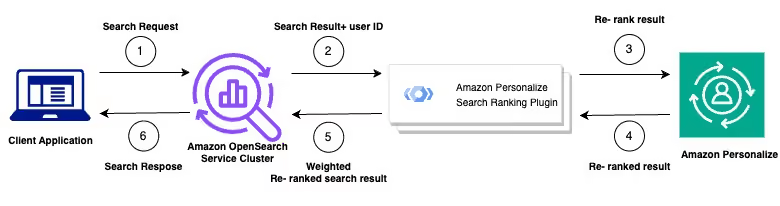
- You submit your customer's query to your Amazon OpenSearch Service Cluster
- OpenSearch Service sends the query response and the user's ID to the Amazon Personalize search ranking plugin.
- The plugin sends the items and user information to your Amazon Personalize campaign for ranking. It uses the recipe and campaign Amazon Resource Name (ARN) values within your search process to generate a personalized ranking for the user. This is done using the GetPersonalizedRanking API operation for recommendations. The user's ID and the items obtained from the OpenSearch Service query are included in the request.
- Amazon Personalize returns the re-ranked results to the plugin.
- The plugin organizes and returns these search results to your OpenSearch Service cluster. It re-ranks the results based on the feedback from your Amazon Personalize campaign and the emphasis on personalization that you've defined during setup.
- Finally, your OpenSearch Service cluster sends the finalized results back to your application.
Benefits of Amazon Personalize and Amazon OpenSearch Service Integration
Combining Amazon Personalize and Amazon OpenSearch Service maximizes user satisfaction through highly personalized search experiences:
Enhanced Relevance: The integration ensures that search results are tailored precisely to individual user preferences and behavior. Users are more likely to find what they are looking for quickly, resulting in a higher level of satisfaction.
Personalized Recommendations: Amazon Personalize's machine learning capabilities enable the generation of personalized recommendations within search results. This feature exposes users to items or content they may not have discovered otherwise, enriching their search experience.
User-Centric Experience: Personalized search results demonstrate that your platform understands and caters to each user's unique needs and preferences. This fosters a sense of appreciation and enhances user satisfaction.
Time Efficiency: Users can efficiently discover relevant content or products, saving time and effort in the search process.
Reduced Information Overload: Personalized search results also filter out irrelevant items to reduce information overload, making decision-making easier and more enjoyable.
Increased Engagement: Users are more likely to engage with content or products that resonate with their interests, leading to longer session durations and a greater likelihood of conversions.
Conclusion
Integrating Amazon Personalize and Amazon OpenSearch Service transforms user experiences, drives user engagement, and unlocks new growth opportunities for your platform or application. By embracing this innovative combination and encouraging its adoption, you can lead the way in delivering exceptional personalized search experiences in the digital age.
Highlighting Serverless Smarts at re:Invent 2023
Quiz-Takers Return Again and Again to Prove Their Serverless Knowledge
This past November, the Cloudtech team attended AWS re:Invent, the premier AWS customer event held in Las Vegas every year. Along with meeting customers and connecting with AWS teams, Cloudtech also sponsored the event with a booth at the re:Invent expo.
With a goal of engaging our re:Invent booth visitors and educating them on our mission to solve data problems with serverless technologies, we created our Serverless Smarts quiz. The quiz, powered by AWS, asked users to answer five questions about AWS serverless technologies, and scored quiz-takers based on accuracy and speed at which they answered the questions. Paired with a claw machine to award quiz-takers with a chance to win prizes, we saw increased interest in our booth from technical attendees ranging from CTOs to DevOps engineers.
But how did we do it? Read more below to see how we developed the quiz, the data we gathered, and key takeaways we’ll build on for re:Invent next year.
What We Built
Designed by our Principal Cloud Solutions Architect, the Serverless Smarts quiz was populated with 250 questions with four possible answers each, ranging in difficulty to assess the quiz-taker’s knowledge of AWS serverless technologies and related solutions. When a user would take the quiz, they would be presented with five questions from the database randomly, given 30 seconds to answer each, and the speed and accuracy of their answers would determine their overall score. This quiz was built in a way that could be adjusted in real-time, meaning we could react to customer feedback and outcomes if the quiz was too difficult or we weren’t seeing enough variance on the leaderboard. Our goal was to continually make improvements to give the quiz-taker the best experience possible.
The quiz application's architecture leveraged serverless technologies for efficiency and scalability. The backend consisted of AWS Lambda functions, orchestrated behind an API Gateway and further secured by CloudFront. The frontend utilized static web pages hosted on S3, also behind CloudFront. DynamoDB served as the serverless database, enabling real-time updates to the leaderboard through WebSocket APIs triggered by DynamoDB streams. The deployment was streamlined using the SAM template.
Please see the Quiz Architecture below:

What We Saw in the Data
As soon as re:Invent wrapped, we dived right into the data to extract insights. Our findings are summarized below:
- Quiz and Quiz Again: The quiz was popular with repeat quiz-takers! With a total number of 1,298 unique quiz-takers and 3,627 quizzes completed, we saw an average of 2.75 quiz completions per user. Quiz-takers were intent on beating their score and showing up on the leaderboard, and we often had people at our booth taking the quiz multiple times in one day to try to out-do their past scores. It was so fun to cheer them on throughout the week.
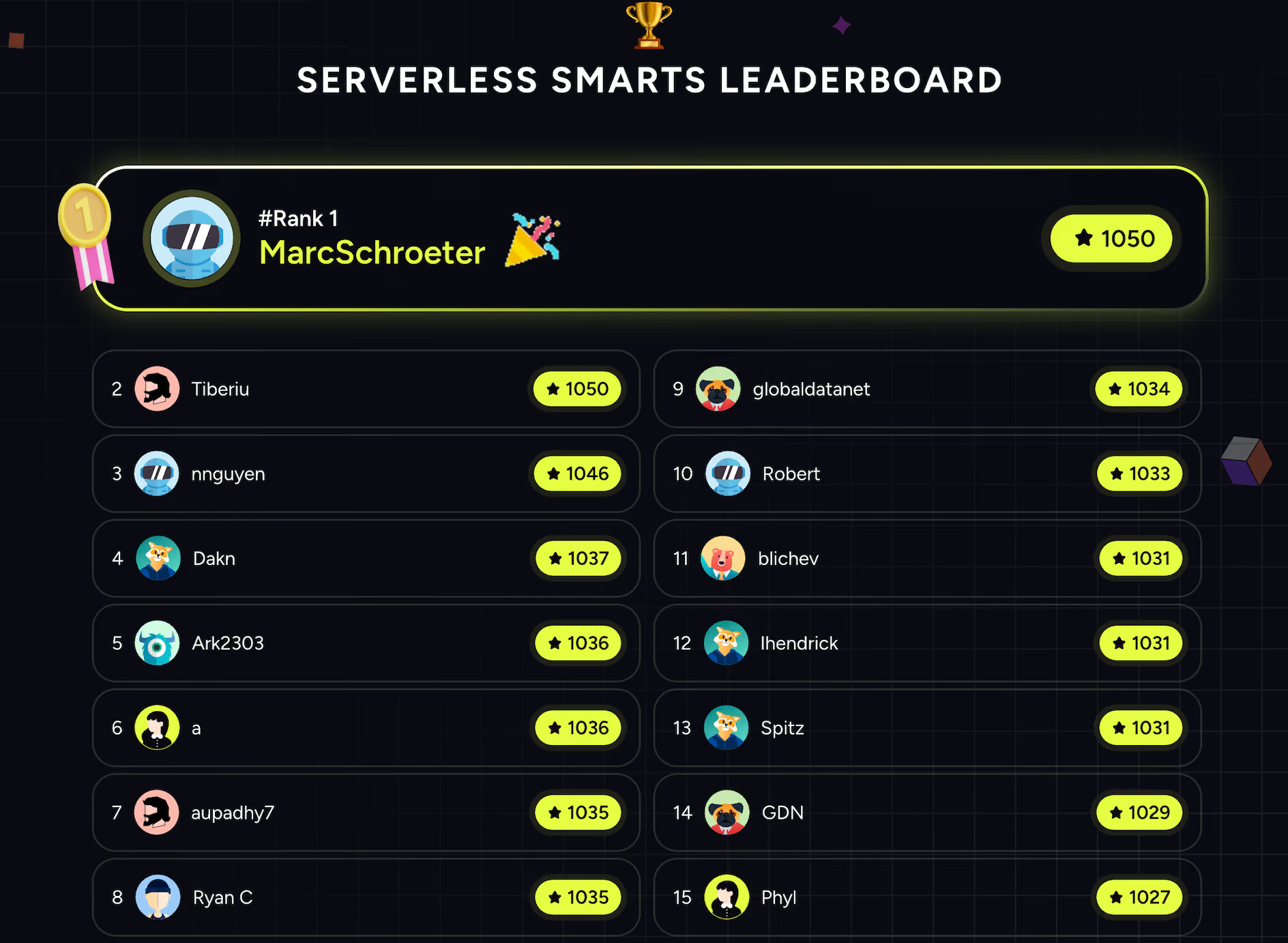
- Everyone's a Winner: Serverless experts battled it out on the leaderboard. After just one day, our leaderboard was full of scores over 1,000, with the highest score at the end of the week being 1,050. We saw an average quiz score of 610, higher than the required 600 score to receive our Serverless Smarts credential badge. And even though we had a handful of quiz-takers score 0, everyone who took the quiz got to play our claw machine, so it was a win all around!
- Speed Matters: We saw quiz-takers soar above the pressure of answering our quiz questions quickly, knowing answers were scored on speed as well as accuracy. The average amount of time it took to complete the quiz was 1-2 minutes. We saw this time speed up as quiz-takers were working hard and fast to make it to the leaderboard, too.
- AWS Proved their Serverless Chops: As leaders in serverless computing and data management, AWS team members showed up in a big way. We had 118 people from AWS take our quiz, with an average score of 636 - 26 points above the average - truly showcasing their knowledge and expertise for their customers.
- We Made A Lot of New Friends: We had quiz-takers representing 794 businesses and organizations - a truly wide-ranging activity connecting with so many re:Invent attendees. Deloitte and IBM showed the most participation outside of AWS - I sure hope you all went back home and compared scores to showcase who reigns serverless supreme in your organizations!
Please see our Serverless Smarts Leaderboard below
What We Learned
Over the course of re:Invent, and our four days at our booth in the expo hall, our team gathered a variety of learnings. We proved (to ourselves) that we can create engaging and fun applications to give customers an experience they want to take with them.
We also learned that challenging our technology team to work together and injecting some fun and creativity into their building process combined with the power of AWS serverless products can deliver results for our customers.
Finally, we learned the value of thinking outside the box to deliver for customers is the key to long term success.
Conclusion
re:Invent 2023 was a success, not only in connecting directly with AWS customers, but also in learning how others in the industry are leveraging serverless technologies. All of this information helps Cloudtech solidify its approach as an exclusive AWS Partner and serverless implementation provider.
If you want to hear more about how Cloudtech helps businesses solve data problems with AWS serverless technologies, please connect with us - we would love to talk with you!
And we can’t wait until re:Invent 2024. See you there!
Enhancing Image Search with the Vector Engine for Amazon OpenSearch Serverless and Amazon Rekognition
Introduction
In today's fast-paced, high-tech landscape, the way businesses handle the discovery and utilization of their digital media assets can have a huge impact on their advertising, e-commerce, and content creation. The importance and demand for intelligent and accurate digital media asset searches is essential and has fueled businesses to be more innovative in how those assets are stored and searched, to meet the needs of their customers. Addressing both customers’ needs, and overall business needs of efficient asset search can be met by leveraging cloud computing and the cutting-edge prowess of artificial intelligence (AI) technologies.
Use Case Scenario
Now, let's dive right into a real-life scenario. An asset management company has an extensive library of digital image assets. Currently, their clients have no easy way to search for images based on embedded objects and content in the images. The company’s main objective is to provide an intelligent and accurate retrieval solution which will allow their clients to search based on embedded objects and content. So, to satisfy this objective, we introduce a formidable duo: the vector engine for Amazon OpenSearch Serverless, along with Amazon Rekognition. The combined strengths of Amazon Rekognition and OpenSearch Serverless will provide intelligent and accurate digital image search capabilities that will meet the company’s objective.
Architecture

Architecture Overview
The architecture for this intelligent image search system consists of several key components that work together to deliver a smooth and responsive user experience. Let's take a closer look:
Vector engine for Amazon OpenSearch Serverless:
- The vector engine for OpenSearch Serverless serves as the core component for vector data storage and retrieval, allowing for highly efficient and scalable search operations.
Vector Data Generation:
- When a user uploads a new image to the application, the image is stored in an Amazon S3 Bucket.
- S3 event notifications are used to send events to an SQS Queue, which acts as a message processing system.
- The SQS Queue triggers a Lambda Function, which handles further processing. This approach ensures system resilience during traffic spikes by moderating the traffic to the Lambda function.
- The Lambda Function performs the following operations:
- Extracts metadata from images using Amazon Rekognition's `detect_labels` API call.
- Creates vector embeddings for the labels extracted from the image.
- Stores the vector data embeddings into the OpenSearch Vector Search Collection in a serverless manner.
- Labels are identified and marked as tags, which are then assigned to .jpeg formatted images.
Query the Search Engine:
- Users search for digital images within the application by specifying query parameters.
- The application queries the OpenSearch Vector Search Collection with these parameters.
- The Lambda Function then performs the search operation within the OpenSearch Vector Search Collection, retrieving images based on the entities used as metadata.
Advantages of Using the Vector Engine for Amazon OpenSearch Serverless
The choice to utilize the OpenSearch Vector Search Collection as a vector database for this use case offers significant advantages:
- Usability: Amazon OpenSearch Service provides a user-friendly experience, making it easier to set up and manage the vector search system.
- Scalability: The serverless architecture allows the system to scale automatically based on demand. This means that during high-traffic periods, the system can seamlessly handle increased loads without manual intervention.
- Availability: The managed AI/ML services provided by AWS ensure high availability, reducing the risk of service interruptions.
- Interoperability: OpenSearch's search features enhance the overall search experience by providing flexible query capabilities.
- Security: Leveraging AWS services ensures robust security protocols, helping protect sensitive data.
- Operational Efficiency: The serverless approach eliminates the need for manual provisioning, configuration, and tuning of clusters, streamlining operations.
- Flexible Pricing: The pay-as-you-go pricing model is cost-effective, as you only pay for the resources you consume, making it an economical choice for businesses.
Conclusion
The combined strengths of the vector engine for Amazon OpenSearch Serverless and Amazon Rekognition mark a new era of efficiency, cost-effectiveness, and heightened user satisfaction in intelligent and accurate digital media asset searches. This solution equips businesses with the tools to explore new possibilities, establishing itself as a vital asset for industries reliant on robust image management systems.
The benefits of this solution have been measured in these key areas:
- First, search efficiency has seen a remarkable 60% improvement. This translates into significantly enhanced user experiences, with clients and staff gaining swift and accurate access to the right images.
- Furthermore, the automated image metadata generation feature has slashed manual tagging efforts by a staggering 75%, resulting in substantial cost savings and freeing up valuable human resources. This not only guarantees data identification accuracy but also fosters consistency in asset management.
- In addition, the solution’s scalability has led to a 40% reduction in infrastructure costs. The serverless architecture permits cost-effective, on-demand scaling without the need for hefty hardware investments.
In summary, the fusion of the vector engine for Amazon OpenSearch Serverless and Amazon Rekognition for intelligent and accurate digital image search capabilities has proven to be a game-changer for businesses, especially for businesses seeking to leverage this type of solution to streamline and improve the utilization of their image repository for advertising, e-commerce, and content creation.
If you’re looking to modernize your cloud journey with AWS, and want to learn more about the serverless capabilities of Amazon OpenSearch Service, the vector engine, and other technologies, please contact us.
.avif)
How Cloudtech’s AWS SMB Competency Changes What they Can Do for Growing Businesses
Introduction
When a growing business starts looking for an AWS consulting partner, the search gets old fast. Every firm claims expertise. Every website has a wall of logos. The question most SMB founders and CTOs actually want answered is a lot simpler: can this partner actually do what they say?
That's the question AWS built the SMB Competency to answer. It's a credential that requires partners to prove their capabilities through technical review and documented customer outcomes, not a form they filled out. Cloudtech just earned it, and this post walks through what that means for the businesses we work with on AWS for SMBs.
TL;DR
- The AWS SMB Competency is an AWS-issued credential that validates Cloudtech's ability to deliver cloud and AI solutions to small and mid-sized businesses.
- Earning it required technical architecture review, documented customer outcomes, and an assessment of Cloudtech's SMB delivery methodology by AWS itself.
- 87 percent of buyers name AWS Specializations as a top-three factor when choosing an AWS partner, and 60 percent call it their primary deciding factor.
- Competency Partners get stronger AWS co-sell support, which can unlock AWS Partner Funding and lower the out-of-pocket cost of a project.
- Cloudtech's live AWS deployments span healthcare, hospitality, and financial services, each delivered as a fixed-price, defined-scope engagement.
What the AWS SMB Competency actually is
The AWS SMB Competency is a specialization inside the AWS Partner Network built for partners serving small and mid-sized businesses. It's the first AWS go-to-market specialization built around the SMB segment specifically.
To get it, partners go through a validation process that covers:
- Technical architecture review by AWS
- Customer success submissions showing real SMB outcomes
- Assessment of SMB-specific delivery methodology
- Review of compliance and security posture for SMB environments
Earning the competency puts Cloudtech in the AWS Partner Solutions Finder with the SMB Competency badge. That's the directory AWS field teams and SMB buyers use to find partners AWS has actually checked. It's not a paid listing. It's earned.
What this means for growing businesses working with Cloudtech
Here's the short version: you get more confidence, more capability, and a partner AWS itself has reviewed. Here's what that looks like day to day.
1. You're working with a partner AWS has verified, not just listed
87 percent of customers name AWS Specializations as a top-three factor when picking an AWS partner for SMBs, and 60 percent call it their primary deciding factor. Makes sense. There are thousands of AWS partners out there. The competency is what separates the reviewed ones from the ones who just signed up.
When you see the AWS SMB Competency badge on Cloudtech's site, it means AWS looked at our delivery, checked our methodology, and confirmed our customer outcomes hold up for businesses at your size and stage.
2. You get a partner built for your scale, not scaled down from enterprise
Most enterprise cloud consulting firms are set up for large organizations: long timelines, big teams, open-ended contracts. The AWS SMB Competency exists because SMBs need something different. Different budgets. Different timelines. Different expectations.
Cloudtech's whole practice is built around the 50 to 200 employee, $10M to $100M revenue company. Fixed-price engagements. Defined scope. Outcomes you can actually measure. The competency confirms this model has been tested across real SMB deployments on AWS, not just pitched.
3. Your projects get stronger AWS co-sell support
AWS SMB Competency Partners get higher co-sell scoring with AWS field teams. In practice, that means AWS territory managers are more likely to refer SMB clients to Cloudtech, more likely to work jointly on opportunities, and more likely to back engagements with AWS resources
4. You get a partner with outcomes AWS has already checked
The competency required Cloudtech to submit documented customer success examples as part of the review. These aren't case studies we wrote for our own website. AWS reviewed them and accepted them as evidence of real SMB delivery.
A few of Cloudtech's live deployments:
Every one of these ran as a fixed-price engagement with a defined outcome. That's the bar the AWS SMB Competency holds us to.
AWS for SMBs: what growing businesses are actually using it for
The AWS SMB Competency reflects something bigger going on. AWS isn't just an enterprise platform anymore. It's the infrastructure layer that growing businesses in healthcare, financial services, and tech are using to compete with much larger companies, without a much larger cost structure.
Here's what Cloudtech delivers most often for SMBs on AWS:
AWS migration from on-premise or Azure
Companies running on legacy on-premise infrastructure, or on Microsoft Azure, are moving to AWS to cut costs, improve scalability, and simplify compliance. A typical migration for a 100-person company takes six to eight weeks and ends with a documented, auditable AWS environment: right-sized infrastructure, cost controls, and a security baseline in place. For a closer look at how these migrations play out, check this out.
Conversational AI on AWS
Amazon Connect and Amazon Bedrock have made it realistic for SMBs to run production-ready AI voice agents and chat assistants without building custom infrastructure from the ground up. Cloudtech deploys these for SMBs in healthcare, hospitality, and financial services, handling thousands of customer interactions a month, with a smooth handoff to a human agent when the conversation needs one.
Generative AI implementation on AWS
Amazon Bedrock gives SMBs access to foundation models from Anthropic, Meta, and others through a managed AWS service. Cloudtech builds generative AI for document processing, customer service automation, and workflow tasks, all inside the client's own AWS environment so data stays where it should.
AWS cost optimization
Most SMBs that have been on AWS for more than a year are overspending by 20 to 40 percent. Cloudtech's AWS cost reviews find unused resources, right-sizing opportunities, and Reserved Instance strategies that bring the bill down without touching what's actually running.
AWS Partner Funding for SMBs
A lot of SMBs don't realize AWS offers Partner Funding for qualifying engagements through the AWS Partner Competency program. That funding can lower the out-of-pocket cost of a migration, an AI implementation, or an infrastructure review when it's delivered by a validated partner like Cloudtech. Ask us about eligibility when you reach out.
Why AWS for SMBs is a different conversation in 2026
Five years ago, AWS was mostly an enterprise platform. The pricing, the complexity, and the ecosystem were all built around companies with dedicated cloud teams and big budgets. That's changed.
AWS has put real investment into making the platform work for smaller companies: simplified managed services, pre-built AI tools, partner funding, and the SMB Competency itself. The signal from AWS is clear. The SMB segment matters to them now. For further insights look at Key benefits of cloud migration for SMBs.
For growing businesses, that's a real opening. The same infrastructure running the world's largest companies is now within reach, and AWS SMB Competency Partners like Cloudtech are what makes that practical at your scale, your budget, and your timeline.
Talk to an AWS SMB Competency Partner
If you're a growing business evaluating AWS consulting partners, or you're already on AWS and want to get more out of it, Cloudtech is here to help. Every engagement starts with a straightforward conversation about where you are, where you want to be, and what an AWS engagement would realistically look like for your business.
Book a 30-minute AWS consultation. No technical background required, no sales deck. Just a conversation about your business and whether AWS is the right next step.
Key takeaways
- The AWS SMB Competency is earned through AWS technical review, not self-declared, which is why 87 percent of buyers weigh it heavily in partner selection.
- Cloudtech's practice is built specifically for the 50 to 200 employee, $10M to $100M revenue company, with fixed-price, defined-scope engagements.
- Competency status brings stronger AWS co-sell support and access to AWS Partner Funding on qualifying projects.
- Cloudtech's documented AWS deployments cover HIPAA-compliant healthcare voice AI, hospitality conversational AI, and SOC 2 financial services infrastructure.
- The most common AWS for SMBs use cases are migration, conversational AI, generative AI, and cost optimization, and Cloudtech delivers all four.
FAQs
What is the AWS SMB Competency?
It's a credential AWS issues to partners who've shown proven expertise delivering cloud and AI solutions to small and mid-sized businesses. Getting it requires technical validation, customer outcome review, and an assessment of SMB-specific delivery methods by AWS.
What does AWS for SMBs actually include?
It covers the range of AWS services applied to growing businesses: migration off on-premise or competing platforms, Conversational AI through Amazon Connect and Amazon Bedrock, generative AI, cost optimization, and managed infrastructure. An AWS SMB Competency Partner like Cloudtech delivers these as fixed-price, defined-scope engagements.
How is an AWS SMB Competency Partner different from a standard AWS partner?
Any company can join the AWS Partner Network. Getting the SMB Competency requires a separate, tougher validation process built for the SMB segment specifically, including AWS review of customer outcomes and delivery methodology. 87% of SMB buyers rank AWS Specializations as a top-three factor in choosing a partner.
Can AWS funding lower the cost of working with Cloudtech?
Yes. Engagements delivered by AWS SMB Competency Partners can qualify for AWS Partner Funding, which can meaningfully reduce out-of-pocket costs. Cloudtech checks funding eligibility on every engagement and walks clients through the process.
What industries does Cloudtech serve as an AWS SMB Competency Partner?
Mostly healthcare, financial services, legal, and SaaS. Every engagement is delivered on AWS with the compliance posture each industry needs, including HIPAA for healthcare and SOC 2 for financial services.
How long does a typical AWS engagement take?
It depends on scope. A migration for a 100-person company usually runs six to eight weeks. Conversational AI and generative AI implementations vary based on complexity, but Cloudtech scopes every engagement with a fixed price and a defined timeline upfront.
.avif)
Healthcare AI Voice Agent
Customer snapshot
Ascend BPO is a US-based healthcare business process outsourcing company managing appointment scheduling and
patient intake for healthcare providers across the United States. With high inbound call volumes and strict HIPAA compliance
requirements, Ascend BPO needed an AI voice agent capable of handling thousands of monthly calls accurately, securely,
and with seamless escalation to human agents when needed.
Goal:
Deploy a HIPAA-compliant AI voice agent on AWS to automate inbound appointment scheduling at scale — handling 2,500–
5,000 calls per month with intelligent human escalation.
Key results
Challenge
High call volume, limited staff capacity
Ascend BPO's healthcare clients receive thousands of appointment scheduling calls every month. Human agents were
spending the majority of their time on routine intake workflows that could be automated — creating bottlenecks and
inconsistent caller experiences
HIPAA compliance at every layer
Every interaction involved Protected Health Information — patient names, dates of birth, insurance IDs, and appointment
details. Any solution needed end-to-end HIPAA compliance covering secure storage, encrypted transmission, access
controls, and full audit trails.
Unpredictable real-world callers
Real callers don't follow scripts. Confused patients, incorrect insurance details, urgent booking requests, and off-topic
questions are all part of everyday call volume. The system needed to handle each scenario gracefully — and escalate to a
human agent without losing context or forcing the caller to repeat themselves.
Solution
Cloudtech designed and deployed a HIPAA-compliant AI voice agent inside Ascend BPO's AWS environment, built on
Amazon Bedrock, Amazon Transcribe, and Amazon Polly. The agent handles the complete appointment scheduling workflow
end to end — from greeting to confirmed booking — without requiring a human for routine calls.
Scope + Timeline
Outcomes
- ,5 00–5,000 inbound calls per month handled autonomously — no human required for routine scheduling
- Identity and insurance verification completed in under 60 seconds per call
- Warm transfer to human agent in under 2 seconds, with full context handed over seamlessly
- Fully HIPAA-compliant — encrypted PHI handling, access controls, and audit trail on AWS
- Stress tested across complex real-world scenarios including confused callers, aggressive behaviour, tangent
conversations, and urgent bookings - Complete patient lifecycle supported — create record, verify and update insurance, check availability, book and confirm
appointment
Get started on your cloud modernization journey today!
Let Cloudtech build a modern AWS infrastructure that’s right for your business.