Introduction
Most business leaders have Gen AI on their radar. Far fewer have a plan that actually produces results.
The gap between awareness and action is real. According to McKinsey's 2025 State of AI survey of 1,491 participants across 101 countries, 71% of organizations now regularly use Gen AI in at least one business function. That majority threshold has been crossed. The question is no longer whether Gen AI belongs in your business — it's whether your strategy is sound enough to generate real returns.
For SMBs and growth-stage companies, the stakes are especially high. Every dollar spent on the wrong tool or poorly scoped implementation is a dollar that doesn't come back. And the technology moves fast enough that waiting for perfect conditions means falling behind.
This guide gives you a practical framework: what Gen AI actually does, where it delivers the strongest ROI, how to build a strategy that holds up, and how to measure outcomes honestly — before and after deployment.
Key Takeaways
- Gen AI creates net-new outputs (text, code, insights) — fundamentally different from traditional automation or predictive AI
- Highest-ROI use cases for SMBs cluster around customer support, operations automation, and industry-specific document workflows
- Strategy before tools: use case prioritization and data readiness come first
- Build, buy, or partner decisions hinge on technical maturity, budget, and how fast you need results
- ROI must be defined with baseline metrics before deployment — not estimated after rollout
What Is Generative AI and Why Does It Matter for Business?
Gen AI vs. Traditional AI: The Core Difference
Traditional AI classifies or predicts from existing data — it tells you whether an email is spam, or whether a customer is likely to churn. Generative AI does something different: it creates net-new outputs from patterns it has learned.
Give it a prompt, and it can draft a proposal, write and debug code, summarize a 40-page contract, or generate a product description in five languages. Business leaders frequently confuse related terms. Here's a plain-language breakdown:
| Term | What It Does |
|---|---|
| Large Language Model (LLM) | The underlying brain — a deep-learning model trained on vast text data |
| Generative AI | The broader capability — creating new content using foundation models like LLMs |
| AI Agent | Adds planning and autonomous action on top of an LLM; can take multi-step actions toward a goal |
| Automation | Executes predefined rules and workflows — no creativity, no context |
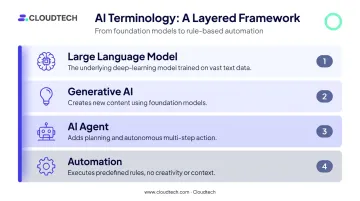
These layers work together: Gen AI produces the output, agents decide what to do with it, and automation carries out the steps.
Why SMBs Should Pay Attention Now
Gen AI's biggest business case is what it equalizes across team sizes.
A 50-person enterprise marketing team produces a certain content volume. Gen AI lets a team of five match that output. The same compression applies to customer support, legal review, and software development — areas where SMBs are typically understaffed relative to larger competitors.
Research from Stanford and MIT studied 5,179 customer support agents at a Fortune 500 software firm and found a Gen AI assistant raised issues resolved per hour by 14% on average — and 34% for lower-skilled agents. That kind of asymmetric productivity gain favors smaller teams most.
High-Impact Generative AI Use Cases for Business
Gen AI's value is only as real as the use cases it's applied to. Not every function benefits equally — and starting in the wrong place is one of the most common ways SMBs burn their first Gen AI investment.
Operations and Workflow Automation
Operations is typically where Gen AI delivers the clearest, fastest ROI. The target: high-volume, repetitive, content-heavy work that consumes skilled employee time without requiring skilled judgment.
High-impact operations use cases include:
- Document summarization — contracts, reports, and compliance documents distilled in seconds
- Internal knowledge retrieval — employees query company knowledge bases in plain language instead of hunting through folders
- Report generation — automated drafting of weekly status reports, financial summaries, and compliance narratives
- Data entry and classification — structured extraction from unstructured inputs like emails, forms, and PDFs
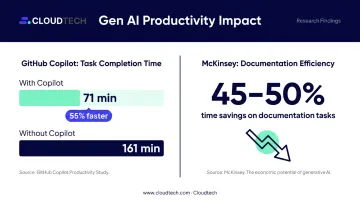
For SaaS and tech companies, code generation is a standout. GitHub's controlled study of 95 professional developers found Copilot users completed a JavaScript task in 71 minutes vs. 161 minutes for non-users — a 55% speed improvement on that bounded task. McKinsey data shows similar gains: 45–50% time savings on documentation tasks, though less than 10% on high-complexity work. The gains are real but task-dependent.
Customer Experience and Marketing
Gen AI enables two capabilities that were previously out of reach for most SMBs: always-on customer support and precisely segmented marketing campaigns — both at a cost structure SMBs can actually justify.
Customer support: AI-powered assistants handle routine queries across multiple languages, escalate intelligently to human agents, and operate around the clock. Cloudtech has deployed Gen AI assistants for healthcare SaaS clients that reduced support tickets by 45% within two months, with complex queries resolved in seconds rather than through manual triage.
Marketing: Campaign timelines that once took a week now compress to hours. Segmented email campaigns, personalized product descriptions, and social content can be generated at scale — with human review as the final quality gate.
Industry-Specific Applications
Healthcare and life sciences: Gen AI targets clinical documentation, patient query resolution, and administrative overhead. Cloudtech's Clinical Document AI uses Amazon Textract and Amazon Comprehend Medical to extract structured data from clinical PDFs and faxes — bringing chart abstraction costs from $8–$15 per chart down to cents per page, while compressing payer-provider authorization workflows from weeks to hours. HIPAA compliance must be designed in from the start, not retrofitted.
Financial services: Practical use cases include drafting suspicious activity reports, interpreting regulatory changes, generating portfolio narratives, and automating compliance documentation. Human review is non-negotiable for accuracy and auditability — but the volume of routine drafting that Gen AI can absorb is substantial.
Manufacturing and logistics: McKinsey reports up to 60% shorter documentation lead time and 10–20% lower logistics coordinator workload from Gen AI applications. The strongest implementations augment existing operational data — generating predictive maintenance narratives from sensor outputs, flagging quality control anomalies — without replacing the underlying systems that produce that data.
How to Build a Generative AI Strategy for Your Business
Most Gen AI projects don't fail because the technology doesn't work. They fail because the strategic foundation was skipped. The sequence matters: strategy before tools, use cases before infrastructure, pilots before scale.
Assess Your Organizational Readiness
Before selecting any tool, evaluate three readiness pillars:
- Data readiness — Is your data clean, accessible, and structured enough to serve as AI input? Custom Gen AI models are 1.5x more likely to take at least five months to reach production when data quality is poor.
- Technical infrastructure — Do you have a cloud environment that can support Gen AI workloads securely and at scale?
- Team capability — Can your team prompt effectively, evaluate AI outputs critically, and govern the results?
Governance requires its own plan. Before deployment, establish:
- Who owns AI outputs and is accountable for their accuracy
- What data can and cannot feed the model
- How bias will be detected and corrected
- What human-in-the-loop controls exist for high-stakes decisions
This is especially critical in regulated industries. For healthcare and financial services clients, Cloudtech embeds HIPAA and SOC 2 compliance requirements from the discovery phase — not as an afterthought.
Prioritize Use Cases by ROI and Feasibility
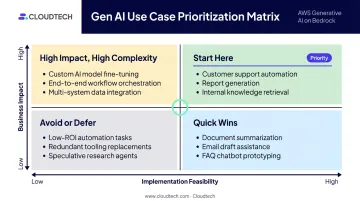
The most practical framework maps candidate use cases on two axes:
- Business impact — revenue potential, cost savings, customer satisfaction improvement
- Implementation feasibility — data availability, integration complexity, regulatory risk
Start with the top-right quadrant: high impact, high feasibility. These are almost always repetitive, content-heavy tasks tied to customer service or internal operations.
When NOT to use Gen AI (per Gartner guidance):
- Numerical forecasting and predictive modeling — use traditional ML instead
- Critical decisions requiring full autonomy without human review
- Workflows where proprietary or sensitive data would pass through public models
Build on Secure, Scalable Cloud Infrastructure
Gen AI workloads require a cloud environment built for scale, security, and compliance. AWS provides the core infrastructure layer through three primary services:
| AWS Service | Primary Role |
|---|---|
| Amazon Bedrock | Managed foundation models (Claude, Titan, Llama) with guardrails and RAG support |
| Amazon SageMaker | Model training, fine-tuning, and MLOps with greater control |
| Amazon Q Business | Employee-facing assistant for querying enterprise knowledge in plain language |
Choosing the right combination of these services depends on your use case, data maturity, and compliance requirements. For most SMBs, working with an AWS consulting partner to architect the right Gen AI stack is faster and more cost-effective than building in-house.
Cloudtech's GenAI Proof of Concept program delivers a working model in approximately four weeks through a fixed-fee, fixed-duration engagement — with AWS Partner Funding available for qualifying workloads to reduce implementation costs.
Build, Buy, or Partner: Choosing Your Gen AI Path
Three paths exist. Each fits a different business profile.
| Path | Best For | Trade-offs |
|---|---|---|
| Buy (SaaS) | Content, marketing, basic support automation | Fastest deployment; least customization; limited data control |
| Build | Proprietary workflows requiring full model control | Highest accuracy potential; requires AI engineering talent and strong data infrastructure |
| Partner | SMBs needing speed-to-value with customization | Balances speed and control; reduces internal burden; avoids vendor lock-in |
The hybrid path is increasingly common among SMBs: start with a commercial SaaS tool to validate a use case quickly, then layer custom capabilities through a partner once ROI is confirmed. This approach de-risks the investment and prevents over-building before you know what the AI application actually needs to do.
The Hidden Costs Most Businesses Miss
Total cost of ownership for Gen AI exceeds initial estimates more often than not. Before signing any vendor contract or partner agreement, map out the full lifecycle costs — not just the launch price. Those include:
- Model and API usage fees (token-based billing scales with usage)
- Cloud compute and storage
- Data preparation and cleaning (often the most underestimated cost)
- Development, integration, and testing
- Compliance reviews and security controls
- Employee training and change management
- Ongoing monitoring and model retraining
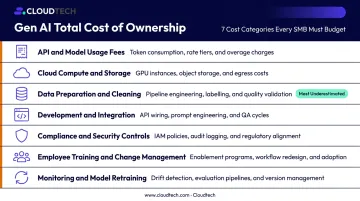
A quoted implementation fee or monthly SaaS subscription covers only the entry point. The costs above are what determine whether a Gen AI investment actually pays off.
How to Measure Gen AI ROI
ROI must be defined before deployment, not reverse-engineered after rollout.
Set a Pre-Deployment Baseline
Establish benchmark metrics tied specifically to your use case before any implementation begins. Without a baseline, there's no ROI to measure, only impressions.
Examples by use case:
- Customer support automation → cost per resolution, tickets resolved per agent per hour
- Operations automation → time per task, error rate, manual review hours per week
- Marketing → campaign output volume, time from brief to publish
- Document processing → pages processed per hour, extraction accuracy rate
Three ROI Categories for SMBs
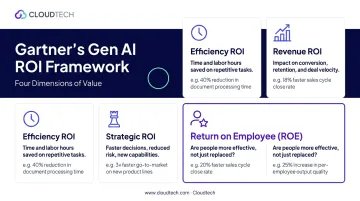
Gartner recommends measuring Gen AI returns across three dimensions:
- Efficiency ROI — Time and labor hours saved by automating repetitive tasks
- Revenue ROI — Impact on conversion rates, retention, or deal velocity from better customer experiences
- Strategic ROI — Faster decisions, reduced risk, or new capabilities that weren't previously possible
Alongside these, Gartner flags Return on Employee (ROE) as a critical fourth metric — whether Gen AI is making your people more effective in their roles, not just reducing headcount.
The Pitfalls That Kill Gen AI ROI
Gartner predicted that at least 30% of Gen AI projects would be abandoned after proof of concept by end of 2025 — citing poor data quality, inadequate risk controls, escalating costs, and unclear business value as the primary causes.
The most common avoidable mistakes:
- Deploying without governance (inaccurate or biased outputs reaching customers)
- Scaling before validating a pilot
- Choosing tools based on vendor hype rather than use case fit
- Underestimating the change management effort required for employee adoption
The businesses seeing the best Gen AI ROI approached it as a workflow redesign project: they mapped processes first, then selected tools to fit, rather than deploying technology and hoping the business case would follow.
Frequently Asked Questions
Which generative AI is best for business?
The right tool depends on your use case, data environment, and technical maturity. For SMBs on AWS infrastructure, Amazon Bedrock and Amazon Q Business offer production-ready capability with flexible deployment options. For content and marketing tasks, commercial tools like ChatGPT or Claude work well as entry points.
How much does it cost to implement generative AI for a business?
Off-the-shelf SaaS tools typically run a few hundred to several thousand dollars per month. Custom or cloud-deployed solutions involve model and API costs, cloud infrastructure, data preparation, and partner or development fees. Always assess full TCO (including training, governance, and ongoing monitoring) not just initial deployment costs.
How long does it take to see results from generative AI?
Well-scoped pilots in high-feasibility areas like customer support automation or report generation can show measurable results within 4–8 weeks. McKinsey's 2024 survey of 1,363 respondents found 1–4 months was the most commonly reported time from project start to production. Broader enterprise transformation typically takes 6–18 months.
What data do I need before implementing generative AI?
Off-the-shelf Gen AI tools require little proprietary data to start. Custom models and RAG systems require clean, structured, and accessible internal data , making data hygiene a genuine prerequisite rather than a nice-to-have.
Is generative AI safe for handling sensitive business data?
Public Gen AI tools carry real data privacy risks for sensitive or regulated information. Enterprise deployments on private cloud environments (AWS with VPC, encryption, and IAM access controls) are designed for compliance with HIPAA, GDPR, and SOC 2. Amazon Bedrock does not share customer inputs or outputs with model providers, so security must be architected in from the start.
What is the difference between generative AI and traditional automation?
Traditional automation executes predefined rules : routing a form submission, triggering an email when a condition is met. Generative AI creates new outputs from context: drafting a response, synthesizing a report, generating a design. That distinction makes Gen AI capable of handling unstructured, variable, and judgment-dependent tasks that rule-based systems cannot touch.