Introduction
Enterprise AI chatbots fail in a specific, costly way: they answer confidently, even when wrong. Whether citing outdated training data or fabricating facts outright, these hallucinations create real risk. In healthcare, financial services, or manufacturing, a confident wrong answer isn't just embarrassing — it's a liability.
McKinsey's 2024 survey found that 44% of organizations reported at least one negative consequence from generative AI, with inaccuracy as the most common complaint. That number isn't surprising to anyone who has watched a standard LLM confidently cite a product policy that changed six months ago.
Retrieval-Augmented Generation (RAG) was built to solve exactly this problem. Instead of relying on what an LLM memorized during training, a RAG chatbot retrieves current, relevant information from your own knowledge base, then uses that context to generate an answer.
This guide is written for technical decision-makers and developers at SMBs evaluating AI chatbot investments. It covers how RAG architecture works end-to-end, the components that make it work, and the design decisions that most often determine whether a production deployment succeeds or quietly becomes shelfware.
Key Takeaways
- RAG = retrieval + generation: the LLM answers from retrieved context, not pre-trained memory
- Retrieval design, chunking strategy, and orchestration matter more than which LLM you pick
- Security must be enforced at the retrieval layer — the LLM cannot reliably suppress unauthorized content
- RAG isn't always the right choice; small, static datasets rarely justify the infrastructure overhead
- AWS-native services (Bedrock, OpenSearch, Kendra) map directly to each RAG component, especially for regulated industries
What Is a RAG-Based AI Chatbot?
A RAG chatbot is a conversational AI system that retrieves relevant information from an external knowledge base at the time of each user query. It then passes that retrieved content to a large language model, which generates a response grounded in those documents rather than its pre-trained memory.
How RAG Differs from Alternatives
Three approaches are commonly compared:
| Approach | Knowledge Source | Reflects Real-Time Changes? | Hallucination Risk |
|---|---|---|---|
| Standard LLM chatbot | Training data only | No | Higher |
| Fine-tuned LLM | Retrained domain data | Only after retraining | Moderate |
| RAG chatbot | External knowledge base | Yes, at query time | Lower when retrieval is accurate |
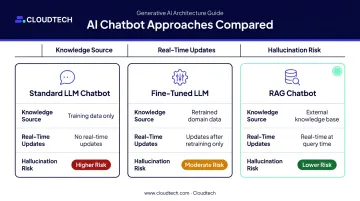
Fine-tuning improves how a model responds and what it knows — but requires expensive retraining cycles every time your data changes. RAG sidesteps this entirely: update the knowledge base, and the chatbot reflects those changes within minutes, no model retraining required.
Why This Matters for Business-Critical Applications
The accuracy problem isn't hypothetical. A 2025 clinical study evaluating GPT-4-generated clinical notes found hallucinations in 1.47% of sentences — across nearly 13,000 evaluated outputs. In a healthcare or financial services context, even sub-2% error rates across thousands of interactions translate into real risk.
RAG reduces this risk by grounding every answer in documents you control. The LLM reasons over retrieved text, which keeps responses tied to sources you can audit and update.
How RAG Architecture Works End-to-End
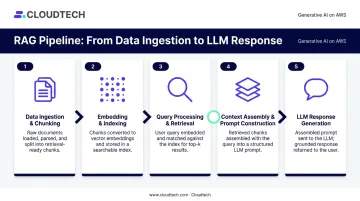
A RAG system processes every user query through five sequential stages — and each stage creates a failure point if it's poorly designed.
Step 1: Data Ingestion and Chunking
Before any user ever types a question, source documents — PDFs, internal wikis, product manuals, compliance documentation — are loaded into the system and split into smaller text chunks.
Chunking strategy has a direct downstream impact on retrieval accuracy:
- Fixed-size chunking: Simple and predictable; Amazon Bedrock defaults to approximately 300-token splits with configurable overlap
- Semantic chunking: Groups text by meaning rather than token count; better for legal or technical material but more computationally intensive
- Sliding window / hierarchical: Bedrock's hierarchical approach retrieves smaller child chunks, then replaces them with broader parent chunks for generation context
Chunks that are too large introduce noise. Chunks that are too small lose context. On proprietary oil-and-gas technical documents, structure-aware chunking achieved MRR 0.644 versus 0.557 for semantic chunking — a meaningful gap in retrieval quality.
Step 2: Embedding and Indexing
Each text chunk passes through an embedding model that converts it into a numerical vector representing its semantic meaning. These vectors are stored in a vector database (Amazon OpenSearch, Pinecone, ChromaDB) that enables fast similarity search.
Use the same embedding model at ingestion time and query time. Mixing models — even ones with identical output dimensions — breaks the retrieval system entirely.
Step 3: Query Processing and Retrieval
When a user submits a question, it's embedded using the same model, and the system searches the vector database for the most semantically similar chunks.
This is where most RAG systems succeed or fail. On the FRAMES multi-hop benchmark, accuracy jumped from 0.408 with no retrieval to 0.660 with a well-designed multi-step retrieval pipeline. Poor retrieval degrades answer quality regardless of which LLM you use downstream.
A common refinement at this stage is re-ranking: a secondary scoring pass that removes low-quality chunks before they reach the LLM. It improves precision at the cost of a small latency increase — usually a worthwhile trade.
Step 4: Context Assembly and Prompt Construction
The top retrieved chunks are assembled into a structured prompt alongside the user's question. The structure matters:
- System instructions (answer only from provided context)
- Retrieved document chunks
- User question
Manage context window size deliberately. Passing in excess text increases token cost and can degrade the LLM's reasoning quality — more context isn't always better.
Step 5: LLM Response Generation
The LLM receives the constructed prompt and generates a natural language response using only the retrieved context. Its job in a RAG system is to reason over and synthesize provided information — not to independently "know" the answer.
That constraint is what keeps hallucinations in check. If the retrieved context doesn't contain the answer, a well-prompted LLM will say so rather than fabricate one.
Core Components of a RAG Chatbot System
A RAG chatbot is an ecosystem of interconnected components. The weakest link determines overall system reliability.
Knowledge Base (Data Sources)
The knowledge base defines the chatbot's "truth boundary." It may include:
- Internal documents and policy manuals
- Product catalogs and technical specifications
- Support ticket history
- Compliance documentation
- Live database connections
A RAG chatbot is only as accurate and current as the data it retrieves from. Define data quality, access permissions, and update frequency before selecting any technical component.
Once your knowledge base is defined, those documents need to be converted into a format the system can search — that's the embedding model's job.
Embedding Model
The embedding model converts both documents and queries into a shared mathematical space so similarity can be measured. Domain alignment matters more than model size. A 2024 clinical retrieval study found that a general-purpose model (BGE-en-large-v1.5) outperformed specialized medical models on two EHR datasets. Test on your actual domain data before committing to a model — a domain label alone doesn't predict performance.
With embeddings generated, you need somewhere to store and search them efficiently — that's where the vector database comes in.
Vector Database and Storage Layer
The vector database stores embeddings and enables fast semantic similarity search. Key selection criteria:
- Retrieval speed and scalability as your document corpus grows
- Metadata filtering support for access control and retrieval precision
- Cloud infrastructure compatibility — especially relevant for AWS-based deployments
Metadata tagging matters beyond basic organization. Tagging chunks with document type, department, date, and access tier improves both retrieval precision and access control enforcement.
Retrieval Layer
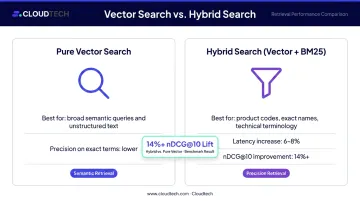
The retrieval layer determines which chunks reach the LLM. Two primary approaches:
| Approach | Best For | Trade-off |
|---|---|---|
| Pure vector search | Broad semantic queries, unstructured text | Lower precision on exact terms |
| Hybrid search (vector + BM25) | Product codes, exact names, technical terminology | 6–8% latency increase |
OpenSearch hybrid search testing showed a 14.14–14.93% nDCG@10 improvement over BM25 alone. For most production systems, the latency cost is worth it.
Orchestration Layer
The orchestration layer manages the full pipeline: user query → retrieval → prompt assembly → generation → response delivery. Every other component passes through it, so failures here affect everything downstream.
Production-grade orchestration must handle:
- No-results scenarios (when retrieval returns nothing relevant)
- Retrieval failures and fallbacks
- Multi-turn conversation context
Popular open-source frameworks include LangChain and LlamaIndex. For teams that prefer a managed path, Amazon Bedrock Knowledge Bases handles ingestion, chunking, embeddings, vector storage, retrieval, and generation as a single integrated service.
Key Architecture Design Decisions for RAG Chatbots
Chunking Strategy and Indexing Approach
Chunking is one of the highest-impact, lowest-visibility decisions in RAG design. Misaligned chunking is among the most common causes of poor retrieval quality — and it's rarely diagnosed correctly because the failure shows up as "bad answers" rather than "bad chunking."
Match strategy to your data:
- Structured technical documents: Structure-aware chunking outperforms semantic methods
- Long-form prose or legal documents: Semantic or hierarchical chunking preserves coherence
- Short, uniform records: Fixed-size chunking is simpler and works well
Retrieval Method: Vector Search vs. Hybrid Search
Use pure vector search when: queries are broad and conceptual, and your corpus is primarily unstructured text.
Use hybrid search when: queries include specific product codes, names, IDs, or technical terminology where exact-match signals matter.
Add re-ranking when retrieval precision is critical and you can absorb the additional latency. For regulated industries where answer accuracy carries legal or clinical weight, the latency cost is almost always justified.
Infrastructure and AWS-Native Component Selection
For teams building on AWS, native services map cleanly to each RAG component:
| RAG Layer | AWS Service |
|---|---|
| LLM access + managed RAG | Amazon Bedrock Knowledge Bases |
| Vector storage + hybrid search | Amazon OpenSearch Service |
| Enterprise document retrieval | Amazon Kendra (note: stops accepting new customers July 30, 2026) |
| Orchestration | Bedrock Agents / LangChain / LlamaIndex |
Choosing AWS-native components simplifies integration, reduces operational overhead, and aligns with compliance frameworks for healthcare and financial services.
Cloudtech's AWS-certified architects build RAG systems on Bedrock sized for SMB requirements. One documented SaaS implementation delivered AI response latency under 4 seconds at the 95th percentile and a 2x increase in user engagement.
Security, Access Control, and Compliance by Design
Security in a RAG system must be enforced at the retrieval layer. The LLM cannot reliably enforce access rules — if sensitive data is retrieved into the context window, the model will use it.
The correct pattern:
- Derive user identity and permissions (e.g., from JWT tokens)
- Convert authorized attributes into metadata filters
- Apply those filters to the vector database query via ACLs before retrieval runs
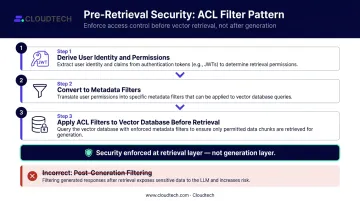
AWS's multi-tenant RAG architecture and OWASP's RAG Security guidance both specify pre-retrieval authorization as the correct control point — not post-generation filtering.
For HIPAA-regulated environments: Amazon Bedrock and Amazon Kendra are both HIPAA-eligible services. Eligibility requires an AWS Business Associate Addendum and customer implementation under the shared-responsibility model — it doesn't make a workload automatically compliant, but it provides the foundation.
When RAG Is (and Isn't) the Right Architectural Choice
Use RAG When:
- The knowledge base is large, dynamic, or proprietary
- Answers must be traceable to specific source documents
- Compliance requires auditability of AI responses
- Frequent model retraining would be prohibitively expensive
- Domain specificity is critical and data sensitivity prevents fine-tuning
Gartner predicts that 80% of GenAI business applications will be built on existing data management platforms by 2028, with RAG identified as a cornerstone of that pattern.
Skip RAG When:
- The dataset is small and rarely changes (fine-tuning may be simpler)
- The task requires only exact keyword lookups (traditional search suffices)
- The use case is simple classification or routing (an LLM alone is adequate)
- The overhead of retrieval infrastructure exceeds the accuracy benefit
A Practical Decision Framework
Before committing to RAG architecture, answer these questions:
- Does the knowledge base change frequently?
- Do answers need to be source-traceable?
- Is domain specificity critical?
- Is the dataset too large or sensitive to embed in a fine-tuned model?
If most answers are yes, RAG is the right foundation. If most answers are no, a simpler approach will deliver faster results at lower cost — and the smarter teams pick the tool that fits the problem, not the one that looks most impressive on a whiteboard.
Frequently Asked Questions
What is the difference between a RAG and a chatbot?
A traditional chatbot generates responses from pre-trained knowledge or scripted rules. A RAG chatbot retrieves relevant information from an external knowledge base at query time before generating a response, producing answers that are more accurate, current, and domain-specific.
How does RAG architecture work?
The user's query is converted into a vector, which is used to search a vector database for semantically similar document chunks. The top results are assembled into a structured prompt, and the LLM generates a response grounded in that retrieved context, not its training data.
What are the core components of a RAG chatbot system?
Five layers: a knowledge base (data sources), an embedding model (converts text to vectors), a vector database (stores and searches embeddings), a retrieval layer (selects relevant chunks), and an orchestration layer that connects all components and manages the query-to-response pipeline.
Do RAG chatbots require model retraining when business data changes?
No. When the knowledge base changes, teams re-index the updated documents. The LLM remains unchanged — only the retrieval layer is updated. This makes RAG significantly more cost-effective for organizations with frequently changing data.
Is RAG suitable for regulated industries like healthcare and financial services?
Yes, when built with proper access controls enforced at the retrieval layer — not at the generation layer. AWS-native services like Amazon Bedrock and Amazon Kendra are HIPAA-eligible and support the compliance foundations required for regulated deployments.
What is the difference between RAG and fine-tuning an LLM?
Fine-tuning changes model behavior and encoded knowledge but requires expensive retraining and cannot reflect real-time data changes. RAG retrieves current information at query time without modifying the model. It's the better fit when data changes frequently or when source traceability matters.