Introduction
Healthcare organizations face a real tension right now. The pressure to adopt AI for patient scheduling, prior authorization, and clinical documentation is mounting — according to HIMSS, 86% of medical organizations already use AI in some capacity. Meanwhile, OCR collected nearly $10 million in HIPAA settlements in 2024 alone, with 30,256 new complaints filed that year.
The risk isn't theoretical. When PHI touches an unvetted AI system, the exposure is immediate — and OCR investigations consistently trace violations back to the boundary where healthcare data meets AI tools.
This guide covers what healthcare organizations actually need to know:
- The difference between HIPAA eligibility and compliance on AWS Bedrock
- Architecture components required for a defensible implementation
- How to handle PHI safely within AI agent workflows
- A sequential deployment approach that holds up under OCR scrutiny
Key Takeaways
- AWS Bedrock is HIPAA-eligible, but a signed AWS BAA is the mandatory first step — eligibility alone produces zero compliance
- PHI must be de-identified or tokenized before any Bedrock call; raw PHI should never reach the model endpoint
- Five non-negotiable controls: VPC PrivateLink, AWS KMS encryption, IAM least-privilege, CloudTrail/CloudWatch audit logging, and a PHI scrubbing pipeline
- Amazon Bedrock Guardrails is a secondary defense — never the primary PHI control
- Physicians spend 13 hours per week on prior authorization — properly architected Bedrock agents directly cut that administrative load
Is AWS Bedrock HIPAA Compliant?
Amazon Bedrock appears on the AWS HIPAA-eligible services list, meaning AWS has designed the service to support HIPAA requirements. The mandatory first step is accepting the AWS Business Associate Addendum (BAA) through AWS Artifact — a self-service process. Without a signed BAA, no PHI workload can lawfully run on Bedrock.
That said, HIPAA-eligible and HIPAA-compliant are not the same thing.
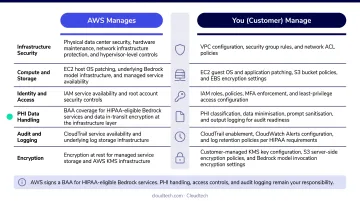
What AWS Guarantees vs. What You Own
| AWS Responsibilities | Customer Responsibilities |
|---|---|
| Securing underlying infrastructure | PHI scrubbing before model invocation |
| Ensuring prompts aren't used to train models | Encryption configuration (KMS) |
| Encryption in transit (TLS 1.2) | VPC endpoint setup and network isolation |
| Model provider isolation from customer data | IAM least-privilege access controls |
| Physical data center security | CloudTrail and CloudWatch audit logging |
What "HIPAA-Eligible" Actually Means
Eligibility means the service can support a compliant implementation. A hospital using Bedrock without VPC endpoints and PHI scrubbing is still non-compliant, even with a BAA signed. Compliance is the customer's architectural responsibility.
Model-Specific Considerations
That architectural responsibility extends to the models themselves. Bedrock hosts third-party models, including Anthropic Claude and Meta Llama, each governed by its own Acceptable Use Policy. Legal teams should verify requirements for each model before deployment. Anthropic, for example, requires qualified professional review when AI is used for healthcare decisions and mandates disclosure to individuals at the start of each session — contractual obligations, not optional guidelines.
Building the HIPAA-Compliant Architecture: Essential AWS Components
HIPAA compliance on Bedrock is an architecture decision. Five controls are non-negotiable.
Network Isolation with VPC and AWS PrivateLink
All Bedrock traffic must flow through VPC interface endpoints, including endpoints for bedrock, bedrock-runtime, bedrock-agent, and bedrock-agent-runtime. No data traverses the public internet.
Standard VPC configuration:
- Private subnets for all compute workloads
- Security groups and network ACLs for layered network controls
- VPC endpoints for Bedrock and every other HIPAA-eligible service in the data path
Identity and Access Management (IAM)
Over-permissioned IAM roles are one of the most common OCR audit findings. Required controls:
- Least-privilege policies granting only
bedrock:InvokeModelfor the specific model ARN - Role-based access — no long-lived user access keys
- MFA enforced for console access
- AWS IAM Identity Center for multi-account environments
Encryption with AWS KMS
Every PHI-adjacent storage resource must use AWS KMS customer-managed keys (CMKs). Required scope and configuration:
- Resources to encrypt: S3, RDS, DynamoDB, Bedrock Knowledge Bases, and CloudWatch Log Groups
- Per-workflow CMKs: If one workflow is compromised, key revocation stays isolated to that workflow
- Automatic key rotation: Enables KMS to generate new cryptographic material on a defined schedule
Audit Logging with CloudTrail and CloudWatch
- CloudTrail: API-level audit trail (who invoked which model, when, from which IAM role)
- CloudWatch Logs: Application-level events (agent actions, tool calls, errors)
Two rules apply to every log group: capture scrubbed metadata only (never raw PHI), and set explicit retention policies. CloudWatch retains data indefinitely by default, but 45 CFR 164.530(j) requires documentation retention for six years from creation or last effective date.
Amazon Macie can scan S3 log buckets for accidental PHI leakage as an additional safeguard.
How to Handle PHI in AWS Bedrock AI Agents
The foundational rule: the Bedrock model must never receive raw PHI.
All 18 HIPAA Safe Harbor identifiers — names, dates, MRNs, SSNs, phone numbers, IP addresses, and more — must be detected and replaced before any prompt reaches Bedrock. Even with a signed BAA, raw PHI at the tool boundary is where OCR audit findings most commonly originate.
The PHI De-Identification Pipeline
Build a multi-stage scrubbing pipeline between your healthcare application and the Bedrock model:
- NER-based PHI detection: Amazon Comprehend Medical's
DetectPHIoperation returns entity types, confidence scores, and character offsets for detected identifiers - Custom regex: catches institution-specific identifiers like proprietary MRN formats that generic models may miss
- Bedrock Guardrails: configured as a secondary check with sensitive-information filters for predefined PII types and custom regex patterns
- Tokenization: replace each detected element with a stable token (e.g.,
[MRN-A47]) so downstream agent calls remain consistent across multi-step reasoning - Confidence gate: if detection confidence drops below a defined threshold, the pipeline fails closed rather than passing uncertain data through
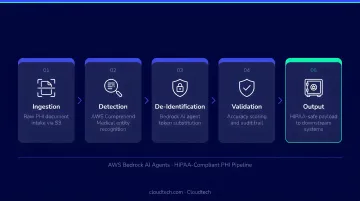
De-tokenization happens only at the final UI render layer, behind an authenticated session with full audit logging. The model operates entirely on tokenized data throughout reasoning, tool-calling, and response generation.
PHI-Safe RAG (Retrieval-Augmented Generation)
The pipeline above governs direct prompts — but RAG introduces a separate risk surface. Storing PHI in vector embeddings or shared OpenSearch indices can expose patient data across tenants.
The safe pattern:
- Embed only de-identified documents
- Use Amazon OpenSearch Service (HIPAA-eligible) with per-tenant index isolation and fine-grained access control
- Apply KMS encryption to the vector store
- Set TTL policies for automatic expiry of sensitive embeddings
Amazon Bedrock Guardrails for Healthcare
Bedrock Guardrails provides configurable sensitive-information filters at the model invocation layer — useful for catching edge cases the upstream pipeline missed. It also includes prompt injection and jailbreak protections that prevent unauthorized queries from exposing ePHI through the AI interface.
Treat it as a secondary layer, not a replacement for upstream scrubbing:
- Does well: catching residual PII, blocking prompt injection, enforcing content policies
- Does not replace: NER-based detection, tokenization, or confidence gating upstream
Step-by-Step: Deploying a HIPAA-Compliant Bedrock AI Agent
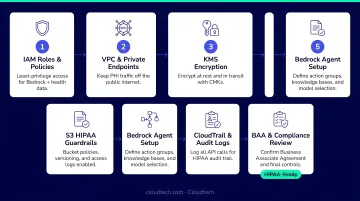
Sequential Deployment Checklist
- Accept the AWS BAA in AWS Artifact and designate a HIPAA-eligible account
- Configure VPC with private subnets and PrivateLink endpoints for all Bedrock service endpoints
- Set up KMS CMKs per workflow and enable automatic key rotation
- Implement the PHI de-identification pipeline — this must be complete before any Bedrock integration begins
- Configure Bedrock Guardrails with healthcare-specific sensitive-information filters and prompt attack detection
- Enable CloudTrail and CloudWatch logging with PHI-scrubbed log groups and six-year retention policies
- Run an AWS Well-Architected review — specifically the Healthcare Industry Lens — before any ePHI flows into the environment
Agent Orchestration for Clinical Workflows
For multi-step clinical workflows, deterministic orchestration using AWS Step Functions or Amazon Bedrock Agents keeps actions auditable and controlled.
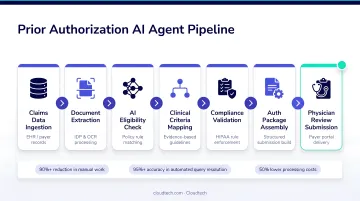
Take a prior-authorization agent as a concrete example:
- Pulls claims data from the source system
- Runs the de-identification pipeline to tokenize all PHI
- Sends tokenized data to Bedrock for draft generation
- Routes output through human-in-the-loop review before submission
Autonomous agents taking irreversible actions without human oversight are both a HIPAA risk and a patient safety concern. Human review checkpoints are not optional in clinical workflows.
Getting this architecture right the first time matters — mistakes with ePHI carry real regulatory consequences. Cloudtech's team, which includes former AWS engineers and holds AWS Advanced Tier Partner status, deploys these Bedrock architectures for healthcare SMBs and startups using fixed-price packages with typical timelines of one to four weeks, rather than the months a ground-up build usually takes.
Common HIPAA Compliance Mistakes to Avoid
Architectural Mistakes
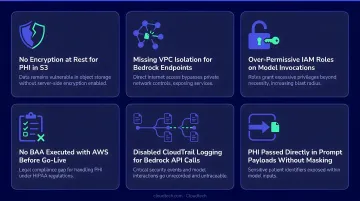
These show up most often in Office for Civil Rights (OCR) audits and security reviews:
- Sending raw PHI to Bedrock without de-identification first — this is the single most common reason architectures fail audit
- Storing LLM prompts or responses in S3 or CloudWatch without encryption or PHI scrubbing
- Shared vector store indices across tenants in multi-tenant RAG applications
- Relying solely on Bedrock Guardrails without an upstream boundary scrubbing layer
- Running Bedrock workloads without VPC endpoints, which leaves traffic exposed on the public internet
BAA and Vendor Coverage Mistakes
Every service in the data path that touches ePHI needs BAA coverage. Using third-party tools or APIs without a signed BAA is a common gap — as is assuming all AWS services are HIPAA-eligible. They are not. Verify each service against the HIPAA-eligible services list before including it in a PHI data path.
Operational and Policy Mistakes
These non-technical findings show up even when the architecture is otherwise sound:
- Insufficient audit-log retention periods (six-year minimum under HIPAA)
- Missing access review documentation — Gulf Coast Pain Management Consultants paid $1.19 million in 2024 partly for failure to terminate former workforce members' access to ePHI
- No formal process for reviewing LLM model acceptable use policies (AUPs) for healthcare use-case restrictions
Real-World Healthcare Use Cases for AWS Bedrock AI Agents
Three workflows where HIPAA-compliant Bedrock agents are delivering measurable results:
Prior Authorization Drafting AMA's 2025 survey found physicians complete an average of 40 prior authorizations per week, consuming 13 hours of staff time — with 95% reporting care delays and 79% reporting treatment abandonment. Bedrock agents can:
- Pull de-identified claims data and generate draft appeals
- Route completed drafts to physicians for review
- Cut turnaround time without removing clinical oversight
Ambient Clinical Documentation A JAMA Network Open study of 263 clinicians found that 30 days of ambient AI scribe use reduced burnout from 51.9% to 38.8% and saved 10.8 minutes of documentation time per workday. With PHI scrubbed before any LLM call, these gains are achievable within a compliant architecture.
Patient Portal Triage Chatbots Agents handling routine patient queries against de-identified knowledge bases free clinical staff for complex cases. The HealCall platform, deployed through Cloudtech's healthcare AI implementations, has demonstrated a 50% reduction in patient wait times and 95%+ accuracy in automated patient query resolution.
These results aren't theoretical. Cloudtech's work with Klamath Health Partnership — delivering a HIPAA-compliant data lake that achieved a 77% year-over-year reduction in infrastructure costs — reflects the same compliance-first architecture applied to every Bedrock AI deployment: validated HIPAA controls, EHR integration patterns, and clinical workflow design built in from the start.
Frequently Asked Questions
Is AWS Bedrock HIPAA compliant out of the box?
No. Bedrock is HIPAA-eligible, not automatically compliant. A signed AWS BAA plus proper architecture — PHI scrubbing, VPC endpoints, KMS encryption, IAM controls, and audit logging — is what produces a compliant implementation.
What is the difference between HIPAA-eligible and HIPAA-compliant on AWS?
HIPAA-eligible means AWS has designed the service to support compliance requirements. HIPAA-compliant means the customer has correctly configured and implemented all required controls within that service for their specific workload. The distinction matters in every OCR audit.
Do I need a BAA with AWS to use Bedrock for healthcare applications?
Yes — a signed AWS Business Associate Addendum is the mandatory legal first step. It's accepted through AWS Artifact as a self-service process and must be in place before any ePHI is processed on the platform.
Can AWS Bedrock AI agents process PHI directly?
Best-practice architecture ensures Bedrock never receives raw PHI. All patient identifiers should be de-identified or tokenized before the prompt reaches any Bedrock model endpoint.
What AWS services are required for a HIPAA-compliant Bedrock architecture?
Core services: AWS Bedrock (with signed BAA), AWS KMS, VPC with PrivateLink endpoints, IAM, CloudTrail, and CloudWatch Logs. Add Amazon Comprehend Medical for PHI detection and Amazon Bedrock Guardrails for secondary filtering in healthcare deployments.
How long does it take to build a HIPAA-compliant AI agent on AWS Bedrock?
Timeline depends on scope and existing infrastructure, typically a few weeks for a targeted workflow or a few months for enterprise-wide deployment. AWS Partners with pre-built HIPAA architecture components — like Cloudtech, whose team includes former AWS engineers — can significantly reduce that timeline.