Introduction
Picture this: a mid-sized medical billing company rolls out an AI chatbot to handle patient inquiries. Within six months, an employee has uploaded a batch of claims data to an unapproved AI writing tool, the chatbot has been tricked into exposing internal pricing logic, and the compliance team is fielding questions from auditors. The AI worked exactly as advertised. The security didn't.
For SMBs in regulated industries, that gap between AI capability and AI security is where real business risk lives.
Generative AI delivers real value: faster document processing, smarter automation, and measurably better customer experiences. But without security embedded at the foundation, the risks accumulate quickly. According to IBM's 2025 Cost of a Data Breach Report, 13% of organizations reported breaches of AI models or applications, and 97% of those organizations lacked proper AI access controls.
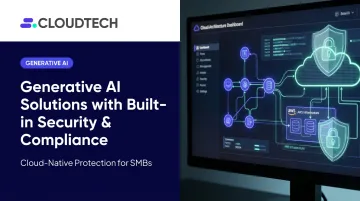
This post covers the most common GenAI security threats, compliance obligations by industry, and how SMBs can deploy generative AI on AWS with security built in from day one.
Key Takeaways
- Built-in GenAI security embeds controls at the model, data, and infrastructure level from day one — not bolted on after deployment.
- Prompt injection, data leakage, and shadow AI are the top threats SMBs face, each carrying regulatory consequences.
- Healthcare, financial services, and manufacturing face distinct compliance obligations that GenAI solutions must satisfy.
- AWS provides a native security ecosystem — Bedrock Guardrails, IAM, CloudTrail, Macie — purpose-built for compliant GenAI.
- The right AWS partner cuts time-to-value and compliance risk, with AWS Partner Funding available to reduce out-of-pocket implementation costs.
Why Generative AI Creates New Security Challenges for SMBs
Traditional software has defined inputs and predictable outputs. Generative AI doesn't. It processes unstructured data, generates novel content, and in agentic configurations, takes real-world actions — sending emails, querying databases, triggering workflows. Existing perimeter-based security tools were not designed for any of this.
For SMBs, the exposure is asymmetric. Large enterprises maintain dedicated AI security teams. Most SMBs don't — and that gap shows up in breach statistics.
The governance problem is just as acute. IBM found that 63% of breached organizations lacked an AI-governance policy or were still developing one at the time of the incident.
Regulators are taking notice across every major SMB vertical:
- Healthcare: HHS/OCR expects HIPAA-compliant AI data handling
- Financial services: SEC and FINRA are scrutinizing AI-driven decisions and recordkeeping
- Data privacy: GDPR and CCPA impose obligations on how AI processes personal data
SMBs that deployed AI tools quickly without governance structures are now facing retroactive compliance risk.
The window for a "move fast and patch later" approach has closed — which means the right architecture choices now determine both your security posture and your compliance standing.
Built-In vs. Bolt-On: What "Secure by Design" Actually Means for GenAI
The Core Distinction
Bolt-on security means adding monitoring tools, content filters, or usage policies on top of an already-deployed AI system. It's reactive, fragmented, and leaves gaps between layers. Built-in security means controls are architected at the foundation — before users ever interact with the system.
CISA's guidance on Secure by Design makes this explicit: security should be prioritized across the entire product lifecycle, not addressed after the fact.
Three Layers Where Security Must Exist
For GenAI deployments, built-in security operates at three distinct levels:
- Data security — encryption at rest and in transit, access controls over training and inference data, sensitive data classification (using tools like Amazon Macie) before data ever reaches the model
- Model security — Bedrock Guardrails configured at the prompt and output layer, prompt injection prevention, hallucination detection via contextual grounding checks, content filters for denied topics and sensitive information
- Infrastructure security — VPC containment, IAM least-privilege policies, CloudTrail audit logging for every model invocation, Security Hub for centralized compliance monitoring
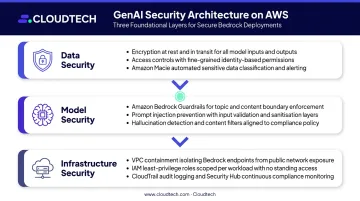
When organizations rely on bolt-on tools instead, they accumulate security debt: fragmented controls that are hard to audit, difficult to update, and inconsistent enough that gaps emerge between layers.
Understanding those three layers immediately raises a practical question: who is actually responsible for securing each one?
The Shared Responsibility Model Applied to GenAI
AWS secures the underlying infrastructure and model runtime. The business — and its implementation partner — is responsible for data governance, access controls, prompt configuration, and compliance alignment.
HIPAA eligibility for Amazon Bedrock does not make your workload HIPAA-compliant. That depends entirely on how your team — or your implementation partner — configures it.
This distinction matters most for SMBs: the compliance gap isn't in AWS's infrastructure. It's in the architecture decisions made before your first user prompt ever runs.
The Top Generative AI Security Threats Every SMB Should Know
Prompt Injection and Model Manipulation
Prompt injection is rated LLM01:2025 by OWASP — the top vulnerability in large language model applications. It occurs when a malicious input causes the AI to ignore its original instructions and perform unintended actions: revealing internal pricing data, exposing customer records, or in agentic systems, executing unauthorized database queries.
In a Gartner survey of 302 cybersecurity leaders, 32% reported an attack on AI applications involving application prompts in the prior 12 months.
Defenses include:
- Input validation and prompt sanitization before content reaches the model
- Output filtering that blocks sensitive data from appearing in responses
- Human-in-the-loop approval gates for any AI agent action with real-world consequences
- Restricting what databases, APIs, or systems an agent can access
Data Leakage and Sensitive Data Disclosure
Two vectors drive most GenAI data leakage:
- Employee-initiated exposure — staff uploading customer data or proprietary documents to unapproved AI tools (the Samsung ChatGPT incident is the most widely cited example)
- Model memorization — overfitted models that reproduce training data in outputs, inadvertently revealing PII, financial records, or clinical information
Each vector carries real regulatory exposure depending on your industry:
- In healthcare, this can constitute a HIPAA breach requiring notification under HHS rules
- In financial services, it may violate GLBA safeguard requirements or SEC recordkeeping rules
- For any business handling EU residents' data, GDPR Article 3(2) may trigger notification obligations regardless of where the company is based
Shadow AI and Ungoverned Tool Usage
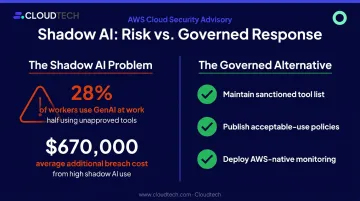
Shadow AI — employees using AI tools without IT or security oversight — is more widespread than most SMB leaders realize. Salesforce and YouGov research across 14,000 workers in 14 countries found that 28% used GenAI at work, and more than half of those GenAI adopters used unapproved tools.
The cost of ignoring this is measurable. IBM found that organizations with high shadow-AI use had breach costs averaging $670,000 more than organizations with low or no shadow AI.
Banning AI outright tends to push usage further underground. A governed AI environment is more effective:
- Maintain a sanctioned list of approved tools employees can use without workarounds
- Publish clear acceptable-use policies so staff understand what's permitted
- Deploy AWS-native monitoring to flag unauthorized AI activity before it becomes a compliance incident
Compliance Requirements for GenAI Across Key Industries
Healthcare (HIPAA/HITECH)
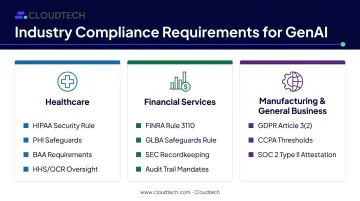
Any GenAI solution that touches patient data — clinical summaries, scheduling chatbots, billing automation — must satisfy HIPAA's Security Rule: administrative, physical, and technical safeguards for electronic PHI, combined with Business Associate Agreements (BAAs) with AI vendors.
HIMSS and Medscape reported that 86% of respondents used AI in their medical organizations as of 2024. At that adoption rate, compliance readiness is an operational requirement — not a future planning exercise.
Amazon Bedrock is listed on AWS's HIPAA Eligible Services Reference — but that eligibility only holds if the customer configures the workload correctly. Cloudtech's deployment for Ascend BPO demonstrates this in practice: the architecture kept all PHI within the customer's own AWS account, processed it through encrypted channels, maintained full audit trails aligned to 45 CFR §164.312(b), and conducted a formal HIPAA compliance audit before go-live.
Financial Services (SOC 2, GLBA, SEC)
Financial services firms using GenAI for customer communication, fraud detection, or document processing face a layered compliance environment:
- FINRA Regulatory Notice 24-09 makes clear that existing supervision rules (Rule 3110) and communication standards (Rule 2210) apply to GenAI — firms must be able to demonstrate oversight of AI-generated content
- GLBA's FTC Safeguards Rule (16 CFR Part 314) requires a written information-security program appropriate to the firm's size and activities — technology-neutral, but fully applicable to AI systems handling customer financial data
- SEC has taken enforcement action over misleading AI claims, signaling active regulatory scrutiny of how firms characterize AI capabilities
In practice, this means audit trails aren't optional. Regulators expect firms to produce documented records of how an AI reached a given output — and to demonstrate that human oversight was part of the process.
Manufacturing and General Business (GDPR, CCPA, SOC 2 Type II)
Manufacturers, SaaS companies, and retailers deploying GenAI carry their own compliance exposure:
- GDPR Article 3(2) applies to any business processing personal data of EU residents, regardless of where the company is located
- CCPA covers for-profit businesses in California meeting statutory thresholds (over $25M in annual gross revenue, personal information of 100,000+ consumers, or 50%+ of revenue from selling personal information)
- Customers in enterprise supply chains increasingly require SOC 2 Type II attestation from vendors using AI in their operations
What to Look for in a Secure Generative AI Solution
Not every "AI with security" claim holds up under scrutiny. Three criteria distinguish genuinely secure solutions from those that treat compliance as an add-on:
Native Security Controls, Not Third-Party Patches
For AWS-based deployments, native security means controls built into the architecture from day one — not layered on afterward. Key components include:
- Amazon Bedrock Guardrails — content filters, topic denials, sensitive information redaction, and contextual grounding checks
- AWS IAM — granular access management at the user and role level
- AWS CloudTrail — complete logging of every Bedrock API call
- Amazon Macie — continuous sensitive data discovery across S3
These controls should be configured before any user touches the system.
Compliance Readiness and Audit Support
The solution should produce audit-ready logs, support data residency requirements, and include documentation for the compliance frameworks your industry requires. Amazon Bedrock and Macie both fall within SOC 1, 2, and 3 scope; Bedrock is also HIPAA-eligible.
That said, platform eligibility isn't the same as workload compliance. Ask any vendor specifically what your deployment's compliance posture looks like — not just what the underlying platform supports.
Transparency and Explainability
In regulated industries, explainability isn't optional. You need to demonstrate what data the model used, how it was processed, and why a given output was produced — for both internal governance and external audits.
Bedrock's contextual grounding checks assess whether model responses are grounded in a verified reference source. That's a concrete, auditable mechanism — not just a policy statement.
Building Secure GenAI on AWS: A Practical Path for SMBs
Why AWS Is the Right Foundation
AWS offers a purpose-built stack for enterprise-grade GenAI:
| AWS Service | Security Role |
|---|---|
| Amazon Bedrock | Foundation model access with native Guardrails (prompt/output filters, content policies, grounding checks) |
| AWS IAM | Granular access control and least-privilege role design |
| Amazon Macie | Automated sensitive data discovery across S3 data pipelines |
| AWS CloudTrail | Complete audit logging of all Bedrock API calls, including model invocations |
| AWS Security Hub | Centralized compliance monitoring across the environment |
| Amazon GuardDuty | Real-time threat detection for unusual access patterns |
This is infrastructure already certified for HIPAA-eligible workloads, within SOC scope, and with GDPR-ready contractual support — though AWS compliance certifications cover AWS's infrastructure, not automatically your workload.
The Implementation Sequence
A security-first GenAI deployment on AWS follows a defined sequence:
- Data governance baseline — classify what data exists, where it lives, and who can access it; run Macie to surface any sensitive data already in S3
- Infrastructure configuration — VPCs, encryption policies, IAM role design, CloudTrail activation for data events
- Model deployment with guardrails — Bedrock Guardrails configured at the prompt and output layer before any user access is granted
- Compliance validation — formal audit against applicable frameworks (HIPAA, GDPR, SOC 2) conducted before go-live
- Ongoing monitoring — Security Hub standards enabled, CloudTrail logs retained per policy, Macie automated discovery running continuously
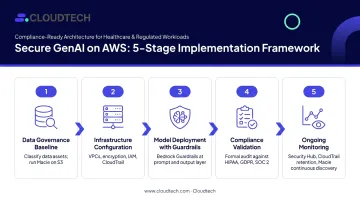
That sequence played out directly in Cloudtech's Ascend BPO healthcare AI deployment: architecture and security controls in week one, build and integration in weeks two and three, stress testing and a formal HIPAA audit in week four — then go-live. Security was the starting point, not an afterthought.
Making It Achievable for SMBs
The legitimate concern for most SMBs is cost and complexity. Cloudtech's pre-packaged GenAI solutions on AWS are designed to deliver this security architecture in four to eight weeks, using AWS Partner Funding programs that can reduce or eliminate out-of-pocket implementation costs for qualifying workloads.
The team — 70% former AWS employees — configures Bedrock guardrails, IAM policies, and CloudTrail correctly from day one. That matters because security misconfigurations remain the leading cause of AI-related data exposures.
Cloudtech's human-first consulting approach also means non-technical stakeholders understand exactly what protections are in place and why, not just that the system was configured securely.
Frequently Asked Questions
What does "built-in security" mean for a generative AI solution?
Built-in security means guardrails, encryption, access management, and audit logging are configured at the foundation of the AI architecture before deployment — not added as separate tools afterward. The result is consistent, auditable protection across the data, model, and infrastructure layers rather than fragmented controls that leave gaps.
What are the biggest compliance risks of deploying generative AI in healthcare or financial services?
In healthcare, the primary risk is HIPAA violation from patient data exposed in AI prompts or outputs — especially when employees use unapproved tools without PHI controls. In financial services, the key risks are gaps in explainability, missing audit trails, and inadequate supervision records required under FINRA Rule 3110, GLBA, and SEC oversight expectations.
Which AWS services help secure generative AI applications?
Five services do the heavy lifting:
- Amazon Bedrock Guardrails — prompt and output controls
- AWS IAM — role-level access management
- Amazon Macie — sensitive data discovery and classification in S3
- AWS CloudTrail — logs every Bedrock API call
- AWS Security Hub — centralized compliance monitoring
Can small and medium-sized businesses realistically afford secure generative AI solutions?
Yes. AWS Partner Funding programs can significantly offset implementation costs for qualifying workloads. Pre-packaged solutions from partners like Cloudtech deploy enterprise-grade security architecture in four to eight weeks — without requiring a large internal security team to manage it.
What is the difference between a secure GenAI solution and a standard AI tool?
A standard AI tool focuses on outputs and functionality. A secure GenAI solution adds governance controls over what data enters the model, what outputs are permitted, who can access the system, and how all activity is logged for compliance purposes — controls that are configured before the first user interaction.
How long does it take to deploy a secure, compliant generative AI solution on AWS?
With the right partner and pre-packaged architecture, a secure GenAI deployment on AWS typically completes in four to eight weeks, with security and compliance configurations validated before go-live. Custom production builds take longer, but pilot proof-of-concept deployments can move considerably faster.