Introduction
Picture this: a business owner installs a "chatbot" on their website, expecting it to handle customer inquiries automatically. Three weeks later, half the support tickets are complaints that the bot couldn't answer anything beyond "What are your store hours?"
This frustration is common — and it usually comes down to deploying the wrong tool.
Businesses are moving fast on conversational AI. According to IBM, 42% of enterprise-scale companies had actively deployed AI by 2024, with another 40% actively experimenting.
Speed without clarity is expensive. Deploying a chatbot when your use case demands an AI agent — or vice versa — wastes budget and creates poor customer experiences at scale.
Here's how to tell the difference — and how to pick the right one.
Key Takeaways
- Chatbots follow scripted rules to handle narrow, predictable queries; they don't learn or adapt on their own.
- AI agents use LLMs to reason, retain context, and complete multi-step tasks without hand-holding.
- Chatbots suit high-volume, repetitive interactions; AI agents handle complex, judgment-intensive workflows.
- The right choice depends on use case complexity, personalization needs, and your team's readiness to support it.
- Many businesses benefit from running both in parallel.
AI Agent vs. Chatbot: Quick Comparison
The core confusion stems from appearance. Both tools use a conversational interface — a chat window, a voice response, a text exchange. That shared surface hides a significant capability gap underneath.
| Dimension | Chatbot | AI Agent |
|---|---|---|
| Decision-making | Pre-scripted rules or keyword matching | Reasons through options using LLMs |
| Context retention | Session-limited or none | Retained across full conversation |
| Action capability | Answers, routes, schedules | Executes multi-step tasks across systems |
| Training required | Manual scripting of responses | Trained on data; improves through interactions |
| Implementation complexity | Low — fast deployment | Higher — requires API integrations and infrastructure |
| Best for | FAQs, routing, appointment links | Billing disputes, lead qualification, complex support |
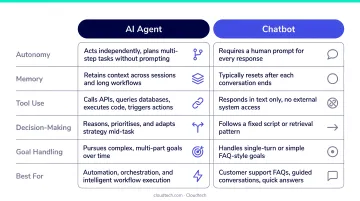
The most important distinction for business decision-makers: chatbots are reactive. They wait for a specific input, then retrieve a scripted answer. AI agents, by contrast, assess the situation, reason through options, and execute tasks end-to-end — without manual programming for each scenario.
That difference matters most when you're deciding which tool fits your actual business problem — and how much operational work you want the system to handle on its own.
What Is a Chatbot?
A chatbot is a software program that simulates conversation through pre-defined rules, keyword matching, or decision trees. The concept isn't new — Joseph Weizenbaum created ELIZA at MIT in 1966, one of the earliest programs to mimic human conversation by pattern-matching text inputs.
Modern chatbots are far more polished, but the underlying mechanic remains consistent: scan for recognized keywords or follow if/then logic to match user input to a pre-written response. More advanced versions use natural language processing (NLP) to handle phrasing variations, but they still operate within a fixed conversational scope. There's no true reasoning — just pattern recognition within defined boundaries.
Why Chatbots Work for SMBs
For the right use case, chatbots deliver real value:
- Low setup cost — most platforms deploy in days, not months
- Available around the clock for routine queries without staffing overhead
- Consistent responses that stay on-brand and on-message
- Handles simple, repetitive interactions so your support team focuses elsewhere
- Predictable behavior: outputs match exactly what you configure
Chatbot Use Cases and Limits
Chatbots perform well when inputs are predictable and outputs are defined:
- Answering FAQs (store hours, return policies, pricing tiers)
- Routing users to the right department
- Capturing lead information through guided form conversations
- Basic appointment scheduling with calendar links
The failure point is just as clear. Gartner found that only 14% of customer service issues are fully resolved through self-service — meaning most chatbot-handled interactions either escalate to humans or leave customers unsatisfied. When a conversation requires context that shifts across turns, real-time data from backend systems, or any judgment call, chatbots hit a hard wall.
What Is an AI Agent?
An AI agent is an autonomous software system built on large language models that can understand natural language, reason through complex situations, retain context across an entire conversation, and execute multi-step tasks — without manual programming for each scenario.
Where a chatbot retrieves, an AI agent thinks. It follows a continuous loop:
- Perceive — understand user input and intent
- Reason — evaluate context, history, and available data
- Act — execute tasks across integrated systems (CRM, databases, APIs)
- Learn — improve through interaction patterns over time
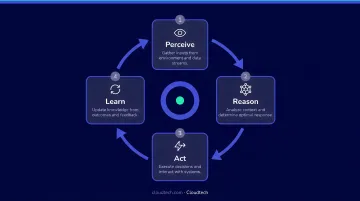
That loop is what makes AI agents useful precisely where scripted tools break down.
Why AI Agents Matter for Business Operations
The business case is concrete. Klarna's AI assistant handled two-thirds of all customer service chats in its first month, equivalent to the work of 700 full-time agents, cutting average resolution time from 11 minutes to under 2 minutes.
Key benefits specific to business operations:
- Handles open-ended, multi-turn conversations without breaking
- Personalizes responses based on customer history and context
- Resolves complex issues autonomously — no human handoff required for most cases
- Improves over time through ongoing interaction data
AI Agent Use Cases
AI agents deliver the most value where variability, judgment, and cross-system action are required:
- Customer service resolution — returns, billing disputes, subscription changes handled end-to-end
- Outbound follow-ups — proactive churn-risk outreach or lead reengagement
- Internal support — IT helpdesk queries, HR policy questions, onboarding workflows
- Sales support — lead prioritization, personalized outreach drafting based on CRM data
The Infrastructure Requirement
AI agents don't run on willpower. They require secure API integrations, real-time data access, and a cloud environment built to handle autonomous workloads reliably. Businesses deploying AI agents on AWS — using services like Amazon Bedrock for reasoning, Amazon Connect for voice, and AWS Step Functions for workflow orchestration — need that foundation to be solid before the agent can perform.
Getting that infrastructure right before deployment is what separates AI agents that perform consistently from ones that fail mid-conversation. For SMBs, that typically means working with an AWS-certified partner — someone who can configure Bedrock, Connect, and Step Functions as an integrated system rather than piecing together services independently. Cloudtech's conversational AI engagements are built on exactly this foundation.
AI Agent vs. Chatbot: Which Should You Choose?
Three questions cut through the decision:
- How complex and variable are the interactions you need to automate?
- Do customers expect personalized, context-aware responses — or just quick answers?
- Do you have the backend integrations and data infrastructure to support autonomous action?
Choose a Chatbot If…
- Your automation needs are narrow and predictable
- You need fast deployment with minimal technical overhead
- Brand message control is non-negotiable — scripted responses ensure consistency
- Your primary goal is deflecting high-volume simple queries from human agents
Example: An e-commerce store automating order status checks, or a healthcare clinic handling appointment booking FAQs. The inputs are predictable, the outputs are defined, and a chatbot handles both reliably without over-engineering the solution.
Choose an AI Agent If…
- You're managing complex, multi-step customer interactions at scale
- The system needs to act — not just answer
- Your customers expect personalized, context-aware support
- You operate in healthcare, financial services, SaaS, or logistics, where interactions involve sensitive data, nuanced judgment, and cross-system tasks
Example: A financial services company automating billing dispute resolution, or a SaaS company using an AI agent to identify and engage churn-risk accounts with personalized outreach. These interactions require judgment and system access that no rule-based bot can replicate.
The Hybrid Approach
Most businesses don't face a binary choice. A hybrid deployment is often the most practical path — especially for SMBs managing both routine volume and complex, high-value workflows.
A common staged approach:
- Start with a chatbot for predictable, high-volume tasks — password resets, FAQs, basic routing
- Build the foundation — cloud infrastructure, data integrations, and access controls needed for agent-level automation
- Expand to AI agents for complex workflows as operational maturity grows and ROI from the chatbot layer is proven
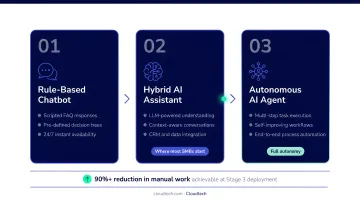
Gartner predicts that by 2029, agentic AI will autonomously resolve 80% of common customer service issues without human intervention — with a 30% reduction in operational costs. The businesses that get there first will be the ones that start building the right infrastructure now — not after the window narrows.
Conclusion
Neither tool is universally superior. Chatbots deliver reliable, cost-efficient handling of repetitive queries. AI agents unlock autonomous resolution of complex, high-value workflows. The right choice depends on what you're actually trying to automate — and whether your infrastructure can support it.
Pick the wrong tool for the job and you'll feel it: higher support costs, slower resolution times, and frustrated customers. Pick the right one — and build the infrastructure to match — and the gains compound quickly. For AI agents especially, that means a cloud environment designed to handle data integrations, security requirements, and real-time processing without bottlenecks.
That's where the work actually starts. Cloudtech helps SMBs build that foundation on AWS — so whether you're deploying a focused chatbot or a fully autonomous AI agent, the infrastructure underneath it can keep up.
Frequently Asked Questions
What is the core difference between an AI agent and a chatbot?
Chatbots follow pre-defined scripts or rules to answer narrow, predictable questions within a fixed scope. AI agents use large language models to reason through situations, retain context across a full conversation, and autonomously execute multi-step tasks — without requiring manual programming for each scenario.
Can a small business benefit from AI agents, or are they mainly for large enterprises?
AI agents are increasingly accessible to SMBs, particularly through cloud platforms like AWS. Company size is less of a barrier than infrastructure readiness — businesses need the right data integrations and API connectivity in place before an agent can perform reliably.
Are AI agents more expensive to implement than chatbots?
Chatbots have lower upfront costs and faster deployment. AI agents require more infrastructure investment, but they typically deliver stronger ROI on complex workflows by reducing human escalations, handle times, and operational overhead — making total cost of ownership the more useful comparison point.
Can a chatbot evolve into an AI agent over time?
Some platforms allow chatbots to be upgraded with LLM capabilities and system integrations, gradually expanding their autonomy. That said, a true AI agent requires a fundamentally different architecture and cannot be achieved by adding features to an existing rule-based bot.
What industries benefit most from deploying AI agents?
Industries with complex, high-volume interactions that require judgment see the strongest results:
- Healthcare: patient triage, appointment follow-ups
- Financial services: billing resolution, fraud alerts
- SaaS: churn prevention, customer onboarding
- Logistics: shipment tracking, exception handling