These aren't random failures — they're the predictable result of architecture built without scalability and security as design requirements from the start. According to Flexera's 2026 State of the Cloud Report, 77% of SMB respondents run some or significant workloads on AWS, yet many of those environments were built reactively rather than intentionally.
This guide covers the foundational principles, architecture patterns, core AWS services, and security controls that allow SMBs and growing companies to build AWS environments that scale under real demand and hold up under real-world threat conditions.
Key Takeaways
- A three-tier architecture (Web, Application, Database) is the proven foundation for scalable, fault-tolerant AWS systems
- Scalability requires stateless design, Auto Scaling, and load balancing working together — not just adding more compute
- Security must be built in from day one — IAM least privilege, VPC segmentation, and encryption are non-negotiable
- High availability depends on Multi-AZ deployments, decoupled services, and automated health-check-driven recovery
- Monitoring, Infrastructure as Code, and cost governance keep architectures reliable as they scale
What Is AWS Cloud Architecture and Why Does It Matter for SMBs?
AWS cloud architecture is the intentional design of compute, storage, networking, and security using AWS-native services. The goal isn't simply moving workloads to the cloud — it's engineering how those workloads behave under load, failure, and cost pressure before problems surface.
The decisions made early have compounding consequences. A poorly designed VPC, a monolithic application, or missing IAM boundaries don't surface on day one. They surface at scale, during an incident, or during a compliance audit — when the cost of fixing them is far higher than getting it right upfront.
The AWS Well-Architected Framework provides the guiding structure here. Its six pillars are:
- Operational Excellence: Running and monitoring systems so they improve over time
- Security: Protecting data, systems, and assets at every layer
- Reliability: Recovering from failures and scaling to meet demand
- Performance Efficiency: Using the right resources for the right workloads
- Cost Optimization: Eliminating unnecessary spend without sacrificing capability
- Sustainability: Reducing environmental impact through efficient architecture
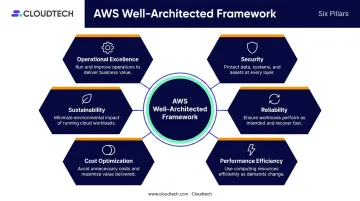
For SMBs, these pillars work best as design constraints applied before launch — not audit criteria applied after. Building with them in mind from day one is what keeps environments from requiring costly rearchitecting when growth hits.
The Three-Tier Architecture: The Foundation of Scalable AWS Design
The three-tier model is a well-documented AWS pattern for web applications. It separates the system into a Web Tier (presentation), Application Tier (business logic), and Database Tier (data layer), allowing each to scale, fail, and recover independently — a zone failure in one tier doesn't bring down the others. Here's how each layer works in practice.
Web Tier (Presentation Layer)
Traffic arrives here first and is distributed across multiple EC2 instances behind an Application Load Balancer (ALB). The ALB requires at least two enabled Availability Zones, places a load balancer node in each, and stops routing to unhealthy targets automatically — resuming once targets recover.
Deploying instances across multiple AZs means a single zone failure doesn't bring the application down. Amazon CloudFront sits in front of this tier as a CDN layer, caching static content at edge locations to reduce latency for geographically distributed users.
Application Tier (Logic Layer)
This layer processes business logic and mediates between the web layer and the database. It lives in private subnets, is never directly accessible from the public internet, and uses an internal ALB to distribute traffic across application instances.
A few additions that strengthen this layer:
- Amazon ElastiCache (Valkey, Redis OSS, Memcached) — accelerates database interactions and reduces load on the database tier
- Private subnet isolation — keeps this layer off the public internet, tightening security
- Independent scaling — adjusts capacity without touching the web or database tiers
Database Tier (Data Layer)
The database tier lives in private subnets using Amazon RDS or Amazon Aurora. Only the Application Tier should have inbound access to this layer.
Key configurations here:
- Multi-AZ DB instances — one standby in another AZ for automatic failover; a Multi-AZ DB cluster adds two readable standby instances
- Aurora failover — promotes a replica to writer, typically in under 60 seconds
- Read replicas — distribute read-heavy workloads without touching the primary instance
- Automated backups — should be configured from day one, not added later
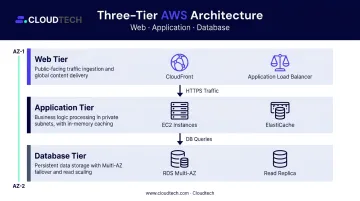
For regulated industries, this tier isolation is a compliance requirement, not a design preference. A HIPAA-compliant EHR environment, for example, must restrict database access to the application layer only and log every access event for audit purposes — gaps here create audit findings, not just security risks.
Core AWS Services That Enable Scalable, Reliable Architecture
The three-tier model provides the blueprint. These AWS services are what actually execute it — handling traffic, storage, compute, and deployment with the consistency SMBs need to scale without adding headcount.
Elastic Load Balancing and Auto Scaling
ELB distributes incoming traffic across healthy instances and automatically registers or deregisters targets as capacity changes. Auto Scaling Groups monitor CloudWatch metrics — CPU utilization, request count, and custom application metrics — then trigger scaling policies to launch or terminate instances based on real demand.
The combination eliminates single points of failure and prevents overprovisioning. During traffic spikes, capacity expands. During idle periods, instances terminate and costs drop.
Amazon S3
S3 is the durable object store used for static assets, backups, logs, and media. It is designed to exceed 99.999999999% (11 nines) of data durability — a durability figure, not an availability guarantee, but remarkable for object storage at any scale.
Storage class selection matters for cost:
| Storage Class | Best For |
|---|---|
| S3 Standard | Frequently accessed data |
| Intelligent-Tiering | Unpredictable access patterns |
| Glacier / Deep Archive | Long-term archival, infrequent access |
Versioning enables rollback capability. CloudFront integration delivers S3-hosted content at edge locations. Lifecycle policies automatically transition aging data to lower-cost tiers — one healthcare SMB achieved a 40% reduction in storage costs by archiving historical patient data to S3 Glacier Deep Archive using automated lifecycle transitions.
Amazon RDS and AWS Lambda
RDS handles patching, backups, and Multi-AZ failover without manual intervention — removing the operational burden that typically requires a dedicated DBA.
AWS Lambda addresses a different problem: event-driven, variable workloads where running instances continuously is wasteful. Lambda scales automatically per invocation, making it cost-efficient for API backends, data transformation pipelines, and scheduled tasks. As concurrent requests increase, Lambda adds execution environments automatically.
Both approaches require stateless application design. If session state lives on an instance rather than in a shared store like ElastiCache or DynamoDB, adding more instances won't solve the problem — it'll replicate it.
Infrastructure as Code
AWS CloudFormation, Terraform, and AWS CDK each define environments in version-controlled, repeatable configurations. The practical benefit:
- Eliminates provisioning drift between development, staging, and production
- Ensures small environment inconsistencies don't compound into production instability
- Integrates with CI/CD pipelines (CodePipeline, GitHub Actions) so every change follows a validated deployment path
Security Best Practices for AWS Cloud Architecture
The AWS Shared Responsibility Model is clear: AWS secures the infrastructure the cloud runs on; customers secure what runs in it. For healthcare and financial services SMBs, the customer-side controls are also compliance requirements.
IAM Least Privilege
Every user, service, and application should have only the permissions it needs — nothing more. CrowdStrike's 2025 Global Threat Report found that valid-account abuse accounted for 35% of cloud incidents in H1 2024. Over-permissioned roles are a primary attack surface.
Practical controls:
- Use AWS IAM Identity Center for SSO with mandatory MFA
- Define break-glass access policies for emergency scenarios — auditable and time-limited
- Apply Service Control Policies (SCPs) at the organizational level to restrict where sensitive data can be stored
VPC Segmentation and Network Controls
Amazon VPC isolates workloads through layered network controls. Database and application tiers are never directly accessible from the public internet — all inbound traffic flows through load balancers.
Key network controls in a well-segmented SMB architecture:
- Public and private subnets separate internet-facing resources from internal workloads
- Security groups act as stateful, instance-level firewalls that restrict lateral movement
- Routing tables enforce traffic boundaries between tiers
- AWS Organizations with structured OUs (Security, Infrastructure, Workloads) prevents flat network exposure
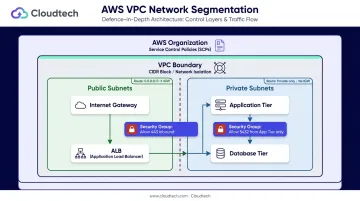
Cloudtech builds this segmentation into every SMB architecture — VPC design, security group configuration, and organizational structure handled together so nothing is bolted on later.
Encryption and Key Management
AWS KMS handles encryption of data at rest across S3, RDS, and EBS volumes. TLS/HTTPS covers data in transit. For HIPAA environments, customer-managed keys (CMKs) with strict key access policies are the standard.
For any environment handling PHI or financial data, encryption is the correct choice. HIPAA technically classifies it as an "addressable" specification — meaning regulated entities must assess appropriateness — but in practice, the risk calculus is straightforward.
Threat Detection and Audit Logging
- Amazon GuardDuty — continuously processes AWS data sources and logs using threat-intelligence feeds and ML models to identify suspicious activity
- AWS CloudTrail — records every API call (who did what, where, and when); event history provides 90 days of searchable management events, with retention extendable to 7 years in S3 for HIPAA compliance requirements
- AWS Config — tracks configuration changes and flags drift from compliance baselines
- AWS WAF and AWS Shield — protect the web tier from common exploits and DDoS attacks
For SMBs without large internal security teams, implementing these controls correctly from the start can be complex. Cloudtech's team — built primarily from former AWS employees — implements these controls as a structured engagement, not a billable hour hunt. The result is a defensible security baseline delivered in weeks, at a cost SMBs can actually budget for.
Designing for High Availability and Fault Tolerance
The guiding principle: assume any component can fail and architect so the system continues functioning at an acceptable level when it does.
Multi-AZ and Health Check-Driven Recovery
| Deployment Pattern | SLA Commitment |
|---|---|
| RDS Multi-AZ instance/cluster | 99.95% monthly uptime |
| EC2 across two or more AZs | 99.99% monthly uptime (Region-level) |
| Single EC2 instance | 99.5% monthly uptime |
The gap between 99.5% and 99.99% is roughly 4 hours of potential downtime per month versus under 5 minutes. For most SMBs, Multi-AZ is a straightforward investment.
Auto Scaling health checks detect unhealthy instances and replace them automatically — removing the need for manual intervention during failures.
Service Decoupling with SQS
Amazon SQS queues requests between services so that if a downstream service slows or fails, upstream services continue accepting traffic rather than failing immediately. Messages are stored redundantly across multiple servers.
This prevents cascading failures. Critical paths keep running even when non-essential features are down, enabling degraded-but-functional operation during partial outages.
When to Consider Multi-Region
Most SMB workloads can meet their resilience goals within a single Region across multiple AZs. Multi-Region becomes relevant for:
- Disaster recovery with strict recovery time requirements
- Global user bases requiring regional performance
- Data sovereignty requirements in specific countries or regions
Multi-Region introduces real trade-offs: higher cost, data consistency complexity, and increased operational overhead. For most SMBs, Multi-AZ delivers the reliability they need without that added complexity — making it the natural first step before evaluating cross-Region strategies.
Monitoring, Cost Optimization, and Automation
Monitoring and Observability
Limited visibility means longer time-to-detection and a larger blast radius when something breaks. Two core tools:
- Amazon CloudWatch — captures metrics, triggers alarms when thresholds are breached, and provides dashboards for operational visibility
- AWS X-Ray — distributed tracing that identifies latency sources and failure points across services
Define meaningful SLOs and alert thresholds so the team knows when the system is operating outside acceptable limits — not after users report problems.
Cost Optimization as an Architecture Decision
Flexera estimates that 29% of IaaS/PaaS spend is wasted across cloud environments. Cost is determined by architecture choices made at design time, not just what runs in production.
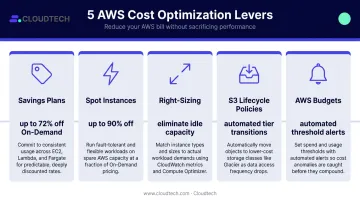
Key levers:
- Savings Plans and Reserved Instances — up to 72% discount versus On-Demand for predictable baseline workloads, in exchange for a usage or term commitment
- Spot Instances — up to 90% discount for batch or fault-tolerant jobs that can handle interruption
- Right-sizing — CloudWatch utilization data identifies instances running far below capacity; Cost Explorer surfaces right-sizing recommendations
- S3 lifecycle policies — automatically move aging data to lower-cost tiers without manual intervention
- AWS Budgets — tracks cost and usage, sends alerts when thresholds are approached, and can trigger automated actions
Governance Through Automation
Manual configuration changes create drift — and drift compounds over time into incidents. A governance-first approach uses four interlocking controls to keep environments consistent across dev, staging, and production:
- Infrastructure as Code (IaC) — version-controlled templates that make every environment reproducible
- AWS Config rules — continuous compliance checks that flag drift the moment it occurs
- Service Control Policies (SCPs) — guardrails that prevent out-of-policy actions at the account level before they cause problems
- CI/CD pipelines — automated deployment paths that eliminate manual changes as a vector for misconfiguration
Frequently Asked Questions
What is AWS cloud architecture?
AWS cloud architecture is the design of how compute, storage, networking, and security components work together on AWS to run applications reliably at scale. It's guided by frameworks like the AWS Well-Architected Framework, which defines six pillars for making sound architecture decisions.
What is the three-tier architecture in AWS?
The three-tier model separates an application into a Web Tier (traffic entry and presentation via ALB), an Application Tier (business logic in private subnets), and a Database Tier (data storage in isolated private subnets). Each layer scales and fails independently, preventing single-tier failures from cascading across the entire system.
How does Auto Scaling work in AWS?
Auto Scaling Groups monitor CloudWatch metrics and automatically launch EC2 instances when demand increases, then terminate them when demand drops. This keeps the application responsive during traffic spikes while controlling costs during quiet periods.
How do I make my AWS architecture more secure?
Four controls cover the essentials:
- Enforce IAM least privilege across all users and services
- Use VPC segmentation with private subnets for application and database tiers
- Enable encryption at rest (AWS KMS) and in transit (TLS)
- Activate CloudTrail and GuardDuty for audit logging and threat detection
What is the difference between high availability and fault tolerance in AWS?
High availability minimizes downtime through Multi-AZ deployments and load balancing. Fault tolerance goes further: the system continues functioning, even in a degraded state, when components fail. This is achieved through redundancy, SQS-based service decoupling, and graceful degradation design.
What AWS services are essential for a scalable cloud architecture?
Six services form the foundation of most scalable AWS architectures:
- Elastic Load Balancing — traffic distribution
- EC2 Auto Scaling — dynamic capacity management
- Amazon RDS or Aurora — managed databases with Multi-AZ
- Amazon S3 — durable object storage
- AWS Lambda — serverless compute for variable workloads
- Amazon CloudWatch — monitoring and alerting