Introduction
The AI customer service market is growing fast — MarketsandMarkets values it at $12.06 billion in 2024, with projections reaching $47.82 billion by 2030. Gartner expects at least 70% of customers to use a conversational AI interface to start a service journey by 2028. Businesses that delay are already watching competitors deflect Tier 1 tickets automatically — while absorbing higher setup costs the longer they wait.
The pricing, though, is anything but straightforward.
The same capability — answering customer questions, deflecting Tier 1 tickets — can cost $30/month on a SaaS starter plan or $30,000+/month in a custom enterprise deployment. That gap isn't arbitrary. It reflects fundamentally different pricing models, conversation volumes, AI sophistication levels, and integration complexity.
Misreading the landscape leads to underbudgeting, wrong-tool selection, or getting locked into contracts that punish growth.
This guide covers the full pricing spectrum: cost tiers by business size, the five pricing models used in the market, key cost drivers, total cost of ownership, and a practical framework for estimating the right budget.
Key Takeaways
- Cost range: Free tiers exist; SaaS tools run $29–$500+/month; enterprise and custom builds can exceed $6,000/month
- Biggest cost drivers: Conversation volume, AI sophistication, channel breadth, and integration depth
- SMBs typically do best on usage-based or flat SaaS plans; enterprises need custom modeling
- Per-resolution pricing aligns cost with value better than per-conversation or per-seat models
- Track cost-per-resolved-issue, not cost-per-month — upgrade when deflection savings clearly outpace what you're paying
How Much Does an AI Customer Service Chatbot Cost?
AI chatbot pricing has no universal standard. Two businesses with similar support volumes can pay dramatically different amounts depending on the platform, model, and configuration they choose.
The two most common mistakes: looking only at the base plan price (and ignoring usage charges), or over-specifying enterprise features that won't be used at current scale.
Here's how the market breaks down by tier.
Entry-Level / SaaS Starter Tier ($0–$50/month)
Typical features:
- Basic chatbot flows with scripted or simple AI responses
- 50–1,000 conversations/month
- One or two channels (usually web chat)
- Minimal analytics, no deep integrations
Common platforms: Tidio Free (50 billable conversations/month), ManyChat Free (25 active contacts), Crisp Free
Best for: Solo operators, early-stage startups, or businesses testing deflection rates before committing to automation at scale.
Mid-Range / Growing Business Tier ($50–$500/month)
What's included:
- Higher conversation volume caps
- Multi-channel support (web, email, social)
- AI-assisted or NLP-powered responses
- CRM and e-commerce integrations
- Basic analytics and reporting
Examples: Tidio Growth ($49.17/month), Freshchat Pro ($49/agent/month), Crisp Essentials ($95/workspace/month), Gorgias Pro ($300/month with 2,000 tickets)
Who it's for: SMBs with consistent support volume who need to reduce repetitive agent workload without a major infrastructure investment.
Enterprise / Custom Tier ($500–$6,000+/month)
Capabilities at this level:
- High or unlimited conversation volumes
- Advanced AI agents with near-human resolution capability
- Deep backend integrations (CRM, ERP, order management)
- SLAs, dedicated support, workforce management add-ons
- Compliance and security configurations
Examples: Zendesk Suite Enterprise ($169/agent/month), Intercom Expert ($132/seat/month), Salesforce Agentforce ($2/conversation + Service Cloud base). Custom-built solutions on AWS infrastructure — Amazon Lex paired with Amazon Connect — fit this tier, with costs driven by usage rather than a flat license.
Best for: High-volume operations, businesses with complex workflows or compliance requirements, and teams building proprietary AI agents on cloud infrastructure.
Key Factors That Affect the Cost of AI Chatbots
Pricing is shaped by a combination of technical and operational variables. Understanding these prevents sticker-shock after deployment.
Type and AI Sophistication
The cost spectrum runs from simple to complex:
- Rule-based chatbots — Pre-scripted decision trees, keyword matching, cheapest to build and run. Limited to questions the script anticipates.
- NLP-powered AI chatbots — Understand varied phrasing and handle more open-ended queries. Mid-range pricing on most SaaS platforms.
- RAG-based AI agents — Retrieve live data from connected knowledge bases to generate contextually accurate answers. Highest capability, highest compute cost.
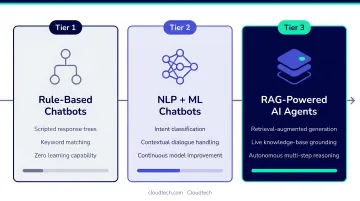
Each step up in sophistication carries higher licensing or compute costs. According to Forrester, an automated interaction typically costs about one-tenth of a conversation handled by a human agent. That cost advantage widens as AI accuracy improves and fewer conversations escalate to human agents.
Conversation Volume and Scale
Volume is where costs get unpredictable. Usage-based pricing (per-conversation, per-resolution) means costs spike during seasonal traffic, marketing campaigns, or product launches. Seat-based pricing keeps costs flat regardless of chat volume.
- Low-volume SMBs often pay less with usage-based tools
- High-volume operations need to model monthly spend carefully — a $2/conversation charge across 5,000 monthly conversations adds up to $10,000 in AI usage alone
Integration Complexity and Channel Depth
Adding channels and backend connections raises costs on two fronts:
- Channel fees: WhatsApp Business Platform charges per delivered template message (rates vary by category and country, effective July 2025). SMS and voice channels carry similar API costs.
- Integration work: Connecting a chatbot to a CRM, ERP, or order management system often requires developer time or professional services — costs that don't appear on any vendor pricing page.
SaaS vs. Custom-Built
The two paths each have distinct tradeoffs:
- SaaS platforms deploy quickly with predictable monthly costs, but per-seat or per-resolution pricing can become expensive at scale
- Custom-built on AWS (using services like Amazon Lex and Amazon Connect) requires higher upfront investment, but infrastructure costs align directly with usage — no fixed per-seat fees
- Regulated industries (healthcare, financial services) often benefit from custom builds, where HIPAA and compliance requirements are architected in from the start rather than bolted on
For SMBs in regulated environments, working with an AWS-certified consulting partner like Cloudtech can close the gap between SaaS convenience and custom-build control — without the enterprise price tag.
AI Chatbot Pricing Models Explained
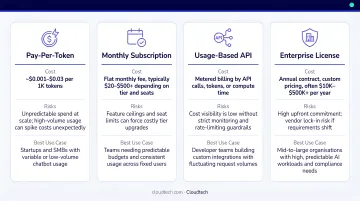
The pricing model you choose determines not just your monthly bill, but whether your costs align with the value the chatbot actually delivers.
Per-Seat Pricing
A fixed monthly fee per human agent using the platform, regardless of AI conversation volume. Finance teams love the predictability. The disconnect: you pay the same whether the bot resolves 100 or 10,000 tickets.
Examples: Zendesk Suite ($55–$169/agent/month), Freshdesk ($19–$79/agent/month), HubSpot Service Hub (starting $20/seat/month)
Best when: Your team size is stable and you need budget certainty month-to-month.
Per-Conversation Pricing
Charged for each conversation the AI engages in, regardless of outcome. A frustrating, unresolved conversation costs the same as a successful one — that misalignment matters.
Example: Salesforce Agentforce at $2/conversation
Watch out for: Volume spikes during campaigns or seasonal peaks.
Per-Resolution Pricing
Charges only when the AI successfully resolves a customer issue without human intervention. You only pay when the bot actually solves something — costs track directly to outcomes.
Examples: Intercom Fin at $0.99/outcome; Zendesk prices by automated resolutions (confirm current rates directly with Zendesk before budgeting)
Critical question: How does the vendor define "resolution"? Definitions vary, and a loose definition can inflate charges.
Platform Fee Plus Usage
A recurring base subscription plus variable AI usage charges layered on top. Common in enterprise setups — Salesforce Agentforce requires a Service Cloud base subscription before per-conversation charges apply.
Teams consistently underestimate usage charges during initial budgeting. The base fee looks manageable — the total bill often does not. Always model out projected conversation volume before signing.
Quick comparison:
| Model | You're Charged For | Best For | Key Risk |
|---|---|---|---|
| Per-Seat | Each human agent | Stable team sizes | Pays regardless of AI volume |
| Per-Conversation | Every AI conversation | Predictable interaction volume | Charges for unresolved chats |
| Per-Resolution | Successful AI resolutions only | Outcome-focused budgets | Vendor definition of "resolution" varies |
| Platform Fee + Usage | Base fee plus variable usage | Enterprise setups | Usage charges routinely underestimated |
Total Cost of Ownership: Beyond the Subscription Price
The plan page price is one layer. A realistic TCO calculation covers four:
- Platform subscription or base fee — the monthly or annual license
- AI usage charges — per-conversation, per-resolution, or compute costs at expected monthly volume
- Add-ons — copilot tools, QA modules, workforce management, extra channels, compliance features
- Implementation and ongoing management — developer time, integration work, training, and knowledge base maintenance
Why Hidden Costs Compound
Consider a 10-agent team handling 5,000 monthly AI resolutions:
| Cost Component | Scenario A (Bundled Per-Resolution) | Scenario B (Seat + Usage + Add-ons) |
|---|---|---|
| Platform/seat fee | Included | $115/agent/month = $1,150 |
| AI resolution cost | $0.99 × 5,000 = $4,950 | $1.00–$1.50 × 5,000 = $5,000–$7,500 |
| Copilot add-on | Included | $50/agent/month = $500 |
| Monthly total | ~$4,950 | $6,650–$9,150 |
The difference isn't the AI — it's the model structure. A platform that bundles all three can cost materially less than one that charges separately for each layer.
The Offsetting Factor
Research benchmarks consistently show that AI-handled interactions cost a fraction of human-handled ones:
- Juniper Research's banking and healthcare analysis estimates savings of $0.50–$0.70 per AI-handled query
- Forrester's more recent analysis puts the automated interaction cost at roughly one-tenth of a human-handled conversation
- McKinsey documented one Asian bank achieving a 40–50% reduction in service interactions and more than 20% cost-to-serve reduction after deployment
A complete TCO picture has to account for both sides of the ledger — what you pay the platform and what you stop paying your support team per ticket.
How to Estimate the Right Budget and Avoid Common Mistakes
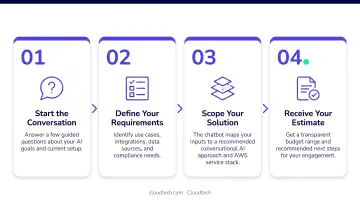
The right chatbot budget starts with your current support economics, not a vendor's pricing page.
A Simple Self-Assessment
- Calculate your current cost-per-ticket — total monthly support cost ÷ monthly conversation volume
- Identify Tier 1 ticket volume eligible for automation (password resets, order status, FAQs, appointment scheduling)
- Model deflection savings — expected deflection rate × cost-per-ticket × monthly volume
- Compare against chatbot cost at expected usage volume (not the base plan price)
Factors to Weigh Before Choosing
- Intended conversation volume and growth trajectory over 12–24 months
- Number of channels needed (web-only is simple; WhatsApp + SMS + voice adds cost and complexity)
- Integration requirements — CRM connections are usually manageable; ERP or order management integrations often need developer resources
- Compliance obligations — HIPAA (healthcare) and FINRA guidance (financial services) add governance and security requirements that not every SaaS tool meets out of the box
- Long-term roadmap — a SaaS tool works for lean teams; businesses anticipating high volume or complex integrations may find custom AWS-native builds more cost-efficient at scale
- Regulated industry considerations — for healthcare and financial services companies, custom AWS-native architectures often deliver cleaner compliance coverage than SaaS tools that bolt on HIPAA or FINRA controls as paid add-ons
Common Mistakes to Avoid
- Focusing only on base plan price without modeling usage charges at expected volume
- Ignoring implementation costs — integration work and setup time are real budget items
- Over-specifying enterprise features your current scale doesn't justify
- Choosing the cheapest option without evaluating resolution accuracy — a low-deflection chatbot increases agent workload rather than reducing it
Conclusion
AI chatbot pricing in 2026 varies dramatically based on pricing model, conversation volume, AI sophistication, and total cost of ownership — figures that rarely surface on a vendor's pricing page. The gap between a $50/month tool and a $5,000/month deployment reflects a gap in capability, not just cost.
The right investment is the one that balances automation performance, integration fit, and long-term cost-per-outcome. For lean teams with predictable volume, a SaaS tool delivers fast ROI. For businesses with complex workflows, compliance requirements, or high conversation volume, a custom-built solution on AWS infrastructure tends to deliver better unit economics — provided it's scoped by a team that knows the platform well. Cloudtech builds conversational AI on AWS for exactly this type of deployment, helping SMBs avoid overbuilding while still getting enterprise-grade performance.
Frequently Asked Questions
How much does an AI customer service chatbot cost?
Costs range from $0 on free SaaS tiers to $6,000+/month for enterprise deployments. The final number depends on pricing model (per-seat, per-resolution, per-conversation), expected conversation volume, AI sophistication, and included features. Custom AWS-native builds are priced separately based on infrastructure usage.
What is an AI chatbot for customer service?
An AI customer service chatbot is software that uses natural language processing and machine learning to automatically respond to customer inquiries across channels. Unlike rule-based bots with scripted flows, AI-native chatbots understand varied phrasing and can resolve issues without human intervention.
What is the difference between per-seat and per-resolution pricing?
Per-seat charges a fixed monthly fee per human agent regardless of AI usage volume. Per-resolution charges only when the AI successfully resolves a customer issue — making it better aligned with actual value delivered, particularly for high-volume teams.
Can AI chatbots actually reduce customer service costs?
Forrester estimates automated interactions cost roughly one-tenth of human-handled conversations, and Juniper Research's banking and healthcare analysis documented $0.50–$0.70 in savings per AI-handled query. ROI depends on resolution accuracy, ticket volume, and implementation quality.
What pricing model is best for small businesses?
SMBs with low or unpredictable volume typically benefit most from usage-based or free-tier SaaS tools, paying only as usage grows rather than locking into per-seat fees. Tidio, ManyChat, and Zoho SalesIQ are common entry points before moving to mid-range platforms.