Introduction
Phone lines at medical practices are overwhelmed. A survey of 294 practice leaders by MGMA found that phones remain a persistent operational bottleneck, consuming staff time across scheduling, eligibility verification, and routine patient questions. That strain lands on an already stretched workforce — MGMA's 2023 operations data puts front-office staff turnover at 40% in 2022 alone.
Conversational AI addresses this directly. By automating high-volume, repetitive patient interactions across voice, SMS, and chat, these systems handle scheduling calls, billing questions, and follow-up outreach without adding headcount.
Healthcare is not a general-purpose deployment environment, though. Any tool that touches patient data must be HIPAA-compliant by design — and the technical requirements for that are more specific than most vendors acknowledge.
What follows breaks down what HIPAA-compliant conversational AI actually requires in practice: the use cases delivering real operational value, the technical safeguards you cannot skip, and how to evaluate or build the right solution.
Key Takeaways
- A signed Business Associate Agreement (BAA) with every vendor touching patient data is the non-negotiable first requirement — without it, the deployment is a HIPAA violation regardless of other safeguards.
- Start with administrative use cases — scheduling, reminders, billing inquiries — before expanding to clinically adjacent workflows.
- Compliance is an architectural property of the full system — not a feature of any single tool.
- AWS HIPAA-eligible services — Amazon Connect, Bedrock, and Transcribe — give healthcare organizations a compliant infrastructure foundation.
- Evaluate vendors on: verifiable security posture, EHR integration depth, speed-to-value, and implementation support.
What Is HIPAA-Compliant Conversational AI for Patient Engagement?
Conversational AI vs. Scripted Chatbots
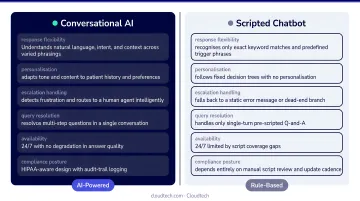
Conversational AI in healthcare refers to NLP-powered systems that automate two-way patient communications across voice, chat, and SMS. Unlike scripted chatbots that follow rigid decision trees, modern systems understand natural language, handle multi-turn conversations, and take real actions: booking appointments, capturing insurance data, processing payments, and routing calls to human agents.
The distinction matters practically. A scripted bot fails when a patient says "I need to move my appointment" differently than the system expects. A conversational AI handles the variation, confirms the rebooking, and updates the EHR record — all without staff involvement.
What "HIPAA Compliant" Actually Means
HIPAA compliance is not a certification a vendor can simply claim. It is a set of administrative, physical, and technical safeguards required under the HIPAA Security Rule for any system that creates, receives, maintains, or transmits electronic Protected Health Information (ePHI) — and every component of a conversational AI system can qualify.
For conversational AI, the types of PHI typically in play include:
- Patient names, phone numbers, and email addresses
- Appointment details tied to care
- Insurance identifiers and billing account information
- Medication information
- Voice data captured during calls
Each data type triggers compliance obligations the moment it passes through a system. That scope directly shapes how vendors are classified under the law.
Covered Entities vs. Business Associates
HHS defines a business associate as any person or organization (outside the covered entity's workforce) that performs functions involving PHI, including data analysis, billing, and administration. An AI vendor processing patient data on behalf of a hospital or clinic is a business associate.
This distinction determines legal responsibility. The covered entity (the healthcare provider) must obtain written assurances, specifically a signed BAA, from every business associate before any patient data flows through their system. Business associates must do the same for their subcontractors.
Most commercial AI platforms, including popular general-purpose chatbots, are not HIPAA-compliant by default. Compliance depends on the full architecture, not just the patient-facing interface. Every layer must meet the standard:
- Compute environment and database storage
- API gateway and network controls
- The AI model and inference layer
Key Use Cases Driving Real ROI
Appointment Scheduling and Reminders
Conversational AI handles inbound scheduling requests 24/7 with no hold time, integrates with EHR and practice management calendars to check real-time availability, and sends automated multi-channel reminders via voice, SMS, and email.
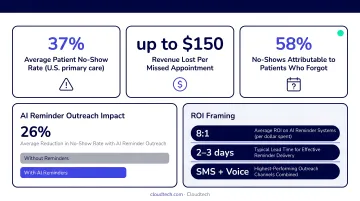
No-shows carry a measurable cost. A 2025 primary-care study covering 1,118,236 appointments found a 6.9% no-show rate and a near-identical 6.8% late cancellation rate — meaning roughly 1 in 7 scheduled visits never happens.
A 2023 randomized quality-improvement study found that predictive models flagging appointments with a 15%+ no-show probability — combined with targeted augmented reminders for that group — reduced missed appointments. The evidence favors risk-stratified outreach over blanket reminder campaigns.
Billing Inquiries and Payment Collection
AI agents handle billing interactions end-to-end within a PCI-DSS and HIPAA-compliant environment:
- Answer common billing questions ("Why was I charged for this?")
- Verify patient balances securely without transferring to staff
- Collect payments over the phone or via text-to-pay links
- Route complex disputes to a human agent with full context
This reduces inbound call volume to billing staff and accelerates collections without requiring patients to navigate phone trees or wait on hold.
Patient Re-Engagement and Chronic Care Outreach
Proactive AI outreach campaigns contact patients who are overdue for appointments, follow up post-discharge, send medication adherence reminders, and close care gaps. Vendor case data from Gridspace reports a 25% response rate, a 15% increase in appointment volume, and a 10% improvement in care-gap closure from AI-driven outreach — though these figures reflect one specific deployment, not industry-wide averages.
CipherHealth's retrospective analysis of approximately 170,000 patients reached through automated outreach resulted in 4,256 scheduled annual wellness appointments, demonstrating the scale at which AI re-engagement can operate.
Insurance Verification and Pre-Visit Intake
AI can collect insurance details, verify eligibility before an appointment, and capture digital intake forms, consents, and medical history — reducing denied claims and eliminating manual verification work. With 95% of office-based physicians having adopted an EHR by 2024, seamless EHR integration is the baseline expectation — and the prerequisite for any of this to work at scale.
HIPAA Compliance Requirements Every Conversational AI Must Meet
Business Associate Agreement
A signed BAA is the first and non-negotiable requirement. Without it, using any AI tool for PHI-related tasks is a HIPAA violation — regardless of encryption, audit logging, or any other technical control. The BAA must cover every vendor in the chain, including subcontractors and the underlying AI models powering the system.
One overlooked risk: some AI vendors store prompts and outputs for model training. If that data contains PHI and the vendor hasn't signed a BAA with appropriate no-retention terms, the organization has a compliance breach. Two contract terms to verify before signing:
- No-retention clause: Vendor cannot store or use PHI inputs for model training
- Subcontractor coverage: BAA obligations extend to every downstream vendor in the AI stack
The FTC's 2024 guidance on AI privacy confirms that AI companies must honor confidentiality commitments around customer data. That protection only holds when it's written into the contract.
Encryption, Audit Logging, and Access Controls
With a valid BAA in place, the next layer is technical controls. Four areas to evaluate in any vendor:
| Requirement | What to Look For |
|---|---|
| Data in transit | Modern TLS protocols (aligned with NIST SP 800-52) across all patient-facing and backend communications |
| Data at rest | Strong encryption (AES-256 is the common vendor standard) for stored transcripts, recordings, and PHI |
| Audit logging | Comprehensive logs documenting who accessed what data, when, and what action was taken — in a reviewable format |
| Role-based access | The "minimum necessary" principle applied: billing AI accesses billing data only; scheduling AI accesses calendar data only |
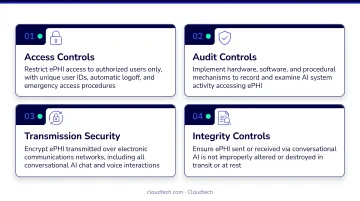
HIPAA's Security Rule treats encryption as an "addressable" specification. Organizations must implement it where reasonable and appropriate, or document an equivalent alternative. Any vendor unwilling to confirm encryption standards for data in transit and at rest should not handle PHI.
Independent Security Certification
SOC 2 Type II and HITRUST CSF serve different purposes:
- SOC 2 Type II validates that a vendor's security controls operated effectively over a defined period, via independent audit. It is not healthcare-specific.
- HITRUST CSF maps controls specifically to HIPAA and other healthcare standards, making it a stronger signal for regulated healthcare environments.
Neither certification guarantees legal HIPAA compliance — but both provide meaningful evidence of a vendor's security posture. Always request the actual certification report, not a marketing claim.
Building HIPAA-Compliant Infrastructure: The AWS Approach
Many organizations focus on selecting an AI tool before securing the underlying infrastructure. That sequence creates risk. Compliance is determined by the entire system architecture — the compute environment, database, API gateway, and network controls must all meet HIPAA standards before any AI layer is added on top.
AWS HIPAA-Eligible Services
AWS provides a documented set of HIPAA-eligible services that can be used to create, receive, process, or transmit ePHI under an AWS Business Associate Addendum. Key services relevant to conversational AI include:
- Amazon Connect — Cloud contact center for voice workflows and call routing
- Amazon Lex — Conversational bot interface for scheduling, FAQs, and routing
- Amazon Comprehend Medical — NLP processing for clinical text
- AWS HealthLake — FHIR-compliant healthcare data store
Cloudtech's healthcare deployments use Amazon Bedrock for AI reasoning, Amazon Transcribe for real-time speech-to-text, Amazon Polly for voice synthesis, and Amazon Connect for call orchestration — with PHI stored in Amazon S3 under SSE-KMS encryption, CloudTrail audit logging, and IAM-enforced access controls.
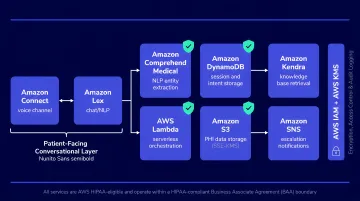
HIPAA eligibility and a signed AWS BAA make these services compliant building blocks — not a turnkey compliance guarantee. The architecture itself must enforce encryption, authentication, monitoring, and access control at every layer. Here's what that looks like when it's built correctly.
What This Looks Like in Practice
In a documented Cloudtech deployment for a healthcare BPO, the team built an 8-node conversational architecture that handled the full appointment scheduling workflow end-to-end. The call flow covered:
- Patient greeting and identity verification
- Insurance confirmation and availability check
- Appointment booking and error recovery
Calls completed in under 5 minutes on average. When the AI couldn't resolve a request, a warm transfer to a human agent completed in under 2 seconds — with full call context passed through.
Cloudtech's team (which includes former AWS professionals) handles HIPAA-compliant architecture on AWS, including BAA execution through AWS Artifact and monitoring configuration through AWS CloudTrail, AWS Config, and Amazon CloudWatch. For healthcare SMBs without a dedicated engineering team, structured implementation support reduces compliance risk and cuts time-to-deployment.
Common Pitfalls When Deploying Healthcare Conversational AI
Vendors Without Verified BAAs
Many AI tools marketed to healthcare lack formal BAAs, rely on subcontractors that don't meet HIPAA standards, or retain prompt/output data for model training without disclosure. Steps to take before any deployment:
- Request the actual BAA language and review its subcontractor provisions
- Ask specifically which third-party services the vendor uses, including underlying LLMs
- Confirm data retention and training-use policies in writing
A vendor unwilling to provide this documentation is a compliance risk, not just an evaluation gap.
Skipping the Pilot Phase
The most common source of compliance gaps and patient safety risks is launching too broadly, too fast. Begin with administrative, zero-clinical-risk workflows and validate the system before expanding.
Start here before moving to clinical-adjacent tasks:
- Appointment reminders and scheduling automation — lowest risk, highest validation value
- Audit mechanism review — confirm logging captures every interaction involving PHI
- EHR sync verification — test read/write accuracy under realistic load
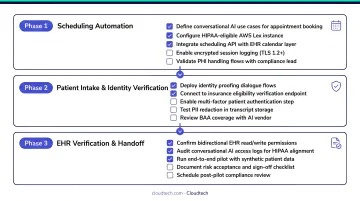
Symptom triage is a separate category entirely. It requires a mature clinical knowledge layer, explicit physician review of AI outputs, and clear disclaimers that the system does not diagnose. Skipping straight to triage without validating the foundation first is how organizations create both liability and patient harm.
Inadequate Staff Training
Staff behavior is one of the most common vectors for HIPAA violations — entering unnecessary PHI into unsecured interfaces, sharing credentials, or bypassing MFA because it feels slower. No platform security model compensates for this.
Ongoing, role-specific training is a HIPAA administrative safeguard requirement, not optional hygiene. Onboarding alone isn't enough. Each role — front desk, clinical, billing — needs training calibrated to the specific interfaces and data they touch.
How to Evaluate and Select the Right HIPAA-Compliant AI Solution
Verifiable Security Posture
Go beyond vendor claims. For any vendor under consideration:
- Request the SOC 2 Type II report (not a summary page)
- Review BAA terms and subcontractor provisions
- Confirm encryption standards for data in transit and at rest
- Ask explicitly about data retention policies for any underlying LLM
EHR Integration Depth
An AI tool is only as effective as the systems it connects with. Look for native, bi-directional integrations with your specific EHR — Epic, athenahealth, Oracle Health — that allow the AI to read real-time availability, access contact records, and write structured notes back to the patient record.
Before signing with any vendor, confirm these integration specifics:
- Supports bi-directional data flow (read and write) with your EHR
- Offers pre-built connectors for your platform — not just API access
- Maps structured data back to the correct fields in the patient record
- Has documented integration timelines and a dedicated technical contact
Speed-to-Value and Implementation Support
Technical fit matters, but so does how fast you can get to a working system. Ask vendors:
- How quickly can we go live with a focused use case?
- Do you offer pre-built healthcare workflows or templates?
- What does dedicated onboarding support look like — is there a named contact?
For healthcare organizations building on AWS, Cloudtech — an AWS Advanced Tier Partner — can configure compliant infrastructure and deploy tested, compliant workflows in weeks, not months.
Frequently Asked Questions
What AI chatbots are HIPAA compliant?
No chatbot is HIPAA compliant by default — compliance depends on the full system architecture. Look for platforms that provide a signed BAA, encryption in transit and at rest, audit logging, and independent certification such as SOC 2 Type II or HITRUST. Confirm that all subcontractors and underlying AI models are also covered under appropriate agreements.
How is AI used in patient engagement?
AI automates appointment scheduling, reminders, billing inquiries, post-discharge follow-ups, and insurance verification. More mature deployments extend into symptom triage and care navigation, though those clinical-adjacent use cases require additional governance and human oversight.
What makes a conversational AI system HIPAA compliant?
Five core requirements: a signed Business Associate Agreement with every vendor touching ePHI, encryption of all patient data in transit and at rest, comprehensive audit logging, role-based access controls applying the minimum necessary principle, and independent security certification.
What is a Business Associate Agreement and why does it matter for healthcare AI?
A BAA is a legally binding contract required by HIPAA that holds an AI vendor to the same data privacy and security standards as the healthcare provider. Without one, sharing any patient data with that vendor constitutes a HIPAA violation and exposes the organization to regulatory fines, regardless of other technical safeguards.
Can small healthcare practices afford HIPAA-compliant conversational AI?
Yes. Cloud-based implementations on AWS allow practices to start with high-ROI, low-risk use cases — appointment reminders, scheduling automation — at a manageable cost, then scale incrementally. Working with an AWS consulting partner can reduce infrastructure costs significantly and eliminates the need for a large internal engineering team to manage compliance architecture.