Introduction
According to the CNCF's FinOps microsurvey, 70% of Kubernetes practitioners identify overprovisioning as their primary overspending factor — and nearly 40% have no cost monitoring in place to detect it. For SMBs running EKS, that combination hits hard: idle EC2 nodes keep billing at full rate, fragmented clusters accumulate quietly, and the problem only surfaces when the monthly AWS bill arrives.
EKS is cost-effective when clusters are actively managed. When node provisioning, resource configuration, and lifecycle decisions run on autopilot, waste compounds steadily until it becomes a real budget problem.
This article covers where AWS instance costs actually accumulate in EKS environments — and the consolidation strategies that address each source: purchasing decisions, workload automation, and the supporting infrastructure that inflates the total bill.
Key Takeaways
- Kubernetes compute costs accumulate gradually through fragmented, underutilized nodes across your cluster
- Oversized resource requests are the root cause of poor bin-packing and blocked consolidation
- Karpenter's consolidation feature automatically removes or replaces underloaded nodes without manual intervention
- Compute Savings Plans combined with right-sized requests deliver the most consistent savings for stable EKS workloads
- Meaningful cost reduction requires better resource decisions, automation, and infrastructure changes — not just fewer instances
How Kubernetes AWS Instance Costs Typically Build Up
EKS compute costs don't spike — they accumulate. The pattern is consistent:
- A scaling event fires and a new node comes online
- Pod counts drop after the traffic burst, but the node stays
- A new deployment lands on an undersized node, triggering another provisioning event
- Over weeks, the cluster carries far more compute than workloads actually need
The underlying mechanism is resource slack — the gap between what pods have been allocated and what they actually consume. When requests are inflated, the scheduler treats capacity as occupied even when CPUs sit mostly idle. Nodes appear "used" while delivering a fraction of their provisioned capacity.
The inefficiency is invisible until a billing tool or cost analysis surfaces it. The CNCF survey found that only 19% of respondents had accurate Kubernetes cost information — the rest were working from estimates or nothing at all. That means most teams are absorbing weeks of compounding waste before they even know the problem exists.
Key Cost Drivers for AWS Instance Costs in Kubernetes
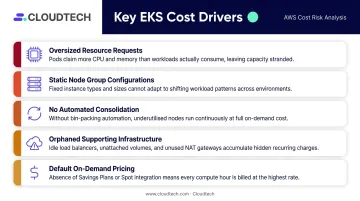
Understanding where costs originate matters before applying any consolidation strategy. The major drivers:
- Oversized resource requests — when pods request far more CPU and memory than they consume, the scheduler cannot densely pack workloads. Nodes fill up on paper while remaining mostly idle in practice
- Static node group configurations — Managed Node Groups locked to specific instance types force the cluster to provision whatever's on the list, often landing on nodes that are too large once pod counts drop
- No automated consolidation — Kubernetes does not natively rebalance pod placement after initial scheduling. Underutilized nodes persist indefinitely unless explicitly deprovisioned
- Orphaned supporting infrastructure — unattached EBS volumes, idle Application Load Balancers, unused Elastic IPs, and oversized NAT gateways generate recurring charges independent of node count
- Default On-Demand pricing for all workloads — using On-Demand instances for interruption-tolerant batch jobs or CI runners leaves substantial discount opportunities unused
The last two categories are frequently overlooked — and the costs compound quietly. Cross-Availability Zone data transfer, for example, carries per-GB charges in both directions ($0.01/GB per direction), which adds up fast in distributed clusters with no zone-aware routing.
Cost-Reduction Strategies for Kubernetes AWS Instance Consolidation
No single lever addresses all sources of waste. The strategies below are organized by where they intervene: at the decision stage, during active cluster operations, or in the surrounding infrastructure.
Strategies That Reduce Costs by Changing Decisions
Each of these is a design-time choice — get them right upfront and you shrink the baseline before optimization tools have anything to work with.
Choose the right instance purchase model. Compute Savings Plans offer up to 66% savings versus On-Demand pricing in exchange for a committed hourly spend amount — and they apply automatically across EC2, Fargate, and Lambda, including EKS worker nodes, without being tied to specific instance types. Spot Instances deliver up to 90% savings for interruption-tolerant workloads like batch jobs and CI runners. The right mix depends on workload predictability, not a blanket preference for one model.
Right-size resource requests before committing to any pricing model. Purchasing Savings Plans against an overprovisioned baseline locks in discounts on waste. Before making financial commitments, benchmark actual CPU and memory consumption using the VPA recommender engine (in Off mode, it writes recommendations to .status without applying them) or cAdvisor metrics. Set requests to reflect measured consumption, not anticipated peaks.
Adopt AWS Graviton instance families where workloads allow. AWS's internal EKS testing reported Graviton2 delivering up to 40% higher performance at 20% lower cost than equivalent M5, C5, and R5 instances. Compatibility requires container images built for ARM64 (multi-arch support), so teams new to Graviton should start with managed services like Amazon RDS or ElastiCache — lower-risk entry points that don't require rebuilding container artifacts.
Use Fargate selectively. Fargate makes sense for variable, short-lived workloads where per-pod billing is more efficient than always-on EC2 nodes. The catch: EKS Fargate adds 256 MiB to declared pod memory, then rounds up to the nearest available compute configuration. Pod resource alignment is critical — misaligned requests mean paying for a larger configuration tier than the workload actually needs.
Strategies That Reduce Costs by Changing How Workloads Are Managed
Three tools do most of the heavy lifting here: Karpenter for node-level consolidation, HPA for replica scaling, and accurate resource requests that make both work correctly.
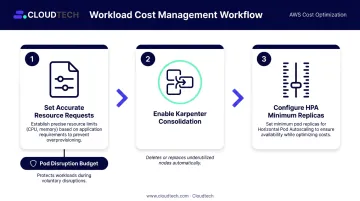
Enable Karpenter consolidation. Karpenter continuously evaluates pod distribution and can either delete a node entirely (when remaining pods fit on existing spare capacity) or replace it with a smaller, lower-priced node. This eliminates the static waste that accumulates after scale-down events.
Karpenter integrates with AWS pricing data to make cost-aware replacement decisions — though note that On-Demand price data is embedded in Karpenter's binary and updated only when Karpenter itself is upgraded.
Configure HPA minimum replicas deliberately. The Horizontal Pod Autoscaler scaled by CPU, memory, or custom metrics via KEDA keeps workload replica counts aligned with actual demand. Setting minimum replicas to 1 minimizes idle pod cost; setting them higher improves availability. Neither extreme is always correct — the right minimum depends on the workload's criticality and acceptable cold-start latency.
Set accurate pod resource requests and limits. Karpenter's consolidation logic depends entirely on pod resource requests — not limits — for scheduling decisions. Inflated requests block tight bin-packing and prevent consolidation from working correctly. Pair accurate requests with Pod Disruption Budgets (PDBs) to control the pace of pod rescheduling during consolidation without halting it entirely.
Strategies That Reduce Costs by Changing the Context Around the Cluster
These address external infrastructure factors that amplify compute spend even when node-level decisions are sound.
Minimize cross-Availability Zone data transfer. Inter-AZ traffic in AWS generates charges on both inbound and outbound paths. Topology-aware scheduling and zone-aware service routing co-locate pods with the storage and services they access most frequently, reducing this hidden but recurring cost.
Audit and eliminate orphaned AWS resources. Unattached EBS volumes, idle Elastic IPs, Application Load Balancers carrying zero traffic, and oversized NAT gateways all generate charges independent of whether any nodes are running. They tend to pile up quietly after feature deprecations, cluster resizes, and between deployment cycles. Regular audits — or automated cleanup policies — catch them before they compound.
Implement cost tagging and namespace-level resource quotas. Without attribution, cost anomalies go undetected until the AWS bill arrives. Tagging EC2 nodes, EBS volumes, and load balancers with team and environment labels — combined with Kubernetes ResourceQuota objects at the namespace level — makes waste visible to the teams responsible for it. For SMBs without a dedicated FinOps function, working with an AWS-certified partner like Cloudtech can get tagging governance and cost controls in place quickly, without needing to build that internal expertise first.
Conclusion
Reducing Kubernetes compute costs on AWS requires knowing where waste actually lives — whether that's instance selection, workload scheduling, or infrastructure configuration. Uniform cuts don't work. Targeted ones do.
Cost consolidation is an ongoing discipline, not a one-time project. Workload demand shifts, new services get deployed, and AWS pricing options evolve. Teams that treat this as continuous work sustain savings over time. That means:
- Building recurring review cadences into engineering operations
- Automating consolidation decisions through tools like Karpenter
- Aligning purchase commitments to validated consumption baselines — not projections
The teams that do this stop watching costs drift back up after every optimization cycle.
Frequently Asked Questions
What is Kubernetes instance consolidation on AWS?
Consolidation redistributes pods across fewer, better-utilized nodes to eliminate underloaded instances. It covers node removal — when remaining pods fit on existing spare capacity — and node replacement with a smaller, cheaper alternative, both aimed at cutting EC2 billing without affecting running workloads.
How does Karpenter consolidation differ from the Cluster Autoscaler?
The Cluster Autoscaler removes nodes when they're empty and no unschedulable pods exist. Karpenter goes further: it actively reschedules pods off partially utilized nodes and replaces them with smaller or cheaper alternatives, using real-time AWS pricing data to evaluate whether the replacement is cost-justified. Cluster Autoscaler reacts to emptiness; Karpenter acts on underutilization.
When should I use Spot Instances for EKS workloads?
Spot Instances suit interruption-tolerant workloads — batch jobs, CI/CD runners, and stateless background processes that can handle a 2-minute termination notice. Avoid them for stateful services, single-replica production deployments, or anything without graceful shutdown and checkpointing in place.
What are Compute Savings Plans and how do they apply to EKS?
Compute Savings Plans discount EC2, Fargate, and Lambda spend in exchange for a committed dollar-per-hour usage amount over one or three years. They apply automatically to EKS worker node spend and are more flexible than Reserved Instances because they're not locked to specific instance types, families, or Availability Zones.
How do I identify underutilized nodes in my EKS cluster?
Start with kubectl top nodes for current CPU and memory consumption, then use CloudWatch Container Insights or Kubecost for deeper analysis at the namespace and workload level. A sustained gap between allocated capacity and actual consumption is the primary consolidation signal.
Can consolidating AWS instances affect application availability?
Consolidation involves voluntary pod rescheduling, which can briefly interrupt workloads. This risk is managed by configuring Pod Disruption Budgets to limit simultaneous evictions, maintaining multiple replicas for critical services, and using Karpenter's do-not-disrupt annotation to exclude specific nodes or pods from consolidation workflows.