Introduction
Ecommerce customer service is under strain. Gorgias analyzed 16,140 ecommerce brands supporting more than 77 million shoppers and found that average ticket resolution takes 18.6 hours — with only 15% of interactions resolved through automation. As order volumes grow and customer expectations for instant answers rise, that gap is becoming a competitive liability.
AI chatbots have moved well past scripted FAQ menus. In 2026, the better tools can track orders in real time, execute refunds, recover abandoned carts, and guide undecided shoppers to a purchase — all without a human agent. Businesses still relying on basic bots, or none at all, are leaving measurable revenue on the table.
Knowing which tools actually deliver is the harder problem. This guide covers:
- What separates capable ecommerce chatbots from glorified FAQ menus
- Five tools worth considering in 2026
- The highest-impact use cases to prioritize
- How to evaluate vendors without getting misled by headline resolution rates
TL;DR
- AI chatbots for ecommerce in 2026 range from rule-based FAQ tools to autonomous agents that resolve orders, returns, and refunds without human intervention.
- Highest-ROI use cases: WISMO (order tracking), cart abandonment recovery, personalized product recommendations, and post-purchase support.
- Evaluate tools on four criteria: commerce platform integration, resolution depth (act vs. answer), pricing structure, and time to value.
- This guide covers Tidio (Lyro), Gorgias, Engaige, Bloomreach Clarity, and Richpanel — matched to different store sizes and needs.
- Stores with custom requirements can build on Amazon Lex and Amazon Bedrock through an AWS Advanced Tier Partner such as Cloudtech.
What Is an AI Chatbot for Ecommerce?
An ecommerce AI chatbot is software that uses natural language processing and machine learning to converse with customers across the shopping journey — from pre-purchase product questions to post-purchase support.
In 2026, the more useful distinction isn't whether to use a chatbot — it's which kind: rule-based or AI-powered.
| Type | How It Works | Limitations |
|---|---|---|
| Rule-based | Follows a fixed decision tree; responds only to preset inputs | Can't handle free-form questions; breaks outside scripted paths |
| AI-powered conversational agent | Uses NLP to understand varied queries; generates contextual responses using store data | Requires proper training data and integration depth to perform well |
| Autonomous AI agent | Does everything above, plus executes actions (refunds, order edits, return initiations) in the backend | Highest capability, highest setup complexity |
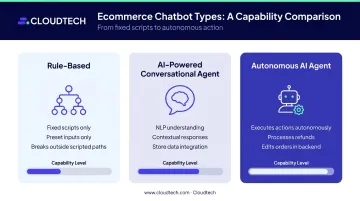
Modern platforms have shifted toward the third category. According to MarketsandMarkets, the global conversational AI market was valued at $17.05 billion in 2025 and is forecast to reach $49.80 billion by 2031 — which means the tools available to ecommerce retailers are only getting more capable from here.
Best AI Chatbots for Ecommerce in 2026
The five tools below were evaluated on commerce platform integration depth, autonomous resolution capability, ease of deployment, and pricing transparency. There is no universal winner — the right fit depends on your store's size, platform, and primary support challenge. Tools are ordered roughly by target scale, from SMB-focused to enterprise-grade.
Tidio (Lyro)
Tidio is an SMB-focused live chat and AI platform. Its Lyro agent handles customer queries across chat channels and is one of the fastest tools to deploy for small and growing stores.
The standout is its flat hybrid pricing and a money-back guarantee on resolution rates — a meaningful assurance for first-time chatbot adopters. It's best suited for stores with high FAQ volume and lower support complexity.
| Attribute | Details |
|---|---|
| Best For | Small ecommerce stores, early-stage automation, FAQ deflection |
| Key Features | Lyro AI agent, live chat, email support, Shopify and WooCommerce integrations |
| Pricing Model | Hybrid: flat helpdesk tiers plus a per-conversation Lyro add-on (from $0.50/conversation) |
Gorgias
Gorgias is a Shopify-centric ecommerce helpdesk with an AI Agent layer that can take real actions — editing subscriptions, issuing refunds, and updating shipping details — directly within Shopify.
It's a natural fit for Shopify-first brands already using Gorgias as their helpdesk. The caveat: AI is an add-on rather than the core product, and its per-resolution pricing stacks on top of an existing helpdesk plan, which can become unpredictable at volume.
| Attribute | Details |
|---|---|
| Best For | Shopify merchants wanting helpdesk + AI in one platform |
| Key Features | AI Agent (refunds, subscriptions, shipping edits), Shopify-native integrations, omnichannel ticketing |
| Pricing Model | Ticket-volume helpdesk plan + per-resolution AI fee (from $0.90–$1.00 per resolved interaction) |
Engaige
Engaige is a purpose-built ecommerce AI support agent that resolves tickets end to end — WISMO, returns, refunds, subscription changes — on top of a store's existing helpdesk and commerce backend.
Rather than drafting a reply for a human to approve, Engaige executes the resolution autonomously — including partial refunds and complex multi-item returns. It also functions as a pre-sale shopping assistant, with product recommendation capability that has driven measurable conversion uplift for DTC brands.
| Attribute | Details |
|---|---|
| Best For | Scaling DTC and mid-market brands needing autonomous resolution and pre-sale product advice |
| Key Features | Autonomous ticket resolution, product recommendation engine, plain-language policy configuration, integrations with Shopify, Gorgias, Zendesk, and 50+ others |
| Pricing Model | Flat package tied to ticket volume (predictable at scale) |
Bloomreach Clarity
Bloomreach Clarity is an AI-powered conversational shopping agent built for product discovery, trained on real-time customer data, product catalogs, and Bloomreach's commerce search intelligence.
Unlike the other tools here, Clarity is not a support automation product. It's designed for the pre-purchase journey — replicating the role of an in-store product expert for shoppers who don't arrive with a specific item in mind. Early-access customers reported an average +9% conversion rate and +20% average order value improvement. Best for brands with large or complex catalogs where discovery is the conversion bottleneck.
| Attribute | Details |
|---|---|
| Best For | Mid-to-large ecommerce brands with broad catalogs focused on product discovery and conversion |
| Key Features | Conversational product search, personalized recommendations, real-time catalog integration, agentic AI shopping journeys |
| Pricing Model | Enterprise licensing (quote-based) |
Richpanel
Richpanel combines a full ecommerce helpdesk with an autonomous AI agent handling refunds, order tracking, subscription changes, and cancellations — and publishes a formal 30-day resolution rate guarantee.
Its guarantee is specific: at least 50% of eligible conversations resolved within 30 days, with no human escalation and no ticket reopening within 72 hours. The deepest functionality kicks in when the entire Richpanel platform is adopted, rather than layering the AI on top of another helpdesk.
| Attribute | Details |
|---|---|
| Best For | Growing mid-market stores seeking combined helpdesk + autonomous AI without platform switching |
| Key Features | Autonomous resolution (returns, refunds, subscriptions), customer self-service portal, Shopify, Recharge, and Loop integrations |
| Pricing Model | ~$0.20 per AI-handled conversation + $100/helpdesk seat/month |
Key Use Cases for AI Chatbots in Ecommerce
Gorgias data shows that WISMO (Where Is My Order) queries alone account for 18% of incoming support requests on average — and that automation can deflect up to one-third of repetitive, low-impact tickets. That's the starting point for the ROI case.
Order Tracking (WISMO)
WISMO is the single highest-volume ticket type in ecommerce. AI chatbots pull live order data and respond instantly, without a human agent touching the ticket. During peak periods like Black Friday, the difference between a 30-second automated response and an 18-hour queue is a measurable retention issue.
Returns and Refund Automation
The key question to ask any vendor is whether their chatbot provides policy information or actually processes the return. The best autonomous agents execute resolutions inside the store's backend — initiating the return, issuing the refund, updating the order status. If a chatbot only drafts a reply for a human to send, that's a partial solution.
Personalized Product Recommendations
AI chatbots with access to live product catalogs can replicate a sales associate: asking clarifying questions, narrowing options, and guiding undecided shoppers to the right product through conversational prompts. Tools like Bloomreach Clarity and Engaige's pre-sale assistant mode operate in this space, with documented conversion uplift for stores that deploy them with well-structured product data and clear conversation flows.
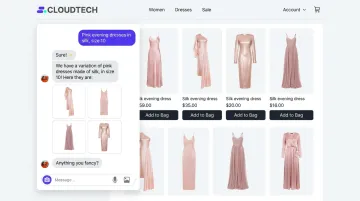
Cart Abandonment Recovery
Baymard's cross-study average puts the global cart abandonment rate at 70.22%. AI chatbots proactively re-engage shoppers who leave items behind via chat, SMS, or messaging apps — with personalized prompts, checkout assistance, or time-limited offers. No verified universal recovery rate exists for chatbot-specific outreach, but the addressable opportunity at 70%+ abandonment is substantial for any store.
Post-Purchase Support and Upselling
Chatbots don't stop being useful at checkout. They deliver shipping updates, answer delivery questions, and surface cross-sell or upsell opportunities based on purchase history — all without additional headcount. Of the five use cases here, post-purchase automation has the most direct impact on customer lifetime value.
How to Choose the Right AI Chatbot for Your Ecommerce Store
The most common mistake buyers make is comparing chatbots by headline resolution rates without asking the harder follow-up: which named customer produced that number, over what ticket types, and what counted as "resolved"?
Gorgias defines a resolved interaction as one handled without human intervention, excluding spam — but the named Psycho Bunny implementation showed a 26% resolution rate, while the headline claim is 60%. Richpanel's guarantee requires no reopening within 72 hours, while most other vendors publish no comparable methodology at all. Those numbers are not interchangeable.
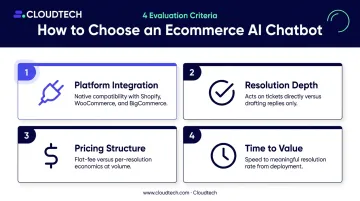
Four Evaluation Criteria That Actually Matter
Does it natively integrate with your stack (Shopify, WooCommerce, BigCommerce, Magento)? A chatbot with shallow platform integration can answer questions but can't act on orders.
Does it act on tickets or only reply? Ask for a demo using your most common ticket type and verify the action executes in your backend — not queued for a human.
Is pricing flat-fee or per-resolution? The economics differ sharply at scale. Model your expected AI-handled volume before comparing sticker prices.
How quickly does it reach a meaningful resolution rate for your team? Gorgias advertises a one-week Shopify launch; HelloPrint had Engaige operational in two weeks. Both are vendor claims, but they give you a reasonable starting point for expectation-setting.
For businesses whose requirements go beyond packaged SaaS tools — custom integrations, proprietary data connections, or specific compliance needs — building directly on AWS infrastructure (Amazon Lex or Amazon Bedrock) is a viable alternative worth evaluating.
Run a Pilot Before You Commit
Real-world resolution rates are always lower than vendor ceilings. The most reliable way to validate fit is to run a limited pilot on your two or three highest-volume ticket types. That data, from your actual customer interactions, is worth more than any vendor benchmark.
Conclusion
The best ecommerce AI chatbot is not the one with the most impressive marketing claims. It's the one that fits your commerce platform, resolves the specific ticket types that dominate your queue, and integrates deeply enough to act — not just answer.
For most SMBs, one of the five tools above will cover the core use cases. For stores with more complex requirements — custom workflows, proprietary data sources, or specific infrastructure constraints — those factors typically point toward a custom build. AWS provides the infrastructure layer to handle that complexity with the control and flexibility off-the-shelf tools can't match.
If you're evaluating a custom AI build on AWS — whether that means a RAG-based knowledge layer on Amazon Bedrock, a data integration pipeline feeding your chatbot, or a cloud architecture designed around your ecommerce stack — Cloudtech's AWS-certified team can help you scope and build the right foundation. Schedule a consultation to talk through your infrastructure requirements.
Frequently Asked Questions
What is the use of chatbots in ecommerce?
Ecommerce chatbots handle customer service queries (order tracking, returns, refunds), help shoppers find products, recover abandoned carts, and collect post-purchase feedback — all while operating 24/7. The primary value is deflecting repetitive, high-volume tickets without adding headcount.
How are chatbots used in customer service?
Chatbots serve as the first point of contact, instantly resolving repetitive queries like order status and return initiation, then routing complex or sensitive cases to human agents. This reduces average response times and lowers support costs simultaneously.
What is the difference between a rule-based chatbot and an AI chatbot for ecommerce?
Rule-based chatbots follow a fixed decision tree and only respond to predetermined inputs. AI chatbots use natural language processing to understand varied queries, generate contextual responses, and in the most advanced implementations, execute actions like issuing refunds or editing orders directly in the store backend.
How do AI chatbots help reduce cart abandonment in ecommerce?
AI chatbots detect when a shopper leaves items in their cart and proactively re-engage them via chat or messaging with personalized prompts, checkout assistance, or time-limited offers. With the global cart abandonment rate sitting at 70.22%, recovering even 5–10% of abandoned carts can add thousands in monthly revenue.
What should I look for when choosing an AI chatbot for my ecommerce store?
Prioritize these four factors:
- Native integration with your commerce platform
- Whether the chatbot resolves tickets autonomously or only drafts replies
- Pricing predictability at your actual order volume
- Vendor-verified resolution rates backed by named customer examples, not just headline percentages
Can small ecommerce businesses afford AI chatbots in 2026?
Yes. Tidio offers per-conversation pricing starting around $0.50, and Richpanel charges approximately $0.20 per AI-handled conversation. Starting with a focused use case like order tracking or FAQ automation keeps initial costs manageable while delivering fast, measurable ROI.