This guide covers what generative AI solutions development actually involves, how the end-to-end process works, what separates successful deployments from abandoned projects, and the mistakes worth avoiding before you write a single line of code.
Key Takeaways
- GenAI development follows a clear sequence: problem definition → data preparation → model selection → integration → deployment → ongoing monitoring
- Gartner found at least 50% of GenAI projects were abandoned after proof of concept by end of 2025 — poor data quality and unclear business value, not the technology, were to blame
- Fine-tuning a pre-trained foundation model (not building from scratch) is the practical path for most SMBs
- GenAI requires ongoing maintenance: models drift over time and periodic retraining is non-negotiable
- Amazon Bedrock and SageMaker compress time-to-production for SMBs without dedicated ML infrastructure
What Is Generative AI Solutions Development?
Generative AI solutions development is the end-to-end process of building AI systems that produce original outputs (text, code, images, predictions, or decisions) by learning patterns from training data.
That distinguishes it from traditional software development, which executes predefined logic. A rule-based chatbot follows a decision tree; a generative AI system understands context, generates responses, and improves with feedback.
What the Process Is Designed to Produce
The output isn't a model. It's a working, business-integrated system that solves a specific problem — automating customer responses, flagging fraud, generating reports, personalizing content — and can be monitored and improved over time.
Fine-Tuning vs. Building from Scratch
Most SMBs face a practical choice early:
- Build from scratch: Requires massive datasets, enormous compute, and months of training. Stanford's AI Index estimated GPT-4 cost approximately $78M to train. Rarely justified even by large enterprises.
- Fine-tune a pre-trained model: Take an existing foundation model (Claude, LLaMA, Amazon Titan) and adapt it to your proprietary data and use case. Faster, cheaper, and typically produces better domain-specific results.
- Integrate via API: Connect to models through services like Amazon Bedrock without managing your own infrastructure. The right starting point for many first-time deployments.
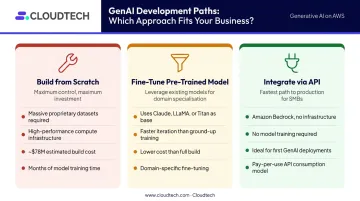
Choosing between these paths depends on your data maturity, timeline, and compliance requirements — which is where guided model selection makes the difference. Cloudtech's GenAI service for SMBs covers all three approaches, matching each client to the right option based on task type, compliance needs, and deployment environment.
Why Businesses Are Investing in Generative AI Development
According to McKinsey's 2024 State of AI report, 65% of organizations were regularly using generative AI in at least one business function — nearly double the figure from just 10 months earlier. McKinsey Global Institute puts the potential annual value of GenAI across business use cases at $2.6T to $4.4T.
What's driving adoption isn't novelty — it's the specific category of problems GenAI solves that traditional software cannot:
- Unstructured data processing — emails, contracts, clinical notes, call recordings that rule-based systems can't parse
- Context-aware content generation — drafting customer communications, summarizing reports, generating product descriptions at scale
- Natural language interfaces — letting non-technical teams query internal knowledge bases without writing SQL or specialist tools
- Predictive analytics on complex datasets — identifying patterns across thousands of variables simultaneously
Without GenAI solutions, teams continue processing data manually, miss patterns in large datasets, and deliver inconsistent customer experiences. For SMBs especially, that gap closes fast — companies slow to adopt are already ceding ground on response time, personalization, and operational cost.
How Generative AI Solution Development Works
The development process translates a business problem into a working AI system by combining structured data, model architecture selection, training or fine-tuning, system integration, and iterative testing. It is iterative by nature, not a one-time build.
AWS services accelerate this considerably for SMBs:
- Amazon Bedrock — managed access to foundation models via API
- Amazon SageMaker — handles training and deployment workflows
- AWS Lambda — serverless inference that scales with demand, no dedicated infrastructure required
As an AWS Advanced Tier Partner, Cloudtech helps SMBs apply these services without needing to build cloud expertise from scratch.
Step 1: Define the Business Problem and Identify Use Cases
The most common cause of GenAI project failure is a poorly defined use case.
Vague objective: "Use AI for customer service." Specific objective: "Reduce ticket resolution time by automating first-response drafts for the top 20 inquiry categories."
Use case prioritization should be based on:
- Data availability — does relevant training data already exist?
- Technical feasibility — is this solvable with current model capabilities?
- Expected ROI — what's the measurable business impact?
Without a specific objective, every downstream decision — scope, architecture, evaluation criteria — becomes harder to get right.
Step 2: Collect, Clean, and Prepare Training Data
Data preparation is the most time-intensive phase of GenAI development — and the one most often underestimated.
Teams must:
- Gather relevant structured and unstructured data across source systems
- Clean for quality, consistency, and completeness
- Label data where the task requires supervised learning
- Address gaps using techniques like synthetic data generation
The quality ceiling is real. A model trained on poor data produces unreliable outputs regardless of how sophisticated the architecture is. Cloudtech uses Amazon Textract, AWS Glue, Amazon Athena, and Amazon S3 to build automated data pipelines that handle this process systematically, replacing the manual handoffs and inconsistencies that typically slow this phase down.
Step 3: Select the Model Architecture and Train or Fine-Tune
Most organizations don't train foundation models from scratch. The practical decision is which pre-trained model to fine-tune and how.
Key selection criteria:
| Factor | What to Evaluate |
|---|---|
| Task type | Text generation, classification, image synthesis, code completion |
| Output quality | Accuracy requirements, acceptable error rate |
| Infrastructure fit | API access vs. self-hosted, latency requirements |
| Compliance | HIPAA, GDPR, data residency constraints |
| Cost | Token-based pricing vs. compute costs for self-hosted models |
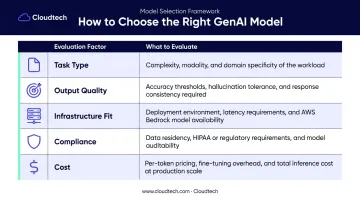
Cloudtech works with models available via Amazon Bedrock — including Anthropic Claude, Amazon Titan, and Meta LLaMA — selected based on client-specific use case requirements rather than preference.
Step 4: Integrate, Test, and Deploy the Solution
The trained model connects to existing business systems — CRM, ERP, internal databases — via APIs and embeds into user workflows. Before full deployment, the solution goes through:
- Model accuracy validation — does output quality meet defined thresholds?
- Edge case testing — how does the system behave on unusual or adversarial inputs?
- User acceptance testing (UAT) — do real users get value from the system?
- Security review — required for healthcare and financial services clients
Deployment approaches like canary releases or staged rollouts reduce risk by exposing the system to a subset of users first, catching issues before they affect the full user base.
In Cloudtech's healthcare SaaS engagement, this integration phase connected a RAG-based AI assistant to Amazon S3 document stores and Amazon Redshift structured datasets via Amazon Bedrock Agents — reducing support tickets by 45% within two months of deployment.
Step 5: Monitor, Retrain, and Iterate
GenAI models degrade as business contexts evolve and data distributions shift — a pattern called model drift. NIST's AI Risk Management Framework explicitly calls for ongoing monitoring of deployed AI systems to detect it before it affects outputs.
Ongoing maintenance includes:
- Real-time performance monitoring (AWS SageMaker Model Monitor can detect data and quality drift against defined baselines)
- Periodic retraining triggered by performance degradation or significant data distribution changes
- Feedback loops that incorporate user behavior back into model improvement cycles
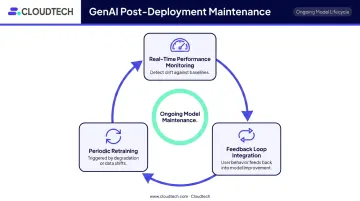
There is no universal retraining interval. Frequency depends on monitoring results, application risk, and how quickly underlying data changes. What matters is having the infrastructure in place to detect when retraining is needed, rather than guessing on a fixed schedule.
Key Factors That Determine GenAI Development Success
Data Readiness
No model sophistication compensates for poor data. A survey of 600 global CIOs and technology leaders by MIT Technology Review Insights found 72% identified data problems as the factor most likely to jeopardize their AI goals.
Before development begins, assess:
- Is the data labeled where required?
- Is it representative of the actual business problem?
- Is it structured, unstructured, or mixed?
- Are there privacy constraints on how it can be used?
Infrastructure and Cloud Readiness
GenAI workloads demand infrastructure most SMBs don't have on-premise. Three requirements in particular create barriers without cloud support:
- Scalable GPU compute — on-demand capacity for training and inference without hardware procurement
- Managed storage and vector databases — used for similarity search and fast retrieval during inference
- SageMaker Inference — reduced foundation model deployment costs by 50% on average and latency by 20%, per AWS benchmarks
AWS provides all three as on-demand services, making GenAI viable for teams without a dedicated data center.
Clear Business Objectives with Measurable KPIs
Without defined success criteria, there's no way to evaluate whether the model is performing or improving. Pick the metric that maps directly to the business problem — query resolution rate, fraud detection accuracy — and lock it in before development begins.
Ethical, Security, and Compliance Considerations
These must be built into development from the start, not retrofitted after deployment:
- HIPAA — cloud providers handling ePHI for covered entities require a signed Business Associate Agreement before any PHI is stored or processed
- GDPR — the European Data Protection Board's Opinion 28/2024 addresses how unlawfully processed training data affects model deployment legality
- EU AI Act — from August 2025, providers of general-purpose AI models face documentation, copyright compliance, and incident-reporting obligations
- FTC — the FTC has warned that companies using customer data for undisclosed model training may be required to delete the resulting algorithms
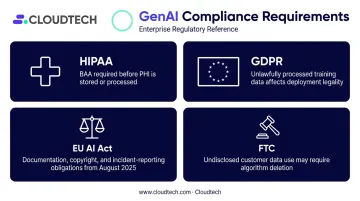
For healthcare clients, compliance architecture is non-negotiable from day one. Cloudtech structures healthcare GenAI deployments on Amazon Bedrock within a HIPAA-eligible AWS boundary, so no PHI leaves the client's account at any point during inference.
Common Misconceptions About Generative AI Development
"We Need to Build a Model from Scratch"
Most successful enterprise GenAI solutions are built by fine-tuning existing foundation models or integrating pre-built model APIs. The economics of from-scratch training — $78M for GPT-4, $191M for Gemini Ultra by Stanford's estimates — don't make sense for most organizations. SMBs consistently get faster, cheaper results by adapting existing models to their specific business context rather than training from zero.
"A Proof of Concept Is the Same as a Production-Ready Solution"
A PoC proves technical feasibility. A production solution requires security hardening, performance optimization under real load, system integration, user onboarding, and monitoring infrastructure. Gartner reported that at least 50% of GenAI projects were abandoned after proof of concept by end of 2025, citing poor data quality, inadequate risk controls, escalating costs, and unclear business value as causes.
Bridging that gap requires deliberate engineering investment — and a realistic plan before the demo ever gets built.
"GenAI Development Is a One-Time Project"
Deploying a GenAI solution doesn't end the work. Ongoing maintenance is non-negotiable because:
- Models drift as the underlying data distribution shifts over time
- Business contexts evolve, making yesterday's prompts and fine-tunes less effective
- User needs change, requiring iteration on workflows and outputs
Treat GenAI the same way you'd treat any production software system: with scheduled maintenance cycles, retraining protocols, and ongoing performance review.
Conclusion
Developing a generative AI solution is a structured, iterative process. It requires clear business objectives, quality data, the right model approach, and cloud infrastructure capable of supporting it. Skip any of them and you're looking at delays, rework, or a system that never makes it past the pilot stage.
For SMBs and startups, the practical advantage of working with an experienced AWS partner is speed and reduced rework. Cloudtech's team — primarily former AWS employees — helps clients move from scoping to a working proof of concept in weeks using pre-built AWS services like Amazon Bedrock, while ensuring solutions are HIPAA-compliant, secure, and scalable from day one.
That combination of infrastructure expertise and vertical-specific experience in healthcare, financial services, and manufacturing is what separates a functioning pilot from a production system that keeps delivering — without constant rework.
Frequently Asked Questions
What is generative AI solutions development?
Generative AI solutions development is the end-to-end process of building AI systems that generate original outputs — text, code, images, or decisions — by training or fine-tuning models on business-specific data and integrating them into existing workflows to solve defined business problems.
How long does it take to develop a generative AI solution?
Full production deployments typically take 4 to 9 months depending on project complexity, data readiness, and integration scope. Proof-of-concept stages can be completed in weeks when using pre-trained foundation models and managed cloud services like Amazon Bedrock.
Do businesses need to build a custom AI model or can they use a pre-built one?
Most SMBs get better results by fine-tuning pre-trained foundation models on their own data rather than building from scratch. This approach saves significant time, cost, and compute resources while still producing domain-specific, accurate outputs.
What data is needed to develop a generative AI solution?
The specific requirements depend on your use case, but teams typically need relevant, clean, and representative data — either structured (databases, spreadsheets) or unstructured (emails, documents, chat logs). Quality gaps, labeling needs, and privacy constraints must be resolved before training begins.
What are the biggest challenges in generative AI development?
The most common obstacles are poor data quality, unclear business objectives, integration complexity, high compute costs, model drift post-deployment, and data privacy compliance. Each of these is manageable with clear scoping and a structured development plan from the outset.
How much does it cost to develop a generative AI solution?
Costs vary widely by complexity and approach. API-based integrations using pre-built models typically start in the tens of thousands of dollars, while fully custom builds can reach hundreds of thousands — with ongoing cloud infrastructure and retraining factored into total cost of ownership.