That's the problem agentic AI chatbots actually solve — and they're fundamentally different from the clunky FAQ bots that frustrated customers for years. The old chatbot was essentially a phone tree dressed up in a text box. An agentic AI chatbot is closer to a skilled receptionist who can check your calendar, book the appointment, update your CRM, and send a confirmation — all without waking you up.
Salesforce research found that 91% of SMBs using AI report it boosts revenue, and AI adoption among small businesses has more than doubled since 2023. This guide covers what agentic AI chatbots are, where they deliver real value for SMBs, how to implement one without a data science team, and what governance guardrails to put in place before handing over any autonomous decision-making.
Key Takeaways
- Agentic AI chatbots perceive context, reason about goals, and take multi-step actions — going far beyond keyword-matched, scripted replies
- For SMBs, they act as a 24/7 team member handling customer service, scheduling, and lead qualification without adding headcount
- Start narrow: automate one or two high-friction workflows before expanding
- AWS services (Amazon Lex, Bedrock, Lambda) make enterprise-grade agentic AI accessible at small-business scale
- Define human approval thresholds and escalation triggers before deployment — governance isn't optional
What Is an Agentic AI Chatbot?
Beyond the Decision Tree
A traditional rule-based chatbot operates on fixed logic: if the customer types "hours," display store hours. If they type anything else, show a fallback message. It's reactive, static, and dependent on whoever wrote the decision tree anticipating every possible input.
An agentic AI chatbot works differently. According to IBM's definition, an AI agent autonomously performs tasks by designing workflows with available tools. Google Cloud adds that agents demonstrate reasoning, planning, and memory — adapting to goals rather than just inputs.
In practice, the chatbot doesn't just respond — it takes action.
The Four-Step Operational Loop
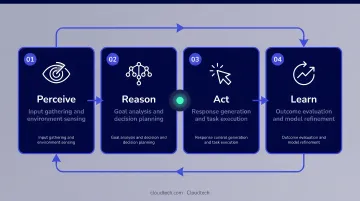
Most agentic AI systems run on a continuous cycle:
- Perceive — Collects context from user input, CRM records, past interactions, and connected databases
- Reason — Uses a large language model to determine the best course of action given that context
- Act — Executes tasks: booking an appointment, sending a confirmation email, updating a record, issuing a refund within a preset limit
- Learn — Refines behavior based on outcomes, improving accuracy over time
Consider an HVAC company's agentic chatbot: it recognizes a returning customer's number after hours, pulls their service history, offers a follow-up appointment based on their last visit, books the slot, and sends a confirmation — all without human involvement.
What "Autonomy" Actually Means
The business owner defines what the agent can and cannot do: spending limits, data access permissions, escalation triggers, and which decisions require human approval. The agent operates within those boundaries independently — supervised by policy, not by a person watching every interaction.
| Type | How It Works | What It Can Do |
|---|---|---|
| Rule-based chatbot | Fixed decision tree | Answer predefined questions |
| Generative AI tool | Creates content on demand | Draft text, summarize documents |
| Agentic AI chatbot | Reasons, plans, acts, learns | Multi-step actions across connected systems |
Key Benefits of Agentic AI Chatbots for Small Businesses
24/7 Coverage Without Additional Headcount
NFIB reported in 2026 that 32% of small-business owners have job openings they can't fill, with 46% finding few or no qualified applicants. Agentic AI chatbots don't replace employees — they fill the gaps that staffing constraints create, particularly outside business hours when competitors who've deployed AI are still responding to leads.
Zendesk's research on Vagaro, a small business software platform, found their AI resolved 44% of incoming requests, cut resolution time by 87%, and pushed customer satisfaction scores to 92%. Intercom's Fin product reports resolving up to 65% of customer conversations end-to-end.
Reduced Workload for Existing Teams
Salesforce's State of Service report found that 77% of service agents report increased and more complex workloads, with 69% struggling to balance speed and quality. When routine tasks — scheduling confirmations, order status updates, payment reminders, FAQ responses — are handled autonomously, human agents can focus on the interactions that actually require human judgment.
95% of service decision-makers at organizations using AI reported significant cost and time savings, according to the same Salesforce research.
Personalization at Small-Business Scale
Agentic AI chatbots pull from CRM data and interaction history to tailor responses in ways that previously required dedicated customer success staff. Without a human manually reviewing the account before every interaction, the chatbot can:
- Remember a repeat customer's preferences and past purchases
- Proactively flag a delayed delivery before the customer asks
- Recommend products based on purchase history at the moment of engagement
Scalability Without Proportional Cost
A holiday traffic surge that would require temporary hiring instead gets absorbed by the same chatbot infrastructure that handles a slow Tuesday. The marginal cost of handling the 500th conversation is virtually the same as the 5th, giving SMBs a cost structure for customer service that previously only large operations could access.
Top Use Cases: Where Agentic AI Chatbots Deliver the Most Value
Customer Service and Support
A well-configured agentic AI chatbot resolves issues, not just answers questions. Specific actions it can take autonomously include:
- Triaging incoming queries and routing by complexity
- Resolving tier-1 issues (returns, order status, account changes)
- Creating and closing support tickets
- Issuing refunds up to a defined threshold
- Pulling full account history before responding
- Escalating to a human agent with context already attached
The key distinction from a FAQ bot: the agent can take action on what it learns, not just display information.
Appointment Scheduling and Lead Qualification
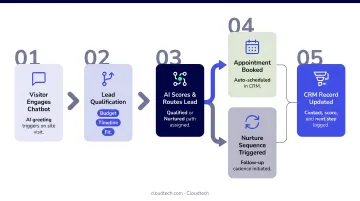
Agentic AI eliminates manual scheduling entirely. The chatbot accesses real-time calendar availability, confirms bookings, sends reminders, and handles rescheduling — no human involvement needed.
On the sales side, the same framework qualifies inbound leads. It asks discovery questions, scores prospects against defined criteria, and routes high-value leads to the sales team with a conversation summary already attached. HubSpot's chatbot builder supports this full workflow — lead qualification, meeting booking, CRM data integration, and email campaign triggers — without any coding required.
Financial Operations
Beyond customer-facing tasks, agentic AI handles back-office work too. For SMBs without dedicated finance staff, it can manage invoice follow-ups, flag overdue payments, and identify cash flow anomalies.
Stripe's automatic collection feature uses AI to choose optimal retry times for failed payments, increasing recovery rates without manual intervention.
Important: Any transaction-level actions — refunds, payment processing, account adjustments — should have human approval thresholds configured before deployment.
Industry-Specific Applications
The same agentic AI framework adapts across verticals:
- Healthcare: Triages patient inquiries, handles appointment scheduling, and reduces administrative wait times. AWS has documented voice-based healthcare agents that authenticate patients, confirm appointments, and record pre-visit information autonomously.
- Manufacturing: Monitors inventory levels and initiates reorder workflows. AWS's supply chain AI applications cover intelligent purchase-order generation and automated approval routing.
- Retail: Acts as a personal shopping assistant, surfacing product recommendations based on browsing behavior and purchase history.
For healthcare SMBs in particular, Cloudtech's work with clients like Klamath Health Partnership demonstrates how AWS-based solutions can be built with HIPAA-compliant architecture from the ground up — a non-negotiable for any patient-facing AI deployment.
How to Implement an Agentic AI Chatbot for Your Small Business
Start With Friction, Not Features
Before evaluating any platform, map your three to five most repetitive, time-consuming workflows. The best candidates for automation share a common trait: a well-trained employee could follow a checklist to complete them. If the process is that predictable, an agentic AI chatbot can handle it.
Common high-friction workflows for SMBs:
- After-hours inquiry handling
- Appointment booking and reminders
- Order status updates
- Invoice follow-up sequences
- Lead intake and qualification
Choose the Right Platform and Infrastructure
SMBs have two practical paths:
Option 1: Activate AI features in existing tools. Platforms like HubSpot, Zendesk, and Intercom already embed agentic capabilities. Intercom states Fin setup takes under one hour. Zendesk's Support Team plan starts at $19/agent/month. These are the lowest-friction entry points.
Option 2: Build on cloud infrastructure. For businesses that need flexibility, scalability, and tighter control, AWS provides purpose-built services:
- Amazon Lex: Conversational interfaces via voice and text, with pay-as-you-go pricing ($0.00075 per text request)
- Amazon Bedrock Agents: Automates multi-step tasks by connecting to company systems, APIs, and data sources
- AWS Lambda: Serverless execution with a free tier covering 1 million requests per month
Working with an AWS-certified consulting partner like Cloudtech can shorten deployment timelines and cut trial-and-error costs — an important factor for SMBs without in-house cloud engineers. Cloudtech's standing in the AWS Small Business Acceleration Initiative also means AWS Partner Funding may be available to offset project costs.
Prepare Your Data and Document Your Workflows
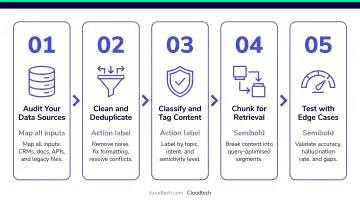
Agentic AI amplifies whatever it works with. Clean data produces accurate decisions; messy data produces errors at scale. Before going live, work through these preparation steps:
- Audit critical data sources (CRM, calendar, ticketing system)
- Document each target workflow step-by-step
- Confirm APIs or integrations exist for each connected system
- Identify and resolve data quality issues
- Define what a successful outcome looks like for each workflow
Run a Pilot, Measure, Then Expand
Choose one narrow use case — after-hours inquiry handling or appointment booking work well as first deployments. Run it for 60-90 days and measure:
- Resolution rate: What percentage of interactions reach a successful conclusion without human intervention?
- Customer satisfaction: Are CSAT scores improving or declining?
- Time saved: How many hours per week is the team reclaiming?
Keep humans in the loop during the pilot to catch edge cases and refine the agent's decision boundaries. Think of those first 90 days as a supervised training period: the goal is refinement, not full autonomy.
Governance, Security, and Oversight
Gartner predicted that over 40% of agentic AI projects will be canceled by end of 2027 because of rising costs, unclear business value, or inadequate risk controls. Governance is what separates successful deployments from canceled ones.
Define the Decision Boundary
Before deploying, document:
- Which decisions the agent can make autonomously
- Which decisions require human approval
- Spending or action limits (refund thresholds, credit limits)
- Which data sources the agent can access
- What triggers escalation to a human
Treat it like onboarding a new employee: you wouldn't hand a new hire access to your business bank account without clear parameters and oversight.
Security Controls That Matter
Apply the principle of least privilege: each agent only accesses the systems it needs for its specific tasks. On AWS, that means:
- IAM roles that grant only the permissions required for the agent's function
- VPC configurations that isolate the agent from systems it doesn't need to touch
- CloudTrail logging that captures every action the agent takes
For regulated industries, the stakes are higher:
- Healthcare (HIPAA): The Security Rule requires administrative, physical, and technical safeguards for electronic protected health information. Any AI interacting with patient data must be architected within a HIPAA-compliant framework.
- Financial services (SOC 2): SOC 2 controls govern how service organizations protect customer data — a chatbot handling financial information needs to operate within this framework.
For SMBs in either space, this is where getting the architecture right from the start matters most. Cloudtech designs agentic AI deployments within HIPAA and SOC 2 frameworks, so compliance is built in — not bolted on after the fact.
Keep Humans in the Loop
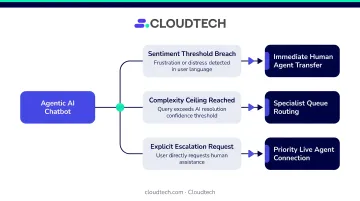
Even well-configured agents encounter situations they're not equipped to handle. Build clear escalation paths that trigger based on:
- Sentiment detection (frustrated or upset customers)
- Complexity thresholds (multi-part issues requiring judgment)
- Explicit customer requests for a human agent
Salesforce research found that 45% of consumers are more likely to use an AI agent when there's a clear path to escalate to a human — and nearly 75% want to know when they're communicating with AI at all. Transparency and escalation paths aren't just ethical best practices; they're features that increase adoption.
Those numbers also point to a practical operational habit: review interaction logs weekly during the first three months. Every edge case the agent mishandles is a training opportunity, not a failure.
Frequently Asked Questions
What is the difference between an agentic AI chatbot and a regular chatbot?
Regular chatbots follow fixed scripts and respond only to specific inputs they've been programmed to recognize. Agentic AI chatbots reason about goals, take multi-step actions across connected systems — booking appointments, updating CRM records, sending emails — and learn from each interaction to improve over time.
How much does it cost to implement an agentic AI chatbot for a small business?
Costs range from $0 (activating AI features already in your existing software) to usage-based AWS pricing — Amazon Lex charges $0.00075 per text request. The real investment is usually setup, configuration, and data preparation, not ongoing licensing.
What tasks can an agentic AI chatbot handle autonomously?
Common autonomous tasks include answering customer questions, booking appointments, qualifying leads, sending follow-up emails, updating CRM records, and processing simple support requests. Configure human approval thresholds for any financial transactions or sensitive decisions before the agent goes live.
Can an agentic AI chatbot integrate with the tools my business already uses?
Most agentic AI platforms integrate with popular SMB tools — CRM systems, calendar apps, helpdesk platforms, e-commerce systems — via APIs and pre-built connectors. Amazon Lex, for example, supports deployment across Slack, Facebook Messenger, Twilio SMS, and mobile devices out of the box.
How do I keep my customer data secure when using an agentic AI chatbot?
Apply least privilege access, encrypt data in transit and at rest, and maintain audit logs of all agent actions. AWS native controls — IAM roles, CloudTrail, PrivateLink — handle most of this without requiring a dedicated security team. Healthcare SMBs should also confirm HIPAA compliance for any AI touching patient data.
How long does it take to deploy an agentic AI chatbot for a small business?
Activating AI features inside an existing platform like HubSpot or Intercom takes hours to days. Custom AWS builds typically take a few weeks with the right partner. Cloudtech's 4-week GenAI Proof of Concept delivers a working prototype with measurable ROI before you commit to a full deployment.