](https://file-host.link/website/cloudtech-ff604p/assets/refined-images/1783599800546000_db565fb4c886476d9de69724dd48940a/360.webp)
Introduction
According to HubSpot's 2025 customer service report, 73% of consumers would leave a company after a single bad experience, and 67% expect support tickets resolved within three hours. For human-only teams managing ticket queues across time zones and channels, hitting that window consistently isn't realistic.
AI chatbots are built to close that gap — and the evidence shows up in operations, not pitch decks: shorter queues, faster first responses, and agents freed from fielding the same questions on repeat.
This article breaks down three specific, measurable ways AI chatbots improve customer support response time: 24/7 instant response coverage, intelligent ticket routing, and deflection of high-volume repetitive queries.
Key Takeaways
- AI chatbots respond instantly, 24/7 — eliminating the queue-based wait times that define traditional support
- They automatically resolve a large share of repetitive queries, reducing ticket volume without adding headcount
- Intelligent routing ensures escalated tickets reach the right agent faster, with context already captured
- Skipping AI support means rising backlogs, inconsistent quality, and staffing costs that grow with every new ticket
- Chatbots get smarter over time — improving accuracy as they learn from interactions and updated knowledge bases
What Are AI Chatbots in Customer Support?
AI chatbots in customer support are software programs that use natural language processing (NLP) and machine learning to understand, respond to, and often fully resolve customer inquiries without a human agent involved.
They're deployed across:
- Website chat windows and help center portals
- Messaging apps (WhatsApp, Messenger, SMS)
- Support ticketing platforms
- Voice channels (AI voice agents)
The business case is straightforward: faster response times, lower ticket volume, reduced support costs, and human agents freed up for complex issues that actually need human judgment.
Three Advantages That Directly Reduce Response Time
The advantages below are tied to operational outcomes that support leaders actively track — first response time, resolution rates, agent efficiency, and customer satisfaction.
Advantage 1: Instant 24/7 Response With Zero Queue Time
AI chatbots respond the moment a customer submits an inquiry. No hold queue. No shift gaps. No "we'll get back to you Monday."
Here's how it works in practice: a customer sends a message at 11 PM on a Saturday. The chatbot receives it, analyzes intent using NLP, and delivers a relevant response within seconds — answering the question outright or capturing context for a Monday-morning handoff. Zendesk's 2026 FRT benchmarks set the gold standard for live chat at instant response. Human-only teams, by definition, can't meet that at 2 AM.
The business case is straightforward:
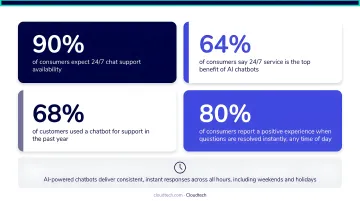
- 74% of consumers now expect 24/7 availability because of AI, according to Zendesk CX Trends 2026
- 61% prefer the immediate response of an AI over waiting for a human agent, per Intercom's 2024 Customer Service Trends Report
- First response time (FRT) is one of the most closely watched support KPIs — customers who receive fast acknowledgment are far less likely to escalate or churn
KPIs impacted: First Response Time (FRT), CSAT, after-hours ticket resolution rate, customer abandonment rate
Highest impact for: Global customer bases, e-commerce (order status), healthcare (appointment queries), financial services (account access), and any business with meaningful inquiry volume outside standard business hours.
Advantage 2: Automated Resolution of Repetitive, High-Volume Queries
A significant share of support volume is entirely predictable: order status, password resets, billing questions, FAQs, basic troubleshooting. These don't require judgment or empathy. They require a correct, fast answer — which chatbots deliver at scale.
The mechanism: chatbots draw from structured knowledge bases and trained response flows to handle these queries end-to-end, deflecting them from the human agent queue entirely. The ticket backlog shrinks without adding a single headcount.
Real-world results from documented deployments illustrate the range:
| Deployment | Automated Resolution Rate |
|---|---|
| Gartner / Solo Brands | 75% of customer interactions |
| Zendesk / Lush | 60% first contact resolution |
| Zendesk / Best Egg | 80% of chat inquiries automated |
| Intercom Fin (product benchmark) | Up to 50% instantly resolved |
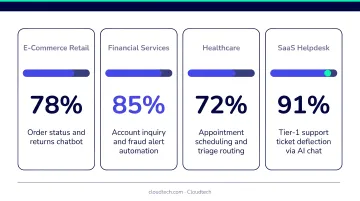
Most teams deploying well-configured AI chatbots see somewhere between 40% and 75% of volume handled without human involvement, with that figure improving over time as the system is refined.
The agent efficiency effect is just as meaningful. MIT Sloan's analysis of a generative AI contact center study found a 14% productivity increase overall, with less-experienced agents resolving 35% more chats per hour when AI assistance was in play.
KPIs impacted: Ticket deflection rate, AI resolution rate, average handle time (AHT), agent productivity, cost per ticket
Highest impact for: SaaS companies, e-commerce operations, and SMBs with high ticket volume and a limited support team — where every hour of agent time matters.
Advantage 3: Intelligent Routing and Seamless Human Handoff
Not every inquiry can be resolved by a chatbot. What separates well-built AI systems from basic ones is what happens next.
Modern AI chatbots don't simply fail when they hit the edge of their capability. They classify the issue, capture the full conversation context, and route the ticket to the most appropriate human agent automatically — tagged by category (billing, technical, complaint) with a summary already written.
Why this matters for response time:
- Agents receiving pre-classified tickets with AI-generated summaries don't start from scratch — they start with context
- Customers don't have to repeat their situation to a second or third person
- Misdirected tickets (a persistent cause of slower resolution and lower CSAT) are reduced significantly
Salesforce's internal data shows Agentforce delivers a 65% reduction in response time for 90% of users, alongside 30% case deflection. Zendesk's Intelligent Triage similarly classifies tickets by intent, sentiment, and language, routing requests to the right team without a human reading and categorizing each one first.
When agents begin interactions with full context rather than starting cold, average resolution time drops and first contact resolution (FCR) improves directly. The industry standard for FCR sits around 75%, according to Salesforce. AI-assisted routing is one of the cleaner levers for pushing above that benchmark.
In Cloudtech's conversational AI deployments, handoff is designed with this continuity in mind: conversation context passes to the human agent automatically at transfer (in some implementations completing the warm transfer in under two seconds) so agents start informed, not cold.
KPIs impacted: First Contact Resolution (FCR), Average Resolution Time (ART), escalation handling time, ticket misdirection rate
What Happens When AI Chatbots Are Missing
Without AI chatbot support, customer support operations become reactive by default. Agents absorb every incoming inquiry — the routine ones alongside the complex ones — and the math stops working during peak periods.
The compounding consequences:
- Backlog growth during evenings, weekends, and high-traffic periods when staffing is thin
- Inconsistent response quality as agents handle high volume under pressure
- Higher error rates in manual ticket routing and triage
- Rising costs as headcount must scale proportionally with inquiry volume
- Agent burnout — Salesforce's 2023 survey of 1,034 service employees found 71% had considered quitting in the prior six months
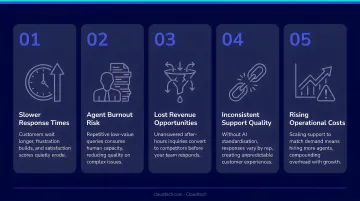
The math on scaling is particularly punishing for SMBs. Every increase in customer demand requires a proportional increase in support staffing. That staffing dependency is exactly what AI chatbots are designed to eliminate.
Getting the Most Value From AI Chatbots
AI chatbots deliver the best results when deployed with clear goals, supported by accurate knowledge bases, and reviewed consistently over time.
Chatbots work best when:
- Knowledge bases are current — outdated documentation produces incorrect resolutions and erodes customer trust faster than having no chatbot at all
- Escalation paths are defined upfront — seamless handoff preserves conversation context so customers never have to repeat themselves
- Performance is reviewed regularly — metrics like FRT, deflection rate, and CSAT should drive ongoing refinement, not just be collected
The infrastructure underneath the chatbot matters as much as the chatbot itself. A conversational AI system needs to handle high concurrent inquiry volumes, stay online 24/7, and integrate reliably with CRM and knowledge base systems.
AWS-based architecture provides the foundation that keeps chatbot performance consistent and scalable — without the cost of enterprise infrastructure. Cloudtech designs and deploys exactly this kind of setup for SMBs, so growing businesses can run reliable conversational AI without overbuilding their cloud environment.
Conclusion
AI chatbots improve customer support response time through a combination of 24/7 availability, automated handling of repetitive queries, and intelligent routing that accelerates every escalation. Each capability directly moves the metrics that determine whether customers come back.
The impact also compounds over time. As chatbots handle more interactions, knowledge bases improve and resolution rates rise. Businesses that see the strongest long-term results treat their chatbot as a living system — updated regularly and actively maintained — not a one-time deployment.
If you're evaluating where conversational AI fits in your support stack, start with the highest-volume, most repetitive queries your team handles today. That's where the fastest, most measurable improvement begins.
Frequently Asked Questions
How can AI chatbots improve customer support response time?
AI chatbots respond instantly to customer inquiries around the clock, eliminating queue-based wait times entirely. They automatically resolve high-volume repetitive queries so human agents focus on complex issues — together, these capabilities reduce first response time from hours to seconds compared to human-only support models.
What is the 10-5-3 rule in customer service?
The 10-5-3 rule isn't a validated industry benchmark. More actionable guidance comes from Zendesk's 2026 data: best-in-class FRT is under one hour for email and social media, and instant for live chat. AI chatbots make that live chat standard achievable at any hour.
What percentage of customer inquiries can AI chatbots resolve automatically?
Well-configured deployments typically resolve 40%–75% of inquiries without human involvement. Gartner documented Solo Brands reaching 75%; Intercom's Fin benchmark sits around 50%. Both figures tend to improve as the knowledge base is refined.
Will AI chatbots replace human customer support agents?
No. AI chatbots handle routine, high-volume queries and triage work. Complex, emotional, or high-stakes interactions still require human judgment and empathy. Agents end up doing more meaningful work, not fewer hours.
How long does it take to implement an AI chatbot for customer support?
A basic deployment typically takes a few weeks when a structured knowledge base already exists. More advanced configurations, including custom routing and CRM integration, generally take longer depending on system complexity and existing infrastructure.
Are AI chatbots effective for healthcare and financial services?
Yes, but with added considerations. Both industries benefit significantly from 24/7 availability and instant FAQ resolution. Healthcare deployments also require HIPAA-compliant infrastructure with encrypted data handling and audit trails, while financial services implementations need careful attention to data privacy and escalation protocols for regulated interactions.