Introduction
Most e-commerce businesses assume they've checked the "AI" box once they've deployed a chatbot. They haven't.
Rule-based chatbots and conversational AI are fundamentally different technologies — and confusing the two is costing businesses real revenue. According to a Forrester Consulting survey of 1,554 consumers, 50% reported frequent frustration with chatbots and nearly 40% rated their chatbot interactions negatively. Worse, 30% said a bad chatbot experience made them likely to take their purchase elsewhere or warn others.
That's not a customer service problem. That's a revenue leak.
This article breaks down what actually separates conversational AI from a chatbot, how the underlying technology works, which capabilities matter most for e-commerce SMBs, and how to get started without an enterprise budget.
Key Takeaways
- Conversational AI handles ambiguity, shifting context, and complex requests that rule-based chatbots cannot
- The conversational AI market is projected to reach $49.80B by 2031, growing at 19.6% CAGR
- 70.22% of online shopping carts are abandoned — proactive conversational AI is a direct recovery mechanism
- Agentic AI completes transactions autonomously — not just answering questions, but acting on them
- SMBs can access enterprise-grade conversational AI through AWS services on pay-as-you-go pricing
From Chatbots to Conversational AI: What's Actually Changed
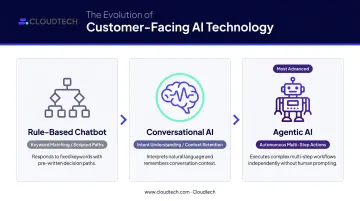
The Limits of Rule-Based Chatbots
A rule-based chatbot operates on decision trees. It matches keywords to predefined responses and follows scripted paths. When a customer types "Where's my order?" it works fine. When they type "I ordered the blue one last week but got the green one and now I'm traveling so I need it reshipped to a different address" — it collapses.
The failure modes are predictable:
- Can't handle ambiguity or multi-part requests
- No memory of what was said two messages ago
- No ability to detect frustration or intent to leave
- Dead ends, forced restarts, and "I didn't understand that" loops
What Conversational AI Actually Does
Conversational AI combines natural language processing (NLP), machine learning, and large language models (LLMs) to understand intent rather than match keywords. It maintains context across an entire conversation and detects customer sentiment — generating dynamic responses rather than retrieving scripts.
In practice, that means a conversational AI can parse a typo-filled, multi-clause request from a first-time customer and respond appropriately. A rule-based chatbot hits a wall at the first unexpected input.
Agentic AI: The Next Step
Beyond conversational AI sits agentic AI — autonomous systems that take multi-step actions without human prompting. Rather than answering a question about a refund, an agentic system initiates the refund, updates the order record, and sends the confirmation — all within a single conversation. For e-commerce, that gap is significant: most customer interactions require an action, not just an answer. An agentic system closes the loop without handing the customer off to another channel.
Why Businesses Are Moving Fast
The global conversational AI market was valued at $17.05B in 2025 and is projected to reach $49.80B by 2031, growing at a 19.6% CAGR. Businesses aren't adopting conversational AI because it's interesting technology — they're adopting it because the customer experience gap between chatbots and AI-powered interactions is becoming a competitive liability.
How Conversational AI Works in E-Commerce
The Core Technology Layers
NLP Layer: Natural language processing extracts meaning, intent, and sentiment from raw customer messages — including typos, casual phrasing, and multi-part requests. Instead of checking whether a message contains the word "return," NLP identifies that the customer wants to initiate a return, feels frustrated, and has a time constraint. That's the difference between triggering a script and actually understanding a person.
Machine Learning Layer: ML models improve over time by learning from historical conversations, purchase data, and browsing behavior. The more interactions the system processes, the better it gets at predicting what a customer needs — and personalizing the response accordingly.
LLMs and Generative AI: Large language models enable human-like, contextually aware responses for complex queries. A customer describing a nuanced product requirement ("something waterproof but lightweight for a hiking trip with my kids in late October") receives a reasoned, curated answer — not a keyword-matched result.
The Integration Layer: Where It Gets Real
A conversational AI system that can't access live data is, at best, a sophisticated dead end. The integration layer — connecting the AI to your CRM, inventory management system, payment gateway, and product catalog — is what enables the system to actually resolve issues rather than describe them.
Without real-time data access, your AI can tell a customer their order might be delayed. With it, it can pull the live tracking status, identify the carrier issue, and proactively offer a replacement or discount.
AWS Services That Power This Architecture
AWS provides the infrastructure stack that makes production-ready conversational AI accessible to growing e-commerce businesses:
- Amazon Lex — NLP and intent recognition for voice and chat interfaces
- Amazon Bedrock — Fully managed access to foundation models for generative AI applications
- Amazon Connect — Omnichannel cloud contact center with AI-powered capabilities
For SMBs building on this stack, the architecture decisions — how these services connect, where data flows, and how integrations are structured — determine whether the system delivers real resolution or just better-worded dead ends. Getting that foundation right is where implementation expertise matters most.
Key Capabilities That Go Beyond Basic Chatbots
Hyper-Personalization at Scale
A rule-based chatbot personalizes at the level of "Hi [First Name], your order number is [Order ID]." Conversational AI operates on an entirely different plane.
By processing real-time behavioral signals — what a customer is browsing right now, their purchase history, their customer segment — conversational AI delivers recommendations and offers tailored to the individual at that specific moment.
A returning customer who previously bought running gear and is now browsing trail shoes gets a different recommendation than a first-time visitor on the same page.
This matters because personalization drives purchasing decisions directly. McKinsey research found that 76% of consumers become frustrated when interactions aren't personalized, and 78% said personalized content made them more likely to repurchase. Personalization drives retention as directly as it drives first purchases.
Multichannel and Multilingual Reach
Customers don't stay on one channel. They might start a conversation in web chat, switch to WhatsApp, and follow up by SMS. Conversational AI maintains context across all of these transitions — no repetition required.
Multilingual support matters just as much for SMBs expanding beyond domestic markets. Native-language customer experience drives measurable loyalty:
- 73% of consumers said they'd be more loyal to a brand offering support in their native language
- 68% said they would switch brands to get it
Adding languages through conversational AI requires no additional headcount.
Proactive Engagement and Cart Recovery
Most conversational AI systems wait for customers to initiate contact. The better ones don't.
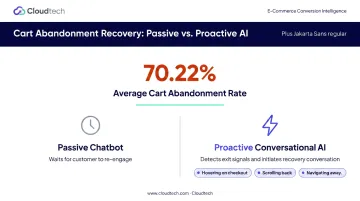
Proactive conversational AI triggers outreach based on behavioral signals: a customer hovering on a checkout page too long, scrolling back through product options, or starting to navigate away. The system initiates the conversation — answering hesitation-causing questions, offering an incentive, or surfacing a relevant comparison — before the customer leaves.
The opportunity is significant. Baymard Institute calculates the average documented cart abandonment rate at 70.22%, based on 50 studies. Every percentage point recovered through proactive engagement represents real revenue.
Agentic Commerce: End-to-End Transactions
Agentic commerce represents the sharpest break from chatbot thinking. An AI agent can autonomously handle the complete purchase flow — product discovery, clarification, selection, checkout, and order confirmation — within a single conversational interface. The customer never navigates a product page or fills in a form.
McKinsey projects that by 2030, agentic commerce could mediate $3–5 trillion in global consumer commerce. The multi-step orchestration behind these flows — Amazon Bedrock Agents, AWS Step Functions, and AWS Lambda — is the same infrastructure Cloudtech uses in complex agentic workflow deployments today.
Intelligent Human Handoff
No AI system handles every scenario well. The question is whether it fails gracefully or catastrophically.
Well-designed conversational AI detects escalation signals — complaint language, repeated failed attempts, explicit requests for a human — and transfers to a live agent with the full conversation context attached. The agent sees everything; the customer repeats nothing.
This is the opposite of a chatbot dead end, where customers reach a "sorry, I can't help with that" wall and have to call in and start from scratch. Intelligent handoff is a design requirement, not an optional feature.
High-Impact Use Cases for E-Commerce Businesses
Product Discovery and Guided Selling
A customer types: "I need a gift for my mom, she likes gardening but her hands hurt so she needs something lightweight, budget around $60."
A conversational AI system processes that as a multi-constraint query — pulling on:
- Recipient relationship and context
- Interest category (gardening)
- Physical limitation (lightweight)
- Price ceiling ($60)
It returns curated options without any browsing or filter-setting required. The same logic applies in fashion, home goods, electronics, or any catalog-heavy vertical.
Order Management and Post-Purchase Support
"Where is my order?" queries represent an average of 18% of incoming e-commerce support requests, with shipping-status questions comprising up to 30% of tickets on some platforms. These are ideal automation targets: high volume, low complexity, and entirely resolvable with real-time data access.
Conversational AI handles:
- Live order tracking with carrier-integrated status
- Return initiation and label generation
- Shipping address changes before dispatch
- Proactive delivery updates and delay notifications
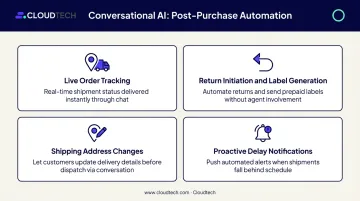
No agent involvement required for any of these. That frees your support team for the interactions that actually need a human.
Cart Abandonment Recovery and Re-Engagement
Generic abandonment emails convert at roughly 3.33% on average. Conversational AI-driven recovery is more targeted. A proactive SMS or chat message goes out minutes after abandonment, referencing the specific product left behind, addressing the most likely objection (price, shipping timeline, size availability), and offering a direct path back to checkout.
The difference shows up in the messaging itself. "Your cart is waiting" is noise. "The size Medium in that jacket is down to 3 units — want to grab it before it sells out?" is a reason to act.
Best Practices for Implementing Conversational AI
Start Narrow, Prove ROI, Then Scale
The most common implementation failure is trying to automate everything at once. Start with one high-volume, low-complexity use case — order status inquiries are a natural choice — and build confidence in the system before expanding to more complex flows like guided selling or returns.
This approach generates measurable ROI quickly, surfaces integration gaps before they affect the full system, and creates internal buy-in for broader deployment.
Integrate Before You Launch
Your conversational AI is only as capable as the data it can reach. Connect CRM, inventory, and product catalog systems before going live — not after. Post-launch integration work is significantly more disruptive and expensive than getting the data layer right upfront.
For SMBs, this is where a structured pre-deployment review pays off. Cloudtech's AWS Architecture Assessment identifies data readiness gaps and integration requirements before any AI deployment begins — so the first conversation your bot handles isn't also the first time you discover a broken data connection.
Define KPIs and Build Handoff Protocols from Day One
Establish your success metrics before launch, not after:
- Conversation completion rate — percentage of sessions that successfully resolved without escalation
- Escalation rate — percentage of conversations transferred to a human agent
- First contact resolution (FCR) — industry standard benchmarks around 75%, per Salesforce
- Conversion rate from chat — purchases attributed to AI-assisted sessions
- Customer satisfaction scores — specifically for AI-handled interactions
Track these weekly. Without regular measurement and retraining, even a well-built system stops improving — and in e-commerce, stagnant automation gets outpaced by customer expectations fast.
Frequently Asked Questions
What is the difference between a chatbot and conversational AI?
Chatbots rely on predefined rules and keyword matching — they follow decision trees and break when customers go off-script. Conversational AI uses NLP, machine learning, and LLMs to understand intent, maintain context across a conversation, and generate dynamic responses that rule-based systems can't replicate.
What is agentic AI and how does it apply to e-commerce?
Agentic AI refers to autonomous systems that execute multi-step actions — browsing inventory, completing checkout, initiating refunds — without human prompting. In e-commerce, this means the AI becomes the transaction interface itself, not just an information layer sitting alongside the website.
How can small e-commerce businesses afford conversational AI?
Cloud-native AWS services like Amazon Lex and Amazon Bedrock operate on pay-as-you-go pricing, making enterprise-grade capabilities accessible at SMB scale. AWS partner funding programs can further offset implementation costs, lowering the barrier to entry significantly.
How does conversational AI reduce cart abandonment?
Conversational AI detects behavioral exit signals and proactively engages customers via chat or SMS with personalized incentives, direct answers to hesitation-causing questions, and a frictionless path back to checkout.
What metrics should I track to measure conversational AI success?
Track conversation completion rate, escalation rate, first contact resolution, conversion rate from AI-assisted sessions, and customer satisfaction scores for AI-handled interactions. Establish baselines before launch so you have a clear before/after comparison.
Which channels can conversational AI operate across in e-commerce?
Modern conversational AI platforms operate across web chat, SMS, WhatsApp, voice assistants, social messaging apps, and email. The best implementations carry context across all of them — so a customer who starts on web chat and follows up by SMS never has to repeat themselves.