Introduction
Most SMB leadership teams are now asking the same question about generative AI: not whether to adopt it, but what it will actually cost. According to McKinsey, 65% of organizations regularly used GenAI by early 2024 — nearly double the previous year's rate. And with Gartner forecasting $644 billion in global GenAI spending for 2025, the pressure on SMBs to act is real.
But the first question most leadership teams ask is the right one: What will this actually cost us?
The honest answer: it varies widely. A proof-of-concept built on a third-party API looks nothing like an enterprise-grade, compliance-ready deployment. The cost gap between the two can run from $20,000 to well over $1 million. Misreading where your project falls on that spectrum leads to underbudgeting, mismatched architecture, and stalled initiatives.
This guide covers GenAI pricing tiers, the key cost drivers, what vendor quotes typically omit, and how to build a budget that holds once the system goes live.
Key Takeaways
- PoC/MVP: $20,000–$100,000; production applications: $100,000–$500,000; enterprise deployments: $600,000+
- Token volume scales directly with user activity and is the biggest ongoing cost driver to plan around
- API-based approaches have low entry costs but become expensive once usage volume climbs
- Regulated industries (healthcare, finance) face additional compliance and data governance costs
- AWS Partner Funding — available through certified implementation partners — can meaningfully offset out-of-pocket build costs
How Much Does Generative AI Cost? Pricing Tiers Explained
Generative AI doesn't have a fixed price. Costs depend on implementation approach, deployment scale, and the specific problem being solved. The most common reason projects go over budget: teams plan for the build but not for what happens after launch.
Three mistakes appear repeatedly:
- Underestimating inference costs at production scale
- Choosing an overpowered (and expensive) model for a straightforward task
- Skipping post-launch costs: data management, monitoring, and model retraining
Here's how costs break down across the three main tiers — use these as planning reference points, not fixed market rates.
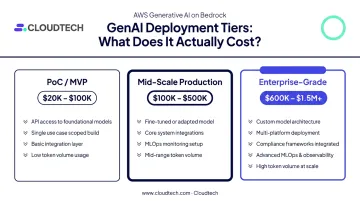
Proof-of-Concept / MVP ($20,000 – $100,000)
What's typically included:
- API access to a third-party LLM (OpenAI, Anthropic, AWS Bedrock)
- One focused use case: internal chatbot, document summarizer, or similar
- Basic integration into one existing system
- Limited monthly token usage (1M–5M tokens/month)
Best for: SMBs and first-time AI adopters validating whether GenAI solves a specific problem — before committing to a larger build.
Mid-Scale Production Application ($100,000 – $500,000)
What's typically included:
- Domain-optimized model (fine-tuned or prompt-engineered for your vertical)
- Integration with core business systems — CRM, ERP, support platforms
- Scalable cloud backend with initial MLOps monitoring
- Token usage in the 10M–50M/month range
Best for: Teams that have proven the concept and are ready to ship a working system to a specific business unit or customer base. This is where pilots become production.
Enterprise-Grade Deployment ($600,000 – $1.5M+)
What's typically included:
- Custom or hybrid AI architecture (RAG, self-hosted models, fine-tuned APIs)
- Multi-platform integrations across the business
- Enterprise security and compliance frameworks (HIPAA, GDPR, SOC2)
- Advanced MLOps with ongoing retraining and performance monitoring
- High token volumes (100M–500M/month)
Best for: Regulated industries — healthcare, financial services, life sciences — where data sovereignty, compliance, and uptime aren't optional. Also applies to any organization running AI across multiple systems at scale.
Key Factors That Drive the Cost of Generative AI Solutions
The final price on any GenAI initiative is shaped by technical decisions, operational requirements, and business constraints. Here's what moves the needle most.
Implementation Approach: API vs. Fine-Tuned vs. Custom/Hybrid
Three primary paths exist, each with a different cost profile:
| Approach | Upfront Cost | Operating Cost | Best For |
|---|---|---|---|
| Closed-source API (OpenAI, Bedrock) | Low | Scales with volume | Pilots, single use cases |
| Fine-tuned model | Moderate | Higher per-token post-tuning | Domain-specific accuracy needs |
| Custom/hybrid (RAG + open-source) | Higher | Significantly lower at scale | High-volume, long-term deployments |
Model choice is the single biggest lever for cost control. Matching model capability to the actual task — not defaulting to the most powerful option — is what keeps deployments affordable at scale.
Scale and Token Volume
API costs are driven by token consumption: every input query and output response costs money. The numbers scale faster than most teams expect.
Example: 1,000 queries/day × 30 days, with 1,000 input tokens and 500 output tokens per query = 45 million tokens/month.
| Model | Monthly Token Cost |
|---|---|
| GPT-4o ($2.50/M input, $10/M output) | $225 |
| Claude 3.5 Sonnet ($3.00/M input, $15/M output) | $315 |
| Amazon Nova Lite ($0.06/M input, $0.24/M output) | $5.40 |
These figures cover token charges only — they exclude embeddings, vector storage, retrieval infrastructure, orchestration, and implementation labor. At higher query volumes, the gap between model choices widens considerably.
Infrastructure and Hosting
Three options, each with different cost structures:
- Cloud GPU rental (SageMaker, EC2 G5): Fast to deploy, elastic, but expensive at sustained load. AWS prices ml.g5.2xlarge LLM hosting at $1.52/hour in SageMaker — a cost that adds up quickly with continuous traffic
- Serverless inference: Pay-per-use, cost-effective for intermittent workloads, but not suited for high-throughput production applications
- On-premises or dedicated GPU: Higher upfront CapEx, better unit economics at high volume
A mismatch between hosting model and actual workload patterns is one of the most common sources of unexpected GenAI spend.
Data Preparation and Quality
Raw business data — CRM records, support transcripts, clinical documents — must be cleaned, labeled, structured, and embedded before it can power a GenAI system. This prep work is routinely underbudgeted. In regulated industries, the cost doesn't stop at launch: HIPAA, GDPR, and SOC2 compliance add ongoing data governance overhead that persists for the life of the system.
Talent and Expertise
Building an internal AI team is a substantial fixed investment. The BLS reports a median annual wage of $112,590 for data scientists as of May 2024 — and a production-ready GenAI system typically requires ML engineers and MLOps specialists on top of that, plus months of ramp time before anything ships.
Partnering with a specialized implementation firm converts those fixed staffing costs into a scoped project investment. For SMBs, this typically means faster deployment, proven methodologies, and access to AWS Partner Funding programs that can meaningfully reduce out-of-pocket costs.
Full Cost Breakdown: What You're Actually Paying For
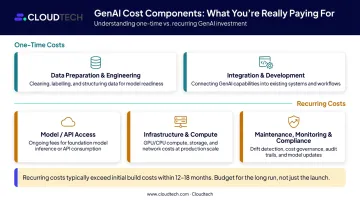
The total cost of a generative AI solution extends well beyond the initial build. For most SMBs, ongoing operational costs — compute, maintenance, and monitoring — end up exceeding the original development spend within 12 to 18 months. Planning for only the upfront work is one of the most common reasons AI projects blow their budgets post-launch.
| Cost Component | One-Time or Recurring | What It Covers |
|---|---|---|
| Model / API access | Recurring | Per-token fees to the LLM provider, or hosting costs for a self-managed model — scales with user volume and query complexity |
| Data preparation and engineering | One-time (with periodic updates) | Cleaning, labeling, structuring, and embedding proprietary data. Compliance audits add to this in regulated sectors |
| Infrastructure and compute | Recurring | Cloud GPU compute, storage, load balancing, and redundancy. Inference costs typically exceed training costs over the system's lifetime |
| Integration and development | One-time | Engineering to connect AI to existing tools (CRM, ERP, communication platforms), including API management, error handling, and orchestration. Routinely underestimated relative to model costs |
| Maintenance, monitoring, compliance | Recurring | Performance monitoring, retraining as data drifts, human-in-the-loop review, and security audits. Production AI systems degrade without scheduled maintenance, and these costs are routinely left out of initial budgets |
The table above covers the full cost surface. Of these components, maintenance and compliance tend to surprise SMBs most — they're open-ended, recurring, and easy to underestimate when the focus is on getting to launch. Build them into your budget from day one.
Budget vs. Premium GenAI Approaches: What's the Difference?
The choice between a lean API-based setup and a fully custom architecture isn't just about upfront cost. It determines long-term scalability, performance, and total cost of ownership.
Performance and Customization
API-based approaches offer strong out-of-the-box capability with limited control. Custom and fine-tuned solutions can be precisely tailored to industry terminology, compliance requirements, and brand voice — producing measurably more accurate outputs for specialized tasks.
Scalability and Long-Term Cost
API costs don't decrease as usage grows. A hybrid architecture — such as RAG combined with smaller open-source models — involves higher upfront investment but can deliver substantially lower per-query costs at scale. A 2024 EMNLP peer-reviewed study found that a SELF-ROUTE hybrid approach cut token costs 39% for GPT-4o and 65% for Gemini 1.5 Pro compared to always sending long contexts to the large model, with comparable performance.
Risk and Control
Lower-cost API approaches introduce vendor dependency, potential data privacy exposure (data leaves your environment), and vulnerability to pricing changes or model deprecations. Custom solutions provide data sovereignty, tighter security, and protection from vendor lock-in — critical for healthcare and financial services clients.
In practice, this architecture difference is decisive for regulated industries. Cloudtech's RAG implementations on Amazon Bedrock keep all data inside the client's VPC and compliance boundary, ensuring PHI and financial records never touch shared infrastructure.
How to Estimate the Right Budget for Your GenAI Initiative
The right budget matches the scale of the problem, the required performance level, and the organization's capacity to maintain the solution over time.
Start with your use case and query volume. Define the specific application — customer support automation, document analysis, internal knowledge assistant — and estimate realistic daily query volume. This determines model tier requirements and monthly token spend. Everything else flows from this.
Account for compliance requirements early. Healthcare, financial services, and other regulated sectors need to budget for:
- Data governance frameworks and compliance auditing
- Private cloud or on-premises infrastructure for HIPAA, GDPR, or SOC2 workloads
- Ongoing security review cycles as regulations evolve
Skipping this planning leads to expensive retroactive fixes.
Evaluate the build vs. partner decision carefully. Building an internal AI team carries high fixed costs and long ramp-up timelines. Working with an AWS-certified implementation partner like Cloudtech turns that into a defined project with predictable scope. Their pre-packaged Bedrock accelerators cover the full deployment stack — RAG architecture, LLM selection (Claude, Titan, Llama), MLOps hand-off, and HIPAA-compliant deployment boundaries — structured as a fixed-fee 4–8 week pilot POC, with T&M pricing for production builds. AWS Partner Funding may also reduce or eliminate out-of-pocket costs for qualifying SMBs.
Common GenAI Budgeting Mistakes to Avoid
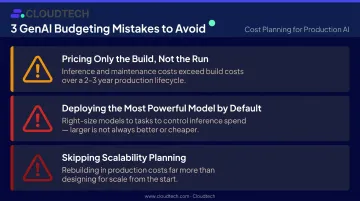
Three mistakes consistently derail GenAI budgets before a solution ever reaches production:
- Pricing only the build, not the run. Development is one line item. Inference, data management, model monitoring, and periodic retraining are ongoing — and over 2–3 years, they routinely exceed the initial build cost. Gartner forecast in 2024 that at least 30% of GenAI projects would be abandoned after proof-of-concept by end of 2025, citing escalating costs and unclear value as primary drivers.
- Deploying the most powerful model by default. Running a flagship LLM on tasks a smaller, cheaper model handles just as well is one of the most common causes of runaway AI spend. Right-sizing models to tasks — through intelligent routing — can cut inference costs without sacrificing output quality.
- Skipping scalability planning at the design stage. What runs efficiently at 500 queries per day often requires a full re-architecture at 50,000. Rebuilding in production costs far more than designing for scale upfront. This is where experienced implementation partners earn their keep — they've already encountered these failure modes.
Sustainable GenAI investment balances performance, compliance, and long-term operating costs — not just the lowest number on an initial quote. Understanding the full pricing landscape is what keeps AI initiatives funded and producing returns past the proof-of-concept stage.
Frequently Asked Questions
How much does it cost to use generative AI?
Costs range from roughly $20,000–$100,000 for a proof-of-concept to $600,000–$1.5M+ for enterprise deployments. Ongoing costs are determined primarily by token usage volume — the number and length of queries your system processes each month.
How much data does generative AI need?
API-based models require minimal proprietary data to start. Fine-tuned or RAG-based systems, however, benefit significantly from large, well-curated internal datasets — documents, records, transcripts — to improve accuracy and reduce hallucinations.
What is the 30% rule for AI?
The commonly cited "30% rule" suggests allocating roughly 30% of your project budget to data preparation, since model performance depends directly on data quality. This is separate from Gartner's finding that 30% of GenAI PoCs would be abandoned — two distinct statistics that are frequently confused.
What is the cheapest way to implement generative AI for a small business?
Start with a closed-source API — AWS Bedrock, OpenAI, or Anthropic — for a single, well-defined use case. This minimizes infrastructure and development costs while letting you validate business value before committing to a larger investment.
Is it better to use an AI API or build a custom generative AI model?
APIs are faster and cheaper to start but scale poorly in cost. Custom or hybrid models like RAG involve higher upfront investment but deliver better economics, data control, and performance accuracy at scale. The right choice depends on usage volume, compliance needs, and long-term growth plans.
What hidden costs should I expect when deploying a generative AI solution?
Several costs are routinely absent from initial vendor quotes:
- Inference costs — often exceed training costs over time as usage scales
- Data governance and compliance auditing — ongoing, especially in regulated industries
- Human-in-the-loop oversight — required for quality control on high-stakes outputs
- Model retraining — necessary as your data drifts and performance degrades