Introduction
Customer service teams are under real pressure. Query volumes keep climbing, customers expect 24/7 responses, and leadership wants automation to absorb the load. AI chatbots have become the default answer — and for good reason. They offer speed, consistency, and scalability that human teams simply can't match at volume.
But most deployments don't deliver.
A 2023 Cyara survey found that roughly 50% of consumers are frustrated by chatbot interactions, with nearly 40% describing their experiences as negative. Worse, 30% of customers abandon a purchase, switch brands, or warn others after a bad chatbot experience.
The technology usually isn't the failure point. The systems and strategy around it are.
This article breaks down why AI chatbot deployments fail, what the technical and organizational gaps actually look like, and how to build one that works from the start.
Key Takeaways
- Most chatbot failures stem from integration gaps, weak data, or unclear strategy — rarely the AI technology itself
- Without backend system access, a chatbot can inform customers but can't actually resolve their issues
- Fragmented or outdated knowledge bases lead directly to inaccurate responses and lost customer trust
- Hybrid human-AI models with clear escalation paths consistently outperform full automation for complex issues
- The most successful deployments launch in a limited scope, validate performance with real data, then expand
Why Most AI Chatbot Deployments Fall Short
The technology isn't the bottleneck. Most failed deployments share the same three root causes: design failures, data failures, and strategy failures.
- Poor conversation design — Flows don't account for how customers actually phrase requests, edge cases go unhandled, and escalation paths are bolted on as afterthoughts
- Weak data foundations — The chatbot pulls from incomplete, outdated, or contradictory sources and produces answers that don't reflect current policy
- No ownership or iteration plan — No clear owner, no defined KPIs, no roadmap for improvement. The project launches and then stagnates
Treating a chatbot as an isolated tool — rather than an integrated system — is where most teams go wrong. A bot deployed on top of existing infrastructure without API connections, defined workflows, or escalation logic will produce broken customer experiences, even if the underlying model is technically capable.
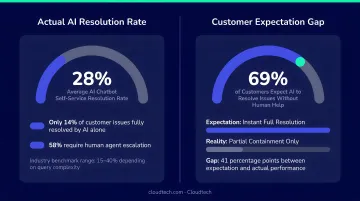
Gartner's 2024 self-service research puts the scale of this problem in sharp focus: only 14% of customer service issues are fully resolved through self-service — and even for "very simple" issues, the resolution rate reaches just 36%. A smarter bot won't close that gap. Better integration, cleaner data, and defined escalation logic will.
Technical Integration and Infrastructure Challenges
The Backend Integration Gap
Most chatbots are deployed on top of existing systems, not integrated within them. Without API connections to CRMs, ticketing platforms, billing tools, and order management systems, chatbots can retrieve information — but they can't take action.
The customer asks "Where's my order?" and gets a generic response instead of a real-time status update. They ask to cancel a subscription and get a link to a help article. The bot responds — but nothing actually gets resolved.
That distinction — a chatbot that responds versus an AI agent that resolves — is the core of the integration problem. Bridging it requires:
- Real-time data retrieval from authenticated customer records
- The ability to trigger workflows across connected systems
- API connections that allow the bot to actually execute tasks, not just surface information
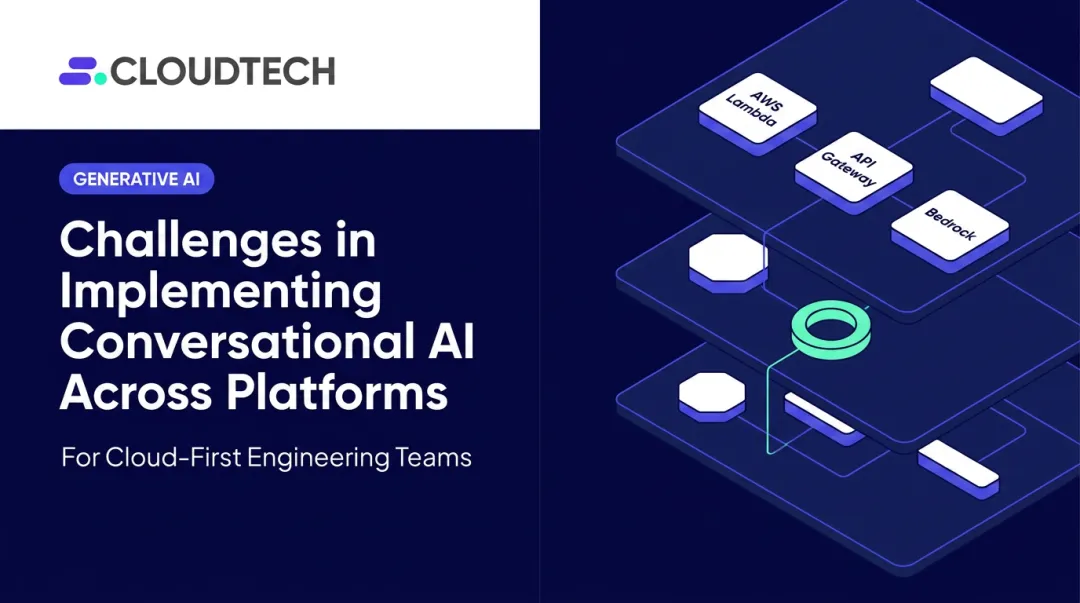
On AWS, this integration layer typically involves Amazon Lex for natural language understanding, AWS Lambda for business logic execution, and API Gateway as the secure entry point between the conversational interface and backend systems. Cloudtech's architecture work — including an AWS API Gateway Service Delivery Designation — reflects exactly this pattern: API Gateway filters and routes requests, Lambda executes the integration logic, and Step Functions manage multi-step workflows across external platforms like CRMs and billing tools.
That same integration thinking extends to escalation. When a handoff from AI to human carries no conversation context, the agent starts blind, the customer repeats themselves, and resolution time climbs. Structured escalation — where full conversation history transfers automatically — must be part of the initial architecture, not a patch applied after complaints start coming in.
Scalability and Performance Under Load
Infrastructure that performs well during testing often degrades under real traffic. Common failure signs include:
- Slow response times during product launches or promotional events
- Dropped conversations mid-session under surge traffic
- Inconsistent answer quality when concurrent users spike unexpectedly
- Timeouts caused by downstream APIs that weren't load-tested
These aren't runtime surprises — they're symptoms of architecture decisions made too early or skipped entirely.
Scalability is an architecture decision, not a deployment setting. Cloud-native designs using auto-scaling and serverless compute — AWS Lambda, Amazon ECS with Fargate, API Gateway throttling — absorb variable load without degradation. Building that in from the start is far cheaper than re-architecting after a high-traffic incident exposes the gaps.
Data Quality and Knowledge Management Challenges
Fragmented and Outdated Knowledge Bases
For most organizations, the biggest pre-deployment obstacle is content, not code. Relevant information sits scattered across help centers, internal wikis, PDFs, Slack exports, and years of accumulated agent notes. When a chatbot pulls from this fragmented pool without a defined source of truth, the output is inconsistent, incomplete, or misaligned with current policy.
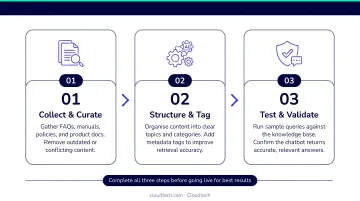
Fixing this requires content decisions before deployment:
- Identify authoritative sources — which documents and databases reflect current policy
- Remove outdated content — old pricing, deprecated products, superseded processes
- Structure for AI retrieval — FAQs, policy documents, and procedures formatted so the AI can reference them accurately at answer time
This isn't a one-time setup task. Policies change, products update, and new issue types emerge. Without a defined update process, chatbot accuracy degrades — sometimes within weeks of a policy change. Knowledge management needs to be an operational discipline with a named owner and a regular review cadence.
Hallucinations, Response Accuracy, and Customer Trust
When knowledge gaps go unaddressed, they create a direct path to hallucinations. In a customer service context, that means the chatbot generates a confident but incorrect or fabricated response — typically because it lacks grounding in verified, business-specific data. The customer gets wrong information delivered with authority.
The legal and trust risks are concrete. The Air Canada chatbot case is instructive: a tribunal confirmed that companies remain liable for misinformation provided by their AI chatbots, regardless of whether a human agent delivered it. In regulated industries — healthcare, financial services — the exposure is higher still.
The technical fix is retrieval-augmented generation (RAG): rather than generating responses from general training data, the AI references verified documents and Q&A datasets at answer time. Research has shown RAG-grounded systems can improve accuracy by up to 18% over ungrounded approaches in complex question-answering tasks.
Grounding alone isn't enough. Feedback loops are equally critical:
- Track unanswered queries to surface knowledge gaps early
- Review real interaction logs on a regular cadence
- Schedule periodic human audits of chatbot responses
- Flag low-confidence answers for escalation before customers see them
These practices let teams catch accuracy problems before they erode trust — not after.
Organizational, Security, and Scalability Challenges
Change Management and Internal Adoption
Chatbot projects frequently stall not because the technology fails, but because no one owns them. Without a named owner, agreed-upon KPIs, and cross-team alignment before launch, deployments drift.
The right metrics go beyond session counts:
- First-contact resolution rate — did the interaction fully resolve the issue?
- Escalation rate — how often does the bot hand off, and why?
- Repeat contact rate — are customers returning for the same unresolved issue?
- Cost per resolution — what does it actually cost to close each ticket?
Internal resistance from support teams is also common. Agents often view AI as a threat to their roles. The framing that tends to work: AI absorbs repetitive, high-volume queries so agents can focus on complex, high-value interactions that require judgment and empathy.
That reframe only holds if the escalation model actually works — if agents consistently receive context-rich handoffs and aren't left cleaning up after a bot that failed.
Data Privacy, Compliance, and Governance
The same internal alignment that prevents adoption failures also surfaces a harder problem: data exposure. AI chatbots touch sensitive customer data across multiple touchpoints — PII, payment information, health records — creating real risk under GDPR, CCPA, HIPAA, and related frameworks. Without defined data access controls, retention policies, and audit trails, compliance risk grows alongside scale.
Governance is both a legal requirement and an architectural one. AI systems need defined guardrails specifying:
- What the bot can say and what topics are out of scope
- What actions it can take versus what must be escalated
- When a human must be involved, regardless of customer preference
For healthcare deployments, this means HIPAA-compliant data handling at every layer — encrypted transmission, role-based access controls, audit logging, and a Business Associate Agreement with AWS. Cloudtech's healthcare engagements — including AI voice automation work for Ascend BPO's healthcare clients — are structured around these requirements from day one. Every PHI touchpoint is encrypted, access-controlled, and fully auditable before the solution goes live.
How to Build an AI Chatbot Deployment That Works
Getting chatbot deployments right isn't about choosing a better platform — it's about the operating model around the technology.
Start small and prove value first. Pick two or three high-volume, low-complexity use cases where success is measurable: FAQ deflection, order status lookups, appointment booking. These are contained enough to launch quickly and generate real performance data before expanding to more complex workflows.
Design the hybrid model as the default architecture. AI handles speed, consistency, and volume. Human agents handle complexity, emotional sensitivity, and edge cases that fall outside the bot's defined scope. The escalation path should be a first-class feature of the architecture — not an afterthought — with full conversation context transferred at every handoff.
Treat the chatbot as a living system. A static deployment decays. Schedule regular reviews of conversation logs and unresolved query patterns. Update the knowledge base on a defined cadence. Use performance data to prioritize improvements, not just to report on them.
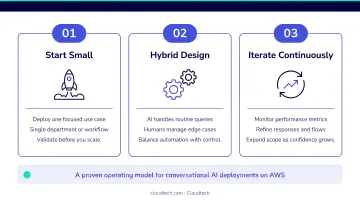
This operating model — structured iteration, clear ownership, and continuous improvement — is where many SMBs need support beyond the technical build. Getting the architecture live is one milestone; keeping it performing is an ongoing discipline. Cloudtech works with SMBs to establish these processes alongside the implementation itself, so teams have the workflows and ownership structures to sustain performance well after launch.
Frequently Asked Questions
What are the most common reasons AI chatbots fail in customer service?
Most failures trace back to the same root causes: poor technical integration with backend systems, fragmented or outdated knowledge bases, and insufficient organizational ownership with no defined KPIs. The technology rarely fails on its own — poor design, bad data, and unclear strategy are what drive most deployments off course.
How do you ensure an AI chatbot integrates properly with existing systems?
The chatbot needs API connections to backend platforms — CRM, ticketing, billing — so it can take action, not just retrieve information. Cloud-native services like API Gateway, Lambda, and serverless orchestration create the integration layer. Integration should be tested thoroughly in a staging environment before any production launch.
What data do you need to prepare before deploying an AI chatbot?
Consolidate content from all relevant sources, remove outdated material, and structure FAQs and policy documents for AI retrieval. Define a single authoritative source of truth before deployment begins. A fragmented knowledge base at launch means inaccurate responses from day one.
How do you measure the ROI of an AI chatbot deployment?
Track deflection rate, first-contact resolution, customer satisfaction (CSAT), cost per resolution, and repeat contact rate. Session counts show how often the bot is used; these metrics show whether it's actually working.
When should a customer be escalated from an AI chatbot to a human agent?
Escalation triggers should be defined before launch and include: high emotional stakes, regulatory sensitivity, multi-step complexity beyond the bot's defined scope, and any explicit customer request for a human. Context from the AI interaction must transfer automatically at handoff.
How long does it typically take to deploy an AI chatbot for customer service?
Timeline depends on integration complexity and knowledge base readiness. A scoped pilot covering two or three use cases can go live in as little as two weeks, while broader rollouts may take up to six months. Starting narrow and expanding iteratively is almost always the faster path.