Introduction
Most SMBs that deploy chatbots share the same frustration: they promise to reduce support load and improve self-service, but users quickly learn to work around them. The bot gives a generic answer, the employee re-asks the question three different ways, and someone ends up calling HR anyway.
The underlying architecture is the real problem. Rule-based bots and even first-generation RAG systems are built around a single exchange: one query, one retrieved document, one generated response. That's fine for simple lookups. It falls apart the moment a user asks something that requires context, multiple sources, or an actual action.
Gartner's 2024 survey of 5,728 customers found that only 14% of service issues were fully resolved through self-service — even for issues customers described as "very simple." That gap points to a structural problem, not a content problem.
Agentic RAG platforms close that gap. Instead of retrieving a single answer, they reason through a request, pull from multiple sources, refine their own queries, and execute actions inside connected systems. This article breaks down how that works — and what it means for employee and customer chatbots specifically.
Key Takeaways:
- Standard chatbots and basic RAG fail on multi-step, ambiguous, or action-requiring requests
- Agentic RAG adds planning, iterative retrieval, and tool execution on top of generation
- Employee bots built on agentic RAG can complete workflows, not just describe them
- Customer bots can resolve issues directly — not just point users to another channel
- AWS services (Bedrock, OpenSearch, Lambda) provide a managed foundation for SMBs
Why Traditional Chatbots and Basic RAG Fall Short
The One-Query, One-Answer Problem
First-generation RAG works like this: a user submits a query, the system retrieves the closest matching document chunk, and an LLM generates a response based on that chunk. For clean, well-formed questions with obvious answers in a single document, this works well enough.
The moment that assumption breaks — and it breaks constantly in real enterprise environments — the system has no recovery path. There's no mechanism to detect a weak retrieval, try a different source, or carry any memory of what was already asked. Every message is a fresh start.
The Real Cost of That Gap
In practice, this creates predictable failure patterns across SMBs:
- Employees re-ask the same question in three different ways, hoping for a better answer
- Customer service bots escalate simple issues because they can't access the systems needed to actually resolve them
- Critical knowledge buried in PDFs gets retrieved partially or not at all, especially when answers span multiple documents
- Every conversation starts cold — no context from the previous message, let alone the previous session
An AWS-published test comparing GraphRAG against standard vector RAG found 80% correct answers with relationship-aware retrieval versus 50.83% with single-pass vector RAG across multi-hop, temporal, and multi-constraint questions. That accuracy gap is the structural cost of retrieval that can't reason about connected information.
What Basic RAG Is Missing
Three things standard RAG doesn't have:
- A planning loop — no ability to decompose a complex request into sub-tasks
- Iterative retrieval — no mechanism to detect weak results and try again
- System connections — no path to actually do anything (create a ticket, check a balance, pull a policy, confirm a booking)
Agentic RAG is built specifically to close all three — adding planning, iteration, and real system access to what basic retrieval leaves unfinished.
What Makes RAG "Agentic"? The Key Shift Explained
Static Retrieval vs. Dynamic Reasoning
The difference between traditional RAG and agentic RAG comes down to control. In standard RAG, the retrieval pipeline runs once and the LLM generates from whatever it gets. In agentic RAG, an AI reasoning layer sits on top of retrieval: it analyzes intent, plans sub-tasks, selects tools, checks results, and iterates until it produces a grounded, reliable answer.
| Standard RAG | Agentic RAG | |
|---|---|---|
| Retrieval passes | One | Multiple, iterative |
| Query reformulation | None | Automatic on weak results |
| Multi-source retrieval | Rare | Standard |
| Action execution | None | Connected via APIs/tools |
| Session context | None | Maintained across turns |
The Agentic Execution Loop
The loop works like this:
- Intent detection — What is the user actually asking?
- Task planning — Does this require multiple steps or data sources?
- Iterative retrieval — Retrieve, evaluate quality, reformulate if needed
- Tool selection — Which system or API can resolve this?
- Action execution — Execute the task (look up account, create ticket, confirm booking)
- Response synthesis — Return a grounded, cited answer
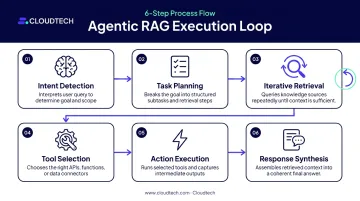
Each step builds on the last — and that sequential reasoning is what enables the bot to take action, not just answer questions.
Memory, Agent Types, and Retrieval Refinement
That execution loop depends on two things the standard RAG model lacks: memory and adaptive retrieval. Agentic RAG maintains session context across a conversation, so the bot tracks what was already discussed, the user's role, and the current workflow state. Follow-up questions build naturally on prior exchanges rather than starting cold.
When the first retrieval pass returns weak or incomplete results, the agent reformulates the query and pulls from a different source. Uber's 2025 EAg-RAG evaluation measured this directly: adding a query optimizer, hybrid retrieval, and enriched metadata produced a 27% relative increase in acceptable answers and a 60% reduction in incorrect advice against their traditional RAG baseline.
Three agent patterns drive this behavior:
- Routing agents classify query complexity and direct requests to the right pipeline
- Query planning agents decompose ambiguous requests into answerable sub-queries
- ReAct agents interleave reasoning traces with actions, deciding when to search, inspect evidence, and act again
How Agentic RAG Powers Employee Chatbots
The HR/IT Helpdesk Use Case
The highest-impact employee use case is also the most straightforward to illustrate. An employee asks: "How much PTO do I have left?"
A traditional bot retrieves the PTO policy document and explains how accrual works. An agentic RAG bot checks the employee's actual balance, surfaces their remaining days, and — if they ask — initiates a time-off request and confirms it, all inside the same conversation.
That shift from describing a process to completing a workflow is what changes the value proposition. The employee doesn't need to know which portal to visit or which form to fill out — the bot handles navigation, retrieval, and action in a single thread. That capability becomes even more valuable when a question crosses departmental lines.
Multi-Department Knowledge Without Multiple Portals
Employee questions rarely fit neatly into one category. "Can I work from home if I'm waiting for an IT replacement laptop?" touches HR policy, IT procedures, and potentially a compliance policy — three separate document sets that a rule-based bot would either ignore or require separate queries to surface.
Agentic RAG routes the query to the right knowledge sources simultaneously and synthesizes a unified response. Cloudtech's Bedrock-based implementations handle this through a purpose-built AWS stack:
- Amazon Bedrock Agents for orchestration across knowledge domains
- Amazon S3 and OpenSearch for indexed document retrieval
- AWS Step Functions for managing multi-step query workflows
Onboarding as a High-Value Workflow
New employees generate a predictable sequence of contextual, action-requiring questions:
- "When is the benefits enrollment deadline?"
- "How do I add dependents to my plan?"
- "Can you send me the enrollment form?"
Each question builds on the last. Each one potentially requires pulling from a different system. Agentic RAG handles this sequential, multi-system pattern better than any static bot — and bounded onboarding workflows like this are where the business impact is most quantifiable.
AWS reports that Deriv used Amazon Q Business to reduce onboarding time by up to 45% and recruiting effort by as much as 50%, demonstrating that bounded, measurable employee workflows are the right starting point for any agentic RAG deployment.

Governance at the Retrieval Layer
Role-based access control isn't optional for internal bots — it's a fundamental requirement. An employee in sales shouldn't be able to surface executive compensation documents. A contractor shouldn't see full HR records.
Cloudtech's agentic RAG builds address this using:
- AWS Lake Formation for table, column, and row-level access permissions
- IAM roles scoped to specific data sources and S3 buckets
- Metadata tagging on indexed documents to enforce classification-based access policies
- AWS CloudTrail logging every retrieval for full auditability
The retrieval pipeline itself operates under IAM execution roles — meaning the agent can only query what its role permits, regardless of how the user phrases their request.
How Agentic RAG Elevates Customer-Facing Chatbots
The Resolution Gap
Customer queries carry more urgency than internal ones. A customer asking about a delayed order or a billing dispute is often already frustrated. Telling them to "contact support" or directing them to a help article is not resolution : it's deflection.
Standard customer chatbots share one core limitation: they're disconnected from the systems that could actually fix the problem. They can describe a refund policy but can't initiate one. They can explain shipping timelines but can't pull the order status.
- Refund requests: Bot explains policy; can't process the refund
- Order status: Bot recites timelines; can't check live fulfillment data
- Billing disputes: Bot describes escalation paths; can't adjust the charge
Agentic RAG changes this by connecting the chatbot to CRM, order management, billing, or scheduling systems via API action groups. The bot can look up the account, confirm the issue, and trigger a resolution workflow without a human in the loop.
The Scale of the Opportunity
Gartner predicts that agentic AI will autonomously resolve 80% of common customer-service issues by 2029, with a 30% reduction in operational costs. That forecast sits against the current 14% full-resolution baseline — the gap between chatbots that answer and agents that actually resolve.
Real deployments are already moving in that direction. Salesforce reported that Agentforce handling routine Wiley inquiries produced an over 40% increase in case resolution compared to their previous chatbot — clear evidence that action-enabled platforms outperform retrieve-only systems in customer service contexts.
Personalization and the Escalation Handoff
Because agentic RAG maintains session context and can pull from customer history, the bot tailors responses to the individual. A returning customer asking about their account gets an answer relevant to their actual situation, not a generic FAQ response. This matters most in industries where account-level detail is expected: healthcare, financial services, and retail.
When a query does exceed the bot's capabilities, the escalation design matters as much as the bot itself. A well-designed agentic RAG system:
- Detects when it has reached the boundary of its competence
- Routes to a human agent automatically
- Passes the full conversation context so the customer doesn't have to repeat themselves
Done well, this handoff is invisible to the customer. Containment rates rise, satisfaction holds, and human agents spend their time on cases that actually need them.
Key Components of an Agentic RAG Platform
The Five Essential Layers
When evaluating any agentic RAG solution, these five layers need to be present and properly integrated:
- LLM reasoning engine — the foundation model that interprets intent, plans tasks, and synthesizes responses (e.g., Anthropic Claude, Amazon Titan via Bedrock)
- Vector database for semantic retrieval from indexed documents (Amazon OpenSearch, Aurora pgvector)
- Retrieval pipeline with iterative refinement covering query reformulation, reranking, and multi-source retrieval
- Tool/API integration layer for connections to business systems (CRM, HRIS, order management) via Lambda or action groups
- Memory and guardrails layer handling session context management, content filters, access controls, and grounding checks
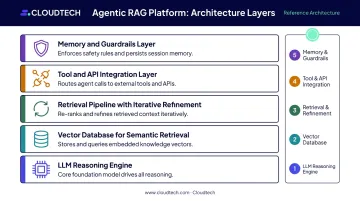
Missing any of these isn't a configuration issue : it's a category difference. A system without tool integration can't execute actions. A system without guardrails can't be safely deployed in a regulated environment.
Data Quality Is the Foundation
The most commonly overlooked implementation factor is also the most consequential: the quality of the documents being ingested.
Uber's EAg-RAG case study is explicit about this : ordinary PDF loaders lost table structure during ingestion, which directly contributed to poor retrieval and bad answers. Adding an agentic reasoning loop on top of malformed source content doesn't fix the problem. It propagates it more confidently.
Getting the ingestion layer right requires deliberate decisions across several dimensions:
- Chunking strategy: AWS's advanced parsing guidance recommends semantic and hierarchical chunking over fixed-size splits
- Query reformulation: Rephrasing queries before retrieval improves match quality against imperfectly indexed content
- Reranking design: The 2023 "Lost in the Middle" study found LLMs use relevant information less reliably when it appears mid-context, making reranking a meaningful accuracy lever
- Metadata enrichment: Adding structured metadata to chunks improves filtering and source attribution
Build vs. Managed Platform
| Approach | Best fit | SMB tradeoff |
|---|---|---|
| LangChain / LlamaIndex / CrewAI | Teams with ML engineering capacity | Maximum flexibility; full ownership of deployment, evaluation, and ops |
| AWS managed path (Bedrock Knowledge Bases + AgentCore) | SMBs prioritizing faster integration | Less infrastructure assembly; AWS coupling and usage cost governance |
| Consulting-assisted deployment | SMBs without dedicated ML engineers | Faster time to production; partner maintains architecture decisions |
Most SMBs don't have the ML engineering capacity to maintain custom agentic pipelines. A consulting-assisted deployment on AWS native services shortens both the build timeline and the ongoing maintenance burden.
Building an Agentic RAG Chatbot on AWS: What SMBs Need to Know
The AWS-Native Stack
AWS provides a managed foundation for agentic RAG without requiring SMBs to stitch together open-source components from scratch:
- Amazon Bedrock — LLM access across Anthropic Claude, Amazon Titan, Meta Llama, and others, with built-in guardrails for content filtering and grounding checks
- Bedrock Knowledge Bases — managed ingestion, indexing, retrieval, and query reformulation
- Amazon Bedrock AgentCore — the current AWS recommendation for agent runtime, memory, identity, and orchestration (note: the prior Agents Classic service closes to new customers July 30, 2026)
- Amazon OpenSearch / Aurora pgvector — vector storage and semantic retrieval
- AWS Lambda / Step Functions — tool execution and multi-step workflow orchestration
One important note for teams mid-evaluation: Amazon Kendra also closes to new customers on July 30, 2026. New designs should evaluate Bedrock Knowledge Bases as the retrieval foundation.
Practical Starting Steps
For an SMB standing up an agentic RAG chatbot, the defensible sequence is:
- Define scope — employee or customer-facing? Which specific workflows to automate first?
- Audit and prepare the knowledge base — clean documents, structured chunking, metadata tagging before any agents are involved
- Establish a baseline — run standard RAG first to identify where multi-step failures actually occur
- Add retrieval pipelines and routing only where tests show real gaps
- Connect a small set of reversible actions — ticket creation, status lookup, appointment booking
- Define guardrails before go-live — not after
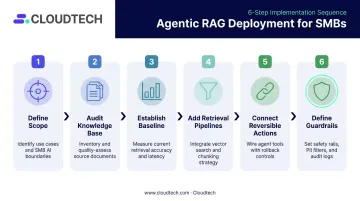
Each of these steps also surfaces risks that are far cheaper to address before deployment than after. Cloudtech's AWS-certified architects guide SMBs through this sequence — typically starting with a scoped architecture review and a fixed-fee pilot to validate the design against real query sets before any production rollout.
Top Implementation Risks
These three risks are solvable upfront — but they become expensive to fix post-deployment:
- Hallucinations from poor document quality — invest in document preparation and chunking before building the agent layer
- Cost overruns from over-querying — estimate costs from workload traces, not generic per-chat benchmarks; token usage, embeddings, reranking, and guardrail checks all accumulate
- Security gaps from improperly scoped access — IAM roles, Lake Formation permissions, and metadata-based filtering must be defined before the bot surfaces any data to users
Frequently Asked Questions
What is an agentic RAG chatbot?
An agentic RAG chatbot combines retrieval-augmented generation with an AI reasoning layer. Instead of retrieving one document and generating a response, it plans multi-step queries, retrieves from multiple sources dynamically, evaluates result quality, and executes actions in connected systems — resolving issues rather than just describing them.
How do you deploy agentic RAG for customer service automation?
Define the customer workflows to automate, connect the chatbot to relevant knowledge bases and CRM systems, and select an LLM platform — Amazon Bedrock is the natural AWS choice. Add guardrails for content filtering and escalation triggers, then validate against a sample of real customer queries before full rollout.
How does agentic RAG differ from a standard AI chatbot?
Standard chatbots follow scripted paths or perform a single retrieval pass. Agentic RAG bots reason through requests, reformulate queries when results are weak, and execute actions in business systems. The practical difference: a standard bot describes how to submit a refund; an agentic RAG bot initiates one.
What AWS services are used to build agentic RAG chatbots?
The core stack includes Amazon Bedrock (LLM access and guardrails), Bedrock Knowledge Bases (document ingestion and retrieval), Amazon OpenSearch (semantic vector search), and AWS Lambda or Step Functions (multi-step tool orchestration). Bedrock AgentCore is AWS's current recommendation for agent runtime and memory.
What are the biggest challenges SMBs face when implementing agentic RAG?
Three challenges come up most consistently:
- Source document quality — poor or inconsistent content is the most common (and most overlooked) cause of weak retrieval accuracy
- ML engineering capacity — most SMBs lack the in-house expertise to build and maintain custom pipelines
- Access control gaps — without proper permissions, the bot can surface documents users aren't authorized to see