Introduction
Small and medium-sized businesses are under pressure to do more with fewer people. Hiring freezes, rising operational costs, and customer expectations that outpace headcount growth have pushed automation from nice-to-have to necessary. Generative AI has moved well past the enterprise-only phase.
58% of US small businesses now identify as generative AI users, up from just 23% in 2023. Adoption has accelerated because the tools are now practical, affordable, and proven across real business functions.
This guide covers what generative AI automation actually is and where it delivers the highest ROI. You'll find a step-by-step implementation framework and concrete use cases for SMBs in healthcare, finance, manufacturing, and retail — whether you're running your first pilot or ready to scale.
Key Takeaways
- Generative AI automation handles complex, judgment-intensive tasks — not just rules-based repetition
- Top use cases include customer support, content creation, document processing, code generation, and data reporting
- Start with a single scoped workflow; pilots can show measurable results within weeks
- Amazon Bedrock and Bedrock Flows provide the core infrastructure for SMB generative AI deployments
- Data quality and governance must be established before deployment, particularly in regulated industries
What Is Generative AI Automation?
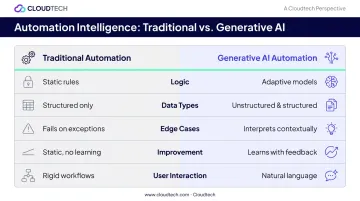
Traditional automation follows rules. It executes defined scripts, handles predictable inputs, and breaks when it encounters anything unexpected. That works fine for structured, repetitive tasks — but most business workflows aren't that clean.
Generative AI automation combines large language models (LLMs) with workflow orchestration systems, so processes don't just execute predefined steps — they generate outputs, interpret context, and adapt dynamically with minimal human input.
How It Differs From Rule-Based Automation
| Dimension | Traditional Automation | Generative AI Automation |
|---|---|---|
| Logic | Predefined, static rules | Adaptive, context-aware models |
| Data types | Structured, predictable inputs | Unstructured data (documents, emails, free text) |
| Edge cases | Fails or requires manual intervention | Interprets and responds contextually |
| Improvement | Static unless manually updated | Improves with feedback and retraining |
| User interaction | Rigid workflows | Natural language interfaces |
McKinsey estimates that approximately 90% of enterprise data is unstructured — emails, PDFs, intake forms, call transcripts, contract text. Traditional automation can't touch most of it. Generative AI can.
The Foundational Technologies
Three technologies make this possible:
- Large language models (LLMs) — Models like Anthropic Claude, Amazon Titan, and Meta Llama generate human-quality text, summaries, decisions, and code
- Natural language processing (NLP) — Enables systems to understand intent and context, not just keyword matches
- Transformer architectures — The underlying architecture that allows models to process long documents and maintain context across complex tasks
For SMBs in particular, this combination opens up automation well beyond what off-the-shelf rule-based tools could handle — think contract review, intake processing, or dynamic report generation that used to require dedicated staff. The use cases below show where that shift is already paying off.
Top Use Cases for Generative AI Automation in 2026
The highest-impact applications fall across five core business functions — from content and customer support to code, data, and documents. Where you start depends on where the bottlenecks are biggest.
Content Creation and Marketing Automation
Salesforce reports that marketers expect generative AI to save five hours per week, with 76% already using it for content creation and 63% for market data analysis.
The practical applications:
- Blog and email drafts — AI writing tools analyze brand voice and past content to generate on-brand first drafts
- Product descriptions at scale — Retailers and e-commerce teams generate thousands of variations without proportional headcount growth
- Ad copy and social content — Automated variation testing without a full creative production cycle
- Personalized campaigns — Gen AI analyzes customer behavior and generates individualized email copy and product recommendations, reducing manual segmentation
A Forrester Consulting study commissioned by AWS found that generative AI-enabled targeted campaigns produced a 65% increase in click-through rate and an 85% increase in conversion rate — though results will vary based on use case and implementation quality.
Customer Service and Support Automation
Gen AI-powered support goes well beyond scripted FAQ bots. Modern systems understand intent, generate contextually appropriate responses, and handle escalations intelligently.
Real-world performance benchmarks:
- Intercom's Fin AI agent reports an average 76% resolution rate across 12,000+ customers, with many exceeding 85%
- Zendesk customer cases show automation rates ranging from 30–40% up to 80%, depending on workflow complexity
For SMBs that can't staff 24/7 support teams, this is particularly valuable. A well-scoped deployment handles routine queries, routes complex cases to humans with full context, and operates continuously without staffing overhead.
Software Development and Code Generation
GitHub's controlled experiment with Copilot found developers completed tasks 55.8% faster than the control group. McKinsey's research found code documentation and new-code generation could be up to twice as fast, with refactoring improvements of 25–30%.
Key applications:
- Auto-completing boilerplate and repetitive code patterns
- Generating unit tests and documentation
- Debugging and identifying error sources
- Accelerating onboarding for new developers unfamiliar with a codebase
The gains are most significant on routine tasks. Complex, novel problems still require experienced human judgment — but the time freed from repetitive work adds up quickly.
Data Analysis and Automated Reporting
Most SMBs don't have a dedicated data science team. Gen AI ingests large, messy datasets, identifies patterns, and generates narrative reports in plain language — putting insights in front of decision-makers in hours rather than days.
This is especially relevant for:
- Finance teams monitoring cash flow, budget variance, and forecasting
- Operations teams tracking production throughput, defect rates, or logistics status
- Marketing teams summarizing campaign performance across channels
One related application: synthetic data generation. In data-scarce environments — healthcare research, early-stage startups — gen AI creates realistic synthetic datasets to train models or run simulations without touching real patient or customer records.
Document Automation and Knowledge Management
Contracts, invoices, intake forms, compliance reports, prior authorizations — most SMBs process hundreds or thousands of these documents manually. Gen AI can read, extract, summarize, classify, and act on them automatically.
A concrete example: AWS customer Ellby used Amazon Bedrock to automate invoice processing, raising their automated rate from below 60% to more than 94%, saving 300+ hours per month, and reducing onboarding time by more than 55%. That's an SMB-scale deployment with measurable, documented results.
Cloudtech's IDP practice — built on Amazon Textract and Amazon Comprehend — runs similar workflows for clients in healthcare, financial services, and legal. Typical results: 80% shorter contract review cycles and 70% less manual data entry.
How to Implement Generative AI Automation: A Step-by-Step Approach
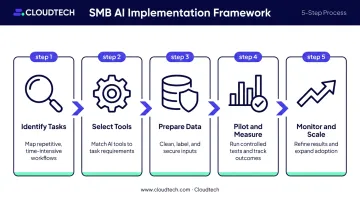
Step 1: Identify High-Impact, Repetitive Tasks
Start with a workflow audit. Look for tasks that are:
- High volume and repetitive (done daily or weekly by multiple people)
- Dependent on unstructured inputs (documents, emails, forms, queries)
- Rule-adjacent but not fully rules-based (require some interpretation)
- Currently creating bottlenecks or backlogs
Strong candidates: customer query triage, invoice review, report generation, contract summarization, content drafting. These are proven entry points with short feedback loops.
Step 2: Select the Right Tools and Platforms
Tool selection criteria for SMBs:
- Integration compatibility with existing systems (CRM, ERP, EHR)
- Security and compliance alignment with your regulatory environment
- Ease of use for non-technical teams
- Scalability as usage grows
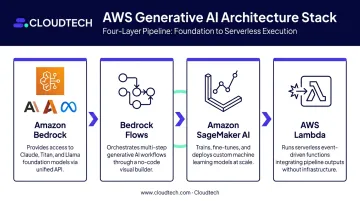
For organizations already on AWS, the core services for gen AI automation are:
- Amazon Bedrock — Fully managed access to foundation models including Anthropic Claude, Amazon Titan, and Meta Llama
- Bedrock Flows — Visual construction of end-to-end gen AI workflows linking models, knowledge bases, agents, and Lambda functions
- Amazon SageMaker AI — For custom model development, training, and deployment
- AWS Lambda — Serverless, event-driven execution that orchestrates automation workflows
Note: Amazon Q Business is active as of mid-2026 but is no longer available to new customers as of July 31, 2026 — factor this into your planning if you were considering it as a starting point.
Cloudtech, as an AWS Advanced Tier Partner with SMB Competency, helps clients navigate service selection and often has access to AWS Partner Funding that can reduce upfront implementation costs — worth exploring before committing to a build approach.
Step 3: Prepare and Govern Your Data
Gartner predicts that 30% of generative AI projects will be abandoned after proof of concept — primarily due to poor data quality, inadequate controls, or unclear value. Data preparation is where most projects actually succeed or fail.
Before deployment:
- Audit data quality — incomplete, inconsistent, or siloed data produces unreliable outputs
- Restrict access by role so only authorized users and systems touch sensitive data
- Define retention and deletion policies, especially critical in regulated industries
- Address HIPAA, GDPR, and financial compliance requirements before any AI model processes sensitive records — not after
Cloudtech's HIPAA-compliant data governance approach includes AWS KMS encryption, Amazon Macie for PHI detection, AWS Config for compliance automation, and CloudTrail for full audit trails — all embedded into the architecture before deployment, not retrofitted after.
Step 4: Pilot, Test, and Measure Outcomes
Start narrow. Pick one workflow, one department, one metric. A well-scoped pilot answers the question: does this work in our environment?
Sample metric framework:
| Use Case | Primary Metric | Secondary Metric |
|---|---|---|
| Customer support | Ticket deflection rate | Average resolution time |
| Content production | Hours saved per week | Content volume output |
| Document processing | Automation rate (%) | Error rate reduction |
| Reporting | Report generation time | Decision cycle speed |
Set baselines before the pilot starts. Without a baseline, you can't demonstrate improvement — and you can't justify scaling.
Step 5: Monitor, Refine, and Scale
Gen AI systems require ongoing attention. Models drift as business data changes — what works in month one may produce lower-quality outputs by month six. Human reviewers, usage metrics, and output quality scores all need to be part of the system, not an afterthought added when something breaks.
Post-deployment monitoring should include:
- Output quality reviews on a sample of AI-generated content
- Performance dashboards tracking key metrics weekly
- Scheduled model updates or retraining cycles as new data accumulates
- Human escalation paths for low-confidence outputs
Cloudtech configures Amazon CloudWatch, AWS X-Ray, and CloudWatch Alarms to track workflow performance continuously and trigger alerts when outputs fall outside defined thresholds — so issues surface before they compound.
Gen AI Automation by Industry
Healthcare and Life Sciences
Healthcare organizations deal with high document volumes, strict compliance requirements, and chronic staffing pressures. Gen AI automation addresses all three.
Key applications:
- Clinical note summarization — Reducing physician documentation burden
- Appointment scheduling automation — AI voice agents handling thousands of inbound calls monthly without human agents for routine bookings
- Prior authorization processing — Extracting and matching clinical data against payer requirements automatically
- Synthetic patient data — Generating realistic datasets for research without exposing real PHI
Cloudtech's Ascend BPO engagement shows what this looks like in production. A HIPAA-compliant AI voice agent handles 2,500–5,000 inbound scheduling calls per month, completing identity and insurance verification in under 60 seconds. When escalation is needed, full context reaches a human agent in under 2 seconds — built on Amazon Bedrock, Amazon Transcribe, and Amazon Polly.
Financial Services
76% of financial institution respondents in a KPMG survey identified fraud detection and prevention as a leading generative AI use case. Beyond fraud, financial services firms are deploying gen AI for:
- Automated compliance monitoring and exception flagging
- Contract analysis and regulatory change summaries
- Financial report generation from raw data
- Customer-facing advisory chatbots for routine queries
One fraud detection case from a Forrester AWS-commissioned study reported a 90% reduction in false positives and 70% time savings for the fraud prevention team. Both gains came from shifting triage work to AI — freeing analysts to focus on confirmed threats.
Manufacturing
Manufacturing gen AI use cases center on documentation, prediction, and communication:
- Maintenance documentation — Auto-generating work orders and service summaries from sensor data and technician notes
- Demand forecasting reports — Synthesizing supply chain data into plain-language operational recommendations
- Quality control summaries — Flagging anomalies in production data and generating exception reports
- Supplier communication drafts — Generating purchase orders, RFQ responses, and logistics updates automatically
Each use case shortens the gap between a data signal and a human decision — which is where most operational delays actually live.
Retail and Logistics
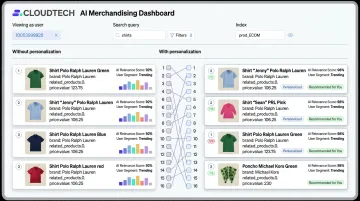
McKinsey reports a large North American retailer generated $150 million in value from generative AI-enabled targeted offers. That's an enterprise-scale result, but the underlying capability — personalized recommendations driven by behavioral data — is accessible to SMBs through Amazon Bedrock-based pipelines.
Retail and logistics applications:
- Personalized product recommendations based on purchase history and browsing behavior
- Dynamic pricing content generation
- Automated inventory status reports and reorder alerts
- Customer communication drafts for shipping updates, delays, and returns
Common Challenges and How to Overcome Them
Three challenges come up consistently in SMB gen AI implementations:
Poor data quality or siloed data — If your data is inconsistent, incomplete, or locked in disconnected systems, AI outputs will reflect that. The fix is a data readiness assessment before deployment, not after.
Lack of in-house AI expertise — Most SMBs don't have ML engineers on staff. Pre-built platforms like Amazon Bedrock significantly lower the technical bar, and working with an experienced implementation partner accelerates deployment while reducing risk. Cloudtech's team (70% former AWS employees) runs 4–8 week pilot engagements that deliver working prototypes before any large-scale commitment.
Integration complexity with legacy systems — Connecting gen AI services to existing EHRs, ERPs, or financial platforms requires careful API mapping and testing. AWS Direct Connect, Amazon VPC, and AWS Outposts provide the infrastructure layer for secure legacy integration without requiring a full system overhaul.
Compliance and ethics deserve equal attention. Gen AI can produce confident but incorrect outputs — NIST calls this "confabulation" — which makes human oversight non-negotiable in high-stakes contexts. Before going live, confirm your deployment addresses:
- Human-in-the-loop validation for clinical, financial, and legal decisions
- Review checkpoints built into workflows from day one
- Data privacy compliance with GDPR, HIPAA, or other applicable requirements
Frequently Asked Questions
What is generative AI automation?
Generative AI automation combines AI models capable of creating new content or making decisions with automated workflow systems. This lets automated processes handle complex, previously human-only tasks — drafting reports, answering queries, analyzing documents — without constant human involvement.
How does generative AI automation differ from traditional automation?
Traditional automation follows pre-programmed, rule-based scripts that fail on exceptions or unstructured input. Generative AI automation interprets context, reasons through ambiguity, and generates original outputs, making it far more adaptable to the variable, unstructured nature of real business workflows.
What are the best use cases for generative AI automation in 2026?
The top use cases are customer service automation, content and marketing generation, software development assistance, automated data analysis and reporting, and document processing. Highest ROI typically comes from high-volume, repetitive workflows that involve unstructured data.
How can small businesses implement generative AI automation without a large IT team?
Start with one clearly scoped use case and a pre-built platform like Amazon Bedrock — no custom model development required. An AWS-certified consulting partner can accelerate your first deployment and help avoid the common pitfalls that sink early pilots.
What AWS services support generative AI automation?
The core stack includes Amazon Bedrock (foundation models like Claude, Titan, and Llama), Bedrock Flows for workflow orchestration, SageMaker AI for custom model development, and AWS Lambda for serverless execution. Together, these services form a complete generative AI automation pipeline.
How long does it take to see ROI from generative AI automation?
Well-scoped pilots in customer support or document processing can show measurable results within weeks. More complex, cross-functional implementations typically deliver sustained ROI within 3–6 months of deployment.