This guide walks through a practical, step-by-step framework for calculating AWS cloud migration ROI. We cover what costs and benefits to include, how to apply the right formula, and where SMBs most commonly go wrong. The AWS Cloud Value Framework—spanning cost savings, staff productivity, operational resilience, business agility, and sustainability—serves as the lens throughout.
Key Takeaways
- ROI spans direct costs (infrastructure, labor, consulting) and indirect benefits (productivity, uptime, time-to-market)
- Use this formula: ROI = (Total Cloud Value – Total Migration Cost) ÷ Total Migration Cost × 100%
- Establishing a pre-migration baseline is the most overlooked—and most critical—step
- McKinsey research found migration inefficiencies produce 14% more unanticipated spend than planned
- MAP funding (AWS Partner program) can significantly cut out-of-pocket migration costs for eligible SMBs
What Is AWS Cloud Migration ROI?
AWS cloud migration ROI measures the business value gained from moving workloads to AWS—relative to the total investment made. It includes both direct financial returns and strategic benefits that compound over time.
Many organizations measure ROI too narrowly, treating it as a simple comparison between an on-premises server bill and an AWS bill. That approach captures cost reduction, not business value.
A McKinsey study of European cloud leaders found that organizations measuring value beyond IT captured cloud value at a 29% rate, versus just 13% among those focused only on IT metrics. For SMBs, that gap matters: an ROI model that excludes agility gains, productivity improvements, and resilience benefits understates the true return and weakens the case for migration when presenting to leadership.
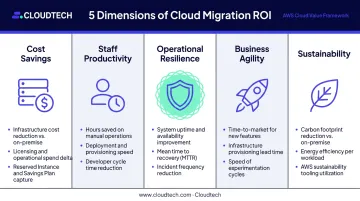
AWS defines five value dimensions that belong in any complete ROI calculation:
| Dimension | What to Measure |
|---|---|
| Cost savings | Avoided infrastructure, facilities, licenses, and support |
| Staff productivity | Maintenance hours avoided; capacity redirected to innovation |
| Operational resilience | Avoided outage frequency, duration, and revenue loss |
| Business agility | Faster provisioning, releases, and time-to-market |
| Sustainability | Energy efficiency gains and ESG program value |
Step 1: Establish Your Pre-Migration Baseline
You cannot calculate ROI without a clear picture of your current state. Skipping this step is the single most common reason migration budgets collapse.
Document Your Full On-Premises Cost Stack
Your baseline must capture every dollar your organization currently spends on on-premises operations:
- Hardware: servers, storage, network devices (include the next 5-year refresh cycle in your cost-of-doing-nothing analysis)
- Facilities: power, cooling, physical space, and property costs
- Software licensing: OS, database, middleware, and application licenses
- Personnel: the fully-loaded cost of IT staff managing on-premises systems
- Support contracts: vendor maintenance and break-fix agreements
AWS's directional guidance uses approximately 150 servers per on-premises FTE as a staffing benchmark, versus roughly 400 on AWS—treat this as directional guidance for estimating administrative savings. The ratio loses accuracy for portfolios under 50 servers.
Quantify the Cost of Doing Nothing
Attach dollar values to each operational pain point so finance and leadership can weigh them as hard costs, not just IT complaints.
Key areas to quantify:
- Unplanned downtime: ITIC's 2024 survey found hourly downtime costs exceeded $300,000 for 90% of mid-size and large enterprises. Use your own revenue-per-hour figures to calculate exposure specific to your organization
- Security incidents: covers breach remediation costs, regulatory penalties, and reputational damage
- Delayed releases: the competitive cost of shipping features weeks or months behind schedule
Use AWS Tools for Inventory
AWS Migration Evaluator (formerly TSO Logic) is the recommended starting point for building a directional business case. The assessment is complimentary and covers three things most SMBs need before committing to a migration budget:
- Compares your on-premises cost profile against AWS pricing scenarios
- Identifies right-sizing opportunities across your server inventory
- Produces a directional business case you can bring to leadership or a partner like Cloudtech for review
Note: AWS Application Discovery Service stopped accepting new customers in November 2025. New customers should use AWS Transform for discovery workflows.
Step 2: Calculate Your Total AWS Migration Costs
Migration costs fall into three buckets. Underestimating any one of them distorts your ROI calculation.
The Three-Bucket Cost Framework
- Pre-migration: Discovery, dependency mapping, compliance assessments, and proof-of-concept work. For SMBs, budget $5,000–$25,000 for assessment and planning.
- Execution: Migration labor, consulting fees, data transfer costs, tooling, and testing. Application refactoring can run $20,000–$100,000 depending on complexity.
- Post-migration: Ongoing compute, storage, networking, managed database services, and cloud administration—the recurring costs most ROI models underestimate.
How Migration Strategy Affects Total Cost
Your migration strategy directly shapes both upfront costs and long-term TCO:
- Rehost (lift-and-shift): Lowest initial effort, but fewer immediate savings. Hidden dependencies and security gaps can inflate costs if discovery is rushed.
- Replatform: Moves workloads to managed or serverless AWS services. Generally more cost-effective than rehosting over time, as managed services reduce operational overhead.
- Refactor: Highest upfront engineering investment, but typically delivers the lowest long-term TCO for workloads that justify a full redesign.
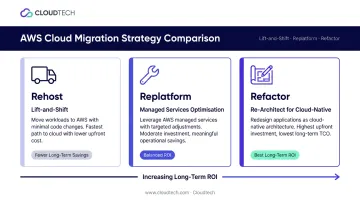
The right strategy depends on the workload, not a blanket preference. Workload-specific discovery—evaluating each application individually before assigning it a path—is what separates accurate cost models from ones that blow up six months post-migration.
Cost Consolidation Credits
Before finalizing your total cost figure, subtract these credits:
- Hardware decommissioning value (retiring aging servers)
- Eliminated data center real estate and power costs
- IT staff time freed from low-value maintenance
AWS Savings Plans and Reserved Instances can reduce compute costs by up to 72% versus On-Demand pricing—but only model these savings once usage patterns are predictable, typically 3–6 months post-migration.
Step 3: Quantify Benefits and Apply the ROI Formula
Assigning Dollar Values to the Five Benefit Dimensions
1. Cost savings: Infrastructure consolidation, eliminated licensing, and reduced facility spend. Pull these directly from your baseline comparison.
2. Staff productivity: The IDC research commissioned by AWS (41 enterprise organizations) reported 47% greater IT infrastructure team efficiency and 86% more staff time available for innovation post-migration. These figures reflect large-enterprise environments. For SMB planning, a conservative 20–30% efficiency gain is a more defensible estimate.
3. Operational resilience: Use your own revenue-per-hour figure multiplied by average annual downtime hours. If you experience 4 hours of unplanned downtime annually and generate $500,000 in monthly revenue, that's roughly $70,000 in annual exposure. That's a real number to put in the ROI numerator.
4. Business agility: Estimate the revenue impact of shipping features faster. If a product launch that currently takes 6 months could ship in 3, even 2–3 additional customer wins per quarter from faster time-to-market adds measurable revenue to your benefit total.
5. Sustainability: AWS infrastructure is up to 4.1 times more energy efficient than on-premises computing, and optimized workloads can reduce associated carbon footprints by up to 99%. For organizations with ESG reporting obligations, this has measurable program value.
Once you've assigned dollar values across all five dimensions, plug them into the formula below.
The ROI Formula—With a Worked Example
ROI = ((Total Cloud Value – Total Migration Cost) ÷ Total Migration Cost) × 100%
Here's how this plays out for a hypothetical SMB healthcare company migrating 50 servers:
Total Migration Cost (Year 1)
- Assessment and consulting: $20,000
- Migration execution: $45,000
- Year 1 AWS compute and storage: $60,000
- Total: $125,000
Total Cloud Value (Year 1)
- Eliminated on-premises infrastructure costs: $80,000
- Avoided MSP/maintenance fees: $35,000
- Productivity gains (IT staff redirected): $25,000
- Avoided downtime costs: $15,000
- Total: $155,000
Year 1 ROI: ($155,000 – $125,000) ÷ $125,000 × 100% = 24%
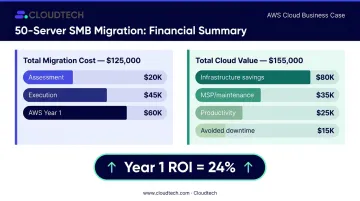
By Year 3, with one-time migration costs fully absorbed and AWS spend optimized through Savings Plans, the same organization typically reaches 60–80% ROI — driven by productivity gains, faster feature delivery, and stable cloud infrastructure costs.
Realistic ROI Timelines
- 6–12 months: Early payback from data center decommissioning and eliminated facility costs
- Year 2–3: Full ROI including agility, innovation, and productivity gains materializes
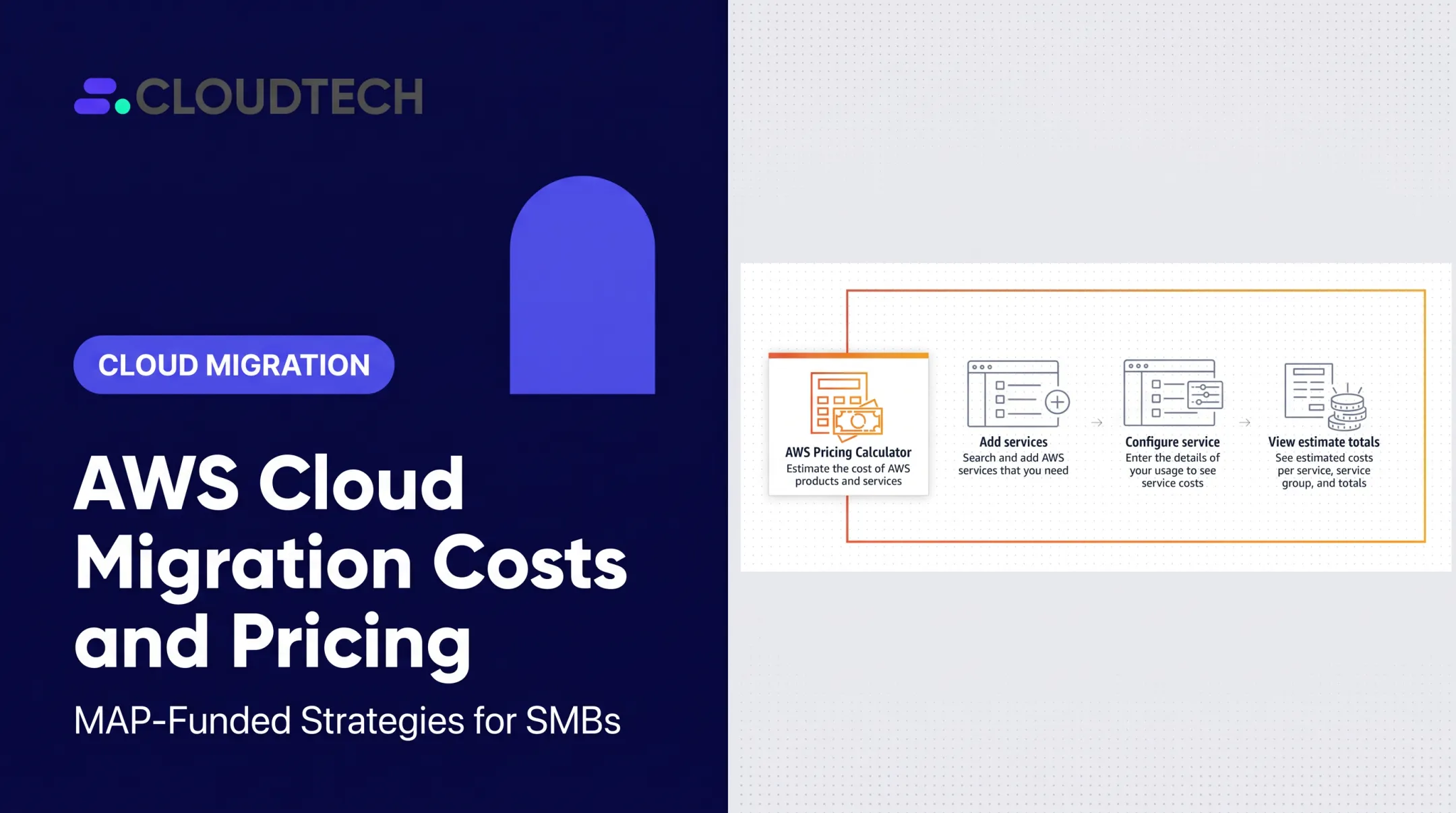
Use the AWS Pricing Calculator and Migration Evaluator to model projected costs and anchor your denominator with real estimates before committing to migration.
Hidden Costs That Derail AWS Migration Budgets
Even well-planned migrations encounter surprises — and these surprises directly erode your ROI. Three cost categories cause the most damage:
Data Transfer and Egress Fees
AWS provides the first 100 GB/month of aggregate regional internet egress free. Beyond that, costs vary by region—VPC pricing shows $0.09/GB in US East (Ohio), and cross-AZ traffic within the same region is charged at $0.01/GB in each direction. If workloads aren't architected for data locality, these fees accumulate fast.
Mitigation: Map data flows before migration. Architect workloads to minimize cross-region transfers where possible.
Licensing Mismatches
Microsoft SQL Server and Oracle workloads are the most common licensing traps:
- SQL Server on EC2: BYOL requires compliance with Microsoft Software Assurance terms. Certain licenses without SA must have been acquired before October 1, 2019
- Oracle on RDS: License Included is limited to Standard Edition Two. BYOL requires appropriate licenses and Software Update License and Support
- SQL Server on RDS: License Included covers the software, hardware, and RDS management, which is often the simpler path for SMBs compared to BYOL
Mitigation: Conduct a licensing audit before migration scoping, not after.
Idle and Overprovisioned Resources
Orphaned EBS volumes, abandoned EC2 instances, and oversized compute accumulate unnoticed after go-live. These aren't one-time costs — they compound every month.
Mitigation: Implement resource tagging policies on day one. Right-size instances based on actual utilization data from Migration Evaluator, not assumptions from on-premises planning.
How to Maximize AWS Cloud Migration ROI
Apply FinOps Discipline Post-Migration
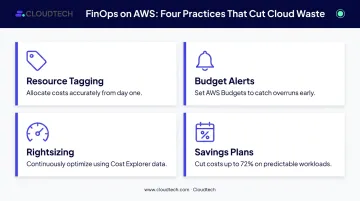
FinOps practices determine whether ROI projections become reality or remain theoretical:
- Enforce consistent resource tagging from day one to allocate costs accurately
- Set budget alerts with AWS Budgets (monitoring and notifications are free; the first two action-enabled budgets are free, then $0.10/day each)
- Rightsize instances continuously using utilization data from AWS Cost Explorer
- Commit to Reserved Instances or Savings Plans for predictable workloads once usage stabilizes—cutting costs up to 72% versus On-Demand pricing
Get Stakeholder Alignment Right
McKinsey found that cloud outperformers were 32% more likely to have active CEO sponsorship and 57% more likely to hire advanced skills like DevOps and FinOps practitioners. Leadership engagement isn't optional—it's a measurable differentiator between migrations that hit their ROI targets and those that fall short.
Before migration begins, three alignment factors are non-negotiable:
- A defined project owner with decision-making authority
- Cross-functional involvement between IT and finance teams
- Clear success metrics agreed upon upfront
Work with an AWS Partner
For SMBs that can't afford to build internal FinOps or DevOps capability overnight, working with an experienced AWS Partner closes that gap quickly. Cloudtech, an AWS Advanced Tier Partner and one of only 26 partners globally selected for AWS's Small Business Acceleration Initiative, helps SMBs model ROI scenarios before committing to migration. The team—70% former AWS employees with 100+ certifications—can build pre-migration business cases, identify licensing risks, and deliver pre-packaged migration solutions in weeks.
Working with an AWS Migration Competency Partner can unlock AWS Migration Acceleration Program (MAP) funding, which can offset or eliminate upfront migration costs for eligible SMBs. Cloudtech's engagement begins with a one-day discovery workshop that directly feeds into a prioritized roadmap—the artifact that gets leadership to yes.
Frequently Asked Questions
What is a good ROI for AWS cloud migration?
ROI benchmarks vary by industry, workload complexity, and migration strategy. Refactored workloads consistently outperform lift-and-shift over a 3-year horizon due to lower steady-state operating costs. Enterprise-focused research (IDC, 2022) reported 413% five-year ROI for large organizations. SMBs should treat that figure as directional context, not a realistic baseline.
How long does it take to see ROI from AWS cloud migration?
Short-term wins from data center cost reduction typically appear within 6–12 months. Full ROI including agility and innovation gains usually materializes in years 2–3. Migration strategy directly affects breakeven timing: rehosting delivers faster initial savings, while refactoring produces greater long-term returns.
What is the formula for calculating AWS cloud migration ROI?
ROI = ((Total Cloud Value – Total Migration Cost) ÷ Total Migration Cost) × 100%. Total cloud value must include both direct savings and indirect benefits such as productivity gains and avoided downtime costs—not just the infrastructure cost differential.
What costs should be included in an AWS cloud migration ROI calculation?
Include one-time costs (assessment, consulting, data migration, testing) and ongoing costs (compute, storage, networking, administration). Cost consolidation credits from retiring on-premises hardware and eliminating facility expenses should offset the total migration cost in your model.
How can SMBs reduce their AWS cloud migration costs?
Three levers matter most: right-size resources from day one rather than lifting and shifting over-provisioned capacity, commit to Reserved Instances or Savings Plans once usage stabilizes, and work with an AWS Partner to access MAP funding that can reduce or eliminate upfront out-of-pocket expenses.
What AWS tools can help calculate cloud migration ROI?
The AWS Pricing Calculator, Migration Evaluator, AWS Cost Explorer, and the AWS Cloud Economics portal are the primary free resources for modeling projected costs and building a business case supported by real usage data. Note that Cost Explorer API calls cost $0.01 per paginated request for programmatic access.