Introduction
A coordinated network of AI agents is fundamentally different from a single agent handling one isolated task. Multi-agent generative AI systems require deliberate architecture decisions, defined communication protocols, and an orchestration layer built to hold up under real production conditions — not just demo environments.
Who should lead this? Organizations with in-house ML or cloud engineering talent — or those working with a specialized AWS or cloud consulting partner. Handing this off to a general IT team without AI experience is how you end up with a system that looked promising in the demo and fails quietly in production.
Without proper planning, the failure modes are predictable:
- Agents that conflict with each other and produce inconsistent outputs
- Compute costs that spiral past any reasonable budget
- Hallucinated outputs that bypass every validation check
- Silent system failures because no one built monitoring in from the start
Gartner estimates that over 40% of agentic AI projects will be canceled by end of 2027 due to escalating costs, unclear value, or inadequate risk controls. This guide covers the full implementation path — from readiness assessment through deployment and validation — so your project doesn't become part of that statistic.
Key Takeaways
- Multi-agent GenAI systems use specialized, coordinated AI agents to handle complex workflows no single agent could complete alone
- Successful implementation follows a clear sequence: assess readiness → define agent roles → select frameworks → build and integrate → validate and monitor
- The most common failure points are poorly scoped agent roles, missing orchestration logic, and no post-deployment monitoring
- AWS services — Bedrock Agents, Lambda, Step Functions, SQS — give you a natively integrated infrastructure layer to build and scale these systems
- Start narrow: one use case, two or three agents, then scale — SMBs consistently see stronger outcomes this way
What Is Multi-Agent Generative AI?
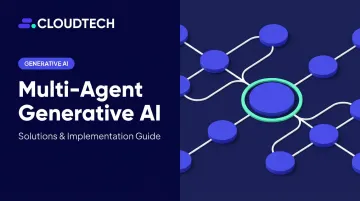
A multi-agent generative AI system is a network of autonomous AI agents, each powered by a large language model, that perceive inputs, reason through tasks, take actions, and communicate with other agents to achieve a shared goal.
That's a different architecture from a single-agent setup, and a different category from the AI tools most teams already use:
- AI assistants react to prompts
- AI copilots provide proactive support within a defined scope
- AI agents operate autonomously toward goals, taking multi-step actions
- Multi-agent systems assign those roles to specialized agents — a research agent, a validation agent, a writing agent — working in sequence or parallel
How the Operational Loop Works
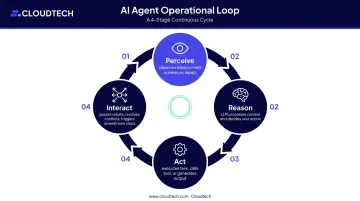
Each agent in the system follows the same core cycle:
- Perceive — observes its environment or receives inputs from another agent or an external system
- Reason — the LLM processes context and decides the next action
- Act — executes a task, calls a tool, or generates an output
- Interact — passes results to the next agent, resolves conflicts, or triggers downstream workflow steps
Why This Matters for SMBs
Because each agent handles a defined role, the system as a whole gains capabilities a single model can't match:
- Parallelization — complex workflows get broken into simultaneous tasks, reducing total processing time
- Fault tolerance — if one agent fails, others continue operating
- Scalability — add agents for new tasks without rebuilding the core system
- Specialization — each agent can be tuned for its specific function
In healthcare, for example, one agent pulls patient records, a second analyzes symptoms against clinical databases, a third drafts a care summary, and a fourth flags anything requiring physician review — without a staff member manually managing handoffs between each step.
Implementation Guide for Multi-Agent Generative AI
A multi-agent implementation broadly covers four phases: planning and readiness, agent design and framework selection, integration and build, and validation and monitoring. Shortcuts in any phase compound into problems in production.
A realistic expectation: a well-scoped first implementation with two to four agents typically takes 6–12 weeks with the right expertise and infrastructure. More complex systems take longer, and ongoing governance never really stops.
Prerequisites and Readiness Assessment
Before any build begins, three things need to be in place:
- A clearly defined use case where multi-agent complexity is genuinely justified — not a task a single LLM call could handle
- Access to quality data sources the agents will query or act upon
- A cloud environment capable of supporting LLM API calls, orchestration logic, and inter-agent messaging at scale
Technical readiness check:
- Does your team have working knowledge of LLM APIs (OpenAI, Anthropic, AWS Bedrock)?
- Has anyone on the team worked with at least one orchestration framework?
- Is logging and monitoring infrastructure already in place — or planned?
Hard non-negotiables — do not proceed if:
- The use case is still loosely defined
- Data governance or security review hasn't been completed (especially in healthcare or financial services)
- There is no designated owner responsible for monitoring agent behavior after deployment
Once your environment and use case are locked in, the next decision is which framework and tools will carry the build. The right choice depends on your workflow's structure and your team's existing familiarity — not just what's trending.
Frameworks and Tools for Building Multi-Agent Systems
| Framework | Best For | Key Strengths |
|---|---|---|
| AutoGen | Code generation, conversational loops | Event-driven architecture, team-state management, detailed tracing |
| CrewAI | Business workflow automation | Role-based agent teams, sequential/hierarchical/hybrid processes |
| LangGraph | Complex branching logic | Graph-based stateful workflows, checkpointing, durable execution |
| LangChain | Broad integrations | Foundational toolkit, wide ecosystem, subagent support |
For teams building on AWS, Amazon Bedrock Agents provides a fully managed layer for creating, orchestrating, and deploying agents with native integrations to Lambda, S3, and DynamoDB — making it a strong fit for organizations that want to reduce infrastructure overhead and stay within a managed cloud environment.
Cloudtech, an AWS Advanced Tier Partner, designs and deploys Bedrock-based multi-agent architectures for SMBs. Each engagement integrates Lambda for compute logic, Step Functions for multi-step orchestration, SQS for asynchronous decoupling, and DynamoDB for metadata persistence.
Supporting infrastructure you'll also need:
- A messaging or event layer for inter-agent communication (Step Functions, SQS)
- A vector database for RAG if agents need to query proprietary data (AWS supports OpenSearch Serverless, Aurora PostgreSQL, Pinecone, MongoDB Atlas, and others)
- An observability layer — CloudWatch and AWS X-Ray — to trace agent decisions and outputs
With your framework and infrastructure selected, you can move into the build itself. The sequence below maps to how production-ready systems are actually constructed — each step depends on the one before it.
Step-by-Step Implementation
Step 1 — Define the problem and agent roles Identify the end-to-end workflow, break it into discrete tasks, and assign each task to one agent with a clear input, output, and scope. Overlapping responsibilities between agents are one of the most common causes of coordination failures.
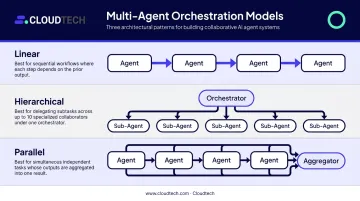
Step 2 — Design the orchestration logic Choose your model based on actual workflow dependencies:
- Linear — one agent passes output to the next in sequence
- Hierarchical — an orchestrator agent delegates to sub-agents (Bedrock's supervisor/collaborator model works well here; AWS limits a supervisor to 10 collaborators)
- Parallel — multiple agents work simultaneously and results are aggregated
Step 3 — Build and integrate agents Select your framework, configure each agent's LLM backbone, define its tools and data access, and establish communication protocols. Start with two agents in a controlled test environment before adding complexity.
Step 4 — Connect to external systems and data Integrate agents with the APIs, databases, and business systems they need to act on. Scope access controls and data permissions to each agent's specific role — not broadly across the system.
Step 5 — Deploy to a managed cloud environment Package agents as containerized services or use a managed platform like Bedrock Agents. Configure the orchestration layer, set up alerting for agent failures or unexpected outputs, and deploy to staging before production.
Post-Implementation Validation
Before any production rollout, run end-to-end test scenarios with known inputs and expected outputs. Check that each agent's outputs are logically consistent and that handoffs are producing the right downstream behavior. Log every agent interaction during testing.
Signs a multi-agent system is failing in staging:
- Agents producing conflicting outputs with no resolution mechanism
- Latency spikes pointing to communication bottlenecks
- Repeated tool call failures
- Hallucinated results bypassing the validation layer
Catching these issues in staging prevents production incidents that affect real users — a minor fix in testing can take hours; the same problem in production can take days and carry real business cost.
Cloudtech runs staged deployments that mirror production before any go-live. Stress testing, fault injection, and compliance audits are all completed before launch, not after.
Common Implementation Challenges and How to Fix Them
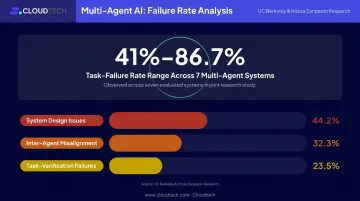
A UC Berkeley/Intesa Sanpaolo study analyzing 1,642 traces from seven open-source multi-agent systems found task-failure rates between 41% and 86.7%. System-design issues accounted for 44.2% of classified failures, inter-agent misalignment 32.3%, and task-verification failures 23.5%. Multi-agent systems introduce emergent behaviors that are difficult to anticipate — these three failure patterns show up most often in production systems, along with practical fixes for each.
Agent Coordination Failures
Problem: Agents produce outputs that conflict or operate out of sequence, resulting in incorrect final results.
Likely cause: Overlapping agent responsibilities, or an orchestration layer that doesn't enforce task sequencing.
Fix: Redesign agent role boundaries so each agent has one clear responsibility. Add an explicit orchestrator or manager agent whose job is to validate handoffs and resolve conflicts before passing results downstream. The study above found that adding high-level verification to one system improved task success by 15.6%.
LLM Hallucination Without a Validation Layer
Problem: One or more agents produce confidently stated but factually incorrect outputs, and those outputs propagate unchallenged.
Likely cause: No answer-checking or verification agent in the workflow; agents grounded only in model knowledge rather than authoritative data sources.
Fix: Introduce a dedicated validation agent that cross-checks outputs against a grounded data source — a RAG pipeline, a trusted API, or a curated knowledge base — before results pass downstream or reach end users. For teams building on AWS, Amazon Bedrock Guardrails adds contextual grounding checks, content filters, and sensitive information masking on top of that validation layer.
Escalating Compute Costs
Problem: LLM API costs grow unpredictably as agent interactions multiply. Anthropic's own research system found that multi-agent systems consumed roughly 15x more tokens than standard chat interactions — at scale, that token volume translates directly to runaway API spend.
Likely cause: Large, expensive models assigned to tasks that don't need them; agents making redundant API calls due to poor workflow design.
Fix: Three adjustments bring costs under control:
- Assign smaller, cost-efficient models to low-complexity tasks like formatting, classification, or link validation
- Reserve large models only for high-reasoning steps where accuracy is non-negotiable
- Implement caching for repeated queries and set hard token limits per agent interaction
Pro Tips for Implementing Multi-Agent GenAI Effectively
Start narrower than you think you need to. Implement one well-defined use case with two or three agents before scaling. Teams that attempt comprehensive multi-agent ecosystems on the first build consistently face integration failures and runaway complexity. Prove value with a contained system, then expand.
Document every agent's decision logic from day one. Maintain a shared interaction log from the start. When unexpected behavior occurs in a multi-agent system — and it will — traceability is the difference between a one-hour debug session and a multi-day investigation. Invest in observability infrastructure before it becomes urgent.
For SMBs without dedicated AI engineering teams, finding the right implementation partner makes a tangible difference in how quickly a system goes from concept to production. Cloudtech's AWS-certified architects have designed and deployed multi-agent GenAI systems on Amazon Bedrock for clients across healthcare, financial services, and manufacturing — with cost architecture built in from the start, not patched in after the fact.
Conclusion
The quality of a multi-agent generative AI implementation determines whether the system delivers consistent business value or becomes an unpredictable liability. Careful role design, disciplined orchestration, and rigorous validation are not optional steps — skip any one of them and failure tends to surface at the worst possible moment.
Start small, validate thoroughly, and scale with intention. Organizations that treat multi-agent AI as an ongoing system to govern and improve — rather than a one-time build — consistently see better outcomes, fewer costly rollbacks, and faster iteration cycles as their needs evolve.
Frequently Asked Questions
What is an example of a multi-agent system in AI?
A customer service system is a practical example: one agent handles initial triage, a second retrieves account information, a third generates a personalized response, and a fourth escalates to a human if the query exceeds its scope.
What are the different types of AI agents?
The main categories are simple reflex agents (react to current inputs), goal-based agents (plan actions toward a defined objective), learning agents (improve over time from experience), and LLM-powered agents (reason through complex tasks using large language models).
What is the difference between a single-agent and multi-agent AI system?
A single-agent system has one AI entity handling a task end-to-end. A multi-agent system distributes that work across multiple specialized agents, each optimized for its specific function. Multi-agent systems handle complex parallel workflows better, but they require more sophisticated orchestration and governance to operate reliably.
How long does it take to implement a multi-agent generative AI system?
A well-scoped initial implementation with two to four agents typically takes 6–12 weeks. More complex enterprise systems with many agents, proprietary data integrations, and strict compliance requirements take considerably longer.
What are the main challenges of implementing multi-agent AI for small businesses?
SMBs consistently run into three challenges:
- Scoping a use case that actually justifies multi-agent complexity over a simpler single-agent approach
- Managing LLM API costs as agent interactions multiply at scale
- Building monitoring and governance without a dedicated AI team
Which industries benefit most from multi-agent generative AI?
Industries with complex, multi-step workflows and high data volumes see the strongest results. That includes healthcare (patient triage and documentation), financial services (risk analysis and compliance), manufacturing (supply chain optimization), and SaaS (automated software development and QA).