Introduction
Most enterprise data doesn't live in neat text files. It lives in PDFs with embedded charts, recorded training videos, product images, scanned forms, and customer call recordings — formats that text-only AI systems can't search or reason over.
Multimodal RAG (Retrieval-Augmented Generation) solves this by ingesting, indexing, and retrieving information across text, images, audio, and video within a single pipeline. That retrieved context feeds directly into a foundation model to generate accurate, grounded answers.
McKinsey reported in 2024 that generative AI has opened up "the other 90 percent of data" — unstructured content like videos, pictures, chats, and product reviews that traditional systems couldn't access. Multimodal RAG is how organizations finally put that data to work.
This guide is written for developers, architects, and technical decision-makers evaluating multimodal RAG on Amazon Bedrock. It covers how the system works end-to-end, which AWS services power it, and the trade-offs that determine whether it's the right fit for a given use case.
Key Takeaways
- Multimodal RAG extends standard RAG to handle text, images, audio, and video within a unified retrieval pipeline
- Amazon Bedrock offers two processing approaches: Amazon Nova Multimodal Embeddings for native cross-modal encoding and Bedrock Data Automation for converting content to text before embedding
- Amazon Bedrock Knowledge Bases automates the full RAG workflow — ingestion through retrieval — without custom infrastructure
- Choosing between the two approaches depends on whether visual fidelity or speech/transcript precision matters more
- Multimodal RAG introduces real cost, latency, and complexity trade-offs that must be weighed before implementation
What Is Multimodal RAG?
Standard RAG is a technique where an AI model retrieves relevant content from an external knowledge base before generating a response, grounding answers in factual source material rather than relying solely on training data. The limitation: standard RAG operates on text documents only.
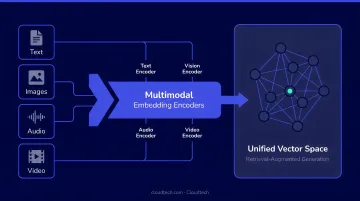
That limitation matters when your knowledge base includes product diagrams, training videos, scanned documents, or equipment photos — content that text-only retrieval simply can't surface. Multimodal RAG removes that constraint by ingesting and encoding content across modalities — text, images, video, and audio — into a shared vector space. A user can submit a text query and retrieve relevant video clips, or upload an image and get back visually similar products. Every content type shares the same vector representation, making cross-modal retrieval possible.
How It Differs from Related Approaches
Two common approaches are often confused with multimodal RAG, but they solve a narrower problem:
- Attaching images directly to a model prompt (direct multimodal inference) works for one-off reasoning but breaks down across thousands of assets — there's no retrieval layer, so the model only sees what you manually include.
- Standalone visual search pipelines handle image similarity but operate independently from text retrieval and answer generation — no unified workflow.
Multimodal RAG integrates all modalities into a single, unified retrieval and generation workflow backed by a vector database. That's what makes it suitable for enterprise-scale knowledge bases with diverse content.
Why Organizations Use Multimodal RAG on Amazon Bedrock
The core problem is straightforward: most organizational knowledge doesn't exist in structured databases. It exists in formats that text-only systems can't process.
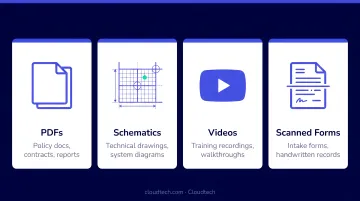
Consider what a manufacturer's knowledge base actually contains: maintenance videos, engineering schematics, scanned equipment manuals, and recorded training sessions. A text-only RAG system retrieves none of that.
The same gap shows up across industries. An e-commerce catalog with thousands of product images, a healthcare organization with diagnostic imaging alongside clinical notes — text-only RAG leaves a substantial portion of that knowledge inaccessible.
Content types that text-only RAG misses:
- Product diagrams and engineering schematics
- Radiology and diagnostic images
- Scanned forms and handwritten documents
- Training videos and recorded demonstrations
- Customer call recordings and meeting transcripts
Amazon Bedrock addresses this through a fully managed service layer. Organizations don't need to maintain custom embedding models, GPU infrastructure, or separate preprocessing pipelines. Amazon Bedrock Knowledge Bases with multimodal retrieval became generally available on November 30, 2025, a recent capability update for teams building on AWS.
For SMBs without dedicated ML infrastructure teams, that managed layer removes the biggest setup barriers. Cloudtech, an AWS Advanced Tier Partner, regularly guides SMBs through these Bedrock configuration decisions — particularly IAM roles, S3 data organization, and model access enablement across regions, which are consistent friction points in first-time implementations.
How Multimodal RAG Works on Amazon Bedrock
Content from diverse sources is ingested, parsed into modality-specific chunks, encoded into vector embeddings, and stored in a vector database. When a user submits a query, the system retrieves the most semantically relevant chunks and passes them to a foundation model for answer generation.
Amazon Bedrock Knowledge Bases orchestrates this entire workflow. The two most consequential configuration decisions — parsing strategy and embedding model selection — happen at the Knowledge Base level.
Step 1: Data Ingestion and Parsing
Content (PDFs, images, audio files, video files) is uploaded to an Amazon S3 bucket, which serves as the data source. The Knowledge Base ingestion job processes each file according to the configured parsing strategy.
The ingestion job supports two parsing strategies:
- Default Bedrock parser — used when feeding content directly into Amazon Nova Multimodal Embeddings for native encoding
- Bedrock Data Automation (BDA) — converts multimodal content to text before embedding
What BDA does during parsing:
- Images: Generates descriptive summaries, extracts embedded text via OCR with word-level coordinates and confidence scores, and detects objects with bounding boxes
- Video: Produces chapter-level summaries, extracts on-screen text (static and dynamic), and segments content with millisecond-level timestamps
- Audio and video with speech: Generates full transcripts with segment and word-level timestamps plus speaker identification/diarization
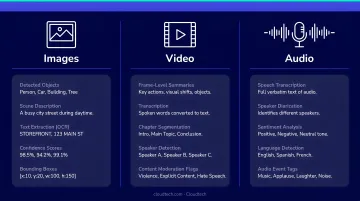
That structured text output is what gets chunked and embedded in the text-first approach — which makes the embedding model choice in Step 2 the critical next decision.
Step 2: Embedding and Vector Indexing
Two embedding pathways are available:
| Approach | Best For | Embedding Model |
|---|---|---|
| Native multimodal | Visual similarity, cross-modal queries | Amazon Nova Multimodal Embeddings |
| Text-first | Transcript precision, compliance records | Amazon Titan Text Embeddings V2 (after BDA conversion) |
Amazon Nova Multimodal Embeddings (model ID: amazon.nova-2-multimodal-embeddings-v1:0) encodes text, images, video segments, and audio natively into a unified vector space. AWS lists configurable output dimensions of 3072, 1024, 384, and 256 — allowing teams to balance retrieval precision against storage and compute costs. Batch inference support was added in November 2025, cutting per-unit embedding costs at scale.
Bedrock Knowledge Bases manages indexing into a connected vector store. For multimodal content, original media files are stored in S3 so retrieved results can return the actual image, video segment, or audio clip alongside text metadata — not just a description of it.
Supported vector store options include:
- Amazon S3 Vectors
- Amazon OpenSearch Serverless
- Amazon Aurora PostgreSQL
- Pinecone, MongoDB Atlas, Redis Enterprise Cloud
Step 3: Retrieval and Answer Generation
At query time, the user's input (text, image, or both) is encoded using the same embedding model used during ingestion. The Knowledge Base runs a vector similarity search to identify the most semantically relevant chunks — regardless of whether those chunks are text passages, image segments, video clips, or audio excerpts.
The retrieved multimodal context is passed as part of the prompt to a foundation model available through Amazon Bedrock — such as Anthropic Claude 3.5 Sonnet, Claude 3.7 Sonnet, or Amazon Nova Pro. The model uses both the retrieved evidence and its own reasoning to generate a grounded answer.
Returning retrieved content in its original modality — the actual image rather than its text description — improves answer quality for visually complex queries. BDA-generated text descriptions work well for keyword retrieval but can miss subtle visual characteristics that drive meaningful similarity matching. This tradeoff is worth factoring in when choosing between the native multimodal and text-first approaches.
Key AWS Services and Configuration Factors
Vector Store Selection
The choice of vector store has more impact than many teams expect:
- Amazon S3 Vectors — AWS states it can reduce vector storage and query costs by up to 90% compared to traditional vector database approaches, making it well-suited for large-scale multimodal catalogs where cost containment matters
- Amazon OpenSearch Serverless — supports hybrid search (combining keyword and semantic vector search), which benefits text-heavy multimodal pipelines where exact-term matching alongside vector similarity improves recall
Vector dimension alignment is a hard requirement: the embedding model and vector store index must use matching dimensions. Mismatches cause silent retrieval failures where queries return results, just not the relevant ones.
Choosing Between Nova Embeddings and Bedrock Data Automation
This is the decision most teams spend the most time on.
Choose Amazon Nova Multimodal Embeddings when:
- The use case is visual-first (product search, scene retrieval, image-to-image matching)
- Users will submit image queries, not just text
- Capturing subtle visual characteristics is more important than verbatim text precision
Choose Bedrock Data Automation when:
- The primary retrieval need is over spoken content or meeting transcripts
- Compliance records require exact verbatim quotes
- The content is audio or video with complex speech that needs structured transcript output
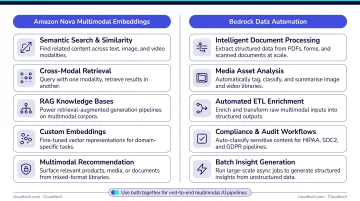
Both approaches can coexist in the same workflow for pipelines that handle mixed content types.
Cost and Latency Considerations
Richer content processing makes multimodal RAG more expensive and slower than text-only RAG. That tradeoff is inherent to the approach, though teams can partially offset it:
- Prompt caching on Amazon Bedrock can reduce inference costs by up to 90% and latency by up to 85% for supported models, according to AWS documentation
- Batch embedding (available for Nova Multimodal Embeddings as of November 2025) reduces per-unit costs during large ingestion jobs
- Using S3 Vectors for storage versus a provisioned vector database reduces ongoing operational costs significantly
These optimizations help, but they don't eliminate the latency ceiling. Multimodal RAG is a poor fit for applications requiring sub-second response times, especially when BDA is preprocessing large video or audio files.
Factor those latency characteristics into architectural decisions before committing to a design.
Common Misconceptions and When Not to Use Multimodal RAG
Misconception 1: "It's just adding images to a prompt"
Attaching a few images to a model prompt is direct multimodal inference — useful for one-off reasoning, but not designed for scale. Multimodal RAG involves a systematic retrieval step that finds the right content at query time from a corpus that may contain millions of assets. The distinction matters when building applications that need to search and surface the right content from a large, growing library.
Misconception 2: "One embedding approach fits all content"
Teams frequently default to either native multimodal embeddings or text-first conversion for all content without evaluating the trade-off per content type. Speech-heavy content processed only through Nova embeddings loses transcript precision that BDA would preserve. Conversely, running all product images through BDA generates text descriptions that fail to capture subtle visual characteristics. The content type should drive the processing decision.
When Multimodal RAG Is Unnecessary
Not every retrieval problem calls for a multimodal architecture. These scenarios typically don't:
- All organizational knowledge already exists in well-structured text documents — standard text RAG delivers equivalent results at lower cost and complexity
- The application only needs to process a small, fixed set of images or videos (a few dozen assets) — direct multimodal prompting with files loaded in context often outperforms a full RAG pipeline
- Retrieval quality problems can be solved by improving text chunking, metadata filtering, or hybrid search on existing text data
Before committing to the architecture, confirm that the problem genuinely requires cross-modal retrieval. If improving text chunking or metadata filtering would close the gap, that's the lower-cost path. Multimodal RAG earns its overhead only when diverse content types are central to the retrieval problem — not incidental to it.
Frequently Asked Questions
What is the difference between multimodal RAG and standard RAG?
Standard RAG retrieves and reasons over text documents only. Multimodal RAG extends retrieval to images, audio, and video by encoding all content types into a shared vector space, enabling queries that span modalities — a text question can return relevant video clips, and an image query can surface visually similar catalog items.
What AWS services are required to build a multimodal RAG application on Amazon Bedrock?
Four core services power the stack:
- Amazon Bedrock Knowledge Bases — retrieval orchestration
- Amazon S3 — data source and vector storage
- Amazon Nova Multimodal Embeddings or Bedrock Data Automation — content processing
- A Bedrock foundation model (Claude 3.5 Sonnet, Claude 3.7 Sonnet, or Amazon Nova Pro) — answer generation
When should I choose Amazon Nova Multimodal Embeddings over Bedrock Data Automation?
Nova Multimodal Embeddings is best for visual-first use cases — product search, scene retrieval, and image-to-image matching. Bedrock Data Automation is better when retrieval precision over spoken content, meeting transcripts, or compliance records requiring verbatim quotes is the priority. Complex pipelines can use both.
Does multimodal RAG on Amazon Bedrock support audio and video content?
Yes. Amazon Bedrock Knowledge Bases multimodal retrieval, generally available as of November 30, 2025, natively supports audio and video alongside text and images. Amazon Bedrock segments video into configurable time-based chunks and encodes them with Nova Multimodal Embeddings, or converts them to structured transcripts via Bedrock Data Automation.
What industries benefit most from multimodal RAG applications?
Manufacturing, e-commerce, healthcare, financial services, and legal organizations see the strongest returns. Each field manages mixed-format content — technical diagrams, product catalogs, diagnostic images, compliance records — that text-only systems simply cannot index or retrieve effectively.
How does multimodal RAG handle queries submitted as images rather than text?
When a user submits an image query, it's encoded by the same multimodal embedding model used during ingestion and matched against stored vectors via semantic similarity. The system returns visually similar or contextually related content regardless of its original modality — no text description of the query image is required.