Introduction
According to the American Hotel & Lodging Association, 65% of hotels reported staffing shortages in 2025, with 71% unable to fill open positions and affected properties averaging 6–7 vacant roles at any given time.
Meanwhile, guests increasingly benchmark hotel service against the seamless digital experiences they get from retail and streaming apps — not other hotels.
AI agents are filling that gap: handling routine requests, personalizing interactions, and freeing staff to focus where human judgment matters most.
This guide covers:
- What AI agents actually are — and how they differ from basic chatbots
- Where they deliver the most impact across the guest journey
- What to evaluate before buying
- Why the cloud infrastructure underneath should factor into your decision
Key Takeaways
- 65% of hotels face staffing shortages, making automation a strategic necessity rather than a luxury
- AI agents go beyond chatbots — they take autonomous, multi-step actions integrated with hotel systems
- Guest impact spans the full stay cycle: pre-arrival booking through post-stay re-engagement
- AI handles routine requests while staff focuses on relationships — that division is what makes the escalation model effective
- Cloud infrastructure quality determines AI agent reliability — poor foundations translate directly to latency, failures, and lost guest trust
What Are AI Agents in Hospitality?
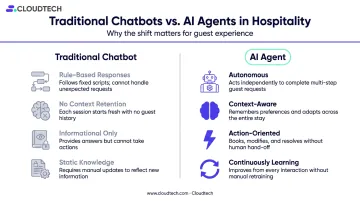
An AI agent is software that understands context, makes decisions, and executes multi-step tasks autonomously. It doesn't just match keywords to responses — it reasons about intent, accesses connected systems, and takes action.
That's a significant step beyond what most hotel chatbots actually do.
Agentic AI vs. Traditional Chatbots: A Critical Distinction
Consider a simple guest request: "Can I check in early?"
- Traditional chatbot: Returns a scripted response. "Early check-in is subject to availability. Please call the front desk."
- AI agent: Checks room availability in the PMS, coordinates with housekeeping on turnover status, confirms the early check-in to the guest, and logs the request — without a staff member touching it.
The same question produces a completely different outcome. Four characteristics define what makes an AI agent genuinely different:
- Autonomous — sets goals and pursues them across multiple steps without constant human prompting
- Context-aware — understands guest intent, sentiment, and history, not just the literal words used
- Action-oriented — executes tasks through live system integrations, not just conversational replies
- Continuously learning — improves from each interaction over time
Why Hotels Are Adopting AI Agents Now
Two forces are converging. First, labor shortages aren't resolving — US hotel employment remains nearly 10% below pre-pandemic levels, and housekeeping and front desk roles are the hardest to fill. Second, guests now expect digital convenience on par with the apps they use daily.
Research from Oracle Hospitality and Skift found that 73% of travelers want to manage their entire hotel experience from a mobile device, and approximately 74% are interested in AI-tailored offers or improved customer service.
An H2c study of 171 hotel chains found 78% already use AI and 89% plan to expand applications within 24 months.
Real-time PMS integrations and falling LLM costs have made hospitality-grade AI agents viable for independent properties and boutique hotels, not just major chains.
Key Use Cases: AI Agents Across the Guest Journey
AI agents don't solve one problem at one moment. They operate across the full guest lifecycle, creating consistent value at every touchpoint.
Pre-Arrival and Booking
Before a guest arrives, AI agents handle:
- Booking inquiries and real-time room availability checks
- Reservation modifications and upgrade requests
- Automated confirmation and pre-arrival communication
The downstream effect is straightforward: faster responses mean fewer guests who abandon an inquiry and book a competitor. An agent that replies to a room inquiry in seconds — at 11pm on a Saturday — converts guests that a front desk team simply can't reach.
During the Stay
This is where AI agents deliver the most visible ROI. Core in-stay applications include:
- 24/7 concierge responses — pool hours, gym schedules, local restaurant recommendations, parking instructions — handled instantly without pulling staff away from complex interactions
- Service coordination — housekeeping and room service requests logged, routed to the right team, and confirmed back to the guest automatically
- Real-time escalation — when sentiment signals frustration, the agent flags the conversation and routes it to a human with full context already attached
That service layer also creates a natural opening for revenue opportunities. By detecting behavioral signals — a guest browsing spa services, a couple celebrating an anniversary — the agent can surface targeted upgrade offers or experience recommendations at the right moment. Ancillary revenue increases without requiring a staff member to pitch anything.
Post-Stay Engagement
After checkout, AI agents automate outreach that most hotels either skip or send generically:
- Personalized follow-up messages referencing specific aspects of the stay
- Review requests timed and worded to maximize response rates
- Re-engagement offers tied to the guest's actual preferences
Done well, this turns a one-time guest into a repeat booker. No additional headcount required.
Multilingual and Omnichannel Coverage
AI agents operate simultaneously across SMS, WhatsApp, web chat, email, and voice — maintaining conversation context if a guest switches channels mid-thread. They respond in 20+ languages without requiring multilingual staff on every shift.
For a 40-room independent hotel serving international travelers, that multilingual coverage would otherwise require hiring multiple shift staff — or leaving guests underserved.
How AI Agents Empower (Not Replace) Hotel Staff
The most common concern about AI in hospitality is workforce replacement. That concern misreads what these systems actually do.
Their actual function is absorption. High-volume, repetitive, low-complexity requests — FAQ responses, basic service coordination, booking confirmations — get handled automatically. Staff time gets redirected toward interactions that genuinely require human judgment, empathy, and creativity.
The H2c study found roughly two-thirds of hotel chains reported that AI frees their teams for more guest-facing work. The Oracle Hospitality research estimated that AI-enabled response technology handled an average of 70% of guest requests automatically and reduced calls to human concierge desks by an average of 35%.
That shift matters beyond efficiency — staff who spend less time on repetitive requests report higher engagement and lower burnout rates.
The escalation model is the critical design feature that keeps service quality intact:
- AI agent handles the request autonomously
- Complexity or emotional charge detected → agent flags the conversation
- Full context (guest history, request details, sentiment) transferred to staff automatically
- Human team resolves the issue personally, without starting from scratch
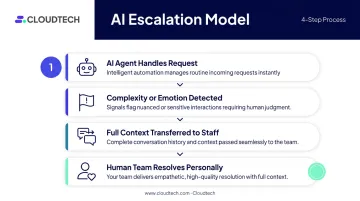
When this handoff works well, guests get faster resolution and staff get better conversations.
What to Look for in a Hospitality AI Agent
Not all AI agents are built the same. Three evaluation criteria matter most for hospitality buyers:
1. Integration depth Does the platform connect natively with your PMS, CRM, and communication channels — or does it rely on shallow workarounds? Shallow integrations mean the agent works from outdated data, leading to incorrect responses and eroded guest trust. Ask specifically about OPERA Cloud, your CRM provider, and any channel management systems you use.
2. Natural language and multilingual capability Can it handle nuanced, colloquial requests from guests in multiple languages without delay? Test with ambiguous questions, not just simple ones.
3. Learning and customization Can the AI be trained on your property's specific policies, amenities, brand voice, and service standards? A generic agent that doesn't know your check-in time or cancellation policy will frustrate guests and undermine staff confidence in the tool.
Privacy and Deployment Considerations
Once you've narrowed your shortlist on capability, two practical factors will determine whether the rollout succeeds: data privacy and implementation planning.
On privacy, verify before committing to any platform:
- End-to-end encryption for data in transit and at rest
- Compliance with GDPR (if serving EU guests) and CCPA (for California guests)
- Configurable data retention policies
- Confirmation that guest data is not used to train third-party models
On timelines, most implementations require 4–12 weeks for full integration and staff onboarding, depending on system complexity and the depth of custom training. Establish baseline metrics for response times, escalation rates, and guest satisfaction scores before go-live so ROI measurement is possible.
The Cloud Foundation Behind High-Performing AI Agents
The underlying cloud infrastructure isn't a background detail — it directly determines whether an AI agent holds up when it matters most.
During peak occupancy periods (conventions, holiday weekends, large group bookings), guest query volumes spike sharply and unpredictably. An AI agent that degrades under load, or that can't access live PMS data because the integration isn't built for scale, creates exactly the kind of service failure it was deployed to prevent.
Reliable AI agent performance at scale requires:
- Real-time data pipelines connecting the AI to PMS and CRM systems — so availability, guest profiles, and service status are always current
- Secure API management for multi-channel communication across SMS, web chat, email, and voice
- Dynamic compute scaling that handles query spikes without degrading response quality; AWS Lambda's serverless architecture handles this automatically, scaling with demand without server management overhead
- Multi-AZ resilience to maintain availability even during infrastructure-level disruptions
AWS services including Amazon Bedrock for AI reasoning, Amazon Kinesis for real-time data streaming, AWS Glue for ETL pipeline automation, and Amazon API Gateway for secure channel integrations support production-ready hospitality AI deployments.
For hospitality businesses without deep in-house cloud expertise, the build-vs-partner decision matters. Cloudtech, an AWS Advanced Tier Partner based in New York, has built this infrastructure stack for customer-experience deployments — including the AWS architecture behind a Monster Reservations Group engagement that achieved 95%+ accuracy in customer preference capture and 500ms response latency, with a projected 67% reduction in cost-per-call. The foundation used Amazon Bedrock for AI reasoning and Amazon Connect for human handoff, designed to replicate across similar use cases.
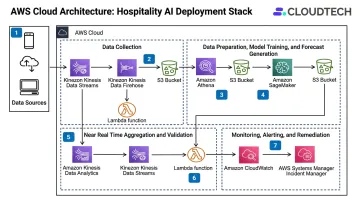
Hospitality teams that lock in scalable architecture early — storage, security, compute, integrations — spend less time firefighting during peak periods and more time on the guest experience itself.
Future Trends in Hospitality AI
The next wave shifts AI from reactive to anticipatory.
Predictive personalization means AI systems that surface guest preferences before they're expressed — offering room service menus at a guest's preferred dining time, adjusting temperature settings based on stated preferences, or flagging local events that match a guest's travel patterns. Two emerging directions are worth watching:
- Emotional intelligence: AI that detects and adapts to guest mood in real time, adjusting tone and escalating proactively when frustration signals appear, rather than waiting for an explicit complaint
- Ambient intelligence: AI embedded throughout the physical property through in-room voice assistants and smart climate control, responding to guests without requiring explicit commands or app navigation
These capabilities raise expectations — and responsibilities. Deploying them well requires ethical guardrails from the start. Trustworthy AI in hospitality means:
- Transparent operation — agents that clearly identify themselves as AI
- Data minimization — collecting only what's necessary for the interaction
- Augmentation as the design principle — AI that makes human staff more effective, not invisible
Those guardrails don't slow adoption — they make it sustainable. The AI in tourism market is projected to grow from $2.95B in 2024 to $13.38B by 2030, a 28.7% CAGR. Properties that build the right cloud and AI foundation now can adopt these capabilities as they mature, without starting from scratch each time.
Frequently Asked Questions
What is the difference between an AI agent and a hotel chatbot?
A chatbot follows rigid, pre-written scripts and can only respond to specific prompts. An AI agent understands context and intent, integrates with your PMS and CRM, and executes multi-step tasks autonomously — checking availability, rerouting housekeeping requests, and confirming bookings without any staff involvement.
Can AI agents in hospitality replace hotel staff?
No — and that's not what they're built for. AI agents absorb high-volume routine requests so staff can focus on interactions that require human judgment and empathy. The memorable moments that drive guest loyalty still come from people, not software.
What tasks can AI agents handle in a hotel?
AI agents handle a wide range of operational tasks without requiring a human agent:
- Booking inquiries, availability checks, and reservation modifications
- Check-in/out coordination and housekeeping or room service requests
- Multilingual communication and FAQ responses
- Personalized upsell recommendations and post-stay follow-up
How long does it take to implement an AI agent for a hotel?
Most implementations take 4–12 weeks, depending on the number of system integrations required, the complexity of your PMS and CRM environment, and the depth of custom training needed on property-specific policies and brand voice.
Are AI agents secure for handling sensitive guest data?
Reputable platforms offer end-to-end encryption and compliance with GDPR and CCPA. Before committing, verify data retention policies and confirm guest data isn't used to train third-party models. Configurable access controls are a must.
How do hotels measure the ROI of an AI agent?
Establish pre-launch baselines for call volume, escalation rates, guest satisfaction scores, and average response times. Track changes in those metrics post-deployment alongside any ancillary revenue increases from automated upselling. Without pre-launch baselines, ROI measurement is guesswork.