Introduction
Picture this: it's 11 PM, a patient is worried about a new symptom, and their doctor's office won't open for another ten hours. They call, get voicemail, and either spend the night anxious or head to an emergency room they don't actually need.
This is the access gap that healthcare AI chatbots are built to address. Long wait times, after-hours dead ends, and overburdened clinical staff aren't new problems — but the tools to bridge them are maturing fast.
The market reflects that urgency. According to Grand View Research, the global healthcare chatbot market was valued at $1.2 billion in 2024 and is projected to reach $4.36 billion by 2030 — a 24% CAGR. Hospitals, clinics, and patient-facing apps are all accelerating adoption.
This article covers what healthcare AI chatbots actually do, how they're being used across care settings, and what it takes to deploy them in a way that's both effective and compliant.
Key Takeaways
- AI chatbots provide 24/7 patient support across scheduling, symptom triage, medication adherence, and mental health conversations
- AI chatbots cut administrative burden and lift patient engagement, but clinical judgment still requires a human provider
- HIPAA compliance and secure cloud infrastructure must be built in from day one — not bolted on after deployment
- Risks like algorithmic bias, misdiagnosis, and data privacy gaps require active human oversight
- Healthcare SMBs can deploy compliant chatbot solutions faster through purpose-built AWS infrastructure
What Are AI Chatbots in Healthcare?
Healthcare AI chatbots are conversational programs that use natural language processing (NLP) and machine learning to simulate human-like dialogue via web or mobile interfaces. They can answer patient questions, collect symptom information, send reminders, and route patients to appropriate care — all without requiring a staff member on the other end.
Purpose-Built vs. General-Purpose AI
Choosing the wrong tool here carries real consequences — HIPAA violations, clinical missteps, and patient data exposure.
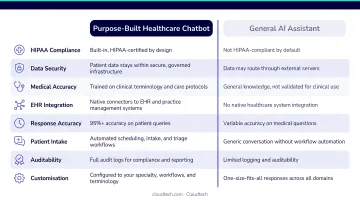
General-purpose tools like standard ChatGPT weren't designed to handle protected health information (PHI). They may train on outdated datasets and lack clinical guardrails. They are not HIPAA compliant by default. A hospital that routes patient conversations through an unconfigured general AI tool isn't just cutting corners; it's creating legal and clinical liability.
Purpose-built healthcare chatbots are different. They're architected with compliance requirements in mind and operate on infrastructure configured to meet regulatory standards. Key differentiators include:
- Built on HIPAA-compliant infrastructure from the ground up
- Include escalation paths to human clinicians when needed
- Apply clinical guardrails that general AI tools don't enforce
- Configured specifically for healthcare deployment contexts
The underlying technology may overlap with general AI, but the safeguards and deployment context are distinct in ways that matter clinically and legally.
How AI Chatbots Are Connecting Patients to Care
Chatbots are most valuable where access gaps are largest: rural communities, after-hours windows, and patients managing chronic conditions between appointments. Here's how they're actually being used.
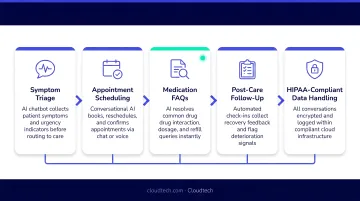
Appointment Scheduling and Reminders
Chatbots handle the full appointment lifecycle — booking, confirmations, rescheduling, and reminders — without tying up front-desk staff. The impact on no-shows is measurable. A randomized study published in The Permanente Journal evaluated over 125,000 primary care visits and found that a targeted second text reminder reduced no-shows by 7% for primary care and 11% for mental health visits.
For administrative teams already stretched thin, automating these touchpoints frees capacity for tasks that genuinely require human judgment.
Symptom Checking and Patient Triage
Triage chatbots ask structured questions, assess urgency, and direct patients toward the right care setting — whether that's self-care advice, a telehealth consult, or an ER visit.
A 2022 observational study found the Ada Health symptom checker achieved 70% top-five diagnostic sensitivity compared to 68.9% for emergency physicians — but also noted that 14% of recommendations were judged unsafe by at least two clinicians. That last figure matters. AI triage works as a complement to clinical assessment, not a substitute for it.
Medication Management and Adherence
Non-adherence is one of healthcare's most persistent and costly problems. According to the CDC, approximately one in five new prescriptions are never filled, and among those that are, roughly half are taken incorrectly.
Chatbots address this by sending personalized reminders, tracking doses, flagging missed medications, and surfacing drug interaction information. For patients managing multiple chronic conditions, this kind of structured follow-up can produce measurable gains — some programs report adherence improvements of 20% or more when automated reminders replace relying on patients to self-manage.
Mental Health Support
Mental health chatbots deliver 24/7 emotional support and structured therapies — including cognitive behavioral therapy (CBT) — in conversational form. A 2025 systematic review covering over 44,000 participants found that users of Youper experienced a 48% decrease in depression and 43% decrease in anxiety. Woebot showed significant mood improvements across thousands of users.
The anonymous, always-available nature of these tools matters. Many people who won't call a therapist will type into a chatbot at 2 AM. That accessibility is the entire value proposition.
That reach comes with a non-negotiable requirement: crisis escalation protocols. The APA has warned that many wellness apps lack adequate safety frameworks. Any mental health chatbot deployed without clear pathways for routing at-risk users to human intervention is not ready for clinical use.
Chronic Disease Management
Patients with diabetes, hypertension, or other ongoing conditions need more than a quarterly check-in to stay on track. Chatbots fill that gap by maintaining contact between appointments and feeding data back to care teams in real time.
Key functions include:
- Tracking reported symptoms and biometric inputs between visits
- Sending condition-specific reminders (medication, diet, activity)
- Flagging concerning trends for clinical review before they escalate
- Reducing reliance on a single 15-minute snapshot every few months
Benefits for Patients and Healthcare Providers
24/7 Availability
The data on after-hours usage is clear. A 2020 population study found that 46.4% of digital symptom checker assessments were completed outside typical office hours (9 AM–6 PM). Patients don't schedule their health concerns around business hours, and chatbots don't require them to.
This is especially significant for underserved and rural populations, where after-hours access to any clinical guidance is often the difference between appropriate self-care and an unnecessary ER visit.
Reduced Administrative Burden
Automating repetitive tasks — appointment scheduling, prescription reminders, FAQ responses — meaningfully reduces the workload on clinical and administrative staff. Juniper Research projected that healthcare chatbot adoption would generate $3.6 billion in annual cost savings globally by 2022, a figure that has continued to grow alongside adoption rates.
Improved Patient Engagement
Personalized, consistent chatbot interactions can shift how patients engage with their own care. Industry deployments from platforms like Memora Health have reported engagement rates above 90% and adherence rates as high as 97% for certain care plans.
These are vendor-reported figures, not peer-reviewed trials — though multiple independent studies on digital health engagement point in the same direction.
Richer Data Collection
Chatbots collect structured data in real time, including:
- Reported symptoms and severity
- Mood and mental health check-ins
- Medication adherence tracking
- Responses to care plan prompts
When that data flows into electronic health records, providers gain a more complete picture of patient health between appointments — and better context for clinical decisions when patients do come in.
Risks and Challenges of AI Chatbots in Healthcare
Misdiagnosis and Overtreatment
High diagnostic accuracy doesn't mean zero risk. A 2026 physician-led red-teaming study evaluated 888 chatbot responses to patient-posed medical questions and found problematic medical advice rates ranging from 21.6% to 43.2% across public large language model chatbots.
The overtreatment risk deserves particular attention. AI chatbots may recommend unnecessary tests or inappropriate medications alongside otherwise sound advice — and patients often can't distinguish between the two. Clinical oversight is the only reliable catch.
Algorithmic Bias and Health Inequity
AI chatbots are only as fair as the data they're trained on. A 2021 Patterns review documented how underrepresentation of certain groups — older adults, women, rural populations, communities of color — in clinical datasets leads to worse performance and inequitable care recommendations for those same groups.
One frequently cited example: a widely used U.S. care management algorithm used health costs as a proxy for need, which effectively halved the number of Black patients identified for additional care. Developers and the organizations deploying these tools must actively audit for bias — it doesn't resolve itself.
Data Privacy and Security Risks
Healthcare chatbots collect sensitive personal health information. General-purpose AI tools don't comply with HIPAA by default. That's a fundamental compliance gap with real exposure for covered entities.
Common risks include:
- Unauthorized data sharing with third-party services
- Inadequate access controls on stored health records
- Insufficient data retention and deletion policies
Any chatbot touching PHI needs to be deployed on infrastructure specifically configured for healthcare compliance.
The Irreplaceable Role of Human Oversight
Some categories of care remain beyond what chatbots can adequately handle:
- Rare or complex diagnoses
- Nuanced treatment planning and surgical decisions
- Empathetic counseling and crisis intervention
The AMA has stated clearly that AI tools must support — not replace — physician judgment. That framing holds. Chatbots absorb high-volume, routine interactions; physicians step in where complexity and human judgment matter most.
HIPAA Compliance and Secure Cloud Infrastructure for Healthcare AI
Deploying a healthcare chatbot isn't just a technical project — it's a compliance project. HIPAA requires any digital tool handling PHI to meet specific standards:
- Data encryption at rest and in transit
- Role-based access controls with least-privilege principles
- Audit logging for all PHI access and transactions
- Business Associate Agreements (BAAs) with every vendor that processes or stores PHI
- Clear data retention and deletion policies
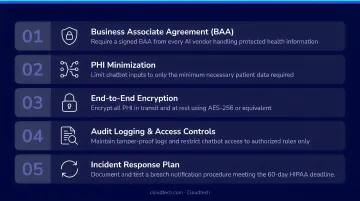
General AI chatbot platforms are often non-compliant by default. Compliance has to be deliberately engineered into the deployment architecture — not assumed.
The Role of AWS in Healthcare AI Deployments
AWS provides a range of HIPAA-eligible services that give healthcare organizations the building blocks for a compliant, secure chatbot deployment:
- Compute & storage: Amazon EC2, S3, RDS
- AI/ML: Amazon Bedrock, Amazon Lex, Amazon Comprehend Medical, Amazon Transcribe Medical
- Security & monitoring: AWS KMS, AWS CloudTrail, Amazon CloudWatch
For healthcare SMBs without in-house cloud expertise, partnering with an AWS-certified firm is often what separates a deployment that holds up under audit from one that creates regulatory exposure. Cloudtech, as an AWS Advanced Tier Partner with healthcare experience — including work with Klamath Health Partnership, where they delivered a HIPAA-compliant data lake architecture and achieved a 77% year-over-year reduction in infrastructure costs — helps healthcare organizations build the right foundation from the start.
Best Practices for Responsible Deployment
Any healthcare chatbot deployment should include:
- Clinical stakeholder involvement in design and testing — not just IT
- Human escalation paths for complex, sensitive, or crisis-level queries
- Regular accuracy and bias audits on an ongoing basis
- Patient transparency about when and how AI is being used in their care
- BAA execution with AWS and any third-party vendors before any PHI enters the system
Frequently Asked Questions
Are any AI chatbots in healthcare HIPAA compliant?
Purpose-built healthcare chatbots can be HIPAA compliant when deployed on HIPAA-eligible infrastructure with proper safeguards — including BAAs, encryption, and access controls. General-purpose tools like standard ChatGPT are not inherently HIPAA compliant and should not handle PHI without a deliberate compliance architecture.
Can AI chatbots replace doctors or healthcare providers?
No. Chatbots handle routine tasks and information delivery effectively but lack the judgment, empathy, and contextual reasoning required for complex diagnosis, nuanced treatment planning, and crisis care. The AMA's position is that AI should augment clinical professionals, not replace them.
What are the most common uses of AI chatbots in healthcare?
The top use cases are appointment scheduling and reminders, symptom checking and triage, medication adherence support, mental health conversations, and chronic disease management check-ins.
How do healthcare AI chatbots protect patient data?
Properly designed healthcare chatbots use encryption, role-based access controls, and HIPAA-eligible cloud infrastructure. Patients should verify that any chatbot they use has a published privacy policy and that their provider has executed a BAA with the chatbot vendor.
What are the main risks of using AI chatbots for medical advice?
Key risks include inaccurate or outdated information, algorithmic bias leading to inequitable recommendations, privacy vulnerabilities in non-compliant tools, and patients foregoing professional care based on chatbot guidance alone.
How much does it cost to implement a healthcare AI chatbot?
Costs vary widely. According to ScienceSoft, a medical AI chatbot can range from $15,000 for a simple informational assistant to over $300,000 for an advanced AI agent, depending on complexity and integrations. Cloud-based deployments typically reduce upfront infrastructure costs compared to building from scratch.