Introduction
Investment management has always been a data-intensive discipline. What's changed is the sheer volume of that data, and the emergence of tools capable of doing something entirely new with it.
Unlike traditional analytical AI that identifies patterns in existing data, generative AI creates new outputs from those patterns: written research summaries, scenario simulations, personalized investor reports, and investment narratives. In financial decision-making, that difference changes what's possible — not just how fast analysis happens, but what kind of analysis gets done at all.
According to AIMA's September 2025 research, 95% of surveyed fund managers now use generative AI in their work, up from 86% in 2023. The debate has shifted from "whether to adopt" to "how fast and how well." Firms that moved early are already seeing measurable advantages in deal flow, research quality, and operational efficiency.
This guide covers where generative AI is being deployed across the investment lifecycle, what's driving adoption, the real challenges firms face, and what's coming next.
Key Takeaways
- Generative AI spans the full investment lifecycle, from deal sourcing to investor communications
- BlackRock, JPMorgan, Morgan Stanley, and Goldman Sachs are already operating at scale with proprietary AI tools
- AI works best layered on top of human expertise — not as a replacement for it
- Legacy infrastructure, data security, and explainability remain the primary adoption barriers
- Financial-services AI spending is projected to nearly triple, from $35B in 2023 to $97B by 2027
Key Ways Investment Firms Are Using Generative AI
Generative AI has moved from pilot project to core infrastructure across investment management. The five application areas below each deliver measurable efficiency gains, and together they're redefining how firms source deals, manage risk, and serve clients.
Accelerating Deal Sourcing and Due Diligence
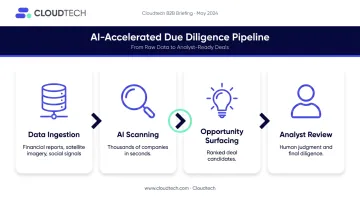
Traditional due diligence is slow. Analysts comb through financial statements, market data, and third-party research over days or weeks. Generative AI compresses that timeline dramatically.
AI algorithms can scan thousands of companies in seconds, analyzing financial reports, market signals, and alternative data sources including satellite imagery, social media activity, and web-scraped information. A 2023 CFA Institute survey of 1,210 investment professionals found that 64% already used alternative data and 55% used unstructured data in their investment processes.
EQT's Motherbrain platform illustrates what this looks like in practice: an AI system supporting the full PE investment lifecycle from opportunity identification through diligence and value creation. The competitive advantage isn't just speed — it's also surfacing opportunities that human teams would never have the bandwidth to find.
Optimizing Portfolio Construction and Management
AI continuously monitors portfolio performance against real-time market data, economic indicators, and cross-asset signals. This enables dynamic reallocation that static models simply can't match. Machine learning models improve over time as they learn from historical performance, refining recommendations with each market cycle.
BlackRock's Aladdin platform sits at the center of this. It functions as a unified investment operating system, spanning portfolio construction, performance management, risk, trading, and operations, giving professionals a whole-portfolio view across public and private markets simultaneously.
Broader firm-wide adoption is accelerating too. Goldman Sachs launched its GS AI Assistant firmwide in June 2025, reaching approximately 10,000 employees before full deployment. The tool summarizes complex documents, drafts initial content, and performs data analysis for bankers, traders, and asset managers — work that previously consumed significant junior analyst hours.
Enhancing Risk Management and Scenario Modeling
Generative AI enables more sophisticated stress testing than traditional frameworks allow. Rather than running models against a fixed set of historical scenarios, AI can simulate complex, multi-variable situations (economic downturns, geopolitical shocks, liquidity crises) and model portfolio impacts across combinations that no analyst could manually construct.
BlackRock's Aladdin Wealth, for instance, tests portfolio exposures against historical shocks including the 2008 financial crisis at enterprise, client, and account levels. Beyond stress testing, McKinsey estimates that generative AI can produce approximately 5% efficiency improvement in asset-management risk and compliance by streamlining manual monitoring, anomaly detection, and noncompliance flagging.
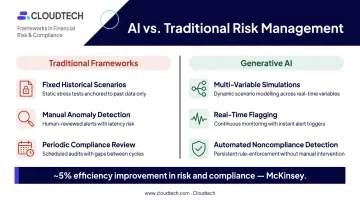
On the compliance side, AI flags unusual transaction patterns in real time, before they escalate into material losses or regulatory violations.
Powering Research, Market Analysis, and Investment Strategy
Large language models are fundamentally changing research workflows. Analysts who once spent hours sifting through earnings call transcripts, regulatory filings, and news can now surface relevant signals in minutes.
Morgan Stanley's AI @ Morgan Stanley Assistant, built on GPT-4, retrieves answers from an internal research corpus that grew from roughly 7,000 to 100,000 documents. More than 98% of Morgan Stanley advisor teams actively use it. The system doesn't replace analyst judgment — it removes the retrieval bottleneck, so analysts spend more time on actual analysis and less time searching.
Sentiment analysis extends this further. NLP models parse earnings calls, social media, and news feeds to gauge market mood and detect shifts before they show up in price data. ESMA's February 2025 research found that among EU funds explicitly using AI, it served as the primary investment-decision driver in only about 30% of cases — confirming that the most effective application is still AI augmenting human expertise, not replacing it.
Automating Investor Communications and Reporting
Generic quarterly updates sent to every investor regardless of their portfolio or preferences are becoming obsolete. Generative AI makes it practical to tailor every communication to each investor's risk profile, holdings, and stated preferences — without adding headcount to the relationship management team.
Morgan Stanley's Debrief AI assistant, launched in June 2024, illustrates how this plays out at the relationship level. With client consent, it transcribes advisor meetings, generates notes and action items, drafts follow-up emails, and transfers notes into Salesforce automatically. Morgan Stanley's CEO projected this could save advisors 10–15 hours per week — time redirected from administrative tasks to actual client relationships.
AI-powered Q&A bots handle routine investor inquiries around the clock, routing complex questions to human relationship managers while resolving common ones instantly.
What's Driving Generative AI Adoption in Investment Firms
Adoption isn't happening because AI is fashionable. Several concrete forces are pushing it forward simultaneously.
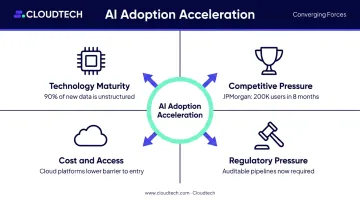
Four forces are converging to make this a structural shift, not a trend:
- Technology maturity: Production-ready LLMs have moved from research curiosity to commercial tool. IDC data cited by CFA Institute shows data volume grew 28% in 2023 alone, with approximately 90% of that data being unstructured — volumes that are simply beyond manual processing capacity.
- Competitive pressure: Leading PE and asset management firms aren't waiting. Vista Equity launched its Agentic AI Factory in June 2025. Hg's Catalyst AI incubator launched in November 2025 with 80+ engineers embedded in portfolio companies. JPMorgan's LLM Suite reached 200,000 users within eight months of its 2024 launch. Firms that delay risk falling behind on deal speed, research depth, and returns.
- Cost and access: Cloud-based AI platforms have dropped the barrier significantly. Mid-sized and smaller investment firms can now access capabilities that once required massive R&D budgets, narrowing the gap that long favored large institutions.
- Regulatory pressure: Regulators scrutinizing AI-driven financial decisions have, counterintuitively, accelerated formal AI adoption. Firms building compliant, auditable pipelines are investing in structured implementation — not ad hoc experimentation.
Challenges Investment Firms Face in Adopting Generative AI
Adoption is real, but it isn't frictionless. Three specific friction points appear consistently across firms of all sizes.
Data Security and Regulatory Compliance
AI models require extensive — and often sensitive — financial datasets. Deloitte's 2025 M&A survey found 67% of respondents cited data security as a primary generative AI adoption challenge. Evolving data protection regulations add complexity, requiring encryption protocols, strict access controls, and continuous system audits.
The Explainability Problem
Many AI models — particularly complex ML systems — don't reveal how they reach conclusions. This creates trust deficits with investors and regulators alike. ESMA's May 2024 guidance applies existing MiFID II obligations to AI in investment services, including governance, client best-interest duties, and transparency requirements. Firms are increasingly adopting Explainable AI (XAI) frameworks to ensure outputs can be audited and communicated clearly.
Legacy Infrastructure
Many investment firms still run systems that weren't designed to handle AI-driven workloads. Integrating generative AI into legacy infrastructure is expensive and slow. The most practical path forward is migration to cloud-based architectures — AWS in particular — that provide scalable, AI-ready foundations without requiring a full rebuild from scratch.
For financial services SMBs navigating that infrastructure gap, Cloudtech builds the AWS-native foundation generative AI requires. That includes centralized data lakes on Amazon S3, intelligent document processing via Amazon Textract, and natural language querying through Amazon Q Business. Their AWS-certified solutions architects handle migration readiness assessments and roadmap planning, with compliance coverage across SOC 2 and PCI-DSS — so firms don't have to manage the complexity in-house.
What's Next: Future Signals for Generative AI in Investment Management
The current adoption wave is early-stage. Several developments will define the next 1–3 years.
Agentic AI Is Coming Fast
Agentic AI goes beyond generating text — these are autonomous systems capable of goal-setting, multi-step reasoning, and independent action. The World Economic Forum describes this shift as moving from prompt-driven generation to systems that can perceive, reason, decide, and act on complex goals without human input at each step.
In investment management, that translates to AI proactively flagging compliance risks, initiating trades, or restructuring portfolio allocations with minimal human prompting. Governance frameworks need to be in place before this capability becomes mainstream — not after.
Regulatory Scrutiny Is Tightening
Global regulators are moving toward more explicit AI governance requirements. ESMA already applies MiFID II transparency and conduct obligations to AI in investment services.
The SEC withdrew its 2023 predictive data analytics proposal in June 2025, and the FCA has stated it doesn't plan additional AI-specific rules — but regulators are moving toward greater scrutiny and disclosure requirements regardless. Firms building compliant AI pipelines now will hold a structural advantage when those requirements arrive.
The Technology Gap Between Firm Sizes Will Narrow
As cloud-native AI tools become more affordable, smaller investment managers will close the gap with large institutions. Financial-services AI spending was $35B in 2023 and is projected to reach $97B by 2027, according to the World Economic Forum and Accenture — growth that will flow across firm sizes, not just to the largest players.
The firms that move early on infrastructure, compliance, and AI-literate talent will be the ones that benefit most when that spending lands.
Frequently Asked Questions
What is generative AI in investment management?
Generative AI refers to AI systems that create new outputs — such as investment narratives, risk scenarios, or research summaries — based on patterns learned from existing financial data. Unlike traditional AI, it generates novel content rather than simply classifying or predicting.
How does generative AI differ from traditional AI used in investment firms?
Traditional analytical AI processes historical data to find patterns and make predictions. Generative AI creates novel outputs — written explanations, scenario simulations, synthesized research — often in response to human prompts. Most leading firms now use both in combination.
Is generative AI replacing human analysts and fund managers?
No. AI handles data-intensive tasks and initial drafts; experienced investors retain responsibility for final judgment, ethics, and client relationships. A 2025 study found that generative AI-adopting hedge funds earned 2–4% higher annualized abnormal returns, with gains concentrated among funds with pre-existing AI talent.
What are the biggest challenges investment firms face when implementing generative AI?
Three barriers consistently emerge across firms:
- Data security and compliance — addressed through encryption protocols and access controls
- Explainability ("black box" problem) — mitigated using Explainable AI (XAI) frameworks
- Legacy infrastructure — resolved through cloud-based architecture migration
Which investment firms are leading in generative AI adoption?
Notable leaders include BlackRock (Aladdin platform), JPMorgan (LLM Suite, 200,000 users), Morgan Stanley (AI @ Morgan Stanley Assistant and Debrief), Goldman Sachs (GS AI Assistant), and PE firms including Vista Equity Partners and Hg Capital.
What infrastructure do investment firms need to effectively run generative AI?
Generative AI requires scalable cloud infrastructure built for large, real-time data workloads — including a modern data platform, secure API integrations, and governance frameworks. AWS is the most common foundation for financial services firms, and working with an AWS-certified consulting partner can significantly reduce implementation time and cost.