Introduction
Sales reps spend just 28% of their week actually selling, according to Salesforce research across more than 7,700 sales professionals. The rest disappears into data entry, CRM updates, email drafting, and deal administration.
Generative AI directly attacks that lost time. Unlike traditional AI that classifies data or flags anomalies, generative AI actively produces outputs — drafting personalized emails, summarizing sales calls, scoring leads, and updating CRM records in real time. The difference isn't incremental; it's a shift from insight to execution.
This article covers what sales leaders need to know: which workflows generative AI automates most effectively, the BCG 10-20-70 framework that separates successful AI adoption from failed experiments, practical implementation steps for SMB sales teams, and the risks that require active management.
Key Takeaways
- Sales reps spend only 28% of their week selling — generative AI targets the other 72%
- McKinsey estimates generative AI could increase sales productivity by 3–5% of global sales expenditures
- The highest-ROI automation targets: email outreach, lead scoring, CRM updates, and forecasting
- BCG's 10-20-70 framework shows that 70% of AI success comes from people and process — not the technology
- Poor data quality and siloed infrastructure are the leading reasons AI deployments fail to deliver ROI
Why Generative AI Is a Game-Changer for Sales Workflow Automation
Why Generative AI Is Reshaping Sales Workflow Automation
The Productivity Problem Is Bigger Than It Looks
That 28% selling-time figure isn't just frustrating — it's expensive. For a 10-person sales team, it means roughly seven full-time equivalents' worth of effort going to administrative overhead rather than revenue-generating activity.
Traditional AI helped at the margins. Predictive models could flag at-risk deals or recommend next actions. But they couldn't do anything — a rep still had to write the email, update the record, or draft the proposal.
Generative AI does a substantial portion of that work directly — drafting, updating, and generating — not just recommending the next step.
What the Data Actually Shows
One caveat worth noting: most published statistics on AI and sales performance reflect broad AI adoption, not generative AI specifically. The numbers below reflect that distinction:
- McKinsey's 2023 analysis estimates generative AI specifically could boost sales productivity by 3–5% of current global sales expenditures — meaningful at scale
- Salesforce found that 83% of sales teams using AI reported revenue growth, versus 66% of teams without it — a 1.3x advantage (broad AI, not generative AI exclusively)
- HubSpot's 2024 report shows sales AI adoption jumped from 24% in 2023 to 43% in 2024, reflecting rapid mainstream uptake
These numbers point to a clear trend — and SMBs are positioned to capture a disproportionate share of that upside.
Why SMBs Benefit Disproportionately
Capabilities that once required enterprise contracts — AI-powered proposal generation, predictive pipeline analysis, personalized outreach at scale — are now accessible through tools that integrate directly with common CRM platforms.
The caveat: the payoff scales with data quality. Teams with clean CRM data, integrated tools, and reliable cloud infrastructure see far better results than those bolting AI onto fragmented systems. This isn't a minor footnote — it's the central implementation challenge for most SMBs.
Key Use Cases: How Generative AI Transforms Sales Workflows
Generative AI doesn't transform sales with one dramatic shift. It improves specific, high-friction points in the workflow — and the cumulative effect drives meaningful productivity and pipeline gains.
Hyper-Personalized Outreach at Scale
Traditional email personalization is a time sink. Salesforce notes qualitatively that sellers spend hours each week crafting personalized outreach — time that compounds across a full sales team.
Generative AI approaches this differently. Rather than starting from a template, it pulls from CRM data, past interaction history, and behavioral signals to draft contextually relevant messages for each prospect. The output isn't a template with a name swapped in — it's a message that references the prospect's industry, recent activity, or prior conversation.
Practical outcomes:
- Reps spend time reviewing and refining AI drafts, not writing from scratch
- First-touch messages reflect actual context rather than generic value propositions
- Higher-quality initial contact frees reps to focus on replies that need real sales judgment
One note: open-rate and reply-rate improvement figures circulating from vendor pages aren't backed by verified primary research. The real benefit is time recovered and rep capacity redirected to higher-value conversations.
AI-Powered Lead Scoring and Prospecting
Manual lead scoring has a well-documented problem: it's subjective. Different reps prioritize differently, gut-feel judgments vary by experience level, and high-intent prospects can sit unworked while reps chase familiar names.
AI lead scoring processes CRM data, firmographic signals, behavioral patterns, and historical conversion data to rank prospects by actual conversion likelihood. Tools like Salesforce Einstein Lead Scoring and HubSpot's lead scoring engine formalize this — replacing opinion with pattern recognition across thousands of past deals.
The business effect: reps spend their outreach time on prospects who are statistically more likely to convert, rather than spreading effort across a full unranked list.
One caveat: no verified primary source confirms a specific conversion-rate lift percentage from AI lead scoring. Claims ranging from 20–50% improvement appear across vendor sites without authoritative backing. Treat those benchmarks with appropriate skepticism and prioritize internal measurement instead.
Intelligent Sales Forecasting
Manual forecasting has a reliability problem: it depends heavily on rep self-reporting, which is optimistically biased, and on manager judgment, which varies.
AI forecasting models analyze historical deal data, pipeline velocity, rep activity patterns, and seasonality to generate more defensible projections. Gartner notes that AI can meaningfully enhance forecast accuracy by improving data capture and predictive modeling.
For startups and SMBs specifically, Salesforce points to AI forecasting as a tool for predicting future revenue and guiding business decisions with more confidence.
The operational value extends beyond the numbers:
- Flags deals likely to close ahead of schedule so leaders can accelerate them
- Surfaces at-risk pipeline before the quarter closes, not after
- Enables real-time resource reallocation based on actual deal velocity
Automated CRM Updates and Admin Work
This is the highest-ROI automation for most SMB sales teams.
AI tools that listen to and transcribe sales calls can auto-populate CRM fields, log call summaries, update deal stages, and surface objection patterns — all without rep involvement. The rep finishes a call and moves to the next one; the CRM updates itself.
HubSpot's 2025 State of Sales Report found that AI saves sales reps an average of 2 hours 15 minutes per day (broad AI), with 64% of sales professionals saving 1–5 hours weekly through automated manual task handling.
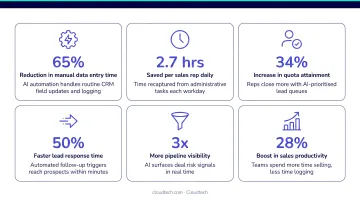
Beyond time savings, real-time call intelligence surfaces coaching moments that managers would otherwise miss entirely — deal risks, competitor mentions, repeated objections — across every conversation, not just the ones a manager happens to sit in on.
The 10-20-70 Framework for AI in Sales
Two frameworks help sales leaders think about AI adoption strategically. One has verified attribution; the other is a widely used heuristic worth treating carefully.
BCG's 10-20-70 Rule
BCG's AI at Scale framework attributes success to a specific breakdown: 10% algorithms, 20% technology and data, and 70% people and processes.
The technology — the AI model itself — accounts for just 10% of the outcome. Data quality and integration account for 20%. The remaining 70% comes from organizational adoption: how well the team is trained, how thoroughly processes are redesigned, and how effectively change is managed.
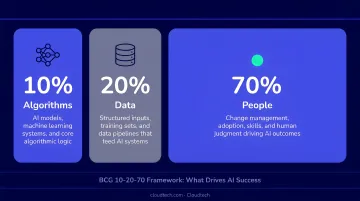
The implication for sales leaders is direct: buying the best AI tool on the market and dropping it into an unprepared sales org will not produce results. Most AI implementations that underperform aren't technology failures — they're adoption failures.
Practical takeaways from the 70%:
- Budget explicitly for rep training, not just tool licensing
- Redesign workflows so AI outputs are actually used, not bypassed
- Measure adoption metrics alongside performance metrics
The 30% Rule — Handle With Care
The "30% rule" — the idea that AI should automate roughly 30% of a rep's workload, keeping 70% focused on human-led activities — circulates widely in AI-for-sales discussions. McKinsey's 2023 research does suggest that approximately one-fifth of current sales functions could be automated.
No primary source from Gartner, McKinsey, Salesforce, or HubSpot formally defines this as a named rule. Treat it as a practical heuristic, not a verified benchmark.
The underlying logic is sound. Automate the repetitive, low-judgment work so human effort concentrates where it matters most:
| Automate These | Keep Human-Led |
|---|---|
| Data entry & CRM updates | Relationship-building |
| Email drafts & scheduling | Complex negotiations |
| Lead scoring & routing | Closing and deal strategy |
How to Implement Generative AI in Your Sales Stack
Starting Framework for SMB Sales Teams
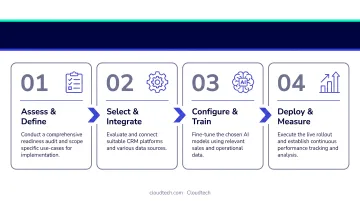
- Audit first — Document your current workflow and identify the three most time-consuming repetitive tasks. These are your automation candidates
- Start narrow — Pick one or two focused use cases (AI email drafting or lead scoring, not both simultaneously plus forecasting)
- Integrate, don't replace — Choose tools that connect to your existing CRM rather than requiring a full stack swap
- Measure the baseline — Know your current email response rates, time-to-close, and rep capacity before deploying, so you can measure actual impact
Implementation Pathways
| Approach | Best For | Trade-offs |
|---|---|---|
| AI-native SaaS tools with native CRM integration | Most SMBs | Fastest to value; less customization |
| In-house AI development | High-maturity, data-rich orgs | Maximum control; high cost and complexity |
| AWS consulting partner | SMBs needing custom AI on AWS infrastructure | Scalable, tailored; requires upfront engagement |
For most SMB sales teams, AI-native SaaS tools with CRM integrations are the right starting point. Once those are running and producing clean data, the underlying cloud infrastructure becomes the next lever worth pulling.
The Cloud Infrastructure Behind AI-Powered Sales
Generative AI tools are only as reliable as the infrastructure they run on. Clean data pipelines, secure storage, and adequate compute are prerequisites — not nice-to-haves.
On AWS, that infrastructure maps to a specific set of services:
- Amazon Bedrock — deploys foundation models and builds generative AI agents
- S3 data lakes — centralizes storage for sales and customer data
- AWS Glue — handles data preparation and cataloging
- Lambda functions — triggers automated workflows like CRM updates
Amazon Bedrock alone powers generative AI applications for more than 100,000 organizations globally, from early-stage startups to large enterprises.
SMBs without an in-house cloud team can work with an AWS Advanced Tier Partner like Cloudtech, which builds cost-efficient, scalable AWS foundations for small and mid-sized businesses — so teams can adopt generative AI without the overhead of standing up enterprise infrastructure from scratch.
Risks and Limitations of Generative AI in Sales
Three Risks That Need Active Management
AI hallucinations are the most immediate concern. Stanford HAI research found that legal AI tools hallucinated in 1 out of 6 or more benchmark queries — and while no sales-specific hallucination rate has been formally studied, the risk transfers directly. An AI that fabricates a pricing claim, invents a client reference, or misquotes a product specification can damage deals and credibility.
One mitigation works consistently: mandatory human review for any customer-facing output. AI drafts. Humans approve before it goes out.
Data privacy and security require attention the moment customer data enters an AI model. CRM records, call transcripts, and contact details all fall under applicable compliance frameworks:
- GDPR for EU customer data (EDPB Opinion 28/2024 addresses AI model data processing directly)
- CCPA for California consumers, with automated decision-making regulations taking effect January 1, 2027
- HIPAA for any healthcare-adjacent sales involving patient data
Over-automation quietly erodes the skills that close deals. Sales runs on human trust, especially in complex B2B engagements. Reps who offload too much to AI stop developing the judgment they need when it counts: in negotiations, objection handling, and relationship development.
The Explainability Gap
Black-box AI erodes rep trust quickly. If a lead is scored low but a rep's experience says otherwise and there's no explanation for why, they'll override it every time. The tool becomes noise.
Explainability should be a concrete selection criterion when evaluating AI tools. Look for systems that show:
- Why a lead scored high or low
- Why a deal was flagged at risk
- What data signals drove the recommendation
The NIST AI Risk Management Framework specifically addresses transparency and interpretability as governance priorities for generative AI deployments. That's not a compliance checkbox; it's a practical signal that a tool was built to work with your team, not around them.
Frequently Asked Questions
How do you use generative AI in sales workflow automation?
Generative AI automates content generation (emails, proposals, call summaries), enables intelligent lead scoring, and powers real-time CRM updates — all integrated directly into existing platforms. Most teams start with an AI writing assistant or lead scoring add-on already inside their current CRM stack.
How does generative AI affect sales workflow automation?
It cuts time on repetitive tasks (estimated at over 70% of the average sales day), accelerates pipeline movement through smarter prioritization, and lets teams scale personalized outreach without adding headcount. The result is more rep capacity focused on high-value selling.
What is the 30% rule for generative AI in sales?
The 30% rule suggests generative AI should automate approximately 30% of a sales rep's workload — specifically low-judgment, repetitive tasks — so human effort stays concentrated on relationship-building, complex negotiations, and deal closing. Note that this is a widely used heuristic, not a formally verified benchmark from a primary research source.
What is the 10-20-70 rule for generative AI in sales?
This is BCG's framework: 10% of AI success comes from the algorithm, 20% from data quality and integration, and 70% from organizational adoption. That means training, change management, and process alignment matter far more than which AI tool you pick. Most implementations underperform due to adoption failures, not technology failures.
What are the risks of using generative AI in sales?
The three primary risks are AI hallucinations producing inaccurate content, data privacy exposure when customer data is processed by AI models, and over-automation eroding the human judgment that drives complex sales. All are manageable with human-in-the-loop review processes, proper tool selection, and clear governance policies.
How can small businesses start using generative AI for sales?
Identify your highest-friction tasks first, then adopt one or two tools (such as an AI email assistant or lead scoring add-on inside your existing CRM) before expanding. Clean, integrated data is a prerequisite — AI tools are only as accurate as the data they run on.