Introduction
According to a 2024 McKinsey survey of more than 340 customer care leaders, 57% expected call volume to rise by as much as 20% over the following one to two years. For SMBs, that trajectory hits harder — there's no headcount buffer, no dedicated workforce planning team, and seasonal spikes can break a lean support operation entirely.
The real pressure isn't volume alone. It's what volume does to your cost structure: more tickets mean more agents, more agents mean longer ramp times, and longer ramp times mean slower resolution during the periods when speed matters most.
That resolution lag feeds directly into cost. Most support operations overspend not because they serve too many customers, but because of structural decisions — which channels they rely on, which query types they leave unautomated, and how escalation paths were built without cost efficiency in mind.
This guide covers how conversational AI reduces support costs at each stage: the decisions made before deployment, the management practices that sustain savings after launch, and the infrastructure factors that determine whether those savings hold as you scale.
Key Takeaways
- Conversational AI cuts costs primarily by handling high-volume, repetitive queries that consume disproportionate agent time
- The biggest cost drivers are staffing overhead, repeat contacts from low first-contact resolution, and peak-demand overstaffing
- Pre-deployment choices — including query audits, platform fit, and knowledge base quality — set the ceiling on realistic savings
- Post-launch optimization — retraining models, tracking containment rates, and tightening escalation rules — drives sustained savings beyond the initial rollout
- Cloud-native infrastructure eliminates fixed peak-capacity costs that traditional contact centers carry year-round
How Customer Support Costs Build Up
Support costs don't appear all at once. They accumulate in layers.
Each new customer adds to ticket volume. Each new product line multiplies query types. Each new channel — chat, email, voice — requires staffing and tooling. None of this feels expensive until volume hits a threshold that exposes the underlying cost structure.
ICMI's 2021 survey of 313 contact center professionals documented how fast these pressures compound:
- 55% reported increased interaction volume year over year
- 44% described staffing as a critical operational challenge
- 58% total agent movement annually, split between attrition and internal transfers
McKinsey adds another layer: 41% of support leaders said new hires take three to six months to reach full productivity. Every agent you replace restarts that clock.
The structural problem is this: traditional support scales roughly linearly. Twice the customers, twice the staff. Conversational AI is designed to break that relationship — but deployment against the wrong query types, on unprepared infrastructure, without operational discipline, will reproduce the same cost curve in a different form.
Key Cost Drivers in Customer Support Operations
Most support cost problems trace back to the same three culprits — and each one has a specific automation lever.
Repetitive Queries and Low First-Contact Resolution
SQM's 2022 benchmark across more than 500 North American call centers found an average first-call resolution (FCR) rate of 71% — meaning 29% of customers called back about the same issue. SQM estimates that each 1% improvement in FCR reduces operating costs by 1%, equivalent to roughly $286,000 annually for a mid-size call center.
For SMBs with leaner operations, repeat contacts are particularly costly — each callback displaces a new customer inquiry that could have been resolved instead.
Peak Demand Overstaffing
Traditional contact centers staff for their worst day, not their average day. That means paying for idle capacity during normal periods — a fixed cost premium that doesn't disappear when volume drops. One retail company found it was paying for 40% more agent capacity than it needed outside of holiday windows, with no way to scale back without risking SLA breaches.
Together, these three factors account for the bulk of avoidable support spend:
| Driver | What Makes It Expensive | AI's Leverage Point |
|---|---|---|
| Repetitive queries | Agent time on low-complexity work | Automated containment |
| Low FCR | Repeat contacts, double handling | Complete issue resolution |
| Peak staffing | Idle capacity outside peak windows | Elastic scaling |
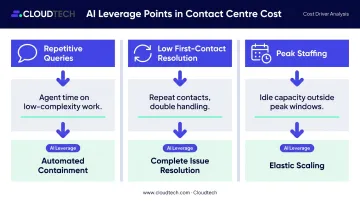
Which driver dominates depends on your business. An e-commerce company typically struggles most with order-status and return queries during peak seasons. A SaaS company often carries disproportionate cost from account access and billing questions. Pinpointing your dominant driver shapes which automation approach delivers the fastest return.
Cost-Reduction Strategies Using Conversational AI
The strategies that reduce support costs differ depending on whether the root problem is a decision gap, a management gap, or an infrastructure gap. Most businesses have all three — but they're rarely equal in size.
Strategies That Reduce Costs by Changing Decisions
These approaches target the choices made before or around deployment. They're the highest-leverage interventions because mistakes here compound throughout the system's life.
Before deployment, two decisions determine most of what follows:
- Audit query distribution first. Without knowing what percentage of tickets fall into automatable categories — order status, password resets, FAQs, account lookups — there's no way to set a realistic containment target or justify the platform investment. Your query audit determines the automation ceiling.
- Define escalation thresholds deliberately. Decide in advance which query types the AI should always hand off. An AI that attempts complex billing disputes or emotionally charged complaints with low confidence generates failed containment — escalations plus repeat contacts — costing more than the pre-AI baseline.
Platform and knowledge base decisions carry equal weight:
Right-size the platform to actual volume. Enterprise-grade conversational AI platforms carry licensing costs that can eliminate savings for an SMB running moderate ticket volumes. Platform selection is a cost decision, not just a technical one. Cloud-native options like Amazon Lex use consumption-based pricing with no upfront commitment, aligning cost to actual usage rather than projected peaks.
Build the knowledge base before go-live. An AI deployed against a thin or poorly structured knowledge base fails to contain queries — and failed containment means more escalations than you had before. Knowledge base investment upfront is cost avoidance, not overhead.
Strategies That Reduce Costs by Changing How AI Is Managed
Getting the decisions right before launch creates the conditions for savings. Sustaining those savings requires treating management as an ongoing discipline, not a post-deployment afterthought.
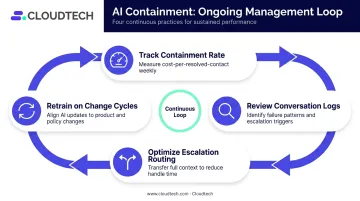
Track containment rate, not just deflection volume. Containment rate — the share of conversations fully resolved without agent handoff — is the direct measure of cost impact. A deflected conversation that ended in abandonment isn't savings; it's a deferred callback. Tracking cost-per-resolved-contact alongside containment rate gives a cleaner picture of what's actually working.
Use conversation logs to find failure patterns. Queries the AI mishandles generate escalations and repeat contacts. Systematically reviewing failed interactions and retraining on them is the primary mechanism for improving containment rate over time. Without this loop, the AI's performance degrades relative to product and policy changes.
Govern escalation routing to protect handle time. When an AI escalates to a human agent without transferring conversation context, the agent must re-collect information already provided. That increases handle time and per-contact cost. Well-designed escalation with full context transfer is a genuine cost lever, not just a user experience preference.
Set a retraining cadence tied to business change cycles. Product launches, pricing changes, and policy updates that aren't reflected in the AI generate incorrect responses — and incorrect responses generate repeat contacts. Proactive retraining tied to known change cycles prevents avoidable cost increases.
Strategies That Reduce Costs by Changing the Infrastructure Context
For many SMBs, integration gaps and fixed infrastructure costs outpace the AI platform itself as cost drivers — making the surrounding environment the higher-leverage target.
Integrate with CRM and helpdesk systems. An AI that can access a customer's account history, open tickets, and prior interactions can resolve issues in a single exchange. Without that context, responses stay generic and customers follow up — often through a higher-cost channel. CRM integration is an enabler of containment, not an optional enhancement.
Deploy on elastically scalable cloud infrastructure. Traditional contact center infrastructure is sized for peak demand, which means paying for unused capacity year-round. Cloud-native conversational AI built on services like Amazon Lex and Amazon Connect scales with actual demand — no hardware refresh cycles, no surplus line provisioning, no fixed cost premium for capacity you're not using.
The financial difference is documented. ANA X migrated its on-premises contact center to Amazon Connect and reported a 58% reduction in monthly operating costs and a 75% reduction in new-line provisioning lead time.
For SMBs without in-house AWS expertise, architecting this environment correctly matters. Cloudtech, an AWS Advanced Tier Partner serving SMBs and mid-market companies, helps businesses build these environments without the overhead of an enterprise integrator — typically delivering working solutions in two weeks rather than the months-long timelines common in larger engagements.
Shift from reactive to proactive AI. Triggering AI conversations based on observed behavior — a customer spending extended time on an error page, for instance — intercepts issues before they become inbound tickets. Proactive support reduces inbound volume at the source. That lowers total contact load — not just the cost per contact — which is a structurally different outcome than efficiency gains alone.
Conclusion
Reducing support costs with conversational AI is rarely a technology problem. The harder challenges are organizational: deciding which queries to automate, managing the transition for your support team, and building the infrastructure to measure what's actually working. The right intervention depends on where cost is leaking in your specific environment.
Businesses that treat deployment as the endpoint underperform those that build optimization into their operating model from day one. Query distributions shift. Products change. Customer expectations move.
The companies that sustain cost savings do three things consistently:
- Track containment rate weekly, not quarterly, so drift surfaces before it compounds
- Retrain proactively when product changes or seasonal patterns alter query volume
- Govern the system actively — reviewing escalation reasons, not just escalation rates
That's the difference between a chatbot that saves money for six months and one that improves your support economics for years.
Frequently Asked Questions
What are the benefits of using conversational AI?
Conversational AI provides 24/7 availability without additional staffing, reduces agent workload by handling repetitive queries automatically, and shortens resolution times through instant responses. The core operational advantage is that volume growth no longer requires proportional headcount increases.
Which AI is best for automating customer support tasks?
The right platform depends on your query types, ticket volume, and existing systems. Cloud-native options like Amazon Lex and Amazon Connect work well for SMBs — consumption-based pricing ties cost to actual usage rather than seat counts or minimum commitments.
How much can conversational AI reduce customer support costs?
IBM's 2024 study of 1,000 executives across 12 countries found that organizations using conversational AI with external customers reported 33% lower cost per contact. That figure reflects large enterprises; actual SMB savings vary based on query mix, containment rate, and integration quality.
What types of customer support tasks can conversational AI automate?
High-frequency, low-complexity tasks are the primary targets: FAQs, order status inquiries, account lookups, password resets, appointment scheduling, and basic troubleshooting. These are the queries that consume the most aggregate agent time while demanding the least human judgment.
How long does it take to implement a conversational AI support system?
For SMBs with a defined scope, pre-configured cloud solutions can go live in as little as two weeks. More complex deployments — multiple channels, deep backend integrations, extensive intent libraries — typically run four to eight weeks.
What is the difference between a chatbot and conversational AI?
Rule-based chatbots follow scripted decision trees and break when users phrase questions outside expected patterns. Conversational AI uses natural language understanding (NLU) to interpret intent — handling varied phrasing, typos, and non-linear requests — and improves over time through retraining rather than manual script updates.