Introduction
Legal professionals spend enormous amounts of time buried in documents. According to an ALM/Bloomberg Law survey of more than 100 corporate counsel, contracts-related tasks consumed at least half of the daily workload for 43% of respondents — and 71% said they managed a high volume of contracts. That figure doesn't include court filings, compliance reports, or regulatory documents.
Natural language processing (NLP) closes that gap. By enabling machines to read, interpret, and extract meaning from text, NLP gives legal teams a way to process large document volumes in minutes rather than days.
This guide covers what NLP for legal documents actually is, how the core techniques work, and where it creates the most value. It also addresses what limitations to expect and how to approach implementation practically.
Key Takeaways
- 43% of corporate counsel spend at least half their day on contracts-related tasks — NLP directly targets this burden
- Legal NLP goes beyond keyword search to understand context, meaning, and clause relationships
- Top use cases include contract review, legal research, compliance monitoring, and Q&A systems
- LLMs hallucinate legal citations at rates as high as 58–88%, making human oversight non-negotiable for any production deployment
- Cloud-native AWS services give SMBs a practical path to deployment without building custom infrastructure from scratch
What Is NLP for Legal Document Analysis?
NLP is a branch of artificial intelligence that enables computers to read, interpret, and generate human language. IBM defines it as a subfield of computer science and AI that uses machine learning to enable computers to understand and communicate with human language.
Legal documents are both an ideal and challenging application for NLP. They're text-heavy, structured around extractable entities (parties, dates, obligations, amounts), and produced at scale. But they're also written in a way that trips up even well-trained models.
Why Legal Language Is Hard for Machines
Several features of legal text make automated processing genuinely difficult:
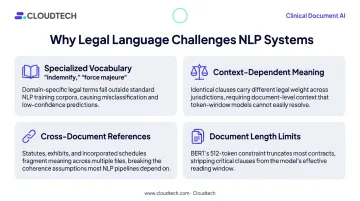
- Specialized terms like "indemnify," "force majeure," and "quantum meruit" rarely appear in standard training data, leaving models without reference points
- Phrases like "reasonable effort" or "material breach" carry different legal weight depending on jurisdiction and contract type — meaning shifts with context, not just vocabulary
- Clauses routinely reference other statutes, exhibits, or prior decisions that the model must locate and interpret before it can understand the original text
- Document length compounds the problem: ECHR judgments studied in prediction research averaged over 2,400 words, while early BERT models topped out at 512 tokens
NLP vs. Keyword Search
Those challenges explain why semantic understanding matters so much more than simple search. Legacy legal software relies on Boolean or keyword search: you find exactly what you search for, nothing more. Search "termination" and you'll miss clauses using "dissolution," "expiration," or "cancellation" to describe the same thing.
Modern NLP systems understand concepts and context. The ABA notes that keyword-based approaches have been augmented by semantic search — systems that retrieve documents based on meaning, not just matching strings. That distinction matters when the goal is finding every relevant clause across a contract library of thousands of documents.
Key NLP Techniques Used in Legal Document Processing
Named Entity Recognition (NER)
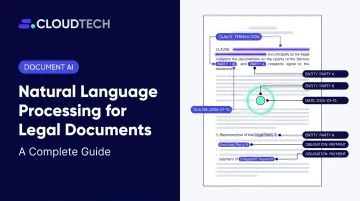
NER models identify and tag specific entities within text — parties to a contract, jurisdiction names, statute references, dates, monetary amounts, and obligations. In legal contexts, this is foundational. Before a system can extract a payment term or flag an indemnification clause, it needs to know what it's looking at.
Research has shown domain-specific NER can perform well on defined tasks: an ensemble model combining Legal-BERT and related pretrained models reached 90.99 micro-F1 on an Indian court judgment NER benchmark — ranking second among 17 competing teams. Performance varies significantly by jurisdiction and document type, so models trained on one legal corpus don't automatically transfer to another.
Text Classification
Text classification assigns documents or clauses to predefined categories. A trained classifier can sort a contract into its component clause types — liability limitation, governing law, termination, intellectual property — and route each to the appropriate reviewer or workflow.
This makes prioritization possible at scale. A compliance team can automatically flag all documents containing arbitration clauses or non-compete provisions without reading each one.
Document Summarization
Two approaches exist:
- Extractive summarization pulls the most important sentences directly from the source document
- Abstractive summarization generates a new summary that captures meaning without copying text verbatim
For legal teams, summarization condenses hundred-page court rulings or complex agreements into actionable briefs. The risk with abstractive methods is that they can alter legal meaning — which is why human review of generated summaries remains necessary.
Transformer Models, Legal-BERT, and LLMs
The current frontier in legal NLP is transformer-based models. Legal-BERT, trained on 12 GB of legal text including over 61,000 EU legislative documents and 164,000 U.S. court cases, outperforms general-purpose BERT on legal benchmarks by 0.2 to 2.5 F1 points depending on the task. GPT-based models fine-tuned on legal corpora extend this further.
These gains are real, though they're task-specific. No single accuracy figure applies across all legal NLP applications.
Retrieval-Augmented Generation (RAG)
RAG systems retrieve relevant source documents and feed them into an LLM's context before generating a response. The goal is grounding answers in actual source material rather than relying on what the model learned during training. AWS describes RAG as adding retrieved content to the model prompt to generate answers tied to retrieved context.
RAG reduces hallucination risk but doesn't eliminate it. In legal applications, that distinction matters: a fabricated citation can result in court sanctions.
Top Use Cases of NLP for Legal Documents
Contract Review and Clause Extraction
This is where NLP delivers the most immediate, measurable value. Automated systems identify, flag, and extract specific clause types — indemnification, payment terms, non-compete, termination — across entire contract libraries.
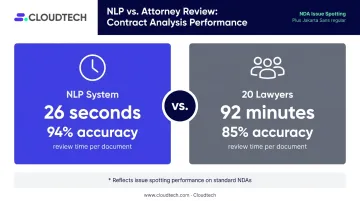
In a vendor study, LawGeex reviewed five standard NDAs in 26 seconds compared to 92 minutes for 20 lawyers, with reported accuracy of 94% vs. 85%. The study covered issue spotting in a narrow document set, not negotiation or complex custom agreements — but it illustrates the speed differential that NLP can produce on well-defined tasks.
Cvent used Kira to review 360 customer contracts in minutes during M&A diligence, though no exact manual comparison was provided.
Legal Research Acceleration
NLP-powered search translates plain-language queries into precise legal concepts and surfaces semantically similar cases and precedents. A lawyer asking "what constitutes breach of fiduciary duty in Delaware" gets relevant case law, not just documents containing that exact phrase.
Attorneys build arguments differently as a result — concept-driven retrieval finds what's actually relevant, while keyword searches miss synonymous language entirely.
Compliance Monitoring and Regulatory Analysis
For financial services and healthcare organizations managing dense regulatory environments, keeping pace manually is unsustainable. NLP handles the heavy lifting across several critical tasks:
- Monitors regulatory filings continuously for relevant changes
- Tracks version-to-version differences across evolving regulatory texts
- Flags non-compliant language in internal documents before it creates exposure
- Reduces the manual review burden of staying current across multiple frameworks simultaneously
Legal Q&A and Client-Facing Tools
NLP-powered Q&A systems handle common legal inquiries around the clock, triage client questions, and direct users to appropriate resources. An ABA article notes that 66% of legal consumers expect a response within one day — with 40% expecting a reply within a few hours. Automated triage doesn't replace attorney judgment, but it closes the response-time gap.
Judgment Prediction and Case Analytics
Predictive models trained on historical case data help attorneys assess likely outcomes, tailor strategy, and set realistic client expectations. An older ECHR study reported 79% average accuracy on a defined set of published cases — but this was retrospective classification of past judgments, not forward prediction of future U.S. cases. Current models are useful for scenario analysis, not reliable outcome guarantees.
Key Challenges of NLP in Legal Document Processing
Ambiguity and Context Sensitivity
Legal language is intentionally precise yet deeply context-dependent. Terms like "reasonable," "material," and "substantial" carry different weight in different jurisdictions, document types, and factual situations. Current NLP models — even domain-specific ones — still struggle with this without extensive fine-tuning on jurisdiction-specific data.
Hallucination Risk in LLMs
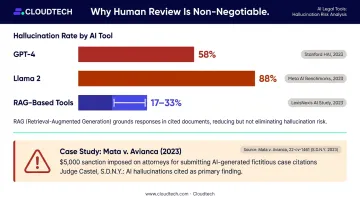
This is the most consequential limitation. A 2024 peer-reviewed study found legal hallucination rates of 58% for GPT-4 and 88% for Llama 2 on direct questions about federal cases. A Stanford study of RAG-based legal research tools found hallucination rates of 17–33% across 202 queries.
In Mata v. Avianca, lawyers submitted a brief containing six fictitious case citations generated by ChatGPT. The court imposed a $5,000 sanction and required notification to judges falsely named as authors.
That case isn't an outlier — it's a preview of what happens without human-in-the-loop review. ABA Formal Opinion 512 makes this explicit, applying competence, confidentiality, and supervision duties to generative AI and requiring attorneys to evaluate data retention, security practices, and whether inputs are used to train models.
Data Privacy and Security
Legal documents contain some of the most sensitive information an organization holds — client confidences, litigation strategy, trade secrets, and privileged communications. Deploying NLP requires controls around:
- Data residency and where documents are processed
- Encryption at rest and in transit
- Access controls and audit logging
- Whether vendor systems use client inputs for model training
Scarce Annotated Training Data
Training NLP models for legal tasks requires large volumes of expert-labeled documents. Producing that data is expensive, requires domain expertise to annotate correctly, and often reflects historical patterns in legal outcomes — raising fairness concerns, particularly for judgment prediction tools applied across different demographic groups.
How to Implement NLP for Legal Document Processing
Start With One Well-Defined Use Case
The most common implementation failure is deploying NLP broadly before understanding what problem it's solving. Pick one high-priority, measurable problem — contract clause extraction, compliance flagging, or document classification — before expanding.
A narrow scope means:
- Cleaner data requirements
- Faster validation against a known baseline
- Shorter time to demonstrable value
Choose Cloud-Native Infrastructure
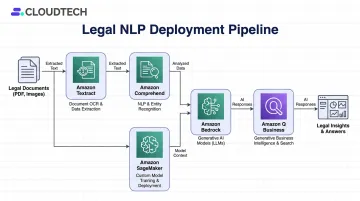
For SMBs and mid-market legal teams, building NLP infrastructure from scratch isn't practical. Cloud-native AWS services provide a scalable, secure foundation:
| AWS Service | Role in Legal NLP |
|---|---|
| Amazon Textract | Extracts text, tables, forms, and signatures from scanned and digital documents |
| Amazon Comprehend | Trains custom entity recognizers for legal-specific entity types beyond preset categories |
| Amazon SageMaker | Builds, trains, and deploys custom ML models in managed environments |
| Amazon Bedrock | Hosts foundation models (including Claude) for contract analysis and Q&A workflows |
| Amazon Q Business | Enables natural language querying of processed document outputs |
Cloudtech, an AWS Advanced Tier Partner based in New York, helps SMBs design and deploy document processing solutions on this stack. With a team built largely from former AWS employees, they structure engagements around your specific document types and compliance requirements — from architecture scoping to production deployment.
Build Human Oversight Into the Workflow
NLP for legal documents is not a deploy-and-forget system. Organizations should:
- Define review triggers: Establish which model outputs require attorney sign-off before action
- Log model decisions: Maintain audit trails for all automated classification or extraction results
- Collect error feedback: Build mechanisms for legal professionals to flag incorrect outputs and route corrections back into training pipelines
- Schedule regular revalidation: Legal language evolves; models trained on 2020 contracts may misread 2024 amendments
The goal is a system that gets more accurate over time, not one that runs unsupervised.
Frequently Asked Questions
What is NLP for legal document analysis?
NLP for legal document analysis uses AI to automatically parse and extract information from legal texts — contracts, court filings, regulations, and more. It enables clause extraction, document summarization, and compliance checking that would otherwise require manual attorney review.
What types of legal documents can NLP process?
Most NLP systems handle contracts, court judgments, regulatory filings, statutes, legal correspondence, and compliance documents. They can process both native digital text and scanned documents when combined with OCR tools like Amazon Textract.
How accurate is NLP for legal document review?
Accuracy varies significantly by task. Domain-specific models perform well on defined classification tasks — Legal-BERT improves over general BERT by up to 2.5 F1 points on legal benchmarks. Complex tasks like ambiguity resolution or judgment prediction still carry real error rates and require human review regardless of model quality.
What are the main limitations of NLP in legal contexts?
The primary limitations are sensitivity to legal ambiguity, LLM hallucination rates (58–88% on some benchmarks), data privacy concerns with client-privileged documents, and the scarcity of high-quality labeled training data. NLP is best used as a decision-support layer, not a replacement for legal judgment.
Is NLP for legal documents secure and compliant?
Security depends on deployment architecture. AWS-based deployments with proper encryption, access controls, and audit logging can meet enterprise and regulated-industry standards. Organizations should still evaluate jurisdiction-specific compliance obligations and vendor data handling practices per ABA Formal Opinion 512.
How long does it take to implement NLP for legal document processing?
Pre-built cloud AI services with a focused use case can get a working solution live in weeks. Custom model development typically takes several months. Cloudtech's AWS Architecture Assessment is a practical starting point for organizations building from the ground up.