Introduction
Customer expectations have shifted fast. According to Zendesk's CX Trends 2026 report, 74% of consumers expect 24/7 support availability, and 88% expect faster response times than they did just a year ago. For most SMBs, meeting that bar with human agents alone isn't realistic — the math simply doesn't work.
Support teams are stretched thin. Slow response times, inconsistent answers, and rising cost-per-ticket are pushing businesses toward AI-powered solutions. The Salesforce State of Service report found that 69% of service professionals already use at least one form of AI.
This guide covers three distinct AI tools reshaping customer service: AI chatbots, copilot agents, and autonomous AI agents. You'll learn how each works, where they differ, which industries benefit most, and how to choose and deploy the right solution — including on AWS.
Key Takeaways
- AI chatbots, copilot agents, and autonomous agents serve different purposes — deploying the wrong one wastes budget
- 74% of consumers expect 24/7 support; AI is the most practical way for SMBs to deliver it
- AWS services (Lex, Connect, Bedrock) make enterprise-grade AI accessible without large upfront costs
- Healthcare, financial services, and e-commerce see the fastest ROI from AI customer service — often within the first year
- Human escalation with full context transfer determines whether customers trust — or abandon — your AI system
AI Chatbots, AI Copilots, and AI Agents: What's the Difference?
Many businesses use these terms interchangeably, but each tool works differently and serves a distinct purpose. Deploying the wrong one leads to poor customer experiences and wasted investment.
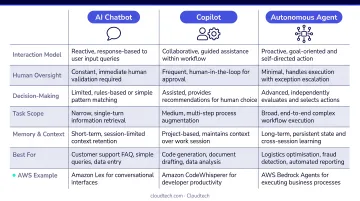
AI Chatbots
AI chatbots are software applications that simulate conversation using rule-based logic or natural language processing (NLP). They're primarily single-purpose, designed to handle structured, high-volume queries at scale.
Two types exist:
- Transactional (rule-based): Scripted, decision-tree driven. Best for FAQs, business hours, simple lookups
- Conversational (NLP-driven): Contextually aware, able to handle more varied phrasing and multi-turn exchanges
Salesforce reports that 58% of customers now use chatbots for simple service tasks — up from 43% in 2020. They're not a novelty; they're standard infrastructure for handling query volume.
AI Copilot Agents
Copilots work alongside human agents rather than replacing them. They operate inside the agent's workspace in real time — surfacing relevant knowledge base articles, suggesting reply drafts, summarizing ticket history, and auto-completing responses mid-conversation.
The human stays in control. The copilot reduces cognitive load and speeds up resolution without removing judgment from the loop. This makes copilots particularly valuable for complex, sensitive, or high-stakes interactions where a wrong answer carries real consequences.
Autonomous AI Agents
Autonomous agents are goal-driven systems capable of executing multi-step tasks from start to finish without human intervention. They can access CRM data, process refunds, update account records, and escalate with full context. Unlike copilots, they close tickets entirely on their own.
Quick Comparison
| Dimension | AI Chatbot | AI Copilot | Autonomous Agent |
|---|---|---|---|
| Autonomy Level | Low — follows scripts | None — assists humans | High — acts independently |
| Task Complexity | Simple, repetitive | Complex, contextual | Complex, multi-step |
| Personalization | Limited | Moderate (agent-guided) | High |
| Human in the Loop | Optional escalation | Always | Exception-based only |
How AI Customer Service Tools Work
The NLP and LLM Foundation
All three tool types rely on natural language processing (NLP) to interpret customer inputs. NLP breaks messages into utterances (what the customer said), intents (what they're trying to accomplish), and entities (specific values like dates, account numbers, or locations).
Modern AI agents go further, using large language models (LLMs) for contextual reasoning and more human-like responses. Where traditional chatbots required exact keyword matches, LLM-powered tools understand intent even when phrasing varies widely — a critical advantage when customers phrase the same question a dozen different ways.
Connecting to Business Data
AI tools don't operate in a vacuum. Their accuracy depends entirely on the data they can access. Well-integrated systems pull from:
- Knowledge bases — product documentation, policies, FAQs
- CRM platforms — customer history, account status, past interactions
- Ticketing systems — open cases, priority flags, SLA timers
- Order management systems — shipment status, returns, invoices
Amazon Bedrock Knowledge Bases, for example, can integrate proprietary business information directly into generative AI applications — allowing AI agents to generate responses grounded in your specific data rather than generic training sets.
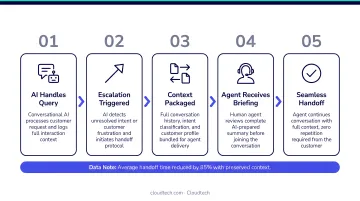
Human-in-the-Loop Escalation
Clear escalation logic is essential in any well-designed AI system. When the AI hits a defined trigger, it should route immediately to a human agent. Common triggers include:
- A query that falls outside the AI's defined scope
- A flagged sensitive issue (billing disputes, legal concerns, safety)
- Detected customer frustration or repeated failed attempts
That handoff must include the full conversation context. A cold transfer where a customer repeats their entire situation is one of the most damaging experiences in customer service. Proper escalation design means the human agent picks up mid-conversation, not at square one.
Key Benefits of AI Customer Service Tools for SMBs
24/7 Availability Without Adding Headcount
AI tools don't take breaks, call in sick, or go offline at 5pm. With 74% of consumers expecting round-the-clock support, after-hours coverage is now a baseline expectation. SMBs that can't staff overnight shifts can still meet after-hours demand without building a second shift.
Faster Resolution and Reduced Wait Times
Routine queries — order status, password resets, business hours, return policies — get resolved instantly rather than joining a queue. Human agents are freed to handle the interactions that actually require judgment. In healthcare, for example, AI-driven appointment scheduling and patient FAQ handling can meaningfully cut administrative burden on clinical staff.
Significant Cost Reduction
Gartner predicts that by 2029, agentic AI will autonomously resolve 80% of common customer service issues without human intervention, leading to a 30% reduction in operational costs. Every query resolved by AI before it reaches a human agent reduces cost-per-ticket directly.
Consistent, On-Brand Responses
Human agents have off days. They interpret policies differently. They miss details. AI tools draw from a single source of truth every time, which means:
- Fewer policy misinterpretations across conversations
- Consistent brand voice regardless of ticket volume
- Reduced compliance risk from agent-to-agent variation
Scalability During Volume Spikes
Black Friday. Product launches. Seasonal surges. Human-only teams face an impossible trade-off: over-hire and carry excess payroll year-round, or under-staff and frustrate customers during peaks. AI eliminates that trade-off, handling 10x normal volume without service degradation.
Top AI Customer Service Use Cases by Industry
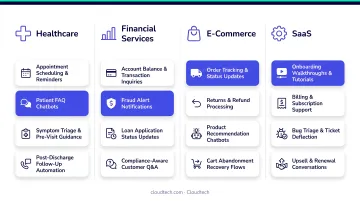
Healthcare
Healthcare generates enormous volumes of repetitive administrative queries. AI chatbots handle:
- Appointment scheduling and rescheduling
- Medication inquiries and prescription refill requests
- Insurance verification questions
- General patient FAQs and care navigation
Autonomous agents can triage incoming patient queries and route urgent cases to the appropriate clinical staff, reducing administrative burden without pulling clinical staff into routine requests. The healthcare chatbot market is projected to grow from $196 million in 2022 to $1.2 billion by 2032, reflecting how rapidly providers are adopting these tools.
Cloudtech has deployed AWS-based solutions for healthcare clients including Klamath Health Partnership, where HIPAA compliance, data security, and integration with existing clinical workflows were built into the architecture from the outset.
Financial Services
Financial AI deployments focus on:
- Account balance and transaction inquiries
- Fraud alert follow-ups and dispute initiation
- Loan application status updates
- KYC and identity verification support
Compliance and data security aren't optional in this sector. Deployments require proper authentication, role-based access controls, and the ability to redact sensitive financial data from transcripts for audit trails. AWS's Amazon Connect for Financial Services includes a built-in security posture designed specifically for these requirements, reducing the compliance overhead teams would otherwise configure from scratch.
E-Commerce and Retail
E-commerce generates the highest volume of low-complexity queries — precisely the interactions AI handles best:
- Order tracking (WISMO queries)
- Returns and exchanges processing
- Product recommendations
- Promotional and loyalty inquiries
These interactions are ideal candidates for full automation. High deflection rates free human agents entirely for escalations, complaints, and complex cases where relationship management matters.
SaaS
TeamSystem's deployment shows what's possible: 80% automation rate and a 99% reduction in repetitive support emails using AI agents. For SaaS companies running lean support teams across onboarding, feature guidance, and subscription management, that kind of deflection changes the economics of support entirely.
How to Choose the Right AI Customer Service Solution
Assess Your Support Volume and Query Complexity
Start with your actual ticket data. Audit your last 30 days of support requests and categorize them:
- High-volume, repetitive (password resets, FAQs, order status): A chatbot is sufficient and cost-effective
- Sensitive, multi-step, or contextual (billing disputes, complex troubleshooting): An autonomous agent or copilot delivers better ROI
- Mixed volume with human judgment required: A copilot supports agents without removing their oversight
Most SMBs discover that 60-70% of their tickets fall into the first category — meaning significant deflection is achievable with relatively simple tooling.
Evaluate Integration Requirements
The right solution must connect to tools already in use. A capable AI that can't access your CRM, help desk, or order management system will give customers incomplete answers — which is worse than no answer at all.
Key integrations to verify:
- CRM (Salesforce, HubSpot)
- Help desk (Zendesk, Freshdesk, Intercom)
- E-commerce platforms
- ERP or order management systems
Consider Technical Capacity and Implementation Timeline
Your team's technical capacity will shape which deployment path makes sense. The two main options look like this:
| Approach | Best For | Watch Out For |
|---|---|---|
| No-code platforms | Lean teams needing fast deployment | Limited customization; bottlenecks as requirements grow |
| Custom-built (e.g., AWS) | Teams needing deep integrations and long-term scalability | Requires a capable implementation partner — without one, timelines and costs expand fast |
Deploying AI Customer Service on AWS: What SMBs Need to Know
The Core AWS Services
Three AWS-native services form the backbone of most AI customer service deployments:
- Amazon Lex — Conversational chatbot interfaces using NLP. Handles intents, utterances, and entities to interpret and fulfill customer requests. Priced at $0.00075 per text request and $0.004 per speech request, with no upfront commitment
- Amazon Connect — AI-powered contact center capabilities across voice and digital channels. Supports autonomous issue resolution, real-time agent recommendations, and generative AI post-contact summaries. No minimums, no long-term contracts
- Amazon Bedrock — Access to foundation models (LLMs) for generative AI agents. Bedrock Knowledge Bases connect proprietary business data to AI responses, grounding outputs in your actual policies and information rather than generic training data
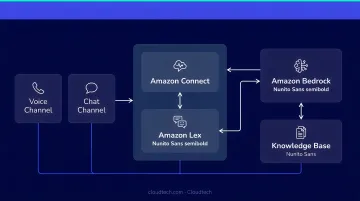
These services are pay-as-you-go, which makes them genuinely accessible for SMBs without large upfront infrastructure investment.
How Cloudtech Helps SMBs Deploy Faster
Building on AWS is powerful — but architecture decisions made early in a deployment have long-term consequences. Cloudtech, as an AWS Advanced Tier Partner, designs and deploys AI customer service solutions using pre-built accelerators that deliver results in weeks, not months.
For eligible businesses, AWS Partner Funding can reduce or eliminate out-of-pocket implementation costs — making the barrier to entry considerably lower than most SMBs expect. Cloudtech's team can walk through funding eligibility as part of an initial consultation.
For healthcare clients, compliance isn't bolted on after the fact. Cloudtech builds HIPAA requirements into the architecture from day one, including:
- Data encryption at rest and in transit
- Role-based access controls
- Audit logging via AWS CloudTrail
- Sensitive data classification through Amazon Macie
Frequently Asked Questions
What is the difference between an AI chatbot and an AI copilot for customer service?
AI chatbots automate customer-facing responses directly — handling queries without any human involvement. Copilots work differently: they assist human agents in real time by suggesting replies and surfacing relevant information. One replaces routine interactions entirely; the other makes the human handling complex ones faster and more accurate.
Can small businesses afford to implement AI customer service solutions?
AI customer service tools range from no-code SaaS platforms with free or low-cost tiers to custom AWS-built solutions. Costs have dropped considerably, and AWS's pay-as-you-go pricing means SMBs pay for actual usage rather than large upfront licenses. Most SMBs recover implementation costs within the first few months through reduced ticket volume alone.
How long does it take to deploy an AI customer service chatbot?
Simple chatbots built on no-code platforms can go live in hours or days. Custom AI agent deployments using AWS services typically take a few weeks when working with an experienced implementation partner. Complexity, integration requirements, and compliance needs are the main factors that affect timeline.
What AWS services are used to build AI customer service solutions?
Amazon Lex handles NLP-powered chatbot interfaces, Amazon Connect powers AI contact center capabilities across voice and chat, and Amazon Bedrock provides LLM-powered generative AI agents grounded in proprietary business data. An experienced AWS partner will typically combine all three to handle everything from simple FAQ deflection to complex, context-aware conversations.
How do AI agents handle complex or sensitive customer issues?
Well-designed AI agents include built-in escalation logic. When they encounter a query outside their scope, detect customer frustration, or flag a sensitive topic, they route the conversation to a human agent — along with the full conversation history and context, so the agent doesn't need to start over.
Which industries benefit most from AI customer service tools?
Healthcare, financial services, e-commerce, and SaaS see the strongest impact. Each combines high volumes of repetitive queries, strong 24/7 service expectations, and clear ROI from deflecting routine tickets to AI — letting support staff focus on escalations, sensitive cases, and revenue-driving conversations.