Introduction
Most businesses still route customer calls through rigid phone trees built a decade ago. The experience is familiar and frustrating: "Press 1 for billing, press 2 for support" — and if your question doesn't fit a menu option, you're stuck.
The business cost is measurable. According to PwC's 2025 Customer Experience Survey, 52% of consumers stopped using or buying from a brand after a single bad experience. That abandonment is compounded by what happens on the call itself: the Qualtrics XM Institute's 2025 Contact Center Trends report — drawing from 23,000+ consumers — found that fewer than 2 in 3 issues get resolved on the first attempt.
LLM-based conversational AI voice bots represent a break from that pattern. Unlike scripted IVR systems, they understand open-ended questions, maintain context across a conversation, and generate responses on the fly — no pre-written script required.
If you're evaluating whether this technology fits your operation, this guide walks through how these systems work, how they compare to legacy voice automation, where they deliver the strongest ROI, and what implementation on AWS actually looks like.
Key Takeaways
- LLM voice bots generate context-aware responses in real time, replacing rigid scripts entirely
- Five pipeline stages power every interaction — from voice detection and ASR through LLM processing and TTSpower every interaction — from voice detection and ASR through LLM processing and TTS
- Healthcare, financial services, retail, and manufacturing see the clearest ROI from automating high-volume routine calls
- Amazon Lex, Polly, Connect, and Bedrock form the composable AWS foundation for production deployments
- Latency, compliance, and escalation handling are the three factors that determine whether a deployment succeeds in production
What Is a Conversational AI Voice Bot?
A conversational AI voice bot is a software system that conducts spoken dialogue with a caller — answering questions, completing transactions, or gathering information — without a human agent involved. Unlike text-based chatbots, voice bots operate hands-free, in real time, and are accessible to users who can't or won't engage with typed interfaces.
LLM-Based vs. Rule-Based Systems
That accessibility only holds up if the bot can actually hold a conversation. Traditional voice bots follow pre-programmed decision trees: if the caller says keyword A, go to node B. LLM-based voice bots work differently:
- They interpret what a caller means, not just what they literally said
- They remember earlier turns in the conversation — no need for callers to repeat themselves
- They compose replies on the fly, rather than selecting from a fixed library of pre-written answers
That difference is the gap between "I didn't understand that, please try again" and "Sure, I can help you reschedule and explain the billing charge — which would you like to start with?"
Core Technology Stack
Every LLM voice bot depends on three layers working in sequence:
- Automatic Speech Recognition (ASR) — converts spoken input to text
- Large Language Model (LLM) — interprets intent and generates a reply
- Text-to-Speech (TTS) — converts the text response back into spoken audio
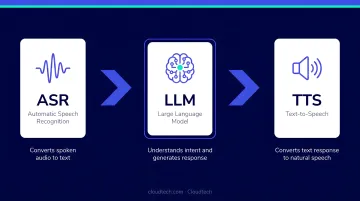
The sophistication of each layer directly determines how natural the conversation feels.
How LLM-Based Voice Bots Work: The 5-Step Pipeline
Step 1 — Voice Activity Detection and ASR
The interaction begins when Voice Activity Detection (VAD) isolates the moment a user starts speaking. An ASR engine then transcribes that audio into text, compensating for accents, background noise, and varied speech pacing.
ASR accuracy is foundational — errors here cascade downstream. Research published in Sensors found that at a 52.94% word error rate, intent classification accuracy dropped to 75.86% — while a WER of 32–33% corresponded to 92–95% intent accuracy.
Testing ASR against your actual caller population — including domain-specific vocabulary and real acoustic conditions — is non-negotiable before going to production.
Step 2 — Speech and Sentiment Analysis
Beyond the literal transcript, advanced systems analyze the audio itself. Vocal tone, speech pace, and pitch carry emotional signals — frustration, urgency, confusion — that words alone don't always convey. This emotional context layer allows the bot to:
- Adjust its tone mid-conversation
- Proactively offer a transfer to a human agent
- De-escalate tension before it compounds
Step 3 — LLM-Based Language Understanding and Response Generation
This is the intelligence core. The LLM maps the transcribed input to meaning using semantic embeddings, interprets ambiguous or incomplete intent, and generates a contextually relevant response. It also maintains a context window — a running memory of prior turns — so it handles multi-part requests coherently rather than treating each utterance in isolation.
The LLM's core functions at this stage include:
- Mapping transcribed input to meaning via semantic embeddings
- Resolving ambiguous or incomplete intent
- Generating contextually relevant responses
- Retaining conversational history across turns
The LLM handles linguistic generation. A separate dialogue management layer (Step 4) governs the conversation's strategic direction.
Step 4 — Dialogue Management and Business Logic
The dialogue management layer is what transforms a general-purpose LLM into a purpose-built business tool. It handles:
- Conversation state tracking — where are we in the interaction?
- Business rule enforcement — compliance constraints, escalation triggers, data validation
- Backend integrations — pulling real-time data from CRM, EHR, or ERP systems mid-conversation
- Agent handoff decisions — when to transfer, and with what context preserved
This layer is what makes the difference between a language model that can hold a conversation and one that can actually run a business process.
Step 5 — Text-to-Speech Synthesis and Delivery
The generated text response passes to a TTS engine, which converts it to speech and delivers it to the caller. Modern neural TTS — like Amazon Polly's neural voices — produces naturally varied, expressive audio that sounds nothing like the flat robotic output associated with early IVR systems.
Speech Synthesis Markup Language (SSML) tags can further fine-tune pacing, emphasis, and tone for specific phrases — useful for delivering time-sensitive information clearly or conveying warmth when appropriate.
IVR vs. Rule-Based Voice Bots vs. LLM Voice Bots: Key Differences
| Dimension | Legacy IVR | Rule-Based Voice Bot | LLM Voice Bot |
|---|---|---|---|
| Input method | DTMF keypad | Limited keyword matching | Open-ended natural language |
| Flexibility | Fixed menus | Pre-scripted decision trees | Dynamic, context-aware |
| Learning ability | None | Minimal | Continuous improvement possible |
| Autonomy | Manual call routing | Basic command execution | Goal-driven task resolution |
| Typical failure | Caller exits menu | Unrecognized commands | Misconfigured guardrails |
To make this concrete: a caller says "I want to reschedule my appointment and also ask about my bill."
- IVR: Forces the caller to pick one option, then navigate the menu again for the second
- Rule-based bot: May handle one request but likely can't hold context for the second without resetting
- LLM voice bot: Acknowledges both requests, handles them sequentially, and confirms when done
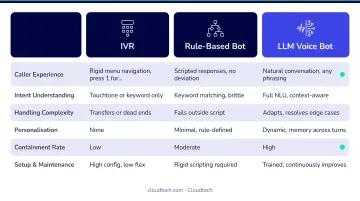
That capability gap explains why ContactBabel's 2025 US Contact Center Decision-Makers' Guide found that 38% of contact center leaders strongly agree customers abandon telephony self-service because it doesn't offer what they need. The technology is the bottleneck — not the caller's patience.
Tradeoffs Worth Acknowledging
LLM voice bots come with real tradeoffs. Businesses moving from IVR should plan for:
- Higher infrastructure complexity — more services to configure, monitor, and tune
- Latency management — round-trip time from speech input to audio output must stay under one second for conversations to feel natural
- Guardrail design — LLMs can generate off-brand or inaccurate responses without proper constraints
None of these are blockers, but each requires deliberate planning before go-live.
Top Use Cases for LLM Voice Bots Across Industries
Healthcare — Scheduling and Patient Intake
Healthcare administrative work is overwhelmingly phone-based. An MGMA poll of 294 practice leaders identified the most time-consuming phone tasks as:
- Eligibility and prior authorization — 45%
- Scheduling — 31%
- Patient intake — 9%
- Prescription refills — 6%
Voice bots handle all four categories without clinical involvement : booking, rescheduling, collecting intake information, and verifying insurance status. When integrated with EHR systems and built on HIPAA-eligible infrastructure, they free clinical staff for tasks that actually require clinical judgment.
Financial Services — Account Queries and Fraud Alerts
J.D. Power's 2025 US Retail Banking Satisfaction Study found 59% of banking problems were resolved in a single contact, up from 56% the prior year — and that improvement drove a 246-point gain in overall satisfaction scores. First-call resolution is where voice automation delivers its clearest ROI.
Voice bots handle the high-volume, low-complexity calls that clog agent queues: balance inquiries, transaction status, loan updates, and payment reminders. They also support proactive outbound scenarios, including real-time fraud alerts, where response time is the only thing that matters.
Manufacturing and Logistics — Order Status and Vendor Support
Supply chain teams field constant inbound calls about shipment ETAs, order status, dock appointments, and proof-of-delivery requests. These are repetitive, structured queries with clear data sources, making them a natural fit for voice automation.
That fit becomes even more apparent across time zones. Businesses can't staff live agents around the clock cost-effectively, and a voice bot fielding "Where's my shipment?" at 2 a.m. is both operationally straightforward and genuinely valuable to the caller who needs the answer.
Voice automation in logistics typically covers:
- Shipment ETA lookups tied to live tracking systems
- Dock appointment scheduling and confirmations
- Proof-of-delivery request handling
- Vendor inquiry routing outside business hours
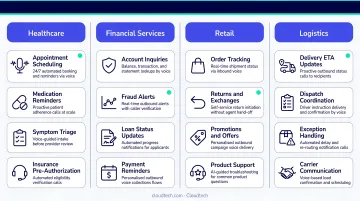
Retail and eCommerce — Returns, Tracking, and Product Questions
Returns are a major operational surface area. NRF's 2023 data put total US merchandise returns at $743 billion, at a 14.5% return rate, which translates to roughly $145 million in return-related costs per $1 billion in sales. Automating return initiation, tracking status, and refund inquiries via voice deflects a predictable volume of inbound contacts.
CRM integration makes retail voice bots useful: instead of generic responses, the bot can greet a caller by name and confirm specific order details before the caller even asks.
Cross-Industry — Smart Escalation and Call Deflection
The universal use case: route routine, high-volume calls to automation while preserving human agents for interactions that require judgment, empathy, or complexity. McKinsey's 2025 contact center research cites AI agents driving a 50% reduction in cost per call in optimized deployments.
Escalation design is as important as deflection. When a caller is frustrated or the query exceeds the bot's scope, the handoff to a live agent should transfer the full conversation context, so the caller never has to repeat themselves.
Building and Deploying a Conversational AI Voice Bot on AWS
The Core AWS Service Stack
AWS provides four modular services that form the backbone of a production LLM voice bot:
| Service | Role |
|---|---|
| Amazon Lex | ASR and natural language understanding |
| Amazon Polly | Neural text-to-speech synthesis |
| Amazon Connect | Cloud contact center telephony layer |
| Amazon Bedrock | Access to foundation models (Anthropic Claude, Meta Llama, and others) |
All four are listed on the AWS HIPAA Eligible Services Reference (updated May 22, 2026), making this stack viable for healthcare deployments — provided customers implement their own access controls, audit logging, and BAA agreements.
Reference Architecture
A typical call flow looks like this:
- Caller dials in via Amazon Connect
- Audio is processed by Amazon Lex for ASR and intent detection
- Detected intent is passed to a foundation model on Amazon Bedrock for response generation
- Response text is converted to speech by Amazon Polly
- Audio is delivered back to the caller via Amazon Connect
- AWS Lambda and API Gateway orchestrate the flow and connect to backend systems
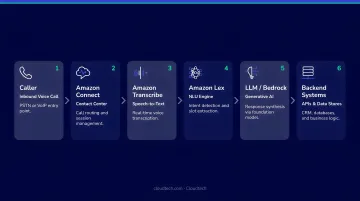
Lex V2's streaming API supports bidirectional conversation streams, enabling the bot to handle interruptions mid-prompt — important for conversations that feel natural rather than transactional.
Three Critical Engineering Considerations
Latency is the most immediate challenge. The round-trip from speech input to audio output needs to stay under one second. Two techniques close this gap: streaming ASR processes audio as it arrives rather than waiting for the caller to finish, and chunked TTS starts audio delivery before the full response is rendered. Both are required to hit the sub-second threshold consistently.
Security and compliance matters especially in regulated industries. HIPAA deployments require encryption at rest and in transit, PII redaction in conversation logs, access controls on PHI, and full audit trails. HIPAA-eligible AWS services are a necessary foundation — but eligibility is not the same as compliance. Application-layer controls remain the customer's responsibility.
Scalability is largely handled by AWS auto-scaling, but architecture decisions made early affect how well the system holds up under pressure. Designing for peak load from the start — particularly in healthcare or retail with seasonal surges — avoids degraded performance when call volume spikes matter most.
Integration Best Practices
Voice bots become significantly more useful when connected to real business data. AWS API integrations allow the bot to query Salesforce, ServiceNow, EHR platforms, or custom databases mid-conversation — enabling answers like "Your policy renews on March 14th" or "Your order shipped this morning and arrives tomorrow" without agent intervention.
The practical approach: start with one well-defined call type — appointment scheduling, order status, or balance inquiry. Validate ASR and NLU performance on real calls before expanding to additional intents. Proving the first workflow builds the confidence and data needed to scale reliably.
For SMBs that want to deploy this stack without standing up an internal engineering team, Cloudtech — an AWS Advanced Tier Partner based in New York — builds and deploys LLM-powered voice bots on this exact infrastructure. Their AWS-certified solutions architects work with clients in healthcare, financial services, and manufacturing, typically delivering in weeks at a cost accessible to small and mid-sized businesses.
Frequently Asked Questions
What is the difference between a traditional IVR, a rule-based voice bot, and an LLM-based voice bot?
IVRs use keypad menus and fixed call routing with no speech understanding. Rule-based voice bots recognize a limited set of spoken keywords but follow pre-scripted paths. LLM-based voice bots understand open-ended natural language, maintain context across multiple turns, and generate dynamic responses — handling requests that were never explicitly scripted.
What AWS services are used to build an LLM-powered voice bot?
The core stack includes Amazon Lex (ASR and NLU), Amazon Polly (text-to-speech), Amazon Connect (cloud telephony), and Amazon Bedrock (access to foundation models like Anthropic Claude and Meta Llama). AWS Lambda and API Gateway orchestrate the pipeline and connect to external business systems like CRM or EHR platforms.
How long does it typically take to deploy a conversational AI voice bot?
A focused MVP covering a defined use case — appointment scheduling or FAQ handling, for example — typically deploys in 4–8 weeks with the right architecture and a qualified AWS partner. More complex deployments involving multiple intents, deep EHR/CRM integrations, or regulated data handling will extend that timeline.
How do LLM voice bots handle sensitive customer data securely?
Secure deployments require encryption at rest and in transit, PII masking in conversation logs, role-based access controls, and full audit trails. AWS's HIPAA-eligible services (Lex, Polly, Connect, Bedrock) cover healthcare compliance, while GDPR deployments use AWS KMS for customer-controlled encryption keys and Amazon Macie for PII discovery.
Can an LLM voice bot integrate with existing CRM or helpdesk tools?
Yes. Via API integrations through AWS Lambda and API Gateway, voice bots connect to Salesforce, ServiceNow, custom databases, and EHR platforms in real time. This enables the bot to look up account details, log interaction data, and personalize responses mid-conversation without any human agent involvement.
What industries benefit most from LLM-based voice bots?
Healthcare (scheduling, intake, eligibility), financial services (account queries, fraud alerts, payment reminders), retail (order tracking, returns), and manufacturing/logistics (order status, shipment tracking) all combine high inbound call volumes with repeatable, data-driven workflows. Each of these sectors sees measurable ROI from voice automation precisely because the use cases are well-defined and high-frequency.