Introduction
Every missed appointment is revenue that walked out the door. For service businesses running lean teams, the math is brutal: a single no-show in healthcare costs an average of hundreds of dollars in wasted clinical capacity, and missed appointments cost providers an estimated $150 billion annually.
Add phone lines flooded with rescheduling calls, staff hours burned on calendar back-and-forth, and leads who book with a competitor because nobody answered at 8 p.m. — and the case against manual scheduling writes itself.
That's the gap AI scheduling chatbots are built to close. They check availability, collect intake information, confirm bookings, send reminders, and update your CRM — without human intervention, around the clock.
For SMBs in healthcare, financial services, and professional services, these tools have moved from optional to a baseline requirement. AI adoption among small businesses surged 41% in 2025, and scheduling automation is one of the clearest entry points.
This guide breaks down the top AI chatbots for appointment scheduling in 2026 — how they compare on features, integrations, and pricing — so you can choose the right tool without wasting time on the wrong one.
Key Takeaways
- AI scheduling chatbots handle the full booking lifecycle — confirmations, reminders, and rescheduling — automatically, around the clock
- The best tools sync with Google Calendar, Outlook, HubSpot, and Salesforce to create one connected workflow
- Critical differentiators: real-time calendar sync, CRM integration, and multi-channel deployment
- Top picks for 2026 include Calendly, Drift, Tars, Cal.com, and ChatBot — each suited to different business types
- No-show prevention drives the highest ROI in healthcare, financial services, and professional services
What Are AI Chatbots for Appointment Scheduling?
An AI appointment scheduling chatbot is a conversational tool that handles the full booking lifecycle without human involvement. It checks real-time calendar availability, collects pre-booking information, confirms slots, sends reminders, and triggers CRM updates — all within a single conversation across web, SMS, or messaging channels.
That's a meaningful step beyond a static calendar link. Here's the difference in practice:
- A basic scheduling tool gives someone a page to pick a time
- An AI scheduling chatbot qualifies the lead first, routes them to the right team member or appointment type, answers their questions, and fires off a confirmation sequence the moment they book
Why This Market Is Growing Fast
The global chatbot market is projected to reach $41.2 billion by 2033, driven largely by businesses automating high-volume, repetitive customer interactions. Scheduling is one of the most frequent workflows in any service business — which makes it one of the highest-value targets for automation.
For SMBs, the operational case is straightforward:
- Fewer staff hours spent on routine coordination
- Fewer no-shows from missed reminders
- Bookings captured outside business hours, when no one is staffing the phones
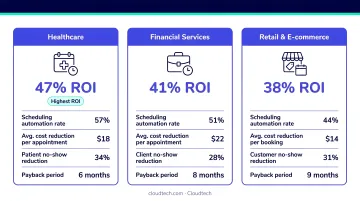
The industries seeing the strongest returns reflect where scheduling volume and revenue impact collide most directly.
Industries seeing the strongest returns:
- Healthcare — high appointment volume, direct revenue impact per no-show, complex intake requirements
- Financial services — compliance-sensitive workflows, advisor capacity constraints
- Professional services — client-facing scheduling tied directly to billable hours
Top AI Chatbots for Appointment Scheduling in 2026
These tools were shortlisted based on scheduling automation depth, integration ecosystem, ease of deployment for non-technical teams, verified user ratings, and fit across healthcare, financial services, and professional services.
Calendly
Calendly is one of the most widely adopted scheduling platforms globally, used by sales teams, consultants, and healthcare practices to eliminate meeting coordination overhead. It connects with Google Calendar, Outlook, HubSpot, Salesforce, Zoom, and 100+ other tools.
What sets Calendly apart from a simple calendar link is its workflow automation layer. It triggers automated email and SMS reminders, post-booking follow-up sequences, and CRM record updates the moment an appointment is confirmed. Its routing forms use conditional logic to direct prospects to the right team member or appointment type based on their answers — functioning as a lightweight lead qualifier before the booking even happens.
A Forrester study found Calendly delivered a 318% ROI for its users, driven largely by time savings on scheduling coordination and reduction in no-shows.
| Feature | Details |
|---|---|
| Key Features | Real-time calendar sync, automated reminders, routing forms, team scheduling, 100+ integrations including HubSpot and Salesforce |
| Best For | Sales teams, consultants, and professional services firms managing high volumes of external meetings and demos |
| Pricing | Free plan available; paid plans from $10/month; Enterprise from $15,000/year |
| Compliance | SOC 2 Type II; HIPAA available on Enterprise (requires BAA) |
| G2 Rating | 4.7/5 (2026) |
Drift (Salesloft)
Drift, now part of the Salesloft platform, is a conversational sales chatbot built specifically for B2B revenue teams. It engages website visitors in real time, qualifies them through intelligent conversation, and books meetings with the right sales rep — converting anonymous traffic into pipeline without manual outreach.
Drift's real differentiator is intelligent routing tied to behavioral data. It uses visitor identity signals and intent cues to personalize conversations and funnel high-intent prospects directly into a booking flow — not a generic contact form. For businesses where every booked meeting has direct pipeline value, Drift connects scheduling to CRM activity in a way most tools don't.
Pricing reflects the enterprise positioning — expect to contact sales for current figures, though third-party sources place it well above $2,000/month.
| Feature | Details |
|---|---|
| Key Features | AI-powered lead qualification, smart routing to sales reps, real-time calendar booking, CRM integration, automated meeting reminders |
| Best For | B2B companies and revenue teams wanting to convert website visitors into booked meetings and qualified pipeline |
| Pricing | Contact sales for current pricing; best suited for mid-market and enterprise-scale teams |
| Compliance | Enterprise security standards |
| G2 Rating | 4.4/5 (2026) |
Tars
Tars is a conversational AI platform built for businesses that need customizable booking flows across multiple channels — web, WhatsApp, and Facebook Messenger. Teams can configure the conversational flow to gather exactly the intake information required before confirming a booking.
This makes Tars a strong fit for healthcare practices and financial advisors where structured pre-booking qualification isn't optional — it's a compliance requirement. The ability to collect insurance details, describe the nature of the appointment, or verify eligibility before confirming a slot cuts the administrative burden at the front desk, reducing back-and-forth between staff and patients before the appointment even begins. Tars also integrates with major calendar and CRM tools via APIs and is HIPAA compliant.
| Feature | Details |
|---|---|
| Key Features | Customizable conversational flows, omnichannel deployment (web, WhatsApp, Messenger), automated SMS/email reminders, human handover, API integrations |
| Best For | Healthcare, financial services, and professional service businesses needing structured pre-booking qualification before confirming appointments |
| Pricing | Starter $99/month; Professional $499/month; Business $999/month |
| Compliance | HIPAA compliant |
| G2 Rating | 4.7/5 (2026) |
Cal.com
Cal.com is an open-source scheduling platform with an API-first architecture and a growing AI feature set. Its standout capability is a voice-based AI phone agent — Cal.ai — which handles appointment booking over voice calls, making it the only tool on this list suited for businesses where customers primarily book by phone.
The open-source foundation gives technical teams full control to extend, self-host, and customize the scheduling infrastructure. For SaaS companies or startups building scheduling into their own product — particularly on AWS — Cal.com provides the flexibility that hosted SaaS tools can't match. Compliance credentials are strong: HIPAA, SOC 2, and ISO 27001 certified.
| Feature | Details |
|---|---|
| Key Features | AI voice phone agent (Cal.ai), open-source architecture, calendar and CRM integrations, API access, self-hosted or managed hosting options |
| Best For | Technical teams, SaaS companies, and businesses with phone-first booking workflows needing a customizable scheduling foundation |
| Pricing | Free for individuals; Team plans from $15/month; self-hosted option available |
| Compliance | HIPAA, SOC 2, ISO 27001 |
| Product Hunt Rating | 4.7/5 (2026) |
ChatBot
ChatBot is a no-code visual platform that lets SMBs build and deploy appointment scheduling bots across websites, messaging apps, and mobile channels — no developer required. It integrates with Google Calendar and major CRM tools, and includes live agent handoff for complex inquiries.
The appeal for smaller teams is speed: a functional scheduling bot can be configured and live within hours. A built-in analytics dashboard tracks booking rates, conversation performance, and handoff frequency, giving teams the data to optimize over time without needing a developer.
| Feature | Details |
|---|---|
| Key Features | Visual no-code bot builder, Google Calendar integration, live agent handoff, multi-channel deployment, built-in analytics dashboard |
| Best For | SMBs and service businesses wanting a fast, no-code path to 24/7 appointment scheduling across web and messaging channels |
| Pricing | Starter $52/month; Team $142/month; Business $424/month |
| Compliance | SOC 2 Type II |
| G2 Rating | 4.6/5 (2026) |
How to Choose the Right AI Scheduling Chatbot
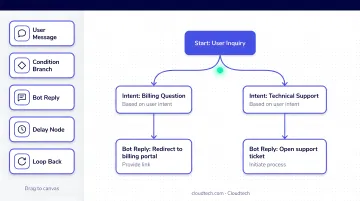
Most businesses pick the wrong tool for the same reason: they evaluate on brand recognition or price rather than integration depth and workflow fit. A chatbot that looks polished in a demo but doesn't connect to your EHR, CRM, or calendar platform creates more admin work, not less.
The Most Common Mistake
Choosing a tool because it's popular — without verifying it integrates with your existing tech stack at the depth your workflow requires. A tool that syncs with Google Calendar but doesn't update your CRM means someone still has to do that manually. That manual gap is where no-shows and data errors accumulate.
What Actually Drives Outcomes
These four factors tie directly to business results:
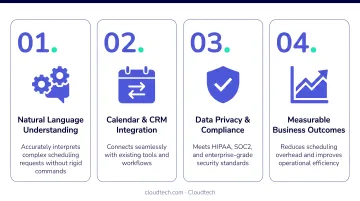
- Real-time calendar sync eliminates double-bookings. Non-negotiable.
- Post-booking automation — confirmation messages, 24-hour reminders, same-day nudges — is the primary mechanism for reducing no-shows.
- CRM integration keeps pipeline data current without manual entry, which matters most for sales teams and client-facing practices.
- Scalability: a tool handling 50 appointments per month may not hold up at 500. Evaluate this before you commit, especially if you're growing across locations or channels.
Compliance Is Not Optional in Regulated Industries
For healthcare and financial services, compliance credentials should be a hard filter, not an afterthought. HIPAA-compliant tools (Tars, Cal.com, Calendly Enterprise) process and store protected health information within the required security controls. Deploying a non-compliant tool in a regulated environment creates liability that outweighs any efficiency gain.
For businesses deploying AI scheduling chatbots on AWS infrastructure — particularly in healthcare or financial services — Cloudtech's AWS-certified engineers can help architect the underlying cloud environment with HIPAA, SOC 2, and security controls baked into the design.
Cloudtech's team has deployed HIPAA-compliant AI voice agents handling thousands of monthly scheduling interactions, using AWS-native services including Amazon Bedrock, Amazon Transcribe, and Amazon Connect.
Frequently Asked Questions
Can AI chatbots be used for appointment scheduling?
Yes — AI chatbots are widely used for appointment scheduling across healthcare, financial services, and professional services. They integrate with calendar systems, check real-time availability, collect pre-booking information, and confirm appointments automatically across web, SMS, and messaging channels.
How can AI chatbots help with appointment scheduling?
AI chatbots eliminate scheduling back-and-forth by handling availability checks, confirmations, and reminders automatically. They enable 24/7 self-service booking and sync confirmed appointments to CRM and calendar systems without manual data entry, reducing no-shows and freeing staff for higher-value work.
What features should I look for in an AI appointment scheduling chatbot?
Prioritize real-time calendar integration, CRM sync, post-booking automation (reminders and follow-ups), multi-channel deployment, and a human handoff option for complex inquiries. For regulated industries, verify HIPAA or SOC 2 compliance before selecting a tool.
How do AI scheduling chatbots reduce no-shows?
They automatically send confirmation messages at booking, reminder messages 24 hours before, and same-day nudges. They also make rescheduling frictionless through chat, turning missed appointments into rebooked ones instead of lost revenue.
Which AI chatbot is best for small businesses booking appointments?
No-code tools like ChatBot and Calendly are strong starting points for SMBs given their ease of setup and accessible pricing. Businesses with structured intake requirements — healthcare practices, financial advisors — will likely need a more configurable platform like Tars.
Will an AI chatbot replace my receptionist for appointment booking?
No. AI chatbots handle routine scheduling tasks — availability checks, confirmations, reminders, and rescheduling — but human staff remain essential for complex, sensitive, or escalated interactions. The chatbot covers the repetitive work; your team handles everything that requires judgment.