Introduction
Deploying conversational AI on a single channel is hard enough. Deploying it across web chat, mobile apps, WhatsApp, SMS, voice assistants, and internal tools simultaneously is a categorically different challenge. A design decision that works perfectly on one platform can silently break the experience on another.
The stakes are real. Gartner projected that at least 30% of generative AI projects would be abandoned after proof of concept by end of 2025 — citing poor data quality, inadequate risk controls, and unclear value as primary drivers. For SMBs scaling across channels without enterprise infrastructure, each of those failure points hits harder and earlier.
This article unpacks the four core challenge areas that derail cross-platform conversational AI: technical integration, user experience consistency, data and compliance, and organizational readiness — with concrete strategies for navigating each one.
Key Takeaways
- Cross-platform AI failures almost always originate in early architecture decisions, not the underlying technology
- Each channel has unique constraints — voice, SMS, chat, and messaging apps each require adapted dialogue design
- Context loss across channels is one of the most damaging and underestimated UX failures
- Resolve data fragmentation before scaling to additional platforms — it only compounds as channels multiply
- A headless, API-first architecture with a centralized NLU engine is the foundation of sustainable multi-channel deployment
What Makes Cross-Platform Conversational AI Uniquely Challenging?
Single-channel bots are contained systems. Every design decision — response length, button layouts, fallback logic — is optimized for one context. Add a second channel and you double the surface area for failure. Add five channels and you've built something that requires fundamentally different infrastructure to hold together.
The platforms businesses typically try to unify each operate by different rules:
| Platform | Key Constraint |
|---|---|
| WhatsApp Business | Requires opt-in; only template messages outside the 24-hour service window |
| SMS | 160-character limit per segment; no rich media |
| Alexa Skills | JSON/SSML responses; 120 KB total response limit; invocation-based |
| Web chat | Supports buttons, carousels, images — but none of these translate to voice |
| Voice/IVR | Requires sub-500ms response latency; no visual elements |
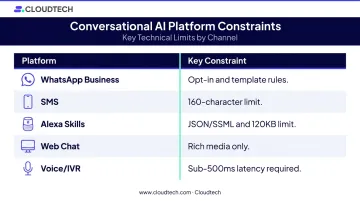
A bot response designed for web chat is frequently undeliverable on SMS, confusing on voice, and non-compliant on WhatsApp. That's not a minor formatting issue — it's a broken experience that erodes customer trust.
These technical constraints are only part of the picture. How well a multi-platform deployment holds together also depends on the organizational layer beneath it — data maturity, governance structures, and the team's capacity to manage complexity across channels.
Technical Integration and Backend Connectivity Challenges
Incompatibility With Existing Systems
Most businesses have customer data distributed across CRMs, ERPs, ticketing systems, and proprietary databases that were never designed to talk to AI agents. Each conversational platform may require different API authentication flows, different data formats, and different integration patterns — creating a web of one-off connections that's expensive to build and fragile to maintain.
The most damaging consequence: bots operating in isolation from real-time backend data. Without live access to order status, account history, or ticket records, an AI agent can only provide static FAQ-style responses. That eliminates the primary business value of deploying conversational AI in the first place.
Platform-Specific API Constraints and Rate Limits
Each channel enforces its own rules that directly affect what your AI can say and how:
- WhatsApp enforces template categories (marketing, utility, authentication) and opt-in requirements — free-form messages are only permitted within the 24-hour service window
- Alexa returns JSON responses with an SSML audio layer; the total response payload cannot exceed 120 KB
- SMS segments messages at 160 characters, with variable network behavior for longer messages
Voice AI adds a latency constraint that web chat doesn't face. AWS identifies 200–500ms as the ideal response range for humanlike conversation — a budget that must cover speech recognition, model inference, retrieval, and speech synthesis combined. Building infrastructure that serves both voice and chat without degradation requires deliberate cloud architecture from the start.
For SMBs building on AWS, services like Amazon Lex, API Gateway, and Lambda provide a viable path to multi-channel backend integration without enterprise-level overhead. For voice workflows with compliance requirements, Amazon Bedrock, Transcribe, and Polly can be composed into HIPAA-aligned pipelines where infrastructure decisions are driven by regulatory constraints from the start.
The Headless Architecture Imperative
When teams build separate bots for each channel, the consequences accumulate quickly: dialogue logic diverges, maintenance burden multiplies, and the user experience fractures in ways that are hard to diagnose.
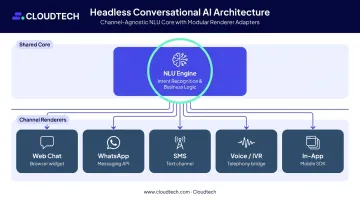
The alternative is a centralized NLU engine with channel-specific adapters, a pattern known as headless or API-first conversational architecture. The model works in two layers:
- Shared core: one engine handles intent recognition and business logic across all channels
- Channel renderers: platform-specific adapters format and deliver responses according to each channel's rules
This structure prevents the "separate bots" trap, reduces maintenance overhead, and makes consistent AI behavior achievable across platforms.
Maintaining Consistent User Experience and Context Across Channels
The Cross-Channel Context Persistence Problem
Here's a common scenario: a customer opens a web chat, describes their issue, and gets halfway to a resolution. They follow up the next day via SMS. The AI has no memory of the previous conversation. The customer explains everything again from scratch.
74% of consumers find it frustrating to repeat their story to different agents. That frustration doesn't disappear when the "agent" is an AI with no cross-channel memory.
Solving this requires a centralized conversation state store and unified customer identity resolution: infrastructure that ties interactions across channels to a single persistent customer record.
Most out-of-the-box chatbot deployments don't include this by default. These are deliberate design decisions that have to be made before deployment begins, not patched in after users start complaining.
Adapting Dialogue for Platform-Specific Constraints
Context persistence is only part of the challenge. Conversation flows that feel natural on a web widget fail completely on other channels. Quick-reply buttons, image carousels, and multi-step forms don't translate to:
- Voice, where nothing visual exists
- SMS, where character limits force truncation
- In-app chat, where UI constraints vary by product
Dialogue must be designed with platform-specific response variants from the start.
Tone and persona consistency create a parallel problem when different teams manage different channel bots. The WhatsApp bot sounds conversational and friendly; the website bot sounds robotic; the voice assistant sounds like a different product entirely. Shared dialogue scripting and documented persona guidelines prevent this drift — and both need to be in place before channels multiply.
Seamless Human Escalation Across Platforms
Escalation paths differ by channel in ways that aren't always obvious until deployment:
- Web chat escalation routes to a live agent in the same interface
- WhatsApp escalation may route to a phone call or email
- Voice escalation may transfer to a different queue with no context carried over
If escalation paths aren't designed per channel, customers hit dead ends. The handoff becomes the worst moment of the experience, the point where the AI's limitations are most visible and the customer's frustration peaks.
Data Quality, Privacy, and Compliance Challenges
Fragmented Data Across Platforms
Each channel generates its own conversation logs, interaction data, and analytics in separate silos. An AI model trained predominantly on web chat data will perform differently on voice transcriptions (which introduce speech-to-text artifacts) or SMS (which uses informal abbreviations and truncated phrasing). Users communicate differently depending on the channel — and a model that hasn't seen that variation will show it.
Zendesk reports that 54% of organizations identify fragmented or siloed data as their largest barrier to using data effectively, with only 22% of business leaders saying their teams share data well.
Most organizations don't discover the full scale of their data fragmentation until after deployment begins. A proactive data audit before multi-platform rollout is the prerequisite that determines whether the AI will actually work — not an afterthought.
Cloudtech's standard engagement process starts with a Data Quality and Governance Assessment: evaluating datasets, data flows, and governance structures to identify issues — duplicate entries, conflicting sources, security gaps — before any deployment begins.
Their healthcare work illustrates why this matters: when appointment data, lab results, and patient history live in disconnected systems, an AI model only receives part of the story.
Varying Compliance Requirements by Channel and Industry
Compliance obligations multiply in cross-platform deployments. Each channel introduces its own regulatory exposure:
- WhatsApp via Meta: Meta acts as a data processor and may engage subprocessors including Meta companies and third parties — meaning conversation data may flow through infrastructure outside your direct control
- Healthcare: Any cloud provider that creates, receives, maintains, or transmits ePHI is classified as a business associate under HIPAA, even when it only stores encrypted data and lacks the decryption key
- Financial services: SOC 2 controls and CCPA obligations apply when conversation records contain California consumers' personal information
- UK/EU: ICO guidance applies when an AI system processes personal data, covering accountability, transparency, data minimization, and DPIAs where required
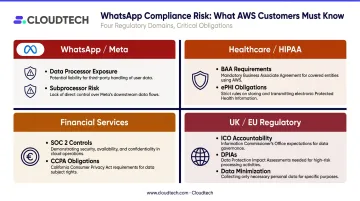
A single compliance policy applied uniformly across channels will leave gaps — particularly in regulated industries where data residency, audit trails, and user consent requirements vary by platform.
Organizational and Scalability Challenges
Cross-platform conversational AI requires a rare combination of skills operating simultaneously: NLP/NLU expertise, dialogue design, API integration, cloud infrastructure, and platform-specific knowledge across every channel being deployed. That combination is uncommon even in larger organizations and rare in SMB teams.
The result is predictable: a capable AI on the primary channel and a broken or degraded version on secondary channels that nobody has the bandwidth to fix.
Three structural challenges compound this skills gap:
- Restricts expansion when proprietary platforms block new channels or prevent data portability — open, modular frameworks are the practical hedge against vendor lock-in
- Misses cross-platform failure patterns when SMBs rely on channel-specific dashboards instead of unified analytics tracking intent accuracy, escalation rates, and satisfaction across all five channels simultaneously
- Allows performance to drift without retraining pipelines and feedback loops — governance structures must span every channel, not just the primary one
Key Strategies to Overcome Cross-Platform Conversational AI Challenges
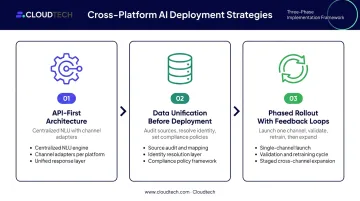
Three principles separate deployments that scale from those that stall:
1. API-first, headless architecture One centralized NLU engine connected to channel-specific adapters prevents the "separate bots" trap from the start. Prioritize platforms that support open frameworks and data portability over drag-and-drop builders that feel convenient but constrain future expansion.
2. Data unification before deployment Audit existing data sources, establish unified customer identity resolution, and define cross-channel data retention and compliance policies before adding new platforms. Without this foundation, expect misrouted queries, stale customer records, and compliance gaps across every channel you add.
3. Phased rollout with feedback loops Launch on one or two channels first. Validate intent accuracy and user experience. Build retraining pipelines. Then expand. Done right, this approach contains early mistakes before they replicate across your entire channel footprint.
For SMBs building the cloud infrastructure that supports AI workloads, Cloudtech's AWS-certified team helps establish the scalable, compliant foundation these deployments require — from API Gateway integrations and Lambda-powered workflows to the data architecture that keeps every channel consistent. The goal is a foundation built around your business context, not a generic template.
Frequently Asked Questions
What are the common challenges of implementing conversational AI tools across multiple platforms?
The core challenges are technical integration with existing systems, context persistence across channels, data fragmentation, compliance variation by platform, and organizational skills gaps. Most failures trace back to early architectural decisions — choosing separate bots per channel or skipping data unification — rather than the technology itself.
How do you maintain consistent conversational AI behavior across different platforms?
Consistent behavior requires a centralized NLU engine with channel-specific adapters (headless architecture), unified dialogue scripting and persona guidelines, and a shared conversation state layer that persists context across channels. Without all three, behavior diverges as channels are added.
What is the biggest technical challenge when deploying conversational AI across channels?
Backend integration and cross-channel context persistence cause the most damage. Bots without real-time access to CRM or order data can only provide static responses, eliminating the primary value of conversational AI. Users who must re-explain their situation across channels lose trust quickly and rarely return.
How does HIPAA or GDPR compliance affect conversational AI across multiple platforms?
Each channel introduces distinct compliance exposure. Third-party APIs like WhatsApp route data through external infrastructure that may include subprocessors outside your control. Healthcare and financial services deployments must verify every channel meets applicable requirements: data residency, BAAs, audit trails, and user consent — not just the primary channel.
Can small and mid-sized businesses successfully implement cross-platform conversational AI?
Yes, but success depends on starting with a clear architecture plan, limiting initial deployment to one or two channels, and using cloud-native services that reduce infrastructure complexity. Skipping the architecture and data readiness steps is the most common — and costly — source of rework.
How long does it typically take to implement conversational AI across multiple platforms?
A basic single-channel deployment takes 4–8 weeks; multi-platform rollouts with backend integrations and compliance requirements generally run 3–6 months. Post-launch iteration — retraining, monitoring, and channel expansion — is ongoing, not a one-time event.