Introduction
Most small and medium-sized businesses are caught in the same bind: customers expect instant answers at 2 AM on a Sunday, but hiring a round-the-clock support team isn't realistic. That gap has real consequences. According to Intercom's 2024 Customer Service Trends Report, 87% of support teams say customer expectations increased in the prior year, and 68% of C-level executives believe retaining customers is harder than it was 12 months ago.
Conversational AI closes that gap without requiring you to double your headcount.
This article breaks down what conversational AI actually is (beyond the buzzwords), five concrete strategies SMBs can deploy today, the industries where it makes the biggest impact, and a practical framework for measuring ROI once you've launched.
Key Takeaways
- Conversational AI handles customer inquiries 24/7 across chat, voice, and messaging — without adding staff
- Personalization at scale drives measurable revenue lift, not just faster responses
- Query automation frees human agents for complex, high-value interactions
- Amazon Lex and Amazon Connect make conversational AI deployment accessible for SMBs
- ROI improves over time — track CSAT, deflection rate, and cost-per-interaction from day one
What Is Conversational AI for Customer Engagement?
Conversational AI uses natural language processing (NLP) and machine learning to interpret customer questions and respond in human-like language across chat, voice, and digital channels.
The key distinction from basic rule-based chatbots: it learns from interactions and handles nuanced, back-and-forth conversations rather than just matching keywords to scripted responses.
Three types matter most for customer engagement:
| Type | How It Works | Best For |
|---|---|---|
| Traditional chatbots | Scripted, decision-tree logic | Simple FAQ deflection |
| Generative AI bots | Contextual, dynamic responses using LLMs | Complex queries, personalized replies |
| AI agents | Autonomous decision-making, can take actions | End-to-end task completion |
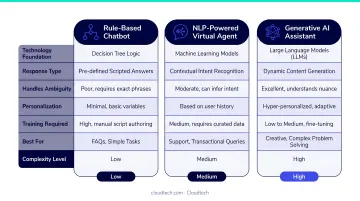
The right mix depends on your customer interaction complexity. A retailer handling order status questions needs something different than a healthcare provider managing appointment scheduling with insurance verification.
5 Proven Strategies to Transform Customer Engagement with Conversational AI
Strategy 1: Deploy AI Agents for 24/7 Omnichannel Support
AI agents can handle customer inquiries across chat, email, SMS, and social media simultaneously — no breaks, no shift changes. Gartner predicts that by 2029, agentic AI will autonomously resolve 80% of common customer service issues without human intervention, producing a 30% reduction in operational costs.
For SMBs specifically, this changes the economics of support:
- No 24/7 staffing requirement — AI handles routine volume during off-hours automatically
- Consistent coverage across channels — the same customer can start a conversation on your website and continue via SMS without losing context
- Human agents focus on complexity — escalations go to people who can actually add value, not queue management
The practical result: your team stops fielding "what's my order status?" at midnight and starts solving the problems that actually require human judgment.
Strategy 2: Hyper-Personalize Customer Interactions at Scale
Traditional marketing treats customers as segments. Conversational AI treats them as individuals. By analyzing purchase history, browsing behavior, and past interactions, AI delivers tailored recommendations and responses that feel genuinely relevant.
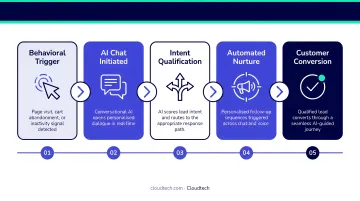
Real-time behavioral triggers make this concrete. A customer abandons a cart — the AI initiates a personalized conversation on the right channel within minutes. Someone browses the same product category three times without buying — the system triggers proactive outreach with a relevant offer. No manual monitoring required.
At volume, that's the difference between a customer who churns quietly and one who converts.
Strategy 3: Automate FAQ and Issue Resolution with AI Chatbots
A significant share of support volume consists of repetitive, low-complexity queries: order status, account information, return policies, basic troubleshooting. Automating these isn't just about efficiency — it's about freeing your human agents for the work that actually requires empathy and judgment.
Modern AI chatbots resolve these queries completely, without human intervention. Intercom's Fin AI Agent, for example, averages a 76% resolution rate across 12,000+ customers, with many customers exceeding 85%.
Deflection rates tell only part of the story. Unlike human agents, AI chatbots deliver the same quality, tone, and accuracy across every interaction — no bad days, no rushed responses at end of shift, no variation in how your return policy gets communicated. That consistency builds brand trust at scale in a way that's genuinely difficult to achieve with a purely human team.
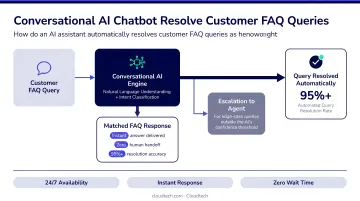
What gets automated well:
- Order and shipping status
- Account information and password resets
- Return and refund policy explanations
- Appointment scheduling and reminders
- Basic troubleshooting steps
Strategy 4: Use Predictive Analytics to Anticipate Customer Needs
Chatbots handle problems customers bring to you. Predictive analytics lets you get there first. By analyzing patterns — browsing frequency, purchase cycles, seasonal behavior — conversational AI systems proactively engage before the issue surfaces.
The healthcare application is concrete: predictive outreach to patients at risk of missing appointments has meaningfully reduced no-show rates in clinical settings. A peer-reviewed study found model-driven appointment reminders reduced no-show rates from 36% to 33% overall, with more pronounced improvements among higher-risk patient groups.
For retention, the application is even more compelling. McKinsey documented a global payments processor that used predictive models to trigger automated interventions and achieved an estimated 20% annual reduction in merchant attrition. The AI identified warning signals before merchants churned — and acted on them automatically.
For SMBs, this means churn prevention doesn't require a dedicated customer success team manually combing through accounts. The system flags at-risk customers and triggers the outreach.
Strategy 5: Automate Marketing and Engagement Workflows
Conversational AI doesn't stop at support. It extends into downstream engagement tasks that traditionally require significant manual effort:
- Audience segmentation based on behavioral signals, not just demographics
- Personalized message delivery timed to individual engagement patterns
- Send-time optimization that picks the right moment for each contact
- Follow-up sequences triggered by specific customer actions
Send-time optimization alone moves the needle. Adobe Journey Optimizer's AI-driven send-time optimization increases email click rates and push open rates by 2% to 10%. KFC Ecuador saw a 15% increase in open rates after implementing the same approach.
The net result is cross-channel campaign orchestration driven by customer behavior, not a marketing calendar. Every customer gets the right message at the right time — automatically.
Industry-Specific Applications
Healthcare
Conversational AI addresses some of healthcare's most persistent operational problems: appointment no-shows, after-hours patient inquiries, and administrative overhead that consumes clinical staff time.
Cloudtech has worked with healthcare organizations including Klamath Health Partnership, helping teams identify where automation creates the most value. In healthcare, the highest-impact use cases include:
- 24/7 patient inquiry handling (symptoms, hours, insurance questions)
- Appointment scheduling and reminder workflows
- Prescription refill request routing
- Post-visit follow-up automation
HIPAA compliance is non-negotiable in this space. Cloudtech's healthcare AI deployments are architected with encrypted PHI transmission, secure call recording storage in AWS S3, role-based access controls, and full audit trails — designed into the architecture from day one.
Financial Services
Banks and insurance providers deal with high-volume, often repetitive account inquiries that make ideal candidates for AI deflection. Bank of America's Erica AI assistant has handled over 2 billion interactions for 42 million clients, fielding 2 million requests per day.
For SMBs in financial services, the most common AI use cases address both customer accessibility and compliance documentation at once:
- Account balance and transaction inquiry handling
- Fraud alert notifications and verification workflows
- Loan status updates and document request routing
- 24/7 availability with built-in interaction audit trails
Retail, SaaS, and Manufacturing
Beyond regulated industries, conversational AI delivers measurable results across commercial verticals:
- Retail: Product discovery, return management, and order tracking — Ada's deployment with Indigo achieved a 14% reduction in orders requiring customer service intervention and $150,000 in savings
- SaaS: Onboarding automation and support ticket deflection, with platforms reporting resolution rates above 85% for common user queries
- Manufacturing: Supply chain query resolution and order status tracking that reduces inbound call volume to human agents
How SMBs Can Get Started: Implementing Conversational AI on AWS
Many SMBs assume enterprise-grade conversational AI requires a large budget and a long runway. That assumption is outdated. AWS offers purpose-built services that can be deployed quickly, especially with a certified partner:
- Amazon Lex — NLP-powered conversational interfaces with automatic speech recognition
- Amazon Connect — AI-driven cloud contact center that integrates directly with Lex bots
- Amazon Comprehend — NLP for intent detection, sentiment analysis, and PII redaction
A Practical 3-Step Starting Framework
- Identify your highest-volume, most repetitive touchpoints — look at support ticket categories and find the queries your team answers the same way 50 times a week
- Integrate the AI layer with existing CRM and data systems — the AI needs context (purchase history, account status, past interactions) to give accurate, personalized responses
- Pilot on one channel before scaling — start with chat on your website, measure deflection rates and CSAT, then expand to voice or SMS
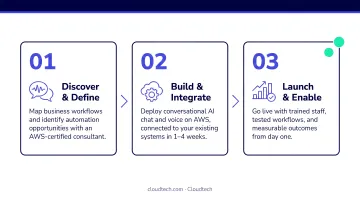
Cloudtech's AWS-certified team, which includes former AWS professionals, helps SMBs move through this framework in weeks rather than months. The deployment follows a structured four-week timeline:
- Week 1 — AWS infrastructure setup and architecture
- Weeks 2–3 — Core agent build and API integration
- Week 4 — Stress testing and compliance audit before full production go-live
As an AWS Advanced Tier Partner, Cloudtech can also help clients access AWS Partner Funding that may reduce out-of-pocket implementation costs.
On the human-AI balance: clear escalation paths keep AI handling volume while humans focus on complexity and empathy. In Cloudtech's deployments, escalations preserve full conversational context — customers never repeat themselves when transferred to a human agent.
Measuring the ROI of Your Conversational AI Investment
Key Metrics to Track
| Metric | What It Tells You |
|---|---|
| Ticket deflection rate | Share of queries resolved without human intervention |
| Average response time | How quickly customers receive their first reply |
| CSAT score | Whether automated interactions satisfy customers |
| Cost-per-interaction | Operational efficiency compared to human-handled volume |
| Customer churn rate | Long-term retention impact of faster, more consistent service |
The ROI case is strong. Forrester's Total Economic Impact study of Agentforce for Customer Service found 396% ROI with payback in under six months.
Building a Continuous Improvement Loop
AI systems need structured feedback to improve. From day one, build in:
- Post-chat satisfaction surveys
- Escalation tracking (which query types consistently require human handoff)
- Intent misclassification logs (where the AI misunderstood the customer's request)
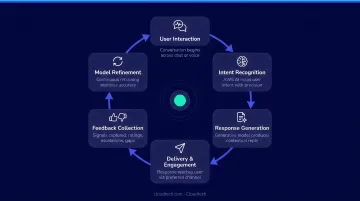
Feed these back into the model regularly. Each improvement cycle tightens resolution rates and lowers cost-per-interaction — the ROI grows as the system learns.
Set Realistic Timeline Expectations
Measuring too early will skew your results. Conversational AI needs real interaction volume before accuracy and resolution rates stabilize, so the first 30–60 days should be treated as a calibration phase rather than a performance evaluation. Most meaningful benchmarks only emerge between 60 and 90 days post-deployment. Give it time before drawing conclusions.
Frequently Asked Questions
What is conversational AI for customer engagement?
Conversational AI uses NLP and machine learning to simulate human-like interactions across digital channels — chat, voice, SMS, and email. It enables real-time customer engagement at any scale, with accuracy that improves as the system processes more interactions.
How do I use conversational AI for customer engagement?
Start by identifying your highest-volume customer touchpoints, then choose an AI platform or work with an AWS-certified partner like Cloudtech to build on native AWS tools. Pilot on one channel first, validate performance, then expand to additional touchpoints once the integration with your CRM and helpdesk is stable.
What are the benefits of conversational AI for small and medium-sized businesses?
The primary benefits are 24/7 support availability without additional headcount, faster response times, reduced cost-per-interaction, and personalized customer experiences that were previously only achievable with large support teams.
How does conversational AI integrate with existing CRM systems?
Most platforms integrate via APIs, allowing the AI to pull customer history and context from your CRM, helpdesk, and e-commerce systems — which is what makes responses accurate and personalized rather than generic.
How do you measure the success of a conversational AI deployment?
Track CSAT scores, ticket deflection rate, average resolution time, and cost-per-interaction. Allow 60-90 days post-deployment before evaluating results — early data captures the calibration period, not the system at full efficiency.
What AWS services are commonly used to build conversational AI solutions?
The three core services are Amazon Lex (conversational interfaces and NLP), Amazon Connect (AI-powered contact center), and Amazon Comprehend (intent detection and sentiment analysis). An AWS-certified partner can combine these into a fully integrated deployment matched to your specific workflows.