Key Takeaways
- Voice AI uses a multi-layer architecture (ASR, NLU, TTS) that's fundamentally different from legacy IVR
- Scheduling, billing inquiries, and outbound reminders deliver the clearest early ROI for SMBs
- Evaluate vendors on production latency, integration depth, and compliance documentation — not demo performance
- Cloud-native AWS deployments reduce integration overhead and speed up time-to-value for SMBs
- TCPA, HIPAA, and PCI-DSS obligations must be addressed before go-live, not after
Staffing a traditional call center around the clock is expensive — and most SMBs are absorbing that cost in the form of missed calls, long hold times, and agents buried in repetitive intake work rather than fixing the underlying problem.
Voice AI changes that math. But the market is crowded, the terminology is inconsistent, and vendor claims range from carefully documented to significantly overstated. For operations leaders, CX directors, and IT decision-makers at SMBs and mid-market companies in healthcare, financial services, retail, and logistics, the real challenge is knowing what to ask vendors before committing.
This guide explains how voice AI actually works, where it creates real value, what separates strong vendors from weak ones, and what you need to nail down before signing a contract.
What Is Voice AI for Call Centers?
Voice AI for call centers is software that handles inbound and outbound phone conversations without a human agent on every call. It understands spoken language, interprets what the caller wants, and responds in real time — a major departure from legacy IVR, which forces callers through rigid menu trees using keypad inputs and pre-recorded prompts.
The Four-Stage Call Processing Pipeline
Every voice AI interaction runs through four stages:
- ASR (Automatic Speech Recognition) — converts spoken words to text in real time; Amazon Lex, for example, processes incoming speech and passes the transcript downstream
- NLU (Natural Language Understanding) — interprets intent, manages conversation state, and collects required information across multiple turns
- Response generation — determines the appropriate action or answer; systems can invoke business logic directly, with an optional LLM layer handling complex or unpredictable inputs
- TTS (Text-to-Speech) — converts the response to natural-sounding audio; Amazon Polly handles this conversion within the Lex pipeline
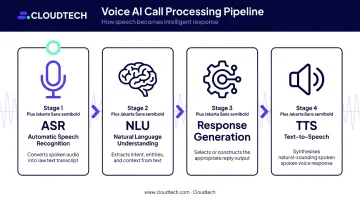
Understanding these four stages matters because that's where vendors actually differ. Early callbots broke on anything unexpected — modern voice AI is built to handle the messiness of real phone calls:
How Modern Voice AI Differs from First-Generation Callbots
- Multi-turn conversations — it tracks context across the full interaction, not just individual utterances
- Barge-in — callers can interrupt mid-prompt, which triggers a playback interruption event and the system adapts
- Sentiment detection — the system monitors emotional cues and can escalate based on distress signals
- Real-time CRM and backend integration — the AI reads from and writes to live systems during the call, enabling personalized responses without human involvement
Vendor performance gaps trace directly to the quality of these layers. Weak NLU produces misinterpretations; missing backend integration produces generic answers. Both problems tend to surface only after go-live — not during a controlled demo.
Where Voice AI Delivers Results: Key Use Cases
Scheduling and Appointment Management
Appointment automation is among the most mature voice AI use cases for SMBs. The AI handles the full booking lifecycle — new appointments, rescheduling, cancellations, confirmation, and reminders — through natural conversation, without an agent touching routine calls.
Healthcare is the clearest example. Cloudtech's implementation for Ascend BPO — a healthcare BPO managing scheduling across multiple provider networks — handled 2,500–5,000 inbound calls per month autonomously.
Identity and insurance verification completed in under 60 seconds per call. When escalation was needed, warm transfers to human agents happened in under 2 seconds, with full call context handed over so callers never had to repeat themselves.
Billing, Payments, and Account Inquiries
Voice AI connects directly to payment processors and billing systems to handle:
- Balance checks and payment history
- Payment processing and confirmations
- Invoice generation and charge explanations
PCI-DSS compliance is mandatory for any solution that touches payment data. Spoken card data brings recording systems, storage, and all connected technology into PCI scope. Sensitive authentication data — CVV/CVC numbers — must not be retained after authorization. Before signing with any vendor, request their current Attestation of Compliance (AOC), not just a "PCI Level 1" badge.
Proactive Outbound Engagement
Voice AI handles outbound calls at scale for transactional communications: appointment reminders, payment due alerts, delivery updates, and renewal notices. Amazon Connect's agentless outbound campaigns support this use case with answering-machine detection built in.
Outbound AI works best when responses are predictable. For complex outbound sales or sensitive collections, human agents still carry the conversation more effectively.
Agent Assist and Post-Call Automation
For organizations not ready to put AI directly on inbound calls, agent assist often shows measurable results within weeks. The AI supports human agents in real time:
- Surfacing relevant knowledge base content during the call
- Generating live transcripts
- Providing full call summaries on escalation
- Automatically logging interaction records to the CRM
Genesys's own support team reported a 5-minute reduction in average handle time per call using AI-assisted summarization. Customers never interact with AI directly — agents just work faster and make fewer errors.
The Business Case: Benefits and ROI Benchmarks
What the Data Actually Shows
Vendor claims on resolution rates vary enormously. A Forrester composite study commissioned by PolyAI — based on a US organization handling 4 million annual calls — reported autonomous resolution rates of 25% in Year 1, 35% in Year 2, and 40% by Year 3, with a payback period under 6 months and an NPV of $11.3M. IBM cites "up to 70%" containment, but without comparable methodology.
Real-world production cases paint a more grounded picture:
| Organization | Outcome | Source |
|---|---|---|
| Alberta Motor Association | Call automation rose from 10% to 35%; CSAT from below 50% to 80%; cost reached $0.65/automated call | AWS customer case |
| Kiwibank | 19% reduction in average handle time; 27% fewer transfers | Genesys, 2024 |
| WaFd Bank | Balance check time dropped from 4.5 minutes to 28 seconds | AWS customer case |
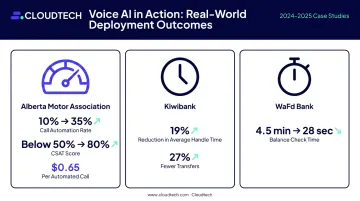
McKinsey research on contact center AI cites deployments reporting 50% lower cost per call — though baseline costs and sample sizes aren't disclosed.
Scalability and the Analytics Dividend
Cost savings are only part of the picture. Voice AI also solves a structural staffing problem: organizations no longer have to choose between overstaffing for peak demand or absorbing hold-time spikes. The system handles concurrent calls without degradation.
Every AI-handled call also generates structured data: transcripts, sentiment scores, intent classifications, resolution outcomes. Kiwibank's voicebot implementation reduced the number of distinct call intents tracked from 1,358 to 23 — a consolidation that made improvement opportunities visible that were previously buried in undifferentiated call recordings.
That data accumulates into a feedback loop: each resolved call sharpens intent models, surfaces routing gaps, and gives operations teams specific levers to pull — not just aggregate metrics to report.
How to Evaluate Voice AI Solutions: A Buyer's Framework
Conversation Quality and Latency
Demo environments are not production environments. Always ask vendors for production benchmarks, specifically:
- End-to-end latency: measured from the end of the caller's utterance to the start of the agent's reply — human-to-human telephone conversations typically fall below 1,000ms; require workload-specific testing rather than trusting vendor-published benchmarks
- ASR accuracy on your audio: not clean studio recordings — test against your actual call center audio, including accented speakers, background noise, and poor connections
- Barge-in handling: how does the system respond when a caller interrupts mid-sentence?
Integration Depth with Existing Systems
An isolated voice AI agent with no live access to your CRM or billing system delivers very limited value. Before evaluating any vendor:
- Audit which systems the AI needs to read from and write to during a call
- Verify native connectors for tools like Salesforce, Zendesk, or HubSpot
- Assess API flexibility for custom integrations, especially EHR systems in healthcare
Organizations already in the AWS ecosystem get a real integration advantage with Amazon Connect and Amazon Lex — native tooling that eliminates much of the custom glue work other platforms require. As an AWS Advanced Tier Partner, Cloudtech helps SMBs build these integrations without the engineering overhead that typically comes with enterprise contact center deployments.
Security, Compliance, and Data Residency
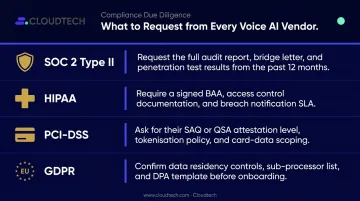
Request actual audit documentation, not vendor badge pages:
| Compliance Area | What to Request |
|---|---|
| SOC 2 Type II | Current report, audit period, covered products, exceptions |
| HIPAA | Signed BAA confirming every service used (voice, recording, transcription, storage, AI) is HIPAA-eligible |
| PCI-DSS | Current AOC, service-provider level, covered scope, shared-responsibility matrix |
| GDPR | Data Processing Agreement, subprocessors, processing locations, applicable Standard Contractual Clauses |
Scalability, Reliability, and Failover
Ask vendors directly:
- Concurrency limits: how many simultaneous calls before latency degrades?
- Uptime SLAs: Amazon Connect publishes 99.99% monthly uptime; Google Dialogflow publishes 99.9% — that difference is meaningful at scale
- Failover mechanisms: what happens when the AI model or a dependency goes down mid-call?
Total Cost of Ownership
Build your cost comparison across a 12-to-24-month window, including:
- Base licensing or per-minute usage fees (Twilio ConversationRelay runs $0.07/min; Amazon Connect voice processing charges $0.038/voice minute, with telephony separate)
- Genesys named-user CCaaS plans range from $75 to $240/user/month
- Integration development, implementation, onboarding
- Ongoing optimization and AI capability add-ons
Per-minute, per-seat, and resolution-based pricing models aren't directly comparable. Build a model using your actual monthly call volume and average handle time to get to a real apples-to-apples number.
Implementation Best Practices
Start Contained, Prove Value, Then Expand
The deployments that struggle are usually the ones that tried to automate everything in the first release. Start with one well-defined workflow — appointment scheduling, balance inquiries, order status — that has clear inputs, measurable outcomes, and limited edge cases. Once you've established proof of value and surfaced the edge cases you didn't anticipate, expanding from there is far less risky.
Design Authentication and Escalation Before Launch
Authentication design is where many deployments stumble. Clunky verification flows drive abandonment before the AI resolves anything — callers hang up or demand a human before the system has a chance to help.
Every escalation path should also transfer full call context to the human agent. Define escalation triggers around specific signals:
- Emotional distress or elevated caller frustration
- Multi-intent complexity the AI can't resolve cleanly
- High-value customer flags requiring a personalized touch
Escalation should be a designed response, not a fallback you figure out later.
Test Against Real Audio, Not Studio Recordings
Verify integration mapping and telephony compatibility before go-live, not during. More importantly, test your ASR against real production audio — calls with accented speakers, background noise, and poor mobile connections. Problems that don't appear in a clean demo will show up on day one.
Understand TCPA and Disclosure Requirements Before You Dial
The FCC's February 2024 ruling confirmed that AI-generated voices are "artificial" voices under the TCPA. Any AI-initiated outbound call requires the same prior express consent as other artificial or prerecorded voice calls. Telemarketing calls require prior express written consent.
Beyond consent, several additional requirements apply from day one:
- Identify the responsible business at the start of every call
- Build HIPAA workflows for healthcare use cases
- Apply PCI-DSS controls wherever payment data is involved
Bring legal counsel in early — particularly if you're running outbound campaigns.
Frequently Asked Questions
What is the difference between voice AI and traditional IVR?
IVR forces callers through preset menu trees using keypad inputs and pre-recorded prompts, with no ability to understand natural speech. Voice AI interprets spoken language, tracks intent across multiple turns, and responds conversationally — handling dynamic, unpredictable interactions rather than rigid scripts.
How much does voice AI for call centers cost?
Pricing varies by model: Amazon Connect charges $0.038/voice minute (telephony separate), Twilio ConversationRelay runs $0.07/minute, and Genesys CCaaS named-user plans range from $75–$240/user/month. Always evaluate total cost of ownership over 12–24 months, including integration and optimization, not just the headline rate.
Can voice AI fully replace human call center agents?
Voice AI handles routine, predictable interactions autonomously — scheduling, account checks, balance inquiries — but complex situations, emotional calls, and high-stakes decisions still require human judgment. The strongest deployments use AI to handle volume and assist agents, not eliminate them.
How long does it take to implement voice AI in a call center?
Timelines depend on complexity and integration requirements. A documented production deployment (Kiwibank's Genesys voicebot implementation) took four months. Starting with a well-defined, contained use case — rather than full-center automation — is the single most important factor in hitting that timeline.
What security and compliance certifications should I require from a voice AI vendor?
Request SOC 2 Type II as a baseline — specifically the audit report, not a badge. Healthcare buyers need a signed HIPAA BAA covering every service in the stack. Payment processing requires a current PCI-DSS AOC. EU customer data requires a Data Processing Agreement with subprocessors and applicable Standard Contractual Clauses documented.
Which call center workflows should I automate with voice AI first?
Start with high-volume, predictable workflows: appointment scheduling, order status inquiries, balance checks, payment reminders. These have clear success metrics, limited edge cases, and deliver measurable ROI quickly — building organizational confidence before you tackle more complex automation.