Introduction
Gartner forecasts a 16% increase in worldwide customer service interaction volume from 2024 through 2028 — and agents are already at a breaking point. 77% report heavier, more complex workloads compared to the previous year, and more than half describe experiencing burnout, according to Salesforce's State of Service research.
That strain is pushing investment decisions to the top of the agenda: 83% of service decision-makers plan to increase AI spending over the next year. But for most SMBs, the path forward isn't obvious — the technology is moving fast, deployment options are confusing, and the cost of a wrong move is real.
This guide provides a clear-eyed look at what generative AI actually does in a contact center context, which use cases deliver the strongest ROI, how to integrate it without replacing your entire infrastructure, and the practices that separate successful deployments from expensive experiments.
Key Takeaways
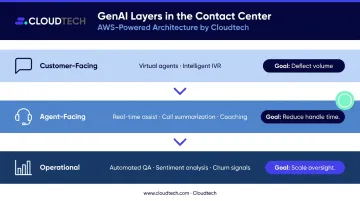
- Generative AI operates across three layers: customer-facing, agent-facing, and operational analytics
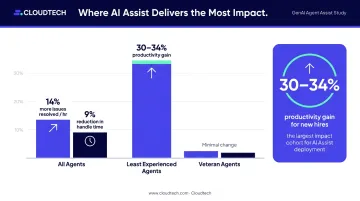
- Real-time agent assist has driven a ~14% increase in issues resolved per hour in documented deployments
- Call summarization can save agents 90 seconds per interaction — hours per month at scale
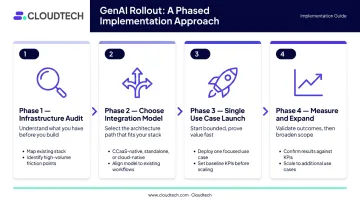
- Phased rollouts starting with one contained use case consistently outperform big-bang deployments
- Amazon Connect + Amazon Lex + Amazon Q offers SMBs a pay-per-use, compliance-ready AI stack
What Is Generative AI in Contact Centers?
Traditional contact center AI operates on rules: keyword triggers, scripted decision trees, predefined intents. It works for narrow, predictable queries — but breaks quickly when customers deviate from the script.
Generative AI takes a different approach. Large language models (LLMs) understand intent and context rather than matching patterns. They generate natural responses dynamically and adapt across multi-turn conversations — the way people actually talk. That distinction matters enormously in a contact center, where no two calls follow the same script.
The Three Layers of GenAI Application
| Layer | Examples | Primary Goal |
|---|---|---|
| Customer-facing | Virtual agents, intelligent IVR | Deflect volume, extend coverage hours |
| Agent-facing | Real-time assist, call summarization, coaching | Reduce handle time, improve consistency |
| Operational | Automated QA, sentiment analysis, churn signals | Scale oversight, improve decision-making |
Each layer solves different problems. Customer-facing AI reduces inbound volume. Agent-facing AI closes the skill gap between new hires and veterans. Operational AI gives leadership visibility they cannot get from manual sampling.
Grand View Research valued the call center AI market at $1.9 billion in 2024 and projects $7.1 billion by 2030 — a 23.8% CAGR. Gartner adds further weight: agentic AI could autonomously resolve 80% of common customer service issues by 2029, with a modeled 30% reduction in operational costs.
Key Use Cases of Generative AI in Contact Centers
Intelligent Virtual Agents and Self-Service
GenAI-powered virtual agents move well beyond rigid IVR menus. They handle multi-turn conversations — a customer who starts asking about a billing dispute, then pivots to a payment plan, then asks about account status — without losing context or forcing a restart.
This matters at scale. McKinsey's research on AI-led service transformation describes mature self-service channels handling 70–80% of interactions, with one fast-growing bank reducing service interactions by 40–50% and lowering cost-to-serve by more than 20% over 12 months.
Staffing for peak hours and after-hours coverage is one of the most expensive contact center challenges. A well-deployed virtual agent handles both around the clock — without adding headcount.
Real-Time Agent Assist
Real-time assist tools listen to live calls and surface relevant information — knowledge base answers, suggested responses, compliance reminders — directly to the agent's screen without interrupting the conversation.
The productivity impact is well documented. A landmark study of 5,172 customer support agents found a ~14% increase in issues resolved per hour and approximately a 9% reduction in average handle time following GenAI assistant deployment.
The least experienced agents gained 30–34% in productivity, while veteran high-performers saw minimal change. AI assist is most powerful exactly where the skill gap hurts most — during onboarding, in high-attrition environments, and when deploying less experienced teams.
Automated Call Summarization and After-Call Work Reduction
After each call, agents typically spend several minutes writing up notes, updating CRM records, and completing administrative wrap-up. Post-call wrap-up accounts for 13.7% of agent activity, according to ContactBabel's 2025 US Contact Center Decision-Makers' Guide.
GenAI summarization eliminates most of that burden. Amazon Connect's post-contact summary feature — which Cloudtech has deployed for healthcare clients including Ascend BPO — saves agents an average of 90 seconds per interaction, translating to roughly 40 hours per month in recovered leadership review time based on Neo Financial's reported outcomes.
For a 50-agent center handling 200 calls daily, those seconds compound into meaningful recovered capacity.
AI-Powered Quality Assurance at Scale
Most contact centers manually review somewhere between 1% and 5% of calls. The sample is too small to be statistically reliable, the process is inconsistent across reviewers, and feedback reaches agents days after the interaction it covers.
GenAI QA flips the model. Frontdoor reports analyzing 100% of inbound and outbound contacts and achieving a 50x increase in QA sampling without adding headcount. Fujitsu reports a 60% improvement in QA efficiency from automating interaction recording and analysis. Every call gets scored, compliance gaps surface immediately, and coaching becomes targeted rather than generic.
Predictive Analytics and Churn Prevention
Conversation intelligence tools scan patterns across thousands of interactions — repeated complaints about the same issue, escalating sentiment scores, topics that correlate with cancellations — and surface them before they become systemic problems.
Amazon Connect Contact Lens, for example, analyzes sentiment in real time, categorizes contacts, and can alert supervisors when a conversation meets configured risk criteria. Beyond flagging individual calls, this surfaces product or process failures that are building dissatisfaction across your entire customer base.
How to Integrate Generative AI Into Your Contact Center
Start With an Infrastructure Audit
Before selecting tools, map what you already have: your CCaaS platform, CRM, knowledge base, WFM system, and telephony layer. Then identify which workflows generate the highest call volume or the most friction.
The goal is to find one or two high-impact starting points , not architect a five-year AI roadmap. Organizations that attempt to transform everything simultaneously typically accomplish less than those that start focused and expand deliberately.
Choose the Right Integration Model
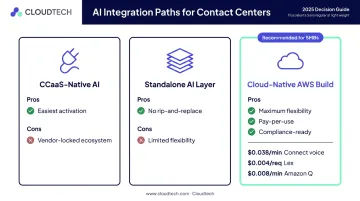
There are three main paths, each with different tradeoffs:
- CCaaS-native AI — Built into platforms like Genesys, NICE, or Five9. Easiest to activate, but constrained to that vendor's ecosystem and roadmap.
- Standalone AI layer — Sits on top of existing infrastructure without rip-and-replace. Useful when switching platforms isn't feasible.
- Cloud-native AWS build — Amazon Connect, Amazon Lex, and Amazon Q assembled as a pay-per-use stack. Maximum flexibility, native compliance posture, and no long-term contracts. Pricing is granular: Connect voice at $0.038 per minute, Lex speech requests at $0.004 per request, and Amazon Q at $0.008 per voice minute.
For SMBs without the internal resources to architect and manage a cloud-native build, working with an AWS Advanced Tier Partner cuts the timeline considerably. Cloudtech's deployment of a HIPAA-compliant AI voice agent for a healthcare BPO client illustrates what this stack can accomplish: full appointment scheduling with warm transfer completing in under 2 seconds, in a production environment.
Prioritize Data Readiness
GenAI is only as accurate as the information it can retrieve. Connecting your AI to CRM records, knowledge bases, and interaction history through retrieval-augmented generation (RAG) means the model retrieves verified, contextually relevant answers rather than generating responses from general training data.
Clean, structured, accessible data is a prerequisite, not an afterthought. RAG works by pulling from an authoritative external knowledge base before generating a response — which directly reduces hallucination risk and keeps answers grounded in your actual policies and procedures.
Deploy in Phases
Start with a single, well-bounded use case: an after-hours virtual agent, call summarization for a specific queue, or automated QA for one team. Establish baseline KPIs before go-live. Measure actual impact. Then expand.
This approach reduces technical risk, builds internal confidence, and gives you real performance data before committing to a broader deployment. A contained first phase also simplifies stakeholder justification: concrete metrics from a live deployment carry far more weight than projections.
Best Practices for Generative AI Adoption in Contact Centers
Define Success Criteria Before You Deploy
Decide which KPIs the AI initiative is expected to move before a single call goes through it:
- Containment rate: what percentage of interactions resolve without a live agent
- Average handle time, measured in seconds rather than general impressions
- After-call work time, which is typically the clearest early indicator of summarization ROI
- CSAT and first contact resolution for customer-facing quality signals
- QA coverage percentage, particularly if you're moving from sampled reviews to full coverage
Without baselines, improvement is invisible and stakeholder buy-in becomes a political exercise rather than an evidence-based one.
Invest in Change Management
Agent attrition in contact centers is already a significant problem — 54% of centers report annual turnover between 21% and 50%, with nearly 80% seeing attrition hold flat or worsen year-over-year. AI deployments that ignore this dynamic make it worse.
Agents who feel surveilled or replaced disengage faster. Effective change management involves:
- Explaining the agent's evolving role clearly and honestly
- Giving hands-on time with AI-assist tools before go-live
- Framing reduced after-call work as a direct benefit to agents, not just efficiency gains for leadership
- Celebrating early wins that agents themselves can feel
Cloudtech builds training and enablement into every engagement as a core delivery phase, not an afterthought bolted on at the end.
Apply Human-in-the-Loop Controls for Regulated Industries
In healthcare and financial services, AI outputs require guardrails. Practical controls include:
- RAG-based knowledge grounding to reduce hallucination
- Approval steps for AI-generated responses in sensitive workflows
- PII redaction before storage and logging
- Regular audits against compliance scorecards
- Clear escalation paths when confidence is low
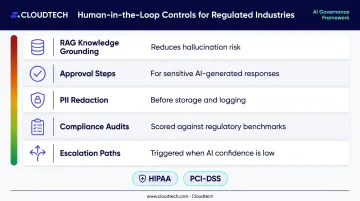
Amazon Connect and Amazon Lex are HIPAA-eligible and appear in AWS's PCI DSS services-in-scope list — a meaningful starting point for regulated industry deployments.
Treat the AI as a System That Needs Maintenance
GenAI models degrade without feedback. Knowledge bases go stale. Prompts that worked in month one can produce lower-quality outputs by month six as conversation patterns evolve.
Operational ownership means building a regular cadence around:
- Reviewing AI performance against QA benchmarks
- Flagging and analyzing low-confidence responses
- Updating knowledge bases as products, policies, and procedures change
- Refreshing prompts based on what agents and customers actually encounter
The technology doesn't manage itself. Treating it as a one-time deployment is how quality silently erodes.
Challenges and How to Overcome Them
Hallucination and accuracy risk: Generative AI can produce confident, wrong answers — a serious problem in customer-facing applications. Mitigations include RAG-based knowledge grounding, clear escalation paths for low-confidence scenarios, and regular audits of AI output against verified sources.
Data privacy and regulatory compliance: Contact centers in healthcare and financial services must meet HIPAA, PCI-DSS, and TCPA requirements. The FCC confirmed in February 2024 that TCPA restrictions on artificial or prerecorded voices explicitly cover AI-generated voices, meaning outbound AI calls require prior express consent. When evaluating vendors, check for:
- Compliance certifications (HIPAA, SOC 2, PCI-DSS)
- Data residency options and PII redaction capabilities
- HIPAA BAAs included in standard tiers, not gated behind enterprise pricing
Agent resistance: McKinsey identifies skills gaps and displacement concern as primary AI implementation barriers. Involve frontline staff early, communicate role changes transparently, and redesign workflows rather than treating deployment as a purely technical project.
Frequently Asked Questions
What is a contact center AI platform?
A contact center AI platform is a software system that uses artificial intelligence (including generative AI, speech recognition, and large language models) to automate, assist, or analyze customer interactions across voice and digital channels. Capabilities typically span virtual agents, real-time agent assist, and automated QA scoring.
How is AI used in contact centers?
AI is applied across three layers: customer-facing (virtual agents, intelligent IVR, chatbots), agent-facing (real-time assist, call summarization, coaching prompts), and operational (automated QA scoring, sentiment analysis, predictive analytics). Each layer targets different efficiency and quality outcomes.
What is the difference between generative AI and traditional AI in contact centers?
Traditional AI relies on predefined rules, intents, or keyword triggers: scripted bots and routing logic. Generative AI uses large language models to understand nuance, generate natural responses, and adapt dynamically across multi-turn conversations, enabling far more flexible and context-aware interactions.
How long does it take to integrate generative AI into an existing contact center?
Timelines vary by approach. Cloud-native platforms like Amazon Connect with Lex and Amazon Q can go live in weeks for a focused use case. Full-stack CCaaS deployments with embedded AI typically require 8–16 weeks. A phased rollout starting with one contained use case is consistently the fastest path to measurable results.
What are the biggest challenges when implementing generative AI in a contact center?
The three primary challenges are: (1) AI accuracy and hallucination risk, requiring grounded knowledge design and audit processes; (2) data privacy and regulatory compliance, particularly in healthcare and financial services; and (3) agent adoption and change management, which often determines whether the technology delivers sustained value.
What AWS services support generative AI in contact centers?
Amazon Connect (core cloud contact center platform), Amazon Lex (conversational AI for voice and chat), and Amazon Q (AI assistant for agent productivity and knowledge retrieval) form the primary stack. Amazon Transcribe, Amazon Polly, and Amazon Bedrock extend the stack for speech processing and custom LLM applications — all on pay-per-use pricing with built-in compliance controls for regulated industries.