Introduction
Running a small business means every dollar and every hour counts. Margins are tight, staff is limited, and customers now expect answers at 11 PM on a Sunday just as readily as they do at 2 PM on a Tuesday.
AI chatbots have become a genuine financial tool for small businesses — one that shows up in the numbers. The gap between a human-handled support interaction (averaging $6.00 per conversation) and a chatbot-handled one ($0.50) tells the real story.
This guide goes beyond feature lists. You'll see exactly how AI chatbot ROI works for small businesses, where the savings and revenue gains actually come from, and how to calculate your own numbers before committing to a platform.
Key Takeaways
- A chatbot-handled interaction costs roughly $0.50 vs. $6.00 for a human-handled one — a $5.50 savings per resolved conversation
- ROI comes from three measurable areas: lower service costs, recovered revenue, and scalable operations
- Businesses receiving 50+ daily inquiries can reach positive ROI within weeks of deployment
- Automation rates and ROI compound over time as the chatbot learns from more interactions
- Skipping chatbots means higher per-interaction costs and slower lead response as competitors pull ahead
What Is AI Chatbot ROI?
AI chatbot ROI is the measurable financial return from deploying a chatbot, calculated by comparing total value gained against total cost of ownership.
The formula:
ROI = ((Value Gained − Total Chatbot Cost) ÷ Total Chatbot Cost) × 100
Where "Value Gained" includes:
- Support costs avoided
- Staff time recovered
- Revenue captured after hours
- Leads converted that would have gone cold
Where "Total Cost" includes:
- Subscription or usage fees
- Setup and implementation time
- Staff training hours
- Ongoing knowledge base maintenance
ROI isn't a one-time calculation. Automation rates climb as the chatbot handles more interactions, and integrations with CRM and sales tools add new value over time. Most businesses see their strongest returns 3–6 months after launch, once the knowledge base matures and deflection rates stabilize. Tracking chatbot ROI as an ongoing metric — reviewed monthly, not just at deployment — is what separates businesses that get incremental gains from those that compound them.
Key Advantages of AI Chatbots for Small Business ROI
The three advantages below are operational and financial — the kind that show up in weekly ops reviews and on P&L statements, not capability comparisons.
Advantage 1: Lower Customer Service Costs Per Interaction
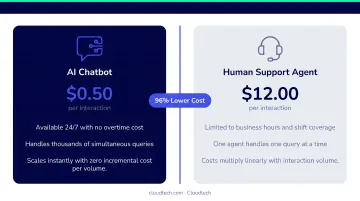
The most direct ROI driver is the cost gap between AI-handled and human-handled conversations.
IBM and Forrester's Watson Assistant study puts this in concrete terms: a human support interaction costs an average of $6.00, while a digital response costs $0.50 — a $5.50 saving per contained conversation. At 50 conversations per day, that's over $100,000 in annual savings potential from routine query deflection alone.
Chatbots create this advantage by handling the repetitive bottom tier of inquiries — FAQs, pricing questions, operating hours, order status — automatically, without a paid employee's time.
Why this matters for small businesses specifically:
- The Bureau of Labor Statistics reports customer service representatives earned a median annual wage of $42,830 in 2024 — and fully loaded compensation (including benefits) runs higher
- Mid-tier chatbot subscriptions from platforms like Tidio start at $32.50/month and Intercom's Fin AI Agent charges $0.99 per successful outcome — a fraction of one employee's cost
- Freshworks reports AI agents deflect more than 45% of incoming queries across industries, with retail reaching 53%
KPIs this advantage directly impacts:
- Cost per resolved interaction
- Support headcount required per revenue tier
- Average handle time
- Ticket resolution rate
When this matters most: Businesses handling 50+ daily inquiries, those with after-hours volume, and any team currently spending hours answering the same 10–15 questions.
Advantage 2: Revenue Recovery Through Faster Lead Response and After-Hours Capture
The second ROI driver is uncaptured revenue: inquiries that go unanswered after hours, visitors who leave without getting a response, prospects who move to a faster competitor. This revenue already exists — a chatbot recovers it rather than generating it from scratch.
The lead response numbers make the case clearly:
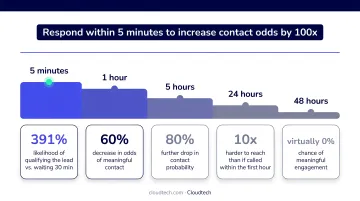
- According to HBR research, companies that respond to leads within one hour are nearly 7 times more likely to qualify them than companies that wait even an hour longer — and more than 60 times more likely than those who wait 24 hours
- The MIT/InsideSales Lead Response Management Study found the odds of qualifying a lead drop 21 times when response stretches from 5 minutes to 30 minutes
A chatbot eliminates that window entirely. It engages visitors at midnight, qualifies interest, collects contact details, and books appointments automatically.
Real-world results:
- Tidio reports Bella Sante, a med spa, earned $66K in sales after deploying Lyro AI, with a 25% increase in sales, 450 leads collected, and 75% support automation
- Salesloft/Drift's 2024 Conversational AI report found 39% of all B2B website conversations occur outside standard business hours
KPIs this advantage directly impacts:
- Lead conversion rate
- After-hours inquiry-to-sale rate
- Cost per qualified lead
- Cart abandonment recovery rate
When this matters most: Service businesses with appointment-based revenue (salons, consultants, contractors), e-commerce stores with cart abandonment, and any business generating inbound leads through search or social outside business hours.
Advantage 3: Operational Scalability Without Proportional Headcount Growth
The third ROI driver breaks a core constraint in small business growth: the assumption that more customers require more staff.
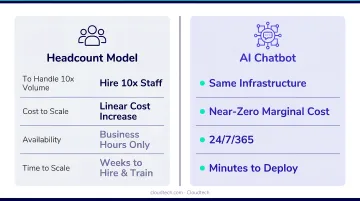
A chatbot handles 50 conversations per month or 5,000 at the same cost. No new hire, no temporary contractor, no degraded service quality during peak periods.
Traditional growth math looks like this: more customers → more inquiries → more staff → compressed margins. Chatbots remove the middle two steps.
The scale of the opportunity:
- Juniper Research projected chatbots would save businesses more than 2.5 billion customer service hours across retail, banking, and healthcare by 2023
- Freshworks reports AI-powered support dropped ticket wait times from over 6 hours to under 4 minutes, with retail response times falling from 12 minutes to 12 seconds
This advantage matters most during three specific moments:
- Growth phases — when inquiry volume scales faster than hiring can
- Seasonal peaks — without a chatbot, peak periods require temp hires or cause service drops that damage retention
- Product launches — new inquiries spike without warning; a chatbot absorbs the volume without preparation time
KPIs this advantage directly impacts:
- Interactions handled per employee
- Support cost as a percentage of revenue
- Team hours spent on repetitive tasks
- Customer response time under peak volume
What Happens When Small Businesses Skip AI Chatbots
The cost of skipping AI chatbots isn't abstract — it shows up in missed leads, wasted staff hours, and a widening gap against competitors who've already automated. Here's what that looks like operationally:
- 39% of B2B website conversations happen outside business hours — every unanswered after-hours inquiry is a warm lead handed directly to a faster competitor
- Staff fielding the same 10 questions every morning aren't doing the work that actually moves the business forward
- Chatbot-enabled businesses are driving routine query costs toward near-zero; manual operations pay full staff cost for every interaction
- Lead response time stays in the minutes-to-hours range, well outside the window where conversion probability is highest
- HubSpot reports 67% of consumers expect issues resolved within 3 hours, and 73% say they'd leave after one bad experience — thresholds manual teams routinely miss during busy periods
The competitive gap compounds. A competitor with chatbot-enabled after-hours capture, instant lead response, and near-zero routine query costs operates at a structurally lower cost base every month.
How to Calculate and Maximize Your AI Chatbot ROI
Establish a Baseline First
You cannot measure ROI without a pre-deployment baseline. Before deploying, document:
- Current cost per support interaction (staff cost ÷ monthly interaction volume)
- Average lead response time
- Number of repetitive inquiries per week
- After-hours inquiry volume (check email timestamps, missed calls)
Skip this step and ROI stays a guess. Document it upfront and you'll have the numbers to prove results.
Account for Hidden Costs
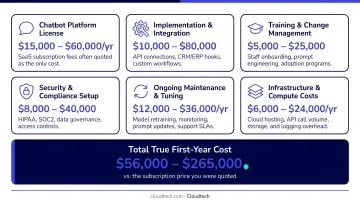
First-year chatbot cost is typically higher than the subscription fee. Small businesses routinely undercount:
- Implementation time — configuring flows, writing responses, testing edge cases
- Staff training hours — getting the team comfortable with escalation workflows
- Integration setup — connecting to CRM, booking systems, or e-commerce platforms
- Ongoing knowledge base maintenance — updating responses as products, pricing, and policies change
These can represent 30–50% of true first-year cost. Accounting for them gives you an honest ROI picture and avoids disappointment when year-one numbers look different from what the subscription fee alone suggested.
Track These Three KPIs Weekly in the First 90 Days
| KPI | What It Tells You | Healthy Target |
|---|---|---|
| Automation rate | % of conversations resolved without escalation | 60–70% |
| Lead capture rate | % of chatbot interactions that collect a contact | Baseline + 15% |
| Cost per resolved conversation | Total chatbot cost ÷ conversations resolved | Falling month over month |
If automation rate falls below 40%, the knowledge base needs expansion — the chatbot is hitting gaps and escalating unnecessarily. Review unresolved conversation logs to identify which question types are causing handoffs, then add responses for those patterns.
When Off-the-Shelf Platforms Hit Their Limits
Standard chatbot subscriptions work well for straightforward FAQ automation. Businesses with higher inquiry complexity, deeper CRM integration needs, or larger data volumes often find automation rates plateau at 30–40% on generic platforms — and no amount of knowledge base tuning closes that gap.
That's where a custom AWS-powered implementation becomes worth evaluating. Cloudtech builds conversational AI solutions for SMBs on AWS infrastructure, including a deployment for Monster Reservations Group that achieved a projected 67% reduction in cost-per-call and 95%+ accuracy in gathering customer preferences — at a cost point accessible to mid-market businesses. If your inquiry volume and complexity have outgrown off-the-shelf tools, a custom build is the next logical step.
Conclusion
AI chatbot ROI for small businesses is trackable, measurable, and driven by three compounding advantages: lower cost per interaction, recovered revenue from always-on engagement, and operational scalability that doesn't require proportional hiring.
These advantages build on each other over time. More training data drives higher automation rates, which push per-interaction costs down. The businesses that start early widen that gap every month — and it becomes harder for manual-response competitors to close.
The businesses seeing the strongest returns treat chatbot ROI as an ongoing practice — baseline, deploy, measure weekly, improve monthly — not a one-time setup. That ongoing discipline is what separates a chatbot delivering 50% ROI from one delivering 500%.
The three drivers that make it work:
- Lower cost per interaction through automation replacing repetitive human-handled queries
- Recovered revenue from 24/7 engagement that captures leads and sales outside business hours
- Operational scalability that grows capacity without proportional headcount increases
Frequently Asked Questions
Are AI chatbots profitable for small businesses?
Yes, when configured around high-volume interactions. At $0.50 per chatbot-handled conversation versus $6.00 for a human-handled one, profitability depends on message volume and configuration quality — businesses handling 50+ daily inquiries typically reach positive ROI fastest.
How can a small business make $1,000 a day using AI chatbots?
The revenue pathways are after-hours sales capture, lead qualification, and cart abandonment recovery. A $1,000/day impact is realistic for higher-volume businesses with average order values above $50–100, where even a 10–15% improvement in after-hours conversion compounds quickly.
How do you calculate ROI for an AI chatbot?
Use: ROI = ((Value Gained − Total Cost) ÷ Total Cost) × 100. Value Gained includes time saved, sales recovered, and support costs avoided. Total Cost includes subscription fees, implementation time, training, and ongoing maintenance.
How long does it take to see ROI from an AI chatbot?
Businesses handling 50+ daily inquiries typically see positive ROI within 2–6 weeks of a well-configured deployment. Full realization, once automation rates stabilize and integrations deepen, generally lands within six months.
What hidden costs should small businesses account for?
Setup time, staff training, integration configuration, and ongoing knowledge base maintenance. These can represent 30–50% of true first-year cost if ignored when evaluating the subscription fee alone.
What KPIs should small businesses track to measure chatbot ROI?
Track these four indicators weekly during the first 90 days:
- Automation rate (target 60–70%)
- Cost per resolved conversation
- Lead capture rate from chatbot interactions
- After-hours conversion rate