Despite that scale, most business leaders don't understand how these systems actually process language. That gap leads to poor vendor selection, misaligned expectations, and tools that never deliver on their promise. This guide breaks down exactly how NLP chatbots work — in plain operational terms — so you can evaluate, deploy, and get value from them.
Key Takeaways
- NLP chatbots understand the meaning behind user input, not just keywords
- They process language through a multi-stage pipeline — from tokenization and intent classification to response generation
- Unlike rule-based bots, they handle varied phrasing and follow-up questions without reprogramming
- They perform best in high-volume, high-variation environments: customer service, healthcare, finance, HR, and e-commerce
- Cloud-native services like Amazon Lex make NLP chatbot deployment accessible to SMBs — no model training required
What Is an NLP Chatbot?
An NLP chatbot is a software program that uses natural language processing to understand the meaning behind user input — not just the literal words — and generate a contextually appropriate response in return.
The reason NLP chatbots exist is straightforward: humans communicate with variation, ambiguity, and implied context. "I want to cancel" and "Can I get out of my subscription?" mean the same thing but share no overlapping keywords. A simple keyword-matching system fails here. NLP was developed specifically to bridge that gap.
NLP chatbots are distinct from rule-based chatbots, which rely on predefined scripts and exact phrasing matches. They're also not the same as large language models (LLMs) — though LLMs are one category of NLP model used to power generative chatbots.
How NLP, NLU, and NLG Work Together
These three terms are easy to confuse:
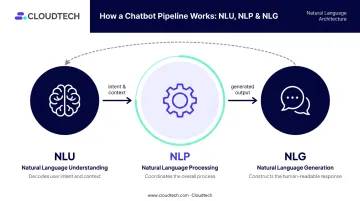
- NLP (Natural Language Processing) — the overarching field of enabling machines to understand and work with human language
- NLU (Natural Language Understanding) — the subset focused on comprehension: interpreting intent, context, and semantic relationships
- NLG (Natural Language Generation) — the subset focused on producing human-readable output from machine representations
All three work together in a functioning chatbot: NLU decodes what the user means, NLP orchestrates the process, and NLG constructs the response.
Types of NLP Chatbots
| Type | How It Works | Best For |
|---|---|---|
| Retrieval-based | Matches input to predefined responses using intent recognition and similarity scoring | Structured, high-volume queries with controlled output |
| Generative | Uses LLMs (like GPT-series) to construct responses from scratch based on context | Open-ended, nuanced conversations |
| Hybrid/Contextual | Blends both approaches; maintains session memory for multi-turn conversations | Complex workflows requiring both control and flexibility |
Contextual bots are worth specific attention — they track conversation state across multiple exchanges, so users don't have to repeat themselves when asking follow-up questions.
How NLP Chatbots Work: A Step-by-Step Breakdown
NLP chatbots don't "read" text the way humans do. They process language through a sequential pipeline, where each stage transforms raw input into something more structured and machine-interpretable.
Input Normalization and Tokenization
Before any analysis begins, the bot standardizes the input. Normalization converts everything to lowercase, strips punctuation, and removes irrelevant characters — so "What's my ORDER status?" and "what is my order status" are treated equivalently.
Once normalized, the text is broken into individual units called tokens — typically words or subwords. These tokens become the discrete pieces the model actually analyzes. According to Hugging Face's tokenization documentation, the standard pipeline runs normalization, pre-tokenization, model tokenization, then post-processing in sequence. Once normalized, the text is broken into individual units called tokens — typically words or subwords. These tokens become the discrete pieces the model actually analyzes. According to Hugging Face's tokenization documentation, the standard pipeline runs normalization, pre-tokenization, model tokenization, then post-processing in sequence.
Those tokens then feed directly into the next stage: determining what the user actually wants.
Intent Classification
With tokenized input ready, the chatbot uses trained AI models to classify what the user is actually trying to accomplish — their intent.
"I need to cancel my subscription" maps to a cancellation intent, not a billing or account support intent. This distinction determines which response gets routed to the user.
Intent classification is where NLP bots most clearly outperform rule-based systems. A 2021 NAACL Industry Track study benchmarked commercial intent detection across multiple datasets, with Watson Assistant achieving 95.7% accuracy on the CLINC150 dataset under full training conditions. Amazon Lex returns confidence scores between 0.0 and 1.0 for each classified intent, allowing developers to set thresholds before a response is triggered.
Entity Recognition
Once intent is classified, the bot identifies specific details embedded in the message — order numbers, dates, locations, names — that are needed to actually fulfill the request.
In "Change my delivery to Thursday at 5pm to my Chicago address," the bot extracts:
- "Thursday at 5pm" → time entity
- "Chicago" → location entity
Without entity recognition, the bot understands the intent but lacks the specifics to act on it.
Response Generation and Dialogue Management
The classified intent and extracted entities are used to generate or retrieve a response:
- Retrieval-based systems select the best-matching pre-written answer from an approved set
- Generative systems use an LLM to construct a response in natural language based on context
Modern NLP chatbots also incorporate dialogue management at this stage. Amazon Lex, for example, uses session attributes and active contexts to persist conversation state across turns — so follow-up questions don't require users to start over.
NLP Chatbots vs. Rule-Based Chatbots
Rule-based chatbots operate on if-then logic and keyword matching. They respond correctly only when the user's phrasing matches exactly what was programmed. Any deviation — a typo, an unexpected synonym, a rephrased question — and the bot either fails or falls back to a generic error message.
NLP chatbots understand meaning and intent across varied phrasing, typos, and synonyms. A user can ask the same question five different ways and still receive a correct, contextual response.
| Dimension | Rule-Based | NLP-Powered |
|---|---|---|
| Input handling | Predetermined scripts, keyword matching | Intent classification with confidence scoring |
| Variation tolerance | Fails on unanticipated phrasing | Handles synonyms, paraphrasing, and ambiguity |
| Response type | Fixed scripted output | Retrieved or generated based on context |
| Update process | Manual reprogramming required | Learns from interaction data over time |
| Multi-turn handling | Limited; resets on deviation | Session state maintained across conversation |
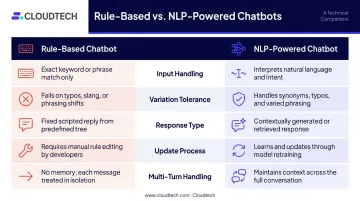
Rule-based bots aren't obsolete. They work well for tightly scoped, low-variation use cases like simple menus or form-filling flows. For anything involving natural language at scale — varied intent, ambiguous phrasing, multi-turn context — rule-based logic breaks down quickly, and NLP is what fills that gap.
Where NLP Chatbots Are Used
High-Impact Deployment Environments
NLP chatbots deliver measurable value across several operational contexts:
- Customer service — automated query resolution, complaint routing, status updates
- Healthcare — patient intake, appointment scheduling, symptom triage, medication reminders
- Financial services — account queries, fraud alerts, balance checks, loan guidance
- E-commerce — order tracking, returns, product recommendations
- HR — candidate screening, onboarding Q&A, policy questions
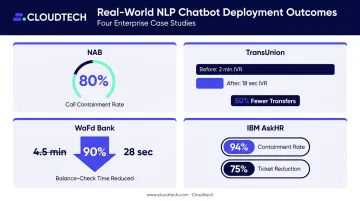
Real deployments back this up. Amazon Lex customer case studies document concrete results across industries:
- NAB: 80% call containment through automated channels
- TransUnion: IVR navigation time cut from 2 minutes to 18 seconds, with a 50% reduction in transfers
- WaFd Bank: Balance-check time reduced by 90% (from 4.5 minutes to 28 seconds)
- IBM AskHR: 94% containment of common HR questions and a 75% reduction in support tickets since 2016
Conditions Where NLP Chatbots Perform Best
These results tend to appear when:
- Query volume is high enough to justify automation
- Input phrasing varies significantly across users
- 24/7 availability is expected or required
- The bot is connected to backend systems (CRM, EHR, order management) for end-to-end resolution — not just conversational deflection
A chatbot that can understand a request but can't act on it is a dead end. Integration with operational systems is what converts a chat interface into actual workload reduction.
AWS-Native Options for SMBs
SMBs looking to deploy NLP chatbots don't need to build models from scratch. Amazon Lex handles conversational interfaces — managing intents, utterances, slots, and session context — with no minimum spend, billed purely on usage. Amazon Comprehend handles NLP text analysis tasks: entity extraction, sentiment, key phrases, and custom classification.
AWS consulting partners like Cloudtech help SMBs architect and connect these services to existing backend systems — cutting deployment time from months to weeks compared to building from scratch.
Conclusion
NLP chatbots work because they process language through a structured, AI-powered pipeline — not guesswork or scripted matching. Knowing how normalization, tokenization, intent classification, entity recognition, and response generation fit together lets operators set realistic expectations, choose vendors on substance, and recognize where automation genuinely adds value — and where it doesn't.
Businesses that understand the mechanics are better positioned to implement strategically — choosing the right bot type, integrating the right backend systems, and tracking outcomes that reflect actual workload impact rather than surface-level metrics. That foundation is what separates deployments that deliver lasting value from those that get abandoned six months in.
Frequently Asked Questions
Are chatbots natural language processing?
Not all chatbots use NLP. Rule-based chatbots rely on keyword matching and scripted logic, while NLP chatbots use AI to understand intent and meaning behind varied language. The term "chatbot" covers both types — NLP chatbots are the ones capable of handling natural, unpredictable human conversation.
Which AI is best for NLP?
The right choice depends on your use case. For structured business automation, retrieval-based models on platforms like Amazon Lex work well. For open-ended, human-like conversation, large language models like GPT-4 or Claude offer greater fluency and contextual depth.
What is the difference between NLP chatbots and rule-based chatbots?
Rule-based chatbots follow fixed scripts and only respond correctly to near-exact keyword matches. NLP chatbots understand intent across varied phrasing and improve over time from interaction data. Rule-based bots require manual updates to handle new phrasing; NLP bots adapt without reprogramming.
What is the difference between NLP, NLU, and NLG?
NLP is the overarching field of enabling machines to understand human language. NLU (Natural Language Understanding) is the subset focused on comprehending what a user means. NLG (Natural Language Generation) is the subset focused on producing coherent, human-readable responses. All three work together in a functioning NLP chatbot.
Can small businesses use NLP chatbots?
Yes. Cloud-native services like Amazon Lex eliminate the need to build or train models from scratch, with usage-based pricing and no upfront commitment. With the right implementation partner, SMBs can deploy NLP chatbots in weeks and automate the bulk of routine customer queries.
What industries benefit most from NLP chatbots?
Healthcare, financial services, e-commerce, and customer service-heavy industries see the strongest results — particularly where query volume is high and 24/7 availability is expected. That said, any industry with repetitive, language-based interactions between people and systems can benefit from NLP automation.