The tension isn't hypothetical. Business associates accounted for 85% of individuals affected by large HIPAA breaches in 2024, despite filing only 16% of breach reports. AI vendors, cloud processors, and API providers fall squarely into that category — and most healthcare SMBs haven't fully reckoned with what that means.
AI can be HIPAA-compliant. But it isn't by default. It requires specific technical, administrative, and contractual safeguards that many organizations skip — often without realizing it. This article covers the HIPAA rules that govern AI, the unique risks AI introduces beyond traditional EHR systems, the technical safeguards required at every layer, and a practical path forward for healthcare teams deploying AI on cloud infrastructure.
Key Takeaways
- HIPAA's Privacy Rule, Security Rule, and Breach Notification Rule all apply to AI systems that handle PHI
- Any AI vendor that handles PHI must sign a Business Associate Agreement (BAA) before accessing patient data
- AI introduces compliance risks legacy systems don't — including LLM inference risks, training data memorization, and real-time PHI capture
- Encryption, access controls, and audit logging must be applied at every layer of the AI stack
- AWS HIPAA-eligible services require your own configuration to achieve actual compliance — eligibility is not a guarantee
What HIPAA Actually Requires from AI Systems
HIPAA governs how covered entities — hospitals, clinics, insurers — and their business associates handle Protected Health Information (PHI). Any AI system that creates, receives, maintains, or transmits PHI on behalf of a covered entity falls under these obligations. There's no AI-specific exemption in the regulations — HHS hasn't created one, and the three core HIPAA rules apply to AI systems the same way they apply to any other technology that touches patient data.
The Three HIPAA Rules That Apply to AI
The Privacy Rule sets national standards for permissible uses and disclosures of PHI. AI tools can only access and use PHI for purposes HIPAA explicitly permits. Deploying a new AI tool doesn't expand what uses are allowable — the same rules apply regardless of how the technology works.
The Security Rule mandates administrative, physical, and technical safeguards for electronic PHI (ePHI). Under 45 CFR 164.302 and 164.306, this covers every system that creates, receives, maintains, or transmits ePHI — including AI applications, inference logs, model outputs, and stored training data.
The Breach Notification Rule requires covered entities and business associates to notify affected individuals, HHS, and sometimes the media following a breach of unsecured PHI. Under 45 CFR 164.404, that notification must happen within 60 days of discovery. AI systems are not exempt — and they can actually expand breach exposure by creating new surfaces where ePHI is stored or transmitted.
BAA Requirements and the Minimum Necessary Standard
Under HHS guidance on cloud computing, any vendor that creates, receives, maintains, or transmits ePHI for a covered entity is a business associate — even if it stores only encrypted data and never views the underlying information. That vendor must sign a BAA before touching patient data. Using an AI API, SaaS tool, or cloud service without a signed BAA is a direct HIPAA violation, regardless of whether a breach occurs.
The minimum necessary standard under 45 CFR 164.502(b) requires covered entities to limit PHI access to what's strictly needed for the stated purpose. This creates a direct design tension: models often perform better with more data, but HIPAA requires scoping access tightly. That tension must be resolved in the AI's architecture, not just in policy documents.
Training data presents its own compliance burden. If a model is trained on patient data, that data must meet HIPAA's de-identification standards via one of two methods:
- Safe Harbor: Remove all 18 categories of identifiers and verify no actual knowledge remains that could re-identify an individual
- Expert Determination: A qualified expert determines the re-identification risk is very small, even when combined with other reasonably available datasets
HHS guidance explicitly notes that re-identification risk increases when datasets are combined — a critical consideration for AI systems that may pull from multiple sources.
Why AI Creates Unique HIPAA Compliance Risks Legacy Systems Don't
Traditional EHR systems handle PHI as structured records with defined access paths. An authorized user queries a record, the system returns data, the transaction logs. The data flows are deterministic and auditable.
AI breaks this model — and the compliance gaps it opens have no equivalent in rule-based systems.
Real-Time Data Capture and LLM Inference Risks
When a patient speaks to an AI voice agent or types into an AI chat interface, PHI is created in the moment. This happens before any downstream processing, access control, or governance layer can be applied. That PHI exists in unstructured form from the instant of capture. Traditional EHR safeguards weren't designed for this scenario.
NIST's 2024 Generative AI Profile (AI 600-1) identifies several privacy risks specific to generative AI systems:
- Models can memorize training data and reproduce it unexpectedly in outputs
- PHI can be inferred or generated even when the original input was anonymized
- Sensitive data in prompts, retrieval context, and generated outputs requires the same HIPAA controls as structured records
These risks don't exist in rule-based legacy systems. A 2025 peer-reviewed scoping review in PMC on patient privacy considerations for large language models in healthcare documents additional limitations of current privacy protections for LLMs in clinical settings. Privacy officers need to treat AI outputs as potential PHI exposure points, not just AI inputs.
Third-Party Integrations and the Subprocessor Chain
Every vendor in a healthcare AI deployment is a potential PHI exposure point. A typical stack might include:
- A cloud infrastructure provider (storage, compute)
- An LLM inference API (e.g., a third-party model provider)
- An EHR integration layer using FHIR
- A speech-to-text or text-to-speech service
- A session management or logging platform
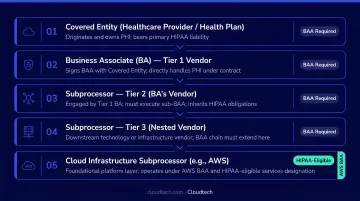
BAA obligations must flow down to every subprocessor in that chain — not just the primary vendor.
Two structural vulnerabilities make auditing this chain harder than it looks:
- The black box audit problem: Most proprietary AI models don't expose how PHI influences their outputs, making it difficult to validate data usage or pass a meaningful compliance audit. Unlike deterministic systems, there's no traceable path from input to decision.
- Session and transcript retention: Organizations should confirm in writing whether any patient interaction data is used for model training or product improvement. Require explicit contractual prohibitions if it is — and don't assume the answer is no without asking.
Technical Safeguards Required for HIPAA-Compliant AI
The technical layer is where most healthcare AI deployments fall short. HIPAA's Security Rule organizes requirements into administrative, physical, and technical safeguards — and all three apply to AI systems.
Encryption, Access Controls, and Audit Logging
Encryption is required for ePHI both in transit and at rest. HHS references NIST SP 800-111 for storage encryption and NIST SP 800-52 for data in motion, with TLS 1.2 as the minimum supported standard and TLS 1.3 required for federal implementations as of January 2024.
For AI systems, encryption requirements cover more ground than a standard database deployment:
- Training datasets and model artifacts
- API payloads and inference request/response logs
- Session transcripts and voice recordings
- Any intermediate data stores used during model inference
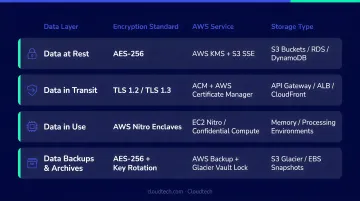
Role-based access controls under 45 CFR 164.312(a)(1) require that only authorized persons or software programs can access ePHI. For a healthcare AI deployment, this means:
- Clinical staff have access to patient-facing AI outputs, not raw model logs
- Engineering teams access infrastructure and logs, not PHI unless required
- Administrative roles are separated from both clinical and engineering access
- Emergency access procedures are documented and tested
Audit logging under 45 CFR 164.312(b) requires hardware, software, or procedural mechanisms that record and examine activity in systems containing ePHI. Many cloud-native AI deployments fail this requirement because vendors don't enable audit logging by default. Logs must be:
- Detailed enough to reconstruct who accessed what data, when, and from where
- Tamper-resistant and exportable
- Compatible with SIEM infrastructure for continuous monitoring
Continuous Monitoring, Incident Response, and Vendor Oversight
HIPAA compliance for AI isn't a one-time configuration. Three ongoing obligations apply:
- Monitor continuously for anomalous data access patterns. AI systems may update through retraining or version releases, and each change should trigger a new risk assessment
- Extend vendor oversight beyond contract signing. Include AI-specific audit rights in BAAs and verify that vendors maintain compliance as their platforms change
- Ensure incident response plans cover AI deployments specifically — with escalation paths and forensic capabilities built for AI-generated data flows, not just structured database records
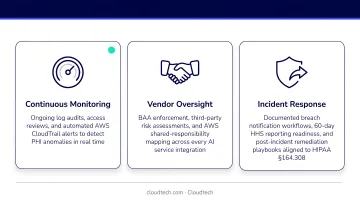
The 60-day notification clock under the Breach Notification Rule runs from the moment of discovery, not from when the investigation concludes.
Building HIPAA-Compliant AI Infrastructure on AWS
Cloud infrastructure is the foundation on which all other safeguards rest. The choice of platform — and how it's configured — determines whether encryption, access controls, audit logging, and breach response are achievable in practice.
AWS offers a Business Associate Addendum (BAA) covering a defined set of HIPAA-eligible services:
- Amazon S3, EC2, RDS, and Lambda
- AWS HealthLake, Amazon Transcribe Medical, and Amazon Comprehend Medical
- AWS CloudTrail and Amazon GuardDuty
The AWS Shared Responsibility Model clarifies the boundary: AWS secures the underlying infrastructure; customers are responsible for security configuration within their workloads.
"HIPAA-eligible" does not mean automatically compliant. The AWS BAA establishes a contractual foundation, but proper configuration by qualified architects is what makes a workload compliant. Access controls, encryption choices, logging enablement, and PHI handling remain customer responsibilities.
Cloudtech, an AWS Advanced Tier Partner, has worked with healthcare SMBs to build exactly this kind of infrastructure. In their engagement with Klamath Health Partnership, a regional medical provider serving underserved populations, Cloudtech assembled the following stack:
- HIPAA-compliant data lake on Amazon S3
- AWS Control Tower for governance
- AWS CloudTrail for audit logging
- AWS KMS for encryption key management
- Amazon Macie for sensitive data discovery
- AWS Security Hub for centralized compliance monitoring
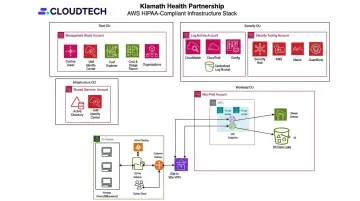
The result: 77% year-over-year infrastructure cost savings while meeting HIPAA's requirements for data confidentiality, integrity, and availability.
For healthcare AI workloads specifically, Cloudtech has deployed HIPAA-compliant conversational AI systems using Amazon Bedrock, Amazon Transcribe, and Amazon Polly, with end-to-end encrypted PHI handling, role-based access controls, and full audit trails designed into the architecture from day one.
Actionable Steps to Deploy AI Within HIPAA Boundaries
Compliance cannot be retrofitted once an AI system is live — and OCR won't accept "we didn't know" as a defense. Complete these three steps before any patient data touches a new AI tool.
Step 1 — Conduct an AI-specific risk assessment before deploying any tool.
- Map every PHI data flow the AI system will touch
- Identify all third-party subprocessors in the vendor chain
- Evaluate encryption and access control configurations
- Document residual risks with mitigation plans
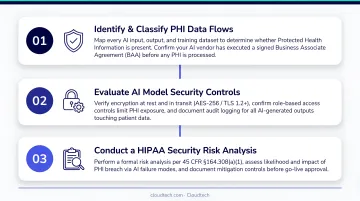
The NIST AI Risk Management Framework (AI RMF 1.0) provides a structured methodology for this assessment — though it doesn't replace HIPAA-specific obligations.
Step 2 — Vet vendors rigorously before signing.
- Confirm the vendor will sign a BAA covering your specific product tier — not just enterprise tiers
- Verify which subprocessors fall within BAA obligations
- Get explicit written confirmation that patient interaction data won't be used for model training
- Request the vendor's most recent SOC 2 Type II audit report and OCR breach history
These are standard due diligence requests. Vendors who refuse to provide them are a red flag worth acting on.
Step 3 — Implement a continuous compliance program post-deployment.
- Audit AI systems at minimum annually — and immediately after any model retraining or significant update
- Track OCR guidance and state-level AI privacy law changes; several states are moving ahead of federal standards
- Train clinical and administrative staff on which tools are approved for PHI use and what triggers a reportable incident
Frequently Asked Questions
Does HIPAA apply to AI tools used in healthcare?
Yes. HIPAA applies to any AI system that creates, receives, maintains, or transmits PHI — the tool type doesn't create an exemption. Both the AI vendor (as a business associate) and the healthcare organization (as a covered entity) share compliance obligations under the same rules.
What is a Business Associate Agreement (BAA) and why does AI require one?
A BAA is a legally required contract between a covered entity and any vendor that handles PHI on its behalf. AI vendors that process patient data must sign a BAA before accessing any PHI. Using an AI tool without a signed BAA is a direct HIPAA violation — even if no breach occurs.
Can AI models be trained on patient data under HIPAA?
Yes, but only if that data is properly de-identified using HIPAA's Safe Harbor or Expert Determination method, or if the training environment itself meets full HIPAA compliance requirements — with appropriate access controls, encryption, and BAAs covering every system involved.
What are the penalties for using non-compliant AI with PHI?
HIPAA civil penalties range from $145 per violation (no knowledge) to $73,011 per violation (willful neglect, uncorrected), with annual caps up to $2,190,294 per violation category. Even unintentional violations — such as using an AI API without a signed BAA — carry real fines, and OCR enforcement of vendor relationships is tightening.
How does cloud infrastructure affect HIPAA compliance for AI?
AWS offers HIPAA-eligible services and signs BAAs, but that eligibility doesn't make a workload automatically compliant. Under the Shared Responsibility Model, proper configuration of encryption, access controls, and audit logging remains the customer's obligation — and requires qualified architects to implement correctly.
What is the minimum necessary standard and how does it apply to AI?
The minimum necessary standard requires AI systems to access only the PHI needed for their specific function. In practice, AI tools should query only the data fields genuinely required — not given broad access to entire patient records for convenience. This governs runtime data access, not just what's used during model training.