Introduction
HR teams are drowning in repetitive questions. According to SHRM's coverage of a Sage survey of over 1,000 HR leaders, 95% of HR professionals say HR is simply too much work — and 73% say the function remains too administrative and process-focused. A separate BambooHR survey of 1,200 HR professionals at U.S. SMBs found 26% are frequently interrupted by ad hoc employee requests for basic information.
Meanwhile, employee expectations have shifted. People interact with AI-powered assistants in their personal lives and expect the same immediacy at work. Most HR teams still respond through email queues or ticketing systems, creating delays that frustrate employees — particularly in remote and hybrid environments where support needs don't follow business hours.
That gap is what conversational AI is built to close. This post covers what conversational AI in HR actually is, why manual query management is failing, which employee queries can realistically be automated, and what SMBs need to know to implement it on AWS infrastructure.
Key Takeaways
- Conversational AI uses NLP and machine learning to deliver instant, 24/7 HR support without adding headcount
- Automatable queries span three tiers: information lookups, transactional requests, and guided multi-step workflows
- Sensitive situations — disputes, disciplinary matters, mental health disclosures — must always escalate to a human with full context preserved
- AWS services like Lex, Lambda, and Bedrock provide a secure, scalable foundation for SMB HR deployments
- ROI spans lower admin overhead, stronger employee experience, and query data that sharpens people strategy
What Is Conversational AI in HR and How Does It Work?
Conversational AI in HR is an AI-powered dialogue system that combines Natural Language Processing (NLP), Natural Language Understanding (NLU), and machine learning to interpret what employees are actually asking. Unlike keyword-matching chatbots, it understands intent, holds context across a conversation, and delivers personalized answers that improve over time.
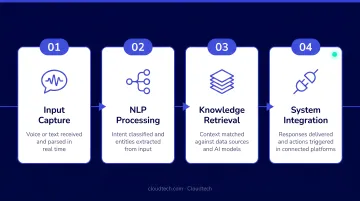
The system works through four interconnected layers:
- Input processing — reads and parses the employee's message, whether typed or spoken
- Intent recognition — identifies what the employee needs (a policy answer, a document, a system action)
- Dialogue management — decides the next step: answer directly, ask a clarifying question, or trigger a system task
- Integration layer — connects to HRIS, payroll, or knowledge base systems to retrieve or execute the request
Conversational AI vs. Rule-Based HR Chatbots
The difference matters practically. Here's a direct comparison:
| Capability | Rule-Based Chatbot | Conversational AI |
|---|---|---|
| Response generation | Scripted, fixed | Dynamic, context-aware |
| Learning ability | Static | Self-improving |
| Contextual memory | None | Maintained across conversation |
| Complexity handling | Simple FAQs only | Multi-step requests |
| Personalization | Generic | Draws on employee profile and history |
Conversational AI also integrates into tools employees already use — Slack, Microsoft Teams, and web portals — so they get answers without switching applications. Cloudtech's chat-based implementations take this further by training agents on company-specific knowledge bases, so responses reflect the organization's actual policies rather than generic templates.
Why Manual HR Query Management Is Failing
The volume problem is real, and it compounds quickly for lean HR teams. The BambooHR SMB survey found:
- 33% of HR teams say managing benefits, time tracking, and payroll across different systems takes too much time
- 52% struggle to manage, analyze, and use employee data effectively
- 30% feel overwhelmed by new-hire paperwork alone
That fragmentation means basic questions — "What's my PTO balance?" "When does open enrollment close?" — require HR to manually cross-reference multiple systems before responding.
The Burnout Cycle
When HR professionals spend the bulk of their day answering the same questions, they have less capacity for talent development, retention strategy, and culture-building. SHRM's Sage survey found 81% of HR professionals reported burnout and 84% felt regularly stressed.
That level of strain affects the quality of every strategic initiative the HR team is supposed to own — from performance management to retention planning.
The Employee Experience Stake
Poor HR support doesn't just frustrate employees — it has retention implications. SHRM's 2024 research across 2,403 respondents found employees with a positive experience are 68% less likely to consider leaving, with only 9% in positive work cultures considering departure versus 42% in negative ones. Slow, inconsistent HR responses contribute to that experience gap.
The Remote Work Amplifier
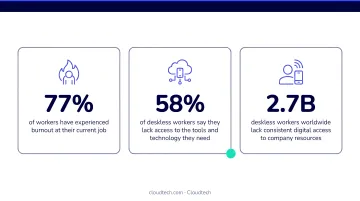
Distributed teams span time zones. Shift-based workers in healthcare and manufacturing often lack reliable computer access entirely — Fidelity's survey of 1,046 HR professionals found 62% cite limited computer access as a barrier for deskless workers, with irregular schedules cited by 56%. HR support systems built around standard business hours leave these workers without answers precisely when they need them most — and that gap has a direct cost to engagement and compliance.
What Employee Queries Can Conversational AI Actually Automate?
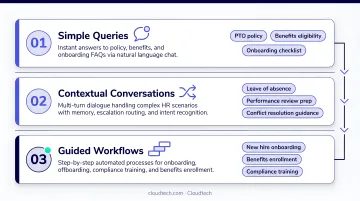
Not all queries are created equal. A tiered framework helps HR teams prioritize where to start and where to draw the line.
Tier 1: Simple Information Queries
These are the highest-volume, lowest-risk queries — pure information retrieval with no system action required:
- Leave and PTO policies
- Payroll schedules and pay stub access instructions
- Benefits enrollment details and deadlines
- Holiday calendars
- Expense reimbursement guidelines
- Attendance rules and remote work policies
The AI retrieves accurate answers from a connected knowledge base. No authentication beyond login is required. These are the right place to start — high impact, low implementation risk.
Tier 2: Transactional HR Requests
Conversational AI can go beyond answering questions to executing actions within integrated HR systems:
- Submitting and tracking leave requests
- Updating personal contact information
- Accessing pay stubs and tax documents
- Initiating expense claims
- Benefits enrollment actions
- Password resets
Role-based access controls are essential at this tier. Employees should only act on their own data — not a colleague's, not their manager's. Cloudtech builds least-privilege IAM policies and authentication checkpoints into transactional workflows by default, ensuring the system confirms identity before executing any action on personal or sensitive records.
Tier 3: Guided Workflow Automation
More complex, multi-step automations that the AI orchestrates across several interactions and systems:
- Delivers onboarding documents, assigns training modules, and walks new hires through policies over days or weeks
- Sends compliance training reminders triggered by role, location, or certification expiry dates
- Coordinates performance review scheduling between managers and direct reports
- Collects structured exit interview feedback before offboarding completes
These require the AI to manage longer conversations and coordinate actions across multiple systems. A practical signal that you're ready: Tier 1 and Tier 2 automations are stable, adoption is consistent, and your HR team has visibility into where the AI hands off to humans.
What Conversational AI Should Never Handle Alone
Expanding AI capabilities across tiers also makes the boundaries more important, not less. Some situations require human judgment, legal awareness, and empathy that no AI system should replace:
- Employee relations disputes
- Disciplinary actions or terminations
- Mental health disclosures
- Pay dispute escalations with legal implications
- Any situation involving protected class information
Escalation needs to be a deliberate design decision, not an afterthought. Cloudtech's conversational AI deployments transfer to a live human agent in under two seconds, with full conversation context passed across — so the employee never has to repeat themselves.
Business Benefits for HR Teams and SMBs
Efficiency and Cost Impact
IBM's AskHR system achieved 94% containment for common HR questions, handled over 11.5 million employee interactions in 2024, and reduced HR operational costs by 40% over four years.
A Forrester study of ServiceNow's HR Service Delivery platform reported over 77,000 end-user hours saved and 17,000 HR processing hours saved for a composite organization.
SMBs won't reach those exact numbers, but the operational logic holds: automating high-volume, low-complexity queries frees HR capacity for work that actually requires human judgment.
Employee Experience Improvement
24/7 availability means an employee on a night shift in a manufacturing facility can check their benefits coverage at 2 a.m. without waiting until Monday morning. Personalization — drawing on the employee's profile, location, and history — makes responses feel relevant rather than generic.
Cloudtech's healthcare AI voice agent for Ascend BPO demonstrates what this looks like in a regulated environment: handling 2,500–5,000 inbound calls monthly, with warm handoff to human agents when needed. The same architecture applies to internal HR support.
Strategic Data Advantage
Every conversation generates data HR teams rarely see from ticket queues:
- Query patterns reveal gaps in policy communication before they become widespread confusion
- No-deflection topics (questions the AI couldn't answer) identify knowledge base holes
- Transfer-to-human rates flag workflows that need refinement or content that's missing
- Sentiment signals in conversation data can surface engagement or retention risks early
Over time, this data shifts HR from reactive support to proactive workforce intelligence — spotting problems before they escalate into turnover or compliance gaps.
Building Your HR Conversational AI on AWS: What SMBs Need to Know
The AWS Technical Stack
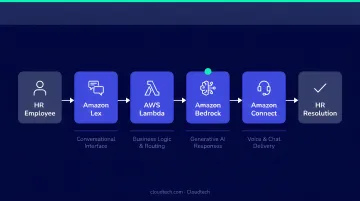
Four AWS services form the core of a production-ready HR conversational AI deployment:
- Amazon Lex V2 — builds the conversational interface with NLU and speech recognition. AWS explicitly lists HR use cases including policy questions, benefits enrollment, time-off requests, and onboarding
- AWS Lambda — handles serverless intent fulfillment and backend integrations without infrastructure overhead
- Amazon Bedrock — provides access to large language models for more nuanced, generative responses; AWS's own examples include PTO balance queries and leave changes with user confirmation
- Amazon Connect — supports voice channel delivery for HR use cases, enabling phone-based employee support alongside chat
These services work together in a single, cloud-native architecture. AWS's managed services reduce infrastructure complexity — there's no server fleet to maintain, and scaling happens automatically as query volume grows. That same managed foundation makes it possible to enforce consistent security controls across every layer from the start.
Security and Compliance: Built In, Not Bolted On
HR data — payroll records, benefits information, health-related data — carries real regulatory weight. The technical controls that must be built in from day one:
- Encryption via AWS KMS for data at rest and in transit
- Access controls via AWS IAM with least-privilege policies enforced by role
- Audit logging via AWS CloudTrail, recording every data access event
- Compliance drift detection via AWS Config
For healthcare SMBs, HIPAA requires that any cloud provider maintaining protected health information — even encrypted — operates under a Business Associate Agreement.
AWS supports HIPAA/HITECH, SOC 2, and GDPR compliance programs. That said, AWS infrastructure alone doesn't make a deployment compliant. The architecture must be built correctly.
Where Cloudtech Fits
For SMBs, getting this right without overspending requires certified cloud expertise. Cloudtech, an AWS Advanced Tier Partner with a team of AWS-certified solutions architects, deploys conversational AI infrastructure — chat and voice — for organizations in healthcare, financial services, and manufacturing. The delivery framework covers:
- Architecture design and AWS environment setup
- Build, API integration, and knowledge base training
- Stress testing and compliance audit
- Production-ready deployment — typically within four weeks
The Slack and Microsoft Teams integrations mean HR assistants can live where employees already work, trained on company-specific knowledge bases from day one.
Frequently Asked Questions
What types of HR queries can conversational AI automate?
Automation works best across three tiers: simple information requests (leave policies, payroll schedules, benefits details), transactional requests (submitting leave or updating personal data), and guided workflows (onboarding, compliance reminders). Start with high-volume, low-risk queries before expanding into transactional and workflow automation.
How is conversational AI different from a basic HR chatbot?
Traditional HR chatbots follow rigid, pre-scripted decision trees and break down when employees phrase questions unexpectedly. Conversational AI uses NLP and machine learning to understand intent, maintain context, and improve with every interaction — handling the natural variation in how employees actually communicate.
How long does it take to implement a conversational AI system for HR?
Focused pilots targeting one or two high-volume use cases (such as policy FAQs and leave requests) can reach production in weeks on modern cloud platforms. Cloudtech's structured delivery framework typically goes from architecture through compliance audit to go-live in four weeks for chat and voice deployments. Enterprise-wide rollouts with deep HRIS integrations take longer and benefit from phased implementation.
Is conversational AI in HR secure and compliant with data regulations?
Yes, when implementation quality is right. Systems built on AWS with KMS encryption, IAM access controls, CloudTrail audit logging, and Config compliance monitoring meet HIPAA, SOC 2, and GDPR requirements. Compliance must be designed into the architecture from the start, not assumed because the infrastructure is cloud-based.
Can conversational AI handle sensitive or complex HR queries?
Conversational AI is best suited to routine, policy-based, and transactional queries. Sensitive situations (disciplinary matters, mental health disclosures, pay disputes with legal implications) should always escalate to a human HR representative. Systems with proper escalation routing transfer these conversations with full context preserved, so employees don't have to repeat themselves.
What metrics should HR teams track to measure conversational AI success?
Track these five KPIs:
- Query auto-resolution rate: routine questions resolved without HR intervention
- Transfer-to-human rate: a high rate signals content gaps or scope issues
- No-deflection topics: questions the AI couldn't answer, revealing knowledge base holes
- Average response time: speed improvement over manual handling
- Employee satisfaction scores: collected via post-interaction surveys