Introduction
Every time a user types into a chatbot, something happens that most businesses haven't thought through: personal data gets created. Names, email addresses, IP addresses, device identifiers, conversation history — all of it falls under GDPR the moment it touches an EU resident. For US businesses serving European customers, that exposure is immediate.
The stakes are real. GDPR Article 83 sets upper-tier fines at €20 million or 4% of global annual turnover, whichever is higher. Enforcement actions targeting AI tools are no longer theoretical:
- Italy's Garante blocked ChatGPT in 2023 and ordered Replika to halt data processing
- Italy's Garante announced a €15 million fine against OpenAI in late 2024
- The UK's ICO issued a preliminary enforcement notice to Snap over its "My AI" chatbot in October 2023
This guide covers what GDPR actually requires from conversational AI systems, how to build compliance into your architecture from day one, and what additional controls regulated industries need beyond the baseline.
Key Takeaways
- GDPR applies to any organization processing EU residents' data — including US-based companies
- Compliance must be built into system architecture from the start, not retrofitted after deployment
- A signed Data Processing Agreement with every AI provider is legally mandatory under GDPR Article 28
- Regulated industries like healthcare and financial services carry compliance obligations that go beyond baseline GDPR
- Automated deletion, consent logging, and data-rights workflows must be configured at the infrastructure level
What GDPR Means for Conversational AI
Scope: Who It Applies To
GDPR's territorial reach extends to any organization — including those headquartered in the US — that interacts with or collects data from EU residents. There is no exemption for non-European companies.
Under GDPR Article 4(1), personal data includes any information relating to an identified or identifiable person. For conversational AI, this means:
- Names, email addresses, phone numbers
- IP addresses and device identifiers (explicitly named in GDPR Recital 30)
- Chat transcript content, if any individual can be identified from it
- Session cookies and browser fingerprints
A FAQ bot that never asks for a name can still process personal data through IP logging alone.
Controller vs. Processor: Why It Matters
The business deploying the chatbot is the data controller — responsible for determining why and how personal data is processed. The chatbot platform vendor or LLM provider (OpenAI, Anthropic, Google) typically acts as the data processor, operating on the controller's instructions.
This distinction matters for liability. Key obligations break down as follows:
This distinction matters for liability. Key obligations break down as follows:
- Controllers must document the lawful basis for processing, honor data subject rights, and ensure every processor has a signed Data Processing Agreement
- Processors have narrower obligations but are directly liable for processing outside the controller's instructions
The EU AI Act Intersection
The EU AI Act introduces a layered overlay for certain conversational AI deployments. Under AI Act Article 6 and Annex III, systems used in employment screening, creditworthiness evaluation, health insurance risk assessment, and emergency healthcare triage are classified as high-risk.
A chatbot interface can inherit this classification based on what it does, not just what it is. High-risk systems face mandatory logging, human oversight requirements, and conformity assessments — on top of baseline GDPR obligations.
Core GDPR Requirements Every Conversational AI Must Meet
Lawful Basis and Transparency
Before collecting any personal data, you must identify a valid legal basis under GDPR Article 6. One lawful basis applies per processing activity — not to the entire bot.
| Use Case | Applicable Lawful Basis |
|---|---|
| Standard customer service bot | Legitimate interests |
| Order/booking queries | Contract performance |
| Marketing follow-ups | Explicit consent |
| Regulated-sector compliance | Legal obligation |
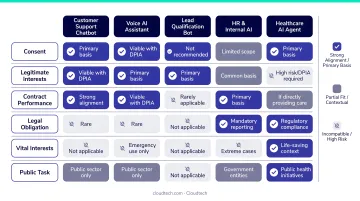
Users must be informed before the chat begins: what data is collected, why, how long it's retained, and how to exercise their rights. A visible "Powered by AI" disclosure is also considered best practice by regulators.
CNIL's chatbot guidance instructs operators to write privacy notices in plain language — not buried in terms and conditions.
Data Minimisation in Practice
GDPR Article 5(1)(c) requires that data collection maps directly to a documented purpose. The most common regulatory finding in chatbot audits is over-collection of data that's never actually used.
- A FAQ bot answering product questions may need no personal data at all
- A booking bot needs name, date, and contact details — not date of birth or employer
- A support bot should log conversation content only if that content is needed for the documented purpose
Constrain the data fields available in your system schema. If the field doesn't have a documented processing purpose, it shouldn't exist in the form.
User Rights and Automated Decision-Making
GDPR grants data subjects enforceable rights that your conversational AI infrastructure must support:
- Article 15 — Right of access (provide a copy of personal data within one month)
- Article 16 — Right to rectification
- Article 17 — Right to erasure ("right to be forgotten")
- Article 20 — Right to data portability
Article 22 requires separate handling. Individuals have the right not to be subject to decisions based solely on automated processing that produce legal or significant effects. Any conversational AI used in loan pre-screening, applicant filtering, or symptom triage must include a clear human escalation path.
EDPB guidance on automated decision-making explicitly covers online credit applications and e-recruiting without meaningful human involvement as Article 22 scenarios.
Data Retention and Deletion
Alongside these user rights sits an equally firm obligation on your end. GDPR's storage limitation principle (Article 5(1)(e)) requires deletion or anonymization once data is no longer needed for its original purpose. Practical windows:
- Customer service conversations: 30–90 days
- Contractual interactions: aligned with the contract duration
- Financial communications: longer, governed by sector-specific regulations (see below)
Auto-deletion rules must be configured at the infrastructure level — not dependent on manual processes. Deletion must cascade to backups and any sub-processor systems.
Building GDPR Compliance Into Your Conversational AI Architecture
Privacy by Design and Consent Architecture
GDPR Article 25 requires data protection to be built in from the outset. Architecturally, this means:
- Default settings are the most privacy-protective available
- Consent gates activate before the chat widget collects any data
- Data fields are constrained in the system schema to only what is necessary
For consent to be valid, EDPB Guidelines 05/2020 require an unambiguous affirmative action — no pre-ticked boxes, no implied agreement. Your consent log must capture:
- Who consented
- When they consented
- What purpose they consented to
- Which version of the privacy policy was shown
Webhook-triggered workflows or slash commands (such as /delete_my_data or /my_data) can automate rights fulfillment, significantly reducing the operational overhead of responding to data subject access requests.
Data Protection Impact Assessments (DPIAs)
A DPIA under GDPR Article 35 is mandatory when conversational AI is likely to result in high risk to individuals. Triggers include:
- Processing special category data (health, financial)
- Making automated decisions with significant effects
- Processing data at large scale using new technologies
Most standard SME customer service bots don't require a full DPIA. Healthcare triage bots, recruitment screening tools, and financial decision-support AI typically do. The ICO's AI and data protection guidance and CNIL's chatbot guidance both provide practical frameworks for structuring the risk assessment.
AWS Services That Support Compliance Architecture
Businesses building conversational AI on AWS can use native services to support GDPR obligations — though technical controls alone don't constitute legal compliance. They must be configured deliberately and tied to documented processing purposes.
| AWS Service | GDPR-Relevant Function |
|---|---|
| Amazon Macie | Automated sensitive data discovery and classification in stored conversations |
| Amazon Comprehend | Real-time PII detection and redaction in conversation data |
| AWS KMS | Encryption key management, rotation, and access control |
| AWS CloudTrail | Audit logging of all data access events |
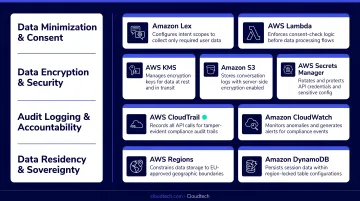
For AWS-based SMBs, the key is embedding these services into the architecture from day one rather than adding them after deployment. Cloudtech structures these tools as core infrastructure components, which is how clients achieve defensible GDPR compliance without enterprise-level overhead or costly post-launch redesigns.
Documentation: The Record of Processing Activities
Technical controls only tell half the story — regulators also expect documented evidence of your processing decisions. GDPR Article 30 requires a Record of Processing Activities (RoPA), and for conversational AI, this register must document:
- The chatbot's data flows and processing purposes
- The AI model provider as a sub-processor
- Any CRM or analytics integrations
- Data categories and retention periods
- The data residency of each component
This documentation is typically the first thing a regulator requests during an audit. Build it during architecture, not after.
Data Security Best Practices for Conversational AI
Encryption and Access Controls
GDPR Article 32 requires appropriate technical measures. For conversational AI:
- In transit: TLS 1.3 or higher for all data between the user, chat interface, and backend systems
- At rest: AES-256 encryption for conversation logs, databases, and backups
- Key management: Encryption keys stored separately from encrypted data, with regular rotation
The principle of least privilege applies across the entire stack. Access controls should enforce:
- Each component and team member accesses only data essential to their role
- Admin interfaces require MFA without exception
- API keys connecting the chatbot to third-party systems are narrowly scoped and rotated regularly
- Role-based access control logs are maintained as audit evidence for GDPR reviews
AI-Specific Threats
LLM-powered conversational AI introduces GDPR-relevant risks that traditional data security frameworks don't fully address:
- Prompt injection (OWASP LLM01:2025): malicious inputs that cause the AI to ignore its instructions or expose data from its context window
- Model data leakage: sensitive information included in training data being regurgitated in responses
Each of these risks has a concrete technical countermeasure. Practical mitigations include:
- Real-time PII redaction before inputs reach the LLM
- Output filtering before responses are shown to users
- Constraining AI responses to a curated knowledge base (RAG architecture)
- Adversarial testing as part of security reviews
Incident Response
Even with strong preventive controls, breach preparedness is non-negotiable. GDPR Article 33 requires notifying the relevant supervisory authority within 72 hours of becoming aware of a breach likely to result in risk to individuals' rights. Your incident response plan must cover:
- Detecting unusual access patterns in conversation logs
- Containing and assessing the breach scope
- Notifying both the regulator and affected users
- Forensic analysis of access and API call logs
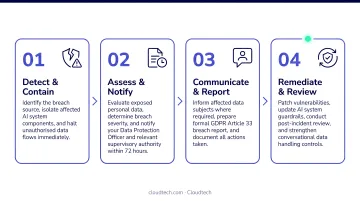
Comprehensive logging is a prerequisite for all four steps. Without detailed records of access events and API calls, meaningful forensic analysis is impossible.
Managing AI Model Providers and Cross-Border Data Transfers
The Mandatory Data Processing Agreement
A signed DPA with every third-party AI provider is legally required under GDPR Article 28. For AI providers specifically, the DPA must include:
- Explicit prohibition on using customer data for model training (or a binding opt-out)
- Sub-processor disclosure obligations
- Breach notification timelines
- Data deletion guarantees at contract end
- The right to audit
Don't assume these clauses exist in default terms of service. Verify before deployment.
Cross-Border Transfer Mechanisms
GDPR restricts transferring personal data outside the EEA unless appropriate safeguards are in place. For US-based AI providers, the two primary mechanisms are:
- Standard Contractual Clauses (SCCs): model data protection clauses issued by the European Commission on 4 June 2021
- EU-US Data Privacy Framework (DPF): effective 10 July 2023; verify your provider's certification at the official DPF list before relying on it
When relying on SCCs, conduct a Transfer Impact Assessment (TIA) to document that the recipient country's laws don't undermine the safeguards. The DPC's enforcement action against Meta over EU-US transfers resulted in a substantial fine, demonstrating the consequences of inadequate transfer documentation.
Where EU hosting isn't possible, anonymizing or pseudonymizing user inputs before they reach the model is a practical alternative. If PII is removed from prompts before they leave the EEA, the transfer may not constitute a personal data transfer at all — though this approach requires careful design and documentation.
GDPR Compliance in Regulated Industries
Healthcare Conversational AI
Healthcare chatbots processing patient data must treat that data as special category data under GDPR Article 9, which carries stricter processing conditions. Technical requirements include:
- End-to-end encryption of all protected health information
- Immutable audit logs of all data access events
- Real-time redaction of PHI from free-text inputs
- A mandatory human escalation path for any triage or clinical decision
For US-facing deployments handling PHI, a HIPAA Business Associate Agreement (BAA) is required alongside the GDPR DPA. These are separate legal instruments with different scope.
Cloudtech builds these controls into healthcare AI architectures as standard components: KMS-based PHI encryption, CloudTrail audit logs retained for seven years, IAM least-privilege access, and context-preserving human escalation paths.
Financial Services Conversational AI
Financial chatbots face GDPR obligations plus sector-specific requirements. Key constraints:
- MiFID II: electronic communications relating to client orders must be recorded and retained (Article 16(7), MiFID II; Delegated Regulation 2017/565 Article 76)
- FCA Consumer Duty: requires firms to deliver good outcomes for retail customers, including clear and non-misleading communications from AI systems
- Article 22: any automated decision affecting access to financial products — loan pre-screening, credit decisions — requires a human review path
- Retention periods: financial communication records may need to be retained longer than GDPR's minimum necessary standard, with legal obligation serving as the lawful basis
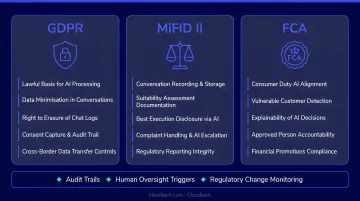
Any chatbot providing information that could constitute financial advice must route advice-shaped queries to a licensed professional.
SaaS and Multi-Industry Deployments
SaaS companies building conversational AI into their products face a layered obligation: they are both a controller (for their own user data) and a processor (for their customers' end users' data).
This means maintaining two levels of documentation:
- A DPA with their AI infrastructure provider (such as AWS)
- A DPA offered to their own customers
- Infrastructure-level tenant separation — VPC isolation and per-tenant encryption keys — to support both obligations simultaneously
AWS-based SaaS architectures can implement these controls at the service layer, keeping tenant data isolated without depending on application-layer logic alone.
Frequently Asked Questions
How do you make conversational AI GDPR compliant?
Start by identifying a lawful basis for each processing activity, then deploy consent mechanisms and a privacy notice before any chat session begins. From there, enforce data minimization with automated retention and deletion policies, sign DPAs with all AI providers, and configure encryption at the architecture level — not as an afterthought.
What are the best practices for GDPR compliance in AI systems?
Build privacy by design into the architecture from day one, not retrofitted after launch. Maintain a Record of Processing Activities, automate user rights fulfillment (access, erasure, portability), and establish retention schedules with auto-deletion. All third-party AI providers must have signed DPAs that explicitly prohibit using customer data for model training.
Does GDPR apply to US companies using conversational AI?
Yes. GDPR applies to any organization — including those based in the US — that collects or processes personal data from individuals located in the EU, regardless of where servers or headquarters are located. Any US business deploying a conversational AI that engages EU website visitors or customers must comply with GDPR in full.
What is a Data Processing Agreement and do I need one for my chatbot?
A DPA is a legally required contract under GDPR Article 28 between your business (the data controller) and any third-party vendor — such as your chatbot platform or LLM provider — that processes personal data on your behalf. Without a signed DPA in place, using that vendor for EU user data is non-compliant, regardless of their general privacy policy.
What are the GDPR penalties for non-compliant conversational AI?
Fines can reach €20 million or 4% of global annual turnover — whichever is higher — for the most serious violations. These aren't hypothetical: Italy's Garante fined OpenAI €15 million over ChatGPT, blocked Replika, and the ICO issued a preliminary enforcement notice to Snap over its "My AI" chatbot. Chatbot-specific enforcement is active and escalating.
Do I need a DPIA for my conversational AI?
A DPIA is mandatory under GDPR Article 35 when processing is likely to result in high risk to individuals — including systems that process special category data, make automated decisions with significant effects, or handle data at large scale. Most standard SMB customer service bots don't trigger this requirement. Healthcare triage bots, recruitment screening tools, and financial decision-support AI typically do.