Key Takeaways
- Legacy healthcare systems create compounding costs in maintenance, compliance risk, and interoperability failures
- GenAI compresses modernization timelines by 40–50% and cuts technical debt costs by 40% (McKinsey, 2024)
- Incremental, module-by-module modernization is safer than rip-and-replace for clinical environments
- AWS Bedrock and HealthLake are HIPAA-eligible under the AWS BAA, though proper customer configuration is required
- Small and mid-sized providers need a compliance-native AWS partner, not a DIY approach
Why Healthcare Legacy Systems Are Reaching a Breaking Point
Most healthcare IT leaders know the problem intimately. The systems propping up daily operations include:
- On-premise EHR platforms from the early 2000s
- AS/400-era billing systems running ICD-9 logic that predates modern coding standards
- HL7 v2 interfaces duct-taped to newer systems through brittle point-to-point connections
- Siloed departmental databases that no single person fully understands anymore
These aren't edge cases. More than 80% of Health Information Organizations still routinely send or receive HL7 v2 messages, while FHIR API adoption — the modern standard for interoperability — remains far from universal. The result is a fragmented data environment where care teams lack real-time patient information, payers struggle to reconcile claims, and patients experience disconnected care across multiple systems.
The Security and Compliance Exposure Is Real
Aging infrastructure creates more than operational headaches. IBM reported the average cost of a healthcare data breach at $9.77 million in 2024 — the highest of any industry. Legacy systems compound this risk: HHS OCR has explicitly noted that older platforms often lack vendor support and patches, and that replacement itself can disrupt critical services — a genuine catch-22.
Maintaining HIPAA compliance on aging infrastructure typically means costly manual workarounds, compensating controls, and audit-heavy processes that introduce human error at every step.
Why "Rip and Replace" and "Lift and Shift" Both Fail
Two default modernization strategies persist in healthcare IT, and both carry serious problems:
- Rip and replace requires shutting down or rebuilding entire systems, risking catastrophic downtime and the loss of decades of embedded clinical workflow logic. The VA's EHR modernization effort illustrates the stakes: GAO estimated the program's lifecycle cost at $16.1 billion, while an independent estimate reached $49.8 billion. Pharmacy-related patient safety issues were documented after implementation.
- Lift and shift solves none of the underlying problems. It migrates inefficiencies and technical debt to a new environment without resolving them.
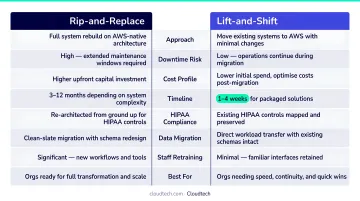
Those failure modes belong to organizations with nine-figure budgets and years to absorb the fallout. Small and mid-sized healthcare providers have neither — which is exactly why a different modernization path is needed.
What Generative AI Does in Healthcare System Modernization
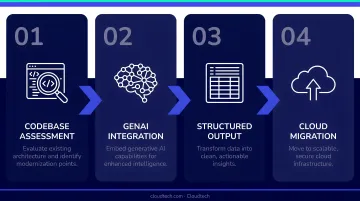
GenAI-assisted modernization takes a different path. Instead of rebuilding everything at once, it uses large language models to analyze, document, refactor, and test legacy codebases incrementally — keeping critical systems running throughout the process.
Each capability addresses a distinct bottleneck — from understanding what you have, to safely modernizing it, to connecting it with modern infrastructure.
Automated Codebase Analysis and Documentation
One of the hardest problems in any legacy modernization is understanding what you actually have. Decades of undocumented changes, retired developers, and missing specifications leave organizations flying blind.
GenAI tools can parse millions of lines of legacy code — including COBOL used in older billing platforms or RPG code from AS/400 systems — and produce:
- Human-readable summaries of system behavior
- Dependency maps showing how components interact
- Auto-generated documentation for previously undocumented modules
According to McKinsey's 2024 analysis, GenAI can compress modernization timelines by 40–50%, largely by accelerating this discovery phase that traditionally consumes enormous time.
AI-Driven Code Refactoring and Translation
GenAI tools can translate legacy code into modern languages — Python, Java, cloud-native functions — while preserving the clinical workflow logic embedded in the original system.
This is not a "one-click" process. Research from ACM found that AI-generated code correctness varies significantly by language and problem complexity, which means human expert review at each stage is mandatory before any output reaches production.
Automated Test Generation
Before any refactoring begins, GenAI generates comprehensive test suites that capture the current system's existing behavior. This creates a regression safety net — so that changes can be verified against the original logic after each modification. In healthcare, where a silent data error can carry patient safety implications, skipping this step is not an option.
API Generation and Integration Modernization
GenAI can analyze legacy system interfaces and generate modern API wrappers, allowing older systems to expose their capabilities through FHIR-compliant or cloud-ready interfaces without requiring full replacement. For healthcare organizations facing ONC interoperability mandates, this approach satisfies compliance requirements without the cost and disruption of a full system replacement.
Key GenAI Use Cases: From EHRs to Claims Processing
Modernizing EHR and Patient Data Infrastructure
EHR modernization is where the complexity is highest and the stakes are greatest. Legacy patient record systems carry complex data schemas, duplicate records, inconsistent formats, and schema mismatches that have accumulated over years of mergers, system updates, and manual data entry.
GenAI accelerates this work by mapping these schemas before migration begins, catching problems that would otherwise surface as errors after go-live. Synthetic data generation addresses another major obstacle in testing: GenAI can create realistic but non-identifiable patient datasets that validate the modernized system without exposing Protected Health Information (PHI). This removes one of the most persistent blockers in healthcare migration projects.
A strong real-world example of what AWS-native healthcare data modernization can achieve comes from Greenway Health, which migrated 638 clients to AWS HealthLake in under one day, ingesting 9.5 billion FHIR resources with zero errors and reaching 8,000 transactions per second — while projecting $1.9 million in software and infrastructure savings through 2025.
Claims Processing and Revenue Cycle Modernization
EHR improvements address the clinical side — but the billing layer carries its own debt. Legacy systems built on ICD-9-era logic create a compounding administrative burden that compounds with every denied claim and manual workaround. The numbers illustrate the scale of the problem:
- The average cost to rework a single Medicare Advantage denial reached $47.77 in 2024 (HFMA)
- 60% of medical group leaders reported rising denial rates that same year (MGMA)
- Administrative transactions tracked by CAQH represent roughly $89 billion annually — about 22% of total healthcare administrative spending
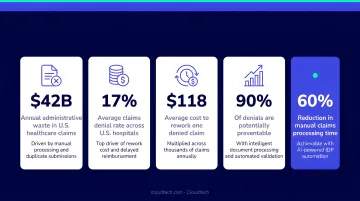
GenAI can analyze and refactor legacy billing logic to support modern ICD-10 and ICD-11 workflows, reducing the structural mismatches that drive claim denials. Forcura, a healthcare workflow company, built an AWS Bedrock-based referral summary feature in under 90 days, serving 900+ providers and nearly 1 million patients — a timeline that shows what's achievable for mid-sized healthcare organizations that don't have years or enterprise-scale budgets to spend on modernization.
A Phased Modernization Roadmap for Healthcare Organizations
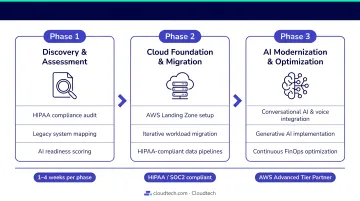
Phase 1 — Assessment and Mapping
Modernization begins with visibility. An AI-assisted discovery phase scans legacy codebases, databases, and integration points to produce an accurate inventory: what exists, what depends on what, and where technical debt is concentrated.
This phase also surfaces hidden HIPAA-relevant data flows — undocumented access paths and data movements that represent compliance blind spots. Organizations often discover they have far more sensitive data exposure than their official documentation suggests.
Cloudtech's engagement with Klamath Health Partnership illustrates this approach in practice. The engagement began with a one-day workshop to capture technical and business outcomes before any implementation work started, resulting in a detailed roadmap built collaboratively with healthcare leadership.
Phase 2 — Prioritize and Pilot
The worst mistake in healthcare modernization is trying to do everything at once. Instead, select a non-critical but representative component as the first modernization target. Good candidates include:
- A reporting module or batch processing job
- A patient intake form or scheduling workflow
- A data export or integration endpoint
This pilot validates the GenAI toolchain, builds team confidence, and produces measurable proof of value without risking core clinical operations.
Phase 3 — Iterative Modularization and Scale
Each successful pilot feeds directly into the next cycle. Each cycle modernizes another component, enforces clean API boundaries, and gradually migrates data workloads to cloud-native infrastructure.
AWS HealthLake provides FHIR-compliant health data storage for modernized data workloads, while Amazon Bedrock supports the GenAI capabilities layer. Cloudtech's AWS-certified team brings pre-built cloud architectures and structured discovery workshops to each cycle, compressing setup time and reducing the likelihood of architectural decisions that create new technical debt.
Managing HIPAA Compliance and AI Governance During Modernization
Compliance cannot be retrofitted. Any GenAI-assisted modernization effort in healthcare must operate within a governance framework from day one.
What an AI Governance Layer Looks Like
- Human review checkpoints before any AI-generated code reaches production
- Audit trails for all automated transformation decisions
- Explainability requirements for changes that affect clinical data flows
- Security scanning on refactored code before deployment
The BAA and PHI Question
When using cloud-based GenAI tools in a healthcare context, the cloud provider must sign a Business Associate Agreement. AWS lists Amazon Bedrock, AWS HealthLake, and AWS Mainframe Modernization as HIPAA-eligible services. HIPAA eligibility confirms a service can be configured for compliant use — it does not mean compliance is automatic. Three additional requirements still apply:
- BAA execution through AWS Artifact before any PHI-adjacent workloads go live
- Customer configuration aligned to HIPAA technical safeguards
- Shared responsibility model obligations fulfilled on the customer side
No real PHI should appear in AI training or testing pipelines. Synthetic data or de-identified datasets must substitute throughout the modernization process.
How Modernization Improves Compliance Posture
Legacy systems frequently carry undocumented data flows and access controls that create compliance blind spots. GenAI-driven discovery surfaces these hidden risks, enabling organizations to build proper access governance and audit logging into the modernized architecture from the start. The result is a cleaner compliance baseline, not just a modernized one.
Choosing the Right AWS Partner for Healthcare Modernization
What to Look For
Evaluating a modernization partner in healthcare comes down to a few non-negotiable criteria:
- Certified AWS expertise — AWS-Certified Solutions Architects and recognized AWS Partner status signal validated technical capability
- Healthcare industry experience — Prior HIPAA-regulated engagements, not just general cloud migration
- Compliance-native approach — HIPAA treated as a design requirement from day one, not a checkbox at the end
- Transparent timelines and pricing — Fixed-scope or clearly phased engagements, not open-ended retainers
Why SMBs Need a Partner, Not a DIY Approach
Large health systems may have internal engineering capacity to manage complex modernization programs. Small and mid-sized providers typically do not. Safely executing AI-driven modernization — HIPAA-compliant data pipeline design, governance frameworks, AWS service selection — requires specialized expertise most SMB IT teams simply don't have on staff.
A qualified partner brings:
- Pre-packaged cloud architectures that reduce setup time
- Familiarity with AWS Migration Acceleration Program (MAP) funding, which can reduce out-of-pocket costs for eligible organizations
- Faster execution because they've solved similar problems before
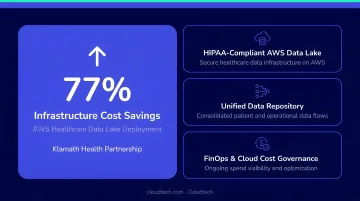
Cloudtech's work with Klamath Health Partnership — delivering a fully HIPAA-compliant data lake and achieving 77% year-over-year infrastructure cost savings — reflects what this partnership model can produce for a small healthcare organization without large internal IT teams.
Long-Term Support Over One-Time Implementation
Modernization is not a project with an end date. Regulatory requirements change, new interoperability mandates emerge, and the architecture that fits your organization today needs to evolve.
Results like the Klamath engagement don't happen in isolation — they require a partner invested in what comes after launch. The right partner provides post-launch support, evolves the architecture as requirements shift, and builds internal team capability so the organization is not permanently dependent on outside help. Cloudtech's model emphasizes knowledge transfer throughout every engagement, leaving clients capable of maintaining and growing their infrastructure independently.
Frequently Asked Questions
What are the biggest challenges of modernizing healthcare legacy systems?
The core barriers are data complexity (decades of inconsistent schemas and undocumented formats), HIPAA compliance requirements that constrain data handling during migration, interoperability mandates requiring FHIR-readiness, and the operational risk of disrupting clinical workflows that run continuously. Effective modernization must address all four in parallel.
How does generative AI handle HIPAA compliance during healthcare system modernization?
GenAI tools must operate within a governance framework using synthetic or de-identified data throughout testing — never real PHI. Human review is required before AI-generated code reaches production, and all cloud services must be HIPAA-eligible with a signed BAA in place.
How long does it take to modernize a healthcare legacy system with AI?
Timelines vary by system complexity, but McKinsey's 2024 research found GenAI can compress modernization timelines by 40–50% compared to traditional methods. A well-scoped pilot phase can typically demonstrate measurable results in weeks rather than months, with broader modularization scaling from there.
What healthcare systems can generative AI help modernize?
Common targets include EHR and EMR platforms, patient scheduling and intake systems, claims processing and billing platforms (especially those running on ICD-9-era logic), lab information systems, and legacy HL7 integration engines.
What is the difference between incremental AI modernization and "rip and replace"?
Incremental AI-assisted modernization refactors and migrates systems module by module while keeping the core operational. Rip and replace requires shutting down or rebuilding entire systems — creating extended downtime and clinical risk. In healthcare, where downtime affects both patient safety and revenue, incremental modernization allows each module to be validated before the next is touched — far lower risk than a full cutover.
How much can AI-driven modernization reduce costs compared to traditional approaches?
McKinsey's 2024 analysis found GenAI can reduce costs tied to technical debt by approximately 40%. AWS Migration Acceleration Program (MAP) funding, available through qualified AWS partners like Cloudtech, can further reduce upfront modernization costs for eligible organizations.