Introduction
Picture this: a potential customer sends a message at 9 PM asking about your pricing. Nobody sees it until Tuesday morning. By then, they've already signed with a competitor.
According to CallRail, 28% of calls to businesses go unanswered — and that's just calls. Factor in live chat, email, and messaging apps, and the gap between customer expectations and small business capacity becomes a real revenue problem.
The good news: conversational AI has become genuinely accessible to small businesses. These platforms go well beyond scripted chatbots — they understand natural language, handle complex follow-ups, and cover Tier-1 support volume around the clock without adding headcount.
The numbers back it up. Salesforce reports that AI resolved 30% of service cases in 2025, with that figure expected to hit 50% by 2027.
What that means for small businesses is a narrowing window to pick the right tool before competitors do. This guide reviews five platforms — Amazon Lex, Zendesk AI, Intercom, Tidio, and Freshchat — evaluated specifically for SMB fit, deployment ease, and pricing transparency.
Key Takeaways
- Conversational AI uses NLP to handle customer messages across chat, voice, and messaging — without adding staff
- The right SMB platform prioritizes no-code setup, CRM integration, and clean human handoff
- Tidio and Freshchat offer the easiest entry points for most SMBs
- Amazon Lex provides the deepest customization for businesses already running on AWS
- Pricing ranges from free tiers to per-outcome models; AI usage fees are often billed separately from the base subscription
- Platforms built on AWS infrastructure scale with your business without requiring a full rebuild
What Is a Conversational AI Platform (and Why SMBs Need One)
IBM defines conversational AI as technologies — chatbots or virtual agents — that use data, machine learning, and natural language processing to simulate human interactions. The key distinction from a basic chatbot: conversational AI understands intent, retains context across multiple turns, and handles free-form language rather than just keyword matching.
Rule-based chatbots follow scripted decision trees. Ask something outside the script and you hit a dead end. Conversational AI handles the same question phrased five different ways and responds intelligently each time.
The SMB Business Case
Small teams wear many hats. Responding instantly to every inquiry is simply not realistic — and the cost of missing them adds up fast.
Consider the economics:
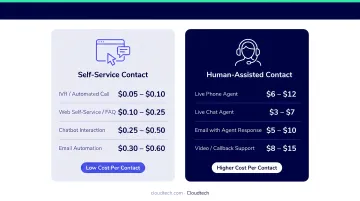
- $1.84 — median cost per self-service customer contact (Gartner, 2024)
- $13.50 — median cost per assisted (human-handled) contact
- 28% of business calls go unanswered entirely
That gap between $1.84 and $13.50 per interaction is where the financial case for conversational AI becomes hard to ignore. Automate routine inquiries and your team focuses on conversations that actually require human judgment.
The five platforms below were evaluated against criteria that matter most to small businesses:
- SMB-friendliness and ease of setup without a dedicated IT team
- NLP quality for handling real, unscripted customer questions
- CRM integration with tools most SMBs already use
- Pricing transparency and realistic time-to-go-live
Best Conversational AI Platforms for Small Businesses
Amazon Lex
Amazon Lex is AWS's conversational AI service — the same technology that powers Alexa — enabling businesses to build chatbots and voice assistants that integrate natively with the AWS ecosystem. For businesses already on AWS or planning to move there, this is the most technically flexible option on this list.
Lex V2 includes a drag-and-drop Visual Conversation Builder, so designing conversation flows doesn't require a developer for every change. It connects directly to AWS Lambda for backend logic, Amazon Connect for voice channels, and deploys across web, mobile, Facebook Messenger, Slack, and Twilio SMS.
The pay-as-you-go model keeps costs proportional to usage — no paying for capacity you're not using yet.
| Key Features | Automatic Speech Recognition (ASR), Natural Language Understanding (NLU), Visual Conversation Builder (V2), AWS Lambda integration, Amazon Connect voice support, multi-channel deployment |
| Pricing | $0.00075 per text request / $0.004 per speech request; new AWS customers receive up to $200 in free tier credits for 6 months |
| Best For | SMBs on AWS infrastructure or working with an AWS consulting partner; teams needing highly customizable, scalable bots |
One practical note: Lex rewards businesses that have technical support during setup. Working with an AWS-certified partner like Cloudtech can cut the deployment timeline significantly — from months to weeks — removing the technical barrier for non-developer teams.
Zendesk AI
Zendesk AI is an embedded AI layer within the Zendesk customer service suite. If your team already lives in Zendesk, this is the lowest-friction path to adding automation — no platform migration required.
It deflects routine support tickets using your existing knowledge base content, handles incoming requests across email, web chat, and social channels, and passes full conversation context to a human agent when escalation is needed. That last part matters: customers should never have to repeat themselves.
| Key Features | AI-powered ticket deflection, knowledge base auto-suggestions, omnichannel inbox, human handoff with full context, built-in analytics dashboard |
| Pricing | Suite Team: $55/agent/month (annual); Suite Growth: $89/agent/month; Suite Professional: $115/agent/month; AI Copilot add-on: $50/agent/month |
| Best For | SMBs already using Zendesk who want AI automation without switching platforms |
Watch the AI usage billing: Zendesk meters automated resolutions separately. Factor that into your total cost estimate before committing to a plan.
Intercom
Intercom combines live chat, AI automation, and proactive messaging in one platform — a common choice for SaaS startups and scaling SMBs that need support and lead qualification handled together.
Its Fin AI agent is powered by GPT technology and trained on your own content. It resolves queries autonomously, supports over 45 languages, and maintains context across conversations. Fin also integrates with Salesforce, HubSpot, and Freshdesk, so it can pull customer data to personalize responses without starting from scratch on each ticket.
| Key Features | Fin AI agent (GPT-powered), proactive messaging triggers, in-app chat, CRM integration, shared inbox, multilingual support (45+ languages) |
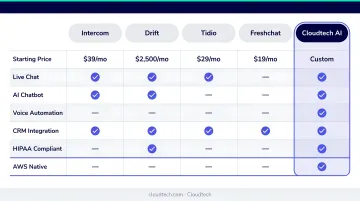
| Pricing | Essential: $29/seat/month; Advanced: $85/seat/month; Expert: $132/seat/month; Fin AI: $0.99 per resolved outcome (50 outcome/month minimum for external helpdesks); 14-day free trial available |
| Best For | SaaS startups, B2B SMBs, and growth-stage companies needing combined AI support and lead qualification |
The per-outcome pricing for Fin is worth modeling before you scale. At $0.99 per resolution, a high-volume operation can see AI costs climb faster than expected — build a conservative projection before committing.
Tidio
Tidio is built around the constraints of small businesses and solo operators: minimal setup, no coding required. Its Lyro AI assistant trains on your FAQ content and handles customer questions out of the box — you can be live in hours, not weeks.
Real-time visitor tracking lets you see what people are browsing before they ask a question, enabling proactive chat triggers at exactly the right moment. Integrations with Shopify, WordPress, and BigCommerce make it a natural fit for eCommerce brands.
| Key Features | Lyro AI assistant, real-time visitor tracking, proactive chat triggers, multichannel inbox (web, Messenger, Instagram, email), Shopify/WordPress/BigCommerce integrations |
| Pricing | Free plan ($0/month, 50 billable conversations); Starter: $24.17/month (annual) or $29/month (monthly); Growth: from $49.17/month (annual) |
| Best For | Retail SMBs, eCommerce brands, and solo operators needing fast, no-code setup with strong eCommerce integrations |
Tidio's free plan is a genuine starting point — not a crippled demo. Small businesses can test the platform with real customer conversations before upgrading.
Freshchat (Freshworks)
Freshchat is the messaging component of the Freshworks suite, designed for budget-conscious SMBs that want AI-powered support without stitching together multiple vendors. The unified agent desktop blends bot and human interactions in one view, so agents aren't context-switching between platforms.
It covers WhatsApp, web, mobile, SMS, and Facebook Messenger out of the box, and integrates directly with Freshdesk and Freshsales — useful if you want CRM, helpdesk, and messaging under one roof.
| Key Features | AI-powered bots, unified agent desktop, WhatsApp and social channel support, Freshworks ecosystem integration, campaign messaging, multilingual capability |
| Pricing | Free plan (up to 10 agents); Growth: $19/agent/month (annual); Pro: $49/agent/month; Enterprise: $79/agent/month |
| Best For | Budget-conscious SMBs seeking messaging, support, and CRM in one ecosystem |
The free plan supporting up to 10 agents makes Freshchat one of the few full-featured platforms where small teams can run a real pilot without a credit card. If you're comparing it against Intercom or Zendesk AI, start here and upgrade only when volume demands it.
How to Choose the Right Conversational AI Platform for Your Small Business
The most common mistake SMBs make: selecting a platform based on feature count rather than deployment reality. A tool with 50 capabilities you can't configure in 90 days delivers zero value in month one.
Prioritize Setup Speed
Small businesses rarely have a dedicated IT team. That means:
- No-code or low-code builders are non-negotiable — most SMBs can't wait on developer resources
- Pre-built templates cut configuration time from weeks to days
- Guided onboarding determines whether you launch in days or abandon the project entirely
Tidio and Zendesk AI can realistically be live within a few days for teams with organized FAQ content. Amazon Lex takes longer but offers far more customization — particularly valuable if you're building on AWS infrastructure with partner support.
Evaluate Integration Depth
AI without access to customer data produces generic, unhelpful responses. Before choosing a platform, map your existing tools:
- CRM: HubSpot, Salesforce, Freshsales
- Helpdesk: Zendesk, Freshdesk
- eCommerce: Shopify, BigCommerce, WooCommerce
Then verify whether the platform connects natively to those tools or requires custom development. Integration depth should be a firm evaluation criterion — not something you discover post-purchase.
Require Seamless Human Handoff
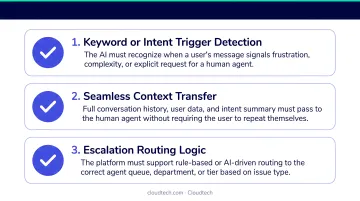
IBM identifies seamless escalation to human agents as a core best practice for conversational AI in customer service. The practical aim is handling Tier-1 volume automatically, so your team stays focused on complex, high-value interactions.
When evaluating platforms, check specifically for:
- Transfer full conversation history when escalating
- Let agents pick up mid-conversation without asking customers to repeat themselves
- Allow tuning of escalation thresholds over time
Match Pricing Structure to Your Growth Trajectory
Subscription and usage-based models both have tradeoffs:
| Model | Best When | Watch For |
|---|---|---|
| Per-agent subscription | Predictable team size | Costs scale with headcount |
| Pay-per-request (Lex) | Variable or low initial volume | Usage spikes increase costs |
| Per-outcome (Intercom Fin) | High resolution rate | Costs grow with AI effectiveness |
Platforms built on scalable cloud infrastructure (Amazon Lex on AWS, for example) can grow with your business without requiring a full rebuild. For businesses planning to expand, this matters: the platform you start with should be one you won't outgrow — and an experienced AWS partner can ensure the architecture supports that from the start.
Conclusion
The platforms reviewed here prove that 24/7 automation, faster response times, and lower support costs are well within reach for small businesses — not just enterprises. The gap between what's available and what's affordable has closed considerably.
The practical approach: identify your primary use case first — customer support automation, lead qualification, or appointment scheduling — then match it to the platform best suited to that need. Pilot with a defined set of KPIs (deflection rate, resolution time, escalation rate) before committing to a full rollout.
If that rollout sits inside a broader AWS environment, implementation complexity can add up quickly. Cloudtech's AWS-certified team works specifically with small and mid-sized businesses to design, implement, and scale conversational AI solutions — typically in weeks, not months, and at a cost structure built for teams that aren't Fortune 500.
Frequently Asked Questions
Frequently Asked Questions
Which AI tool is best for small business?
The right platform depends on your use case, tech stack, and budget. Tidio and Freshchat are strong starting points for ease of use, while Amazon Lex suits businesses already on AWS that need more customization and scalability.
What is conversational AI and how is it different from a regular chatbot?
Rule-based chatbots follow scripted decision trees and break when users go off-script. Conversational AI uses NLP, intent detection, and context retention to handle free-form language across multi-turn conversations, adapting to how people actually communicate.
How much does a conversational AI platform cost for a small business?
Entry points range from free tiers (Tidio, Freshchat) to usage-based models (Amazon Lex at $0.00075 per text request) to subscription plans starting around $19–29/month. Factor in implementation time and integration costs alongside the software fee — these often exceed the platform price for more customized deployments.
Can small businesses implement conversational AI without technical expertise?
Most SMB-focused platforms — Tidio, Freshchat, Zendesk AI — offer no-code builders and guided setup that non-technical teams can handle. For more customizable solutions like Amazon Lex, working with an AWS-certified partner removes the technical barrier considerably.
How does conversational AI integrate with CRM and existing tools?
Most platforms offer native connectors for common CRMs (HubSpot, Salesforce), helpdesks (Zendesk, Freshdesk), and eCommerce platforms (Shopify). These integrations give the AI access to customer history, so responses reflect actual account context instead of starting from scratch.
How quickly can a small business go live with a conversational AI platform?
No-code platforms like Tidio or Zendesk AI can be live within days for teams with organized content. More customized solutions built on Amazon Lex typically take a few weeks — particularly when integrated with existing cloud infrastructure and CRM systems.