Introduction
Law firms are adopting generative AI faster than most expected. According to Thomson Reuters' 2025 Generative AI in Professional Services Report, 28% of law firms now actively use generative AI — nearly double the 14% reported just a year earlier. Another 17% expect it to become central to their workflow within 12 months.
The tension is real. Firms face competitive pressure to adopt AI, yet the legal profession demands accuracy, confidentiality, and ethical accountability that general-purpose tools don't inherently provide. Delay too long and clients go elsewhere; adopt carelessly and you risk sanctions, data exposure, or professional responsibility violations.
Given those stakes, getting implementation right matters. This article breaks down what generative AI actually does for law firms, where it delivers the most value, which risks require active management, and how to begin implementation without compromising security or compliance obligations.
Key Takeaways
- 28% of law firms use generative AI today; adoption nearly doubled in one year
- Generative AI drafts, summarizes, and analyzes — it doesn't just retrieve
- Biggest use cases: legal research, contract review, due diligence, and administrative tasks
- Core risks: hallucinations, confidentiality breaches, and competence obligations
- Secure cloud infrastructure must be built in from the start — before any AI tool goes live
What Is Generative AI — and Why Should Law Firms Pay Attention Now?
Traditional AI in legal tools — Westlaw's relevance ranking, document flagging in e-discovery platforms — classifies and retrieves existing information. Generative AI does something different: it creates new content in response to prompts. Ask it to summarize a deposition, draft a demand letter, or identify anomalies across 10,000 contracts, and it produces an output, not just a list of search results.
That distinction matters because it changes the scope of what can be automated.
The Legal Profession Is at a Tipping Point
A LexisNexis international survey of nearly 8,000 lawyers, law students, and consumers found that 47% of legal professionals expect generative AI to have a significant or transformative impact on legal practice. Legal-specific platforms — Harvey AI, CoCounsel Legal, and Lexis+ with Protégé — are now purpose-built for attorney workflows, trained on legal content, and designed to reduce (though not eliminate) the hallucination risks common in general-purpose models.
The Augmentation Argument
The more useful question isn't whether AI replaces lawyers — it's what a lawyer can accomplish when AI handles the routine work. In practice, that division looks like this:
- AI handles: first drafts, research summaries, contract anomaly flagging, routine correspondence
- Lawyers retain: judgment, contextual interpretation, client counsel, and final review
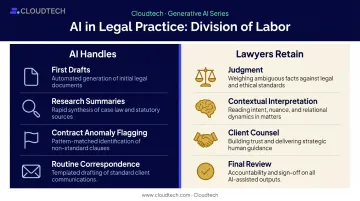
For lean firms operating with limited associate bandwidth, that shift in capacity can be substantial.
Key Use Cases: How Law Firms Are Using Generative AI Today
Legal Research and Case Analysis
AI tools can scan case law databases, surface relevant precedent, and return summaries in minutes rather than hours. The critical distinction: general-purpose models like ChatGPT carry meaningful hallucination risk for legal citations, while legal-specific platforms (CoCounsel grounded in Westlaw, Lexis+ with Protégé grounded in LexisNexis content) use verified citation sources to reduce that risk. Neither eliminates it entirely — attorney verification remains mandatory.
Contract Drafting and Review
Generative AI can generate first-draft agreements in a firm's preferred language, flag non-standard clauses against playbooks, and surface compliance gaps. An Onit-affiliated preprint found leading large language models reviewed procurement contracts in 0.73–4.7 minutes compared to 56.17 minutes for junior lawyers, with comparable issue-detection accuracy. Treat that as a preliminary data point, not a universal benchmark — the study used procurement contracts and didn't test complex negotiation scenarios.
Due Diligence in M&A and Litigation
For high-volume work, the efficiency gains are substantial. A 2025 Harvard Law School Center report — based on confidential interviews with COOs and partners at 10 Am Law 100 firms — documented one case where a complaint-response system reduced associate time from 16 hours to 3–4 minutes. The firm was anonymous and the report doesn't describe a controlled time study, but the directional finding reflects what legal AI practitioners are reporting consistently.
Administrative and Client Communication Tasks
Non-billable work eats attorney time. Generative AI handles these tasks without pulling attorneys away from billable work. Common applications include:
Non-billable work eats attorney time. Generative AI handles these tasks without pulling attorneys away from billable work. Common applications include:
- Drafting routine client letters and status updates
- Generating billing summaries and invoice narratives
- Logging CRM updates and scheduling follow-ups
- Producing intake questionnaires and standard correspondence
Predictive Analysis and Strategic Decision-Making
Beyond document work, AI tools trained on historical case outcomes can evaluate settlement probabilities, surface litigation risk patterns, and give attorneys more data behind their client recommendations. This is still an emerging capability — not yet standardized across practice areas — but early deployments in insurance defense, mass tort, and commercial litigation are producing usable outputs that practitioners are beginning to rely on.
The Benefits of Generative AI for Legal Practice
Time and Cost Efficiency
The efficiency case is straightforward: less time on drafting, research, and administrative work means more time on billable strategy and client service. Thomson Reuters projects AI could save legal professionals up to 12 hours per week by 2029. Even a fraction of that gain matters — for a firm billing at $400/hour, five recaptured hours per attorney per week adds up to $8,000 or more in additional monthly billing capacity per attorney.
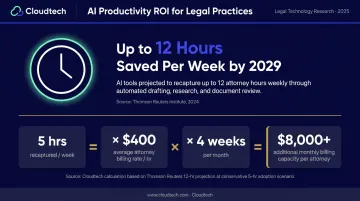
Competitive Leveling for Small and Mid-Sized Firms
Historically, smaller firms couldn't match large firms on research depth, paralegal bandwidth, or due diligence capacity. That gap is narrowing — and firms that move early have the most to gain. The 2024 LexisNexis Investing in Legal Innovation Survey found that 43% of Am Law 200 respondents had a dedicated generative AI budget, compared to only 19% of other large firms (50+ attorneys). Smaller firms adopting these tools now can access research and drafting capabilities that were previously out of reach — without the overhead of a large-firm infrastructure.
Increased Capacity Without Proportional Headcount Growth
Firms can take on more client matters without hiring at the same rate. A two-attorney boutique using AI-assisted research and contract drafting can handle the workload that previously required additional associates. That translates directly into higher profitability and faster growth without a proportional jump in payroll.
Practical capacity gains include:
- Drafting standard contracts and NDAs in minutes rather than hours
- Completing preliminary due diligence reviews with fewer billable hours
- Running conflict checks and intake processing with minimal staff time
Improved Decision-Making Quality
The Harvard Law interviews described what practitioners call an "80/20 inversion" — attorneys using AI-assisted research spend 80% of their time on interpretation and strategy rather than information gathering. The result is sharper, better-supported legal advice — and clients who feel the difference in the quality of counsel they receive.
Risks and Ethical Considerations Law Firms Must Navigate
AI Hallucinations and the Accuracy Problem
Generative AI models can produce confident-sounding but completely fabricated case citations. This is the hallucination problem, and it has already resulted in formal sanctions.
In Mata v. Avianca, Inc. (No. 22-cv-1461, S.D.N.Y.), attorneys Steven Schwartz and Peter LoDuca submitted a brief containing ChatGPT-generated fictitious opinions. Judge P. Kevin Castel found subjective bad faith and imposed $5,000 jointly and severally on Schwartz, LoDuca, and the firm Levidow, Levidow & Oberman P.C. Legal-specific platforms with verified citation sources reduce this risk. Even so, every AI-generated output still requires attorney review before use.
Client Confidentiality and Data Security
Inputting client documents, privileged strategy, or matter-specific facts into open-source AI models may expose confidential information and potentially waive attorney-client privilege. ABA Formal Opinion 512 requires lawyers to evaluate any AI tool across four dimensions before entering client information:
- Terms of service and permitted data uses
- Data retention policies and deletion rights
- Vendor access to submitted content
- Breach notification procedures
Firms must use platforms with strict data isolation and understand exactly how inputs are stored or used.
Professional Responsibility Obligations
ABA Formal Opinion 512 (July 2024) identifies the duties at stake:
- Rule 1.1 (Competence) — lawyers must understand the capabilities and limitations of any AI tool used
- Rule 1.4 (Communication) — material AI use may trigger disclosure obligations
- Rule 1.6 (Confidentiality) — unprotected data inputs can create confidentiality violations
- Rules 3.3 and 5.1/5.3 — candor to the tribunal and supervisory responsibility for AI outputs
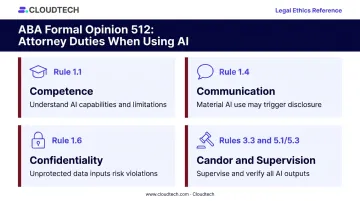
Bar associations across the country are issuing guidance. Florida, D.C., and California have each published formal ethics opinions. Attorneys cannot delegate professional judgment to AI — the output must be independently reviewed and verified.
Court Disclosure Requirements
Courts are moving on AI disclosure. U.S. Magistrate Judge John D. Love in the Eastern District of Texas issued a standing order (April 9, 2025) requiring attorneys to:
- Certify whether generative AI was used in the filing
- Identify the specific tool used
- Confirm that all facts and citations were independently verified
Requirements vary significantly by jurisdiction and individual judge. Attorneys must check standing orders before submitting any AI-assisted filing.
Bias in AI Outputs
AI models trained on historical legal data can inherit systemic biases present in that data. This can influence research prioritization or analysis in ways that are difficult to detect. Legal-specific platforms with curated training data reduce exposure, but attorneys should actively question outputs that appear to favor certain precedents or jurisdictions without clear justification.
How to Successfully Implement Generative AI at Your Law Firm
Start with a Pain Point Audit, Not a Tool Audit
Before evaluating platforms, identify your highest-friction, lowest-value workflows:
- Contract first drafts for routine transactional work
- Research summaries for recurring matter types
- Routine client correspondence and billing narratives
- Due diligence checklists for standard M&A work
Targeting AI at specific pain points creates measurable ROI and manageable change management. Broad adoption without clear use cases leads to underutilization — and wasted budget.
Build on a Secure, Compliant Cloud Foundation
Generative AI runs on infrastructure. For law firms, that infrastructure must satisfy confidentiality obligations, maintain audit trails, and enforce access controls before a single client document touches an AI tool.
A properly architected AWS environment addresses this through:
- Encryption at rest and in transit via AWS KMS and TLS across all data flows
- IAM-scoped access controls ensuring AI services operate under least-privilege permissions
- VPC isolation keeping AI workloads within private network boundaries
- CloudTrail audit logging creating an immutable record of every API call and data access event
- AWS Config and Security Hub continuously monitoring for compliance drift against HIPAA, SOC 2, and similar frameworks
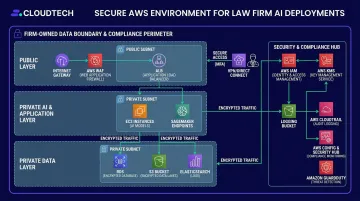
Cloudtech's generative AI on Amazon Bedrock deployments are built on this architecture — all data processing occurs within the client's own AWS account, no data leaves the firm-controlled environment, and the entire pipeline is auditable. Firms that own their data boundary own their compliance posture — and that distinction matters when a client or regulator asks questions.
Only 41% of law firms had any generative AI policy in place as of the 2025 Thomson Reuters report. Getting the infrastructure and governance layer right before scaling AI tools is how firms avoid becoming cautionary examples.
Pilot, Verify, and Iterate Before Scaling
Start with one use case and one practice group. Build human review requirements into the pilot from day one — AI outputs must be attorney-verified before use, without exception. Track three metrics:
- Accuracy rate — how often does the AI output require significant correction?
- Time savings — how much time does the attorney save per task?
- Quality delta — does the final work product improve, stay the same, or decline?
Use that data to build an internal case for broader rollout. Firms that skip this step either over-invest in tools that don't fit their workflows, or hit accuracy problems at scale that damage client relationships. A structured pilot prevents both outcomes.
Frequently Asked Questions
What is generative AI and how is it different from AI already used in legal research tools?
Traditional AI in tools like Westlaw classifies and retrieves existing information based on relevance signals. Generative AI actively creates new content — drafts, summaries, analyses — by drawing on patterns learned from large datasets. That makes it more versatile, but it also requires more careful human oversight, since the outputs are generated rather than retrieved.
Will generative AI replace lawyers?
No. ABA Formal Opinion 512 requires attorneys to retain independent professional judgment over any AI-generated output. AI cannot replicate attorney judgment, contextual interpretation, or client counsel — but lawyers who use these tools effectively will hold a real competitive edge over those who don't.
What are the biggest ethical risks of using generative AI in legal practice?
The key risks are hallucinations that produce fabricated legal citations (as seen in Mata v. Avianca), confidentiality exposure when client data enters AI systems without proper data isolation, and the duty of competence — attorneys must understand and independently verify any AI-generated output before use.
Can small law firms realistically afford generative AI tools?
Most legal AI tools use subscription pricing, so enterprise budgets aren't required. For firms that identify the right use cases, the time saved on research, first drafts, and admin tasks typically outweighs the cost.
Do courts require lawyers to disclose AI use in filings?
Requirements vary — some courts have issued standing orders requiring disclosure or certification of AI-assisted filings, while others have no rules yet. Always check the specific court's and judge's standing orders before submitting any AI-assisted document.
What should law firms look for when choosing a generative AI tool?
Prioritize three things: legal-specific training data with verified citations to reduce hallucination risk, strict data confidentiality guarantees keeping client information in a controlled environment, and integration capability with the firm's existing document management and workflow systems.