Introduction
A used car lot operates on thin margins and thinner staffing. When a buyer texts at 9 PM asking about a 2019 F-150 with 44,000 miles, that inquiry doesn't wait until Monday morning — and neither does the competitor's listing on the next tab.
The math is blunt: a missed inquiry on a $20,000 truck isn't a missed conversation. It's a missed deal. Research from Harvard Business Review found that companies contacting web leads within one hour were nearly seven times more likely to qualify those leads than companies that waited even one additional hour — and that was across industries where inventory sits still. Used car lots don't have that luxury.
This guide covers what conversational AI actually is (and how it differs from the chatbots that break on question two), why independent and BHPH dealers specifically stand to gain, the six use cases that move the needle, what to look for in a platform, and how to measure results without guesswork.
Key Takeaways
- Conversational AI answers inventory-specific buyer questions 24/7 using live data and NLP — not scripted menus
- Slow responses cost used car lots disproportionately given single-unit inventory, lean staffing, and price-sensitive buyers
- Six core use cases — from lead capture to post-sale engagement — can be fully automated
- Platform selection hinges on real-time DMS/inventory integration, CRM sync, and automotive-specific conversation design
- ROI comes fastest through after-hours lead recovery, no-show reduction, and lead-to-appointment conversion
What Is Conversational AI for Used Car Dealerships?
Beyond the Basic Chatbot
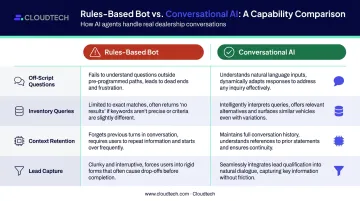
Most "chatbots" dealerships have encountered are rules-based: they follow a decision tree, and the moment a buyer goes off-script, the conversation collapses into "please call us during business hours." That's not conversational AI.
Conversational AI uses Natural Language Processing (NLP) and large language models to conduct context-aware dialogues across voice, SMS, website chat, and messaging apps. It understands what buyers actually mean — even mid-conversation topic shifts or vague descriptions — and responds in kind.
The difference matters immediately at a used car lot. A buyer asking "is the blue F-150 on your lot still there?" needs a real-time inventory query answered in plain English, not a dropdown menu. A rules-based bot can't do that. A conversational AI connected to a live inventory feed can.
Rules-based vs. conversational AI at a glance:
| Rules-Based Bot | Conversational AI | |
|---|---|---|
| Off-script questions | Fails or escalates | Handles naturally |
| Inventory queries | Not possible | Live feed lookup |
| Context retention | None | Full conversation memory |
| Lead capture | Manual follow-up required | Automatic, mid-conversation |
How It Works in Practice
The AI connects to three things:
- Inventory feed — via DMS integration or data sync, so the AI knows what's on the lot right now
- CRM — to log every lead, conversation transcript, and buyer preference automatically
- Scheduling system — to check calendar availability and book appointments without human intervention
Within a single conversation, the AI can answer availability questions, collect buyer details, pre-qualify financing intent, and schedule a test drive — all before a salesperson is ever involved. For a two-person operation where the owner is mid-deal, that's the difference between capturing a lead and losing it.
Why Used Car Dealerships Specifically Need Conversational AI
New car franchises often have Business Development Center (BDC) teams, extended hours, and rows of identical trim levels that make inventory questions simpler. Independent used car lots operate in a different environment entirely.
The After-Hours Gap
Car shopping doesn't follow a 9-to-5 schedule. Buyers research, compare, and submit inquiries when they have time — evenings, weekends, lunch breaks. Most independent lots are closed or skeleton-staffed during those windows, which means leads pile up without a response.
Every hour without a reply is an hour the buyer spends on a competitor's website.
Single-Unit Inventory Changes Everything
At a franchise dealership, selling one Camry means there are eight more on the lot. At an independent used lot, selling the red Camry means that inquiry is moot — and a response sent six hours late referencing a car that already sold damages credibility. Black Book estimated used retail days-to-turn at approximately 38 days as of June 2025, with meaningful variation by market. Fast-turning inventory punishes slow response harder than virtually any other retail category.
Staffing Reality
Most independent used car lots run lean. The owner often doubles as the general manager, finance manager, and floor salesperson simultaneously. Routine inquiries — hours, pricing, availability, financing questions — compete directly with active deal conversations for the same person's attention.
Conversational AI separates the routine from the revenue-generating. While the AI handles "do you have anything under $15,000?" the owner can close the deal in front of them.
The BHPH Dimension
Buy Here Pay Here dealers face a specific challenge: financing questions arrive at all hours from buyers who often can't wait. Buyers need immediate answers on questions like:
- What's the minimum down payment?
- Do I qualify with bad credit?
- What are your in-house financing terms?
Voicemail doesn't cut it. Conversational AI handles this pre-qualification layer and routes warm, prepared buyers to the finance team with full context already captured.
Key Use Cases of Conversational AI at a Used Car Dealership
Lead Capture and Qualification
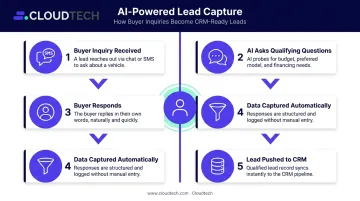
Every website visitor, SMS inquiry, or social media message gets an immediate response — regardless of the time. The AI asks targeted qualifying questions:
- What's your budget range?
- Any specific make, model, or mileage preference?
- Are you financing or paying cash?
- Do you have a trade-in?
That qualified data — contact info, vehicle interest, financing parameters, full conversation transcript — pushes automatically into the CRM. No manual entry means no dropped leads when the lot is busy.
Real-Time Inventory Q&A
Connected to a live inventory feed, the AI answers specific questions accurately: Is this vehicle still available? What's the mileage? Has it been in an accident? When a preferred unit is already sold, the AI can suggest alternatives matching the buyer's stated preferences — keeping them engaged rather than sending them to a competitor listing.
"Is the red Camry still there?" gets a real answer, not a form to fill out.
Appointment Scheduling and No-Show Reduction
The AI books test drive and sales appointments directly within the conversation by checking real-time calendar availability, confirming the slot, and sending automated reminders via SMS or email. Practical impact:
- No back-and-forth phone tag to set an appointment
- Automated reminders reduce no-shows
- Sales staff see a scheduled pipeline each morning rather than a cold lead list
Financing Pre-Qualification and F&I Hand-Off
Before a buyer sets foot on the lot, the AI collects budget, down payment range, and trade-in details — preparing both the buyer and the finance team for a productive conversation.
What the AI should not do: quote specific APR, make credit decisions, or promise financing terms. Those require human involvement and regulatory compliance. The AI's job is to warm up the handoff, not replace the finance manager.
Automated Follow-Up and Lead Reactivation
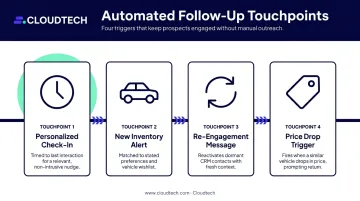
Most dealerships lose deals not at first contact, but in the days after. Manual follow-up is inconsistent — busy days mean cold leads. Conversational AI runs automated follow-up sequences that keep buyers moving through the pipeline:
- Personalized check-ins timed to the buyer's last interaction
- New inventory alerts matched to stated preferences
- Re-engagement messages for dormant CRM contacts
- Triggered outreach when a previously sold unit's price drops on a similar vehicle
Post-Sale Engagement and Service Reminders
The relationship doesn't end at the sale. Conversational AI handles:
- Service reminders and maintenance check-ins
- Review requests timed appropriately after purchase
- Referral prompts for satisfied buyers
For independent lots, post-sale engagement is an underused channel. Repeat business and referrals don't require new ad spend — just the right message sent at the right moment — which AI handles without staff lifting a finger.
Must-Have Features When Evaluating a Conversational AI Platform
Non-Negotiables for Used Car Lots
| Feature | Why It Matters Operationally |
|---|---|
| Real-time DMS/inventory integration | AI responses reflect current stock — no "that car already sold" credibility damage |
| Native CRM sync with full conversation logging | Every lead is captured automatically, with context intact |
| Multichannel support (voice, SMS, web chat) | Buyers contact dealers through multiple channels — coverage must match behavior |
| Automotive-specific conversation design | Generic chatbot platforms require extensive customization to handle VIN-specific questions, objection handling, and automotive terminology |
On DMS platforms: Frazer and DealerCenter are built specifically for independent used car dealers. DealerSocket, Dealertrack, and CDK serve the broader dealership market. VinSolutions is a CRM platform rather than a DMS. Evaluate any conversational AI vendor's integration capabilities against your specific system.
TCPA Compliance Requirements
The FCC's February 2024 ruling (FCC 24-17) confirmed that AI-generated voices fall within the TCPA's "artificial or prerecorded voice" restrictions. For dealer-initiated outbound AI calls or texts, prior express consent is required.
Ask any vendor directly:
- How do you capture and store consent?
- How do opt-outs get tracked and honored?
- Are call recording disclosures handled automatically?
BHPH dealers face additional consumer finance disclosure requirements. Treat compliance as a vetting question — one that needs answers before you sign a contract, not after deployment.
How to Implement Conversational AI at Your Used Car Dealership
Step 1: Audit Before You Automate
Before selecting a platform, identify your biggest gaps:
- Are after-hours inquiries going to voicemail?
- Is follow-up inconsistent because it depends on manual effort?
- Are leads being logged, or is the CRM incomplete?
Start with the highest-volume gap rather than trying to automate everything simultaneously. That's the fastest path to measurable results.
Step 2: Technical Integration
The core connections are:
- Inventory feed — DMS integration or CSV export for real-time stock data
- CRM sync — bidirectional, with full conversation logging
- Phone/chat routing — either embedding a chat widget or routing inbound phone lines through the AI
Chat-only deployments can often go live within days. Full voice + chat + CRM integrations typically take one to four weeks depending on platform and complexity.
Step 3: Configuration and Knowledge Training
This is where most implementations succeed or fail. The AI needs dealership-specific knowledge:
- Hours, location, lot policies
- Financing programs and general eligibility information
- Escalation rules — when does the AI hand off to a live person, and how?
Dealerships pursuing custom builds on cloud infrastructure — rather than off-the-shelf SaaS — should verify that any technical partner has direct experience with DMS systems and automotive CRM workflows. Familiarity with how dealerships actually operate (not just how APIs connect) separates fast deployments from extended, expensive ones.
Measuring ROI: What Success Looks Like for Used Car Lots
Leading Indicators to Track
Don't wait for closed deals to evaluate performance. These metrics predict revenue impact:
- Lead response rate — what percentage of inbound inquiries receive a response within minutes, not hours
- After-hours lead capture volume — are inquiries that arrive outside business hours being captured and logged?
- Lead-to-appointment conversion rate — are more leads turning into scheduled visits?
- No-show rate — is it declining compared to pre-implementation baseline?
The Revenue Math
The math is straightforward. Say an independent lot averages $1,800 front-end gross per vehicle. Recovering just two missed after-hours leads per week — inquiries that previously went to voicemail and were never followed up — adds roughly $14,400 in monthly gross without a single new hire.
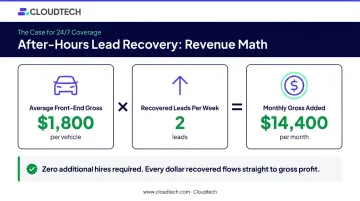
Don't model best-case conversion. Model what happens when leads that currently get zero follow-up start getting a response within two minutes.
First 30–60 Days: What to Watch
- CRM data completeness — are all conversations logging automatically, or are gaps appearing?
- Escalation rate — is the AI handing off to humans at the right frequency, or is it over-escalating (indicating misconfigured thresholds) or under-escalating (indicating buyers hitting dead ends)?
- Appointment show rate — compare to the pre-implementation baseline to confirm reminder sequences are working
Expect imperfect configuration at launch. The first 60 days are calibration, not evaluation.
Frequently Asked Questions
How is conversational AI different from a regular chatbot for used car dealerships?
Traditional chatbots follow fixed scripts and fail the moment a buyer asks something unexpected. Conversational AI uses NLP to understand intent, handle context shifts mid-conversation, and complete tasks — checking live inventory, booking appointments, logging leads to the CRM — all within a single interaction.
Why do used car dealerships benefit from conversational AI more than new car franchises?
Used lots deal with single-unit inventory that moves fast, leaner staffing, and buyers who shop heavily after hours and on price and timing. The cost of a slow or missed response is proportionally higher, and the staff bandwidth to handle every inquiry manually is lower — making automation more impactful per dollar.
How does conversational AI handle inventory questions when stock changes daily?
Effective platforms connect directly to the dealership's DMS or inventory feed in real time. When a vehicle sells, it stops appearing in AI responses — preventing the credibility-damaging scenario where a buyer is told a car is available when it already sold.
Can conversational AI handle BHPH financing inquiries?
Yes. The AI can collect buyer financial parameters, answer general questions about in-house financing availability and down payment ranges, and route pre-qualified buyers to the finance team with full context. Quoting specific APR terms or making credit decisions requires a human — both for accuracy and to stay within federal lending regulations.
Is conversational AI compliant with TCPA and FCC regulations for auto dealers?
The FCC's February 2024 ruling confirmed AI-generated voices fall under TCPA's artificial or prerecorded voice restrictions, requiring prior express consent for outbound AI calls. Verify that your platform handles consent capture, opt-out tracking, and disclosure requirements. Inbound conversations carry lower risk because the customer initiates contact.
How quickly can a used car dealership get conversational AI up and running?
Chat-only deployments can go live in days. Full voice plus chat plus CRM integrations typically take one to four weeks, depending on platform complexity and the number of system integrations required — with purpose-built automotive platforms generally moving faster than generic tools.