Introduction
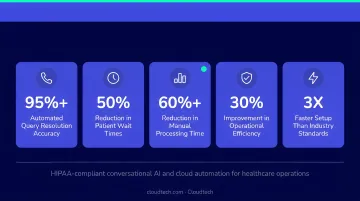
Healthcare front desks are hemorrhaging revenue. Missed appointments cost the U.S. healthcare system more than $150 billion annually, with individual physicians losing roughly $200 per unused time slot. No-show rates across outpatient clinics range from 12% to over 40% — and that's before factoring in the calls that never get answered, the slots that go unfilled, and the patients who book with a competitor instead.
Legacy IVR systems and basic online booking portals don't solve this. They handle simple inputs on fixed menus, can't understand natural language, don't sync with your EHR in real time, and offer no intelligence when a patient says "I need to see someone soon about my knee."
Modern AI chatbots work differently. They understand patient intent through NLP, check live EHR availability, apply your scheduling rules, and write confirmed appointments back to the system, all without adding headcount or extending office hours.
Use this guide to identify the right platform for your practice, understand what separates capable tools from costly mistakes, and walk away with a clear shortlist before you talk to a single vendor.
Key Takeaways
- Patient no-shows cost the U.S. healthcare system $150B+ annually — AI scheduling cuts this through automated reminders and instant waitlist backfill.
- Every platform must provide a signed BAA and verified EHR integration — generic compatibility claims don't count.
- Hyro fits large health systems; Luma Health leads for Epic-centric practices; Voiceoc suits SMBs with WhatsApp-heavy patient populations.
- Prosper AI is the top pick for voice-first, multi-specialty groups needing deep EHR scheduling automation.
- The cloud infrastructure running these tools determines their HIPAA compliance and reliability, not the chatbot layer alone.
Why AI Chatbots Are Reshaping Healthcare Appointment Scheduling in 2026
The Structural Problem With Manual Scheduling
Booking a single appointment sounds simple. In practice, it requires matching provider availability, room access, insurance eligibility, urgency level, and patient preference — all at once. At any volume above a handful of appointments per day, that coordination breaks down.
The consequences are measurable. MGMA research estimates no-shows cost a single physician practice roughly $150,000 per year, climbing past $1 million for multi-physician groups. Every unfilled slot is revenue gone with nothing to show for it.
How AI Scheduling Platforms Address This
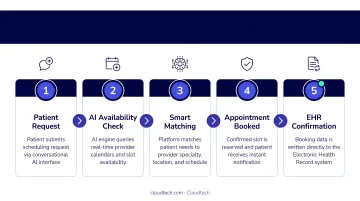
Modern AI chatbots function as a permanent scheduling coordination layer:
- Interpret patient requests in plain language, no forms or phone trees required
- Pull live EHR availability, not from a static cache
- Apply visit types, provider preferences, and insurance rules automatically
- Write confirmed appointments back to the EHR without staff involvement
- Operate around the clock, including evenings and weekends
Hyro's 2026 benchmark data, drawn from nearly 400 health systems, found AI agents achieve a median containment rate of 52% on scheduling interactions. Generic call center implementations, by contrast, land between 6–10%.
Where AI Scheduling Has Limits
AI excels at routine bookings, follow-ups, waitlist management, and reminders. It should escalate to humans for:
- Symptom-driven urgency assessment and emergency triage
- Complex multi-provider care coordination
- Situations where clinical judgment is required
How well a platform handles that handoff separates the tools worth deploying from those that create more problems than they solve — which is exactly what the comparisons below address.
Best AI Chatbots for Healthcare Appointment Scheduling in 2026
These platforms were selected based on EHR integration depth, HIPAA compliance documentation, scheduling automation capability, multi-channel support, and fit across practice sizes — not feature count alone.
Hyro
Hyro is a healthcare-specific adaptive communications platform that powers call centers, websites, and scheduling workflows using knowledge-graph and NLP technology. Its defining characteristic: responses self-update when the underlying scheduling data or web content changes, with no manual retraining required.
Deployed at major health systems including Intermountain Health, Novant Health, and Weill Cornell Medicine, Hyro's real-world results include a 47% increase in online bookings at Weill Cornell and 85%+ automation of repetitive tasks across client sites. Novant Health reported reducing patient wait times from eight minutes to under one minute after deployment.
| Category | Details |
|---|---|
| Key Features | Multi-channel deployment (phone, web chat, SMS); adaptive NLU; physician lookup; 24/7 appointment booking; Epic integration; emergency keyword detection and escalation; call-to-text deflection |
| EHR Integrations & Compliance | Epic (verified via native integration); Salesforce Health Cloud; HIPAA compliant (verified badge on official site) |
| Best For | Large health systems with 500+ providers needing enterprise-grade scheduling automation |
Luma Health
Luma Health is a patient engagement and scheduling platform with one of the deepest native integration footprints in the Epic ecosystem. It also connects to Oracle Cerner, athenahealth, MEDITECH, and eClinicalWorks — all verified from official integration documentation.
Its differentiator is waitlist intelligence: when a patient cancels, Luma automatically reaches out to waitlisted patients in priority order to backfill the slot. Combined with AI-powered reminders and outreach, it's purpose-built to reduce no-show rates across high-volume practices. Worth noting: it's strongest as a text and portal-based engagement tool, and less suited for practices that need AI to handle live phone calls.
| Category | Details |
|---|---|
| Key Features | AI scheduling with automated reminders; Smart Waitlist auto-backfill; digital intake forms; referral coordination; recall campaigns; patient feedback collection |
| EHR Integrations & Compliance | Epic (deepest integration), Oracle Cerner, athenahealth, MEDITECH, eClinicalWorks; fully HIPAA compliant |
| Best For | Epic-centric health systems needing a full patient engagement suite with strong no-show reduction tools |
Prosper AI
Prosper AI is a voice-first scheduling platform that deploys named AI agents (Anna for inbound scheduling, Tom for reminders, Sara for re-engagement) to answer patient calls with zero hold time and book directly into the EHR. Backed by Y Combinator (Summer 2023), it's the only platform reviewed here that combines patient-facing scheduling and payer-facing workflows from a single vendor.
Beyond scheduling, Prosper handles insurance verification, prior authorization follow-up, and claims status — all from the same platform. With 80+ native EHR integrations including Epic, athenahealth, Cerner, MEDITECH, NextGen, and eClinicalWorks, it has the broadest EHR coverage on this list.
In a documented deployment at a Northeast OB/GYN group (6 locations, 30 providers), call abandonment dropped from 12% to 2% — an 89% reduction — with 100% of calls answered and approximately 50% resolved end-to-end by AI.
| Category | Details |
|---|---|
| Key Features | Voice AI agents for inbound/outbound calls; 80+ EHR integrations; insurance verification; prior auth follow-up; outbound re-engagement campaigns; QA scoring on every call; no-code customization |
| EHR Integrations & Compliance | Epic, athenahealth, Cerner, MEDITECH, NextGen, eClinicalWorks, Veradigm; HIPAA with BAA, SOC 2 Type II, AES-256 encryption, TLS in transit |
| Best For | Multi-specialty clinics and health systems needing voice scheduling and RCM from one platform; custom usage-based pricing |
Microsoft Azure Health Bot
Azure Health Bot is a cloud-native conversational AI service built for healthcare providers, payers, and pharmaceutical organizations. It enables teams to deploy HIPAA-compliant chatbots using a built-in medical content library — meaning you don't have to train clinical guidance logic from scratch.
It integrates natively with FHIR-compliant Azure Health Data Services and Microsoft Teams, making it the natural fit for organizations already running in the Microsoft/Azure ecosystem. Pricing follows Azure's consumption model: a free tier covers 3,000 messages per month, with additional messages at $2.50 per 1,000.
One limitation: it's primarily chat-focused with limited native outbound voice capability, and deep EHR integrations outside the Microsoft stack require Azure development expertise.
| Category | Details |
|---|---|
| Key Features | Built-in medical content library; FHIR-compliant Azure Health Data integration; Microsoft Teams channel support; configurable human escalation; custom scenario builder |
| EHR Integrations & Compliance | Azure Health Data Services (FHIR), Azure Active Directory; HIPAA BAA available through Azure; GDPR compliant |
| Best For | Healthcare organizations embedded in the Microsoft/Azure ecosystem; consumption-based pricing via Azure |
Voiceoc
Voiceoc is a front desk automation platform built for hospitals and small-to-mid-size clinics. Patients can book, reschedule, and cancel through voice calls, website chat, and WhatsApp without staff involvement — and Voiceoc claims up to 80% reduction in front-desk call volume at healthcare clients.
Its built-in WhatsApp integration addresses a channel most competitors ignore, which makes it a genuine differentiator for practices serving patient populations that rely on WhatsApp for day-to-day communication. During the booking conversation, the platform extracts clinical context — specialty, urgency, preferred date — to match patients to the right provider in real time.
One important caveat: specific named EHR integrations are limited in public documentation. Athenahealth and Cerner integrations are documented; Epic is not verified. For practices on other EHR systems, confirm compatibility directly before committing.
| Category | Details |
|---|---|
| Key Features | Booking, rescheduling, and cancellation via voice, web chat, and WhatsApp; 24/7 availability; real-time availability checks; automated confirmations and reminders; FAQ handling; after-hours support |
| EHR Integrations & Compliance | athenahealth (verified), Cerner (verified); HIPAA compliant (verified on official site); BAA, SOC 2, and HITRUST not independently verified — confirm with vendor |
| Best For | Small-to-mid-size clinics with multichannel patient populations, particularly WhatsApp users; quote-based pricing |
How We Chose the Best AI Chatbots for Healthcare
Evaluation Criteria
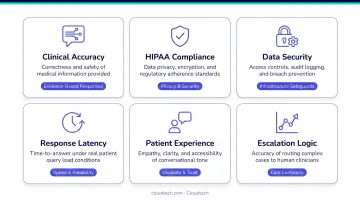
Tools were assessed across six dimensions:
- HIPAA compliance with signed BAA — required, not optional
- EHR integration depth — named systems and integration method, not vague compatibility claims
- Channel capabilities — voice, chat, SMS, WhatsApp, or some combination
- Deployment speed — how quickly a practice can go live
- Real-world evidence — documented case studies with actual outcomes
- Practice size fit — SMB-appropriate vs. enterprise-only
The most common mistake healthcare buyers make: evaluating tools on feature count rather than integration depth with their specific EHR environment. A platform with 200 features is worthless if it can't write appointments back to your Epic instance cleanly.
Non-Negotiable Compliance Requirements
Every platform reviewed must meet these standards — and you should verify each one with the vendor before signing:
- Signed Business Associate Agreement (BAA) — a self-attestation on a marketing page is not sufficient
- PHI encrypted at rest (AES-256) and in transit (TLS)
- Role-based access controls and audit logging
- Documented HIPAA compliance — not just a checkbox, but a security posture you can review
When evaluating EHR integration, ask vendors specifically: is this a native API connection, or does it route through middleware? Middleware-based integrations introduce latency, additional failure points, and sometimes data accuracy issues.
The Infrastructure Layer That Makes It All Work
For healthcare SMBs deploying any of these tools, the underlying cloud infrastructure determines whether the solution is actually HIPAA-compliant and scalable in practice.
AWS-hosted deployments built on HIPAA-eligible services form the compliance foundation these chatbots require. The core stack typically includes:
- AES-256 encryption via AWS KMS (data at rest)
- TLS in transit, enforced at every layer
- Audit logging through AWS CloudTrail
- PHI detection via Amazon Macie
- Access controls through AWS IAM
- Threat monitoring via Amazon GuardDuty
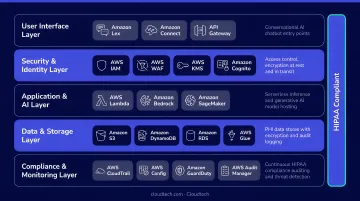
Configuring this correctly is where implementation risk concentrates. Cloudtech has deployed this exact architecture for healthcare SMBs, including the Klamath Health Partnership. Engagements range from full implementation to focused 10-hour advisory sessions for organizations that need expert guidance without a long-term commitment.
Conclusion
The best AI chatbot for healthcare appointment scheduling isn't the one with the longest feature list. It's the one that fits your EHR environment, works on the channels your patients actually use, meets compliance requirements you can verify, and scales with your practice.
For healthcare SMBs, that means evaluating on three fundamentals before anything else:
- HIPAA documentation that's transparent and verifiable, not just checkbox compliance
- EHR integrations confirmed to work with your specific system, not just listed on a spec sheet
- Real-world outcome data — look for published metrics from practices similar in size and specialty
The cloud infrastructure layer matters just as much as the chatbot itself. A scheduling tool deployed on a misconfigured or non-HIPAA-eligible environment creates regulatory exposure, not operational efficiency.
Cloudtech works with healthcare organizations to design and deploy AWS-based cloud infrastructure that supports AI-driven patient engagement tools — helping teams go live faster, stay audit-ready, and scale without the overhead of managing cloud architecture in-house. If your AWS environment needs to be ready before you go live, reach out to Cloudtech for a consultation.
Frequently Asked Questions
Frequently Asked Questions
Which AI chatbot is best for healthcare?
Hyro is the strongest fit for large health systems, Prosper AI leads for voice-first multi-specialty groups, Luma Health is the top pick for Epic-centric practices, and Voiceoc covers SMBs with multichannel needs including WhatsApp. The right choice depends on your practice size, EHR system, and primary communication channels.
Which AI model is best for scheduling?
Voice AI agents like Prosper AI handle the most complex scheduling scenarios — insurance verification, multi-step bookings, outbound re-engagement. Hyro and Luma Health excel at structured scheduling workflows with deep EHR integration. The best choice depends on whether your primary channel is phone, chat, or self-service portal.
Are AI chatbots for healthcare HIPAA compliant?
Compliance varies by vendor. Look for a signed BAA, AES-256 encryption at rest, TLS in transit, role-based access controls, and audit logging — and verify each requirement directly with the vendor before deployment. All five platforms reviewed here provide HIPAA compliance documentation.
How do AI chatbots integrate with EHR systems?
Enterprise-grade platforms integrate via native APIs, HL7/FHIR-compatible data exchange, or direct EHR connectors. Always verify that your specific EHR (Epic, Cerner, athenahealth, etc.) is supported natively — not just through generic middleware — since integration depth directly affects scheduling accuracy and data reliability.
Can AI chatbots reduce no-show rates in healthcare?
Yes. AI scheduling platforms reduce no-shows through automated reminders, intelligent waitlist backfill when cancellations occur, and proactive outbound re-engagement. Peer-reviewed research in The American Journal of Medicine found automated reminders reduced no-show rates by 5.8 percentage points compared to no reminder — and AI-driven platforms extend this with real-time waitlist backfill that staff can't manage manually at the same speed.
How much do AI chatbots for healthcare appointment scheduling cost?
Entry-level tools start around $99–$300/month, with platforms like Luma Health reported at roughly $250/month for smaller practices. Enterprise platforms (Hyro, Prosper AI) use custom or usage-based pricing. Contact vendors directly for quotes based on your call volume and integration requirements.