Introduction
Most car buyers expect a response from a dealership within minutes of submitting an inquiry. The reality? A DAS Technology study of more than 1,700 dealerships found that 19% took over an hour to respond and 4% didn't respond at all — a gap that costs dealers real revenue every day.
Meanwhile, the average car buyer spends nearly 14 hours researching before purchasing. They're visiting multiple websites, comparing inventory, and forming opinions — often without a single human interaction from the dealership. By the time a salesperson follows up, the buyer may have already moved on.
Conversational AI closes this gap directly. Modern AI systems understand context, handle multi-step conversations, and go well beyond pre-written FAQ responses — scheduling appointments, qualifying leads, pulling inventory matches, and handing off to sales at the right moment.
This article covers the top applications of conversational AI across the automotive customer lifecycle, the measurable benefits for dealerships and service shops, and what to consider when choosing an implementation partner.
Key Takeaways
- Conversational AI closes documented response gaps that cost dealerships leads daily
- Core use cases include lead capture, inventory recommendations, service scheduling, and 24/7 query resolution
- Hyundai and BMW deployments show measurable outcomes at scale
- Benefits include lower operational costs, higher conversion rates, and richer decision-making data
- Implementation success depends on cloud infrastructure fit and a phased rollout
What Is Conversational AI in the Automotive Industry?
Conversational AI refers to software systems that simulate human dialogue using Natural Language Processing (NLP), machine learning, and large language models (LLMs). As AWS defines it, these systems understand and respond to text or speech through natural language understanding, automatic speech recognition, and dialogue management.
That's a meaningful distinction from a rule-based chatbot, which follows a fixed decision tree. Ask it something outside its script and it breaks down. A conversational AI system interprets intent, handles follow-up questions, and adjusts its responses based on context — responding the way a person would, not the way a form does.
How This Applies to Automotive
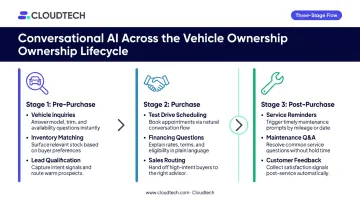
For dealerships and service shops, conversational AI goes well beyond FAQ handling. It operates across the full ownership lifecycle:
- Pre-purchase: Answering vehicle inquiries, matching inventory to buyer preferences, qualifying leads
- Purchase: Scheduling test drives, supporting financing questions, routing hot prospects to sales staff
- Post-purchase: Sending service reminders, handling maintenance questions, collecting customer feedback
Where It Deploys
Conversational AI isn't limited to a website chat widget. It operates across:
- Dealership and OEM websites
- SMS and messaging apps (WhatsApp, Facebook Messenger)
- Voice channels (phone, IVR)
- CRM and DMS systems for real-time data access and action
That omnichannel reach means automotive businesses can engage customers at every touchpoint — from first inquiry to long-term service — through a single, consistent AI layer.
Top Applications of Conversational AI in the Automotive Industry
Lead Qualification and Capture
When a potential buyer fills out a contact form at 9 PM, what happens? At most dealerships, nothing until the next morning. Conversational AI changes that dynamic entirely.
An AI system responds instantly to inbound inquiries, asks targeted qualifying questions — budget, timeline, trade-in, financing interest — and routes high-quality leads directly into the CRM without any manual intervention. Sales staff arrive the next morning to a prioritized list of pre-qualified prospects, not a raw inbox.
The performance data supports this. The DAS Technology study found 19% of dealerships took over an hour to respond to leads — a window in which most buyers have either moved to a competitor or gone cold. Automating the first response eliminates that gap entirely.
One vendor case from Impel (Available Car) reported a 62% increase in appointment-set rate across approximately 7,000 leads, with more than 30% of engaged leads and appointments originating after business hours. These are vendor-reported figures tied to a specific deployment, not industry-wide benchmarks — but they illustrate what consistent, instant engagement can produce.
Smart Inventory Recommendations
The average new-vehicle buyer spends over 13 hours researching before committing. A significant portion of that time goes toward comparing models, features, and price ranges across multiple websites — often without ever speaking to a dealer.
Conversational AI shortens that research phase. A buyer describes what they're looking for — SUV, under $45,000, third-row seating, good fuel economy — and the system surfaces matching inventory in real time, directly from the dealer's stock. No form submissions, no waiting for a callback.
The result works for both parties:
- Buyers get immediate answers without filling out a contact form
- Sales teams receive prospects who've already seen relevant options, cutting time spent on information gathering
Appointment Scheduling and Service Coordination
Scheduling a service appointment shouldn't require a phone call during business hours. Conversational AI handles the entire process autonomously — checking technician availability, factoring in vehicle type and service requirements, and confirming a time that works for the customer, at any hour.
Cox Automotive's Fixed Ops study found that 60% of service customers rate online or mobile scheduling as important — and that 74% of customers who return for service are likely to buy from that dealership again, compared with just 40% among those who don't.
Automated reminders via SMS or email reduce no-shows and keep service bays fuller. Consistent follow-up happens without anyone on staff having to track it.
After-Sales Support and Maintenance Reminders
The relationship between a dealership and a customer shouldn't end at vehicle delivery. Conversational AI makes proactive post-purchase engagement practical at scale — something that's difficult for human teams to sustain at scale.
AI agents can:
- Send service reminders based on mileage, vehicle age, or last service date
- Answer common maintenance questions without requiring a phone call
- Troubleshoot basic issues and determine whether a visit is needed
- Send insurance renewal notifications and recall alerts
- Prompt customers for reviews or post-service feedback
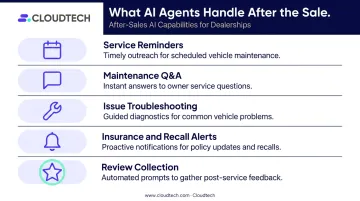
That shift from reactive to proactive is exactly what drives the retention numbers Cox's research documents: customers who return for service are nearly twice as likely to buy again from the same dealership.
24/7 Customer Support and Query Resolution
Pricing, financing options, service costs, vehicle availability, dealership hours — these questions arrive around the clock and don't require a senior salesperson to answer them. Conversational AI handles this volume continuously, without staffing costs scaling proportionally.
When a query exceeds the AI's capability — complex financing scenarios, trade-in negotiations, complaints — the system hands off to a human agent with full conversation context preserved. The customer doesn't have to repeat themselves. The agent picks up exactly where the AI left off.
Cox Automotive's research found that 52% of franchise dealer leaders already identify 24/7 engagement through automated text, chat, or email as a core AI use case — the most commonly cited application in their 2024 survey.
Key Benefits of Conversational AI for Automotive Businesses
Improved Operational Efficiency
Automating high-volume, repetitive communication tasks — scheduling, reminders, FAQ responses, lead follow-up — frees staff to focus on work that actually requires human judgment. Impel reported one automotive deployment where AI set 27% of showroom appointments and saved 400 labor hours in 90 days. Toyota Motor North America cut average customer support call handling time by 20% using Amazon Connect and AI services.
Results like these aren't universal, but the pattern is consistent: dealerships that deploy AI on routine tasks recover meaningful staff capacity without adding headcount.
Enhanced Customer Experience
Those efficiency gains translate directly to the customer side. Slow email follow-ups, missed calls, and business-hours-only service access are friction points that push prospects toward competitors. Conversational AI delivers instant, personalized responses at any hour — giving buyers the convenience they already expect from retail, banking, and every other service category.
Higher Lead Conversion Rates
Speed is the primary variable in lead conversion. The faster a dealership responds and qualifies a prospect, the less likely that prospect is to walk away. AI closes the response gap automatically, ensures every lead gets a follow-up, and moves qualified prospects to appointment scheduling — no human delay required.
Cost Savings at Scale
| Cost Driver | Without AI | With AI |
|---|---|---|
| After-hours coverage | Additional staff or missed leads | Automated, continuous |
| Volume spikes | Temporary staff, longer queues | Handled without incremental cost |
| Routine query handling | Human agent time | Resolved by AI |
| Training new staff | Ongoing, per-hire cost | One-time AI configuration |
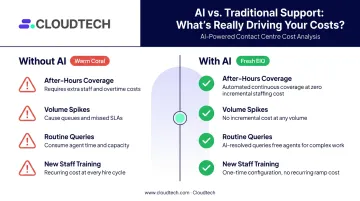
This equation is particularly relevant for SMB dealerships and independent service shops competing against larger operators with deeper headcounts.
Data-Driven Insights
Every conversation generates structured data. Keyword trends, common objections, peak inquiry times, most-asked questions, escalation triggers — all of it feeds into a continuous improvement loop. Dealerships can use this data to refine inventory decisions, adjust staffing schedules, update marketing messaging, and improve the AI's performance over time.
Real-World Examples from Leading Automotive Brands
Hyundai Mexico — Hyundai Live
Hyundai Mexico partnered with Whisbi to launch Hyundai Live, a live-selling and AI-supported engagement project. Over nine months, it attracted more than 1 million livestream viewers and delivered an average of 70 pre-qualified leads to dealerships monthly — with a reported 300% ROI (vendor-reported by Giosg; confirmed by Hyundai Mexico's own press coverage).
That's AI-supported lead generation producing measurable pipeline, not just engagement numbers.
BMW Group / Alphabet — Alphie
BMW Group's fleet mobility subsidiary, Alphabet, developed a conversational AI assistant to handle recurring driver queries around the clock. A Microsoft Cloud case study confirms the chatbot provides 24/7 support for leasing customers — covering the kind of routine, high-volume inquiries that would otherwise require dedicated staffing outside business hours. Even premium OEMs use conversational AI to cover bandwidth gaps — not to replace human judgment on complex issues, but to handle the volume that makes human-only support impractical.
Mercedes-Benz
Mercedes-Benz has deployed Facebook Messenger chatbot functionality across multiple regional markets, with documented implementations in South Africa and the Middle East (including bilingual English/Arabic support). The deployments supported test drive scheduling and surfaced customer preference data through chat interactions. Capabilities vary by market — these are regional pilots, not a unified global rollout — but they demonstrate how conversational AI can adapt to local language and context at scale.
Choosing the Right Conversational AI Implementation Partner
Implementation quality determines outcomes more than technology selection. A well-configured AI on a standard platform will consistently outperform a premium tool that's poorly integrated into your workflows.
What to Evaluate
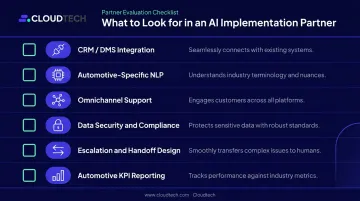
When assessing implementation partners, automotive businesses should prioritize:
- CRM/DMS integration — Does the AI connect directly to your existing systems, or does it operate in isolation?
- Automotive-specific NLP — Has the model been trained on dealership terminology, vehicle specifications, and service language?
- Omnichannel support — Can it handle web chat, SMS, voice, and messaging apps from a single configuration?
- Data security and compliance — How is customer conversation data encrypted, stored, and governed?
- Escalation and handoff design — How does the AI transfer to a human agent, and does context carry over?
- Reporting against automotive KPIs — Can you measure appointments set, leads qualified, and escalation rates?
Why Cloud Infrastructure Matters
Conversational AI solutions built on scalable, secure cloud platforms offer clear advantages over standalone SaaS chatbot tools: easier integration with existing automotive software stacks, better reliability at volume, and the flexibility to expand from a single location to a multi-site dealer group without rebuilding from scratch.
AWS provides the foundational services that power enterprise-grade conversational AI:
- Amazon Lex — natural language processing for voice and chat
- Amazon Connect — contact center orchestration and routing
- Amazon Bedrock — managed access to foundation models for generative AI features
For SMBs without dedicated internal engineering teams, working with an AWS-certified consulting partner to configure and integrate these services can significantly reduce deployment timelines and infrastructure complexity.
Start Focused, Then Expand
The most effective implementations don't attempt a comprehensive rollout on day one. They identify one or two high-impact, clearly scoped use cases — appointment scheduling or after-hours lead capture are natural starting points — deploy those well, measure against defined KPIs, and expand from there.
This approach reduces implementation risk and generates early wins that build internal buy-in. It also produces the performance data needed to make confident decisions about where to extend AI capabilities next.
Frequently Asked Questions
What is conversational AI in the automotive industry?
Conversational AI refers to NLP- and ML-powered systems that simulate human dialogue to handle customer interactions at every stage — from initial vehicle inquiries to post-purchase service support. Unlike scripted chatbots, these systems understand context and handle complex, multi-turn conversations.
How is conversational AI different from a traditional automotive chatbot?
Traditional chatbots follow predefined rules and break down outside their scripted paths. Conversational AI interprets intent, learns from interactions, manages multi-turn dialogue, and integrates with CRM and DMS systems to take real-time actions — like booking appointments or updating lead records.
What are the main benefits of conversational AI for car dealerships?
The core benefits include 24/7 lead capture, automated appointment scheduling, and faster response times. Dealerships see the biggest gains outside business hours, when most inquiries would otherwise go unanswered.
Can conversational AI support after-sales and service operations, not just sales?
Yes. AI agents can proactively send maintenance reminders, answer service questions, handle scheduling, collect post-service feedback, and send insurance renewal alerts — covering the full span of vehicle ownership, well beyond the initial purchase.
What should automotive businesses look for when selecting a conversational AI platform?
Key criteria include:
- Automotive-specific NLP training
- CRM and DMS integration capability
- Omnichannel support across web, SMS, and voice
- Strong data security and governance standards
- Scalability across multiple locations
- Reporting tied to dealership KPIs like appointments set and lead conversion rates
How long does it typically take to implement conversational AI for an automotive business?
Timelines depend on integration complexity, system readiness, and channel scope. Focused deployments — like appointment scheduling or after-hours lead capture — can move from scoping to go-live in a matter of weeks.