Introduction
Finding a cloud architect or DevOps engineer through traditional hiring takes an average of 47–49 days for technical roles, according to LinkedIn data cited by CIO Dive — and that's before onboarding even begins. For a business racing toward a product launch or cloud migration deadline, that delay kills momentum.
The U.S. IT staffing market reached $37.89 billion in 2023 and is projected to hit $52.21 billion by 2029 — reflecting how widely businesses have moved to access specialized IT talent without the friction of permanent hiring.
IT staff augmentation is how they're doing it. This article explains what it is, how it compares to outsourcing and managed services, when it makes sense, and what separates a strong partner from a weak one.
Key Takeaways
- IT staff augmentation supplements your in-house team with external technical professionals on a temporary or project basis
- You pay only for the skills and time you need — no benefits, no long-term salary commitments
- Unlike outsourcing, augmented professionals work under your management and follow your workflows
- It works best when you need specific expertise quickly without adding permanent headcount
- AWS consulting firms like Cloudtech embed directly with your team to deliver cloud modernization without the overhead of a full hire
What Are IT Staff Augmentation Services?
IT staff augmentation is the practice of bringing external technical professionals — cloud architects, DevOps engineers, data engineers, cybersecurity specialists — into your existing team on a temporary or project basis. The client retains full management control. The augmented professionals follow your processes, report to your managers, and operate as an extension of your internal team.
How It Differs from Traditional Hiring
Full-time hiring involves months of recruiting, onboarding overhead, benefits packages, and long-term salary commitments. The numbers are concrete:
- $4,700 average cost per hire (SHRM, 2022) — before onboarding or training
- 41–49 days to fill a role, with technical positions at the longer end
- Ongoing benefits burden equal to 43% of base wages, based on BLS Employer Cost data from March 2026
Augmented IT staff can be operational in days to weeks, and scaled back when the project concludes — with none of that overhead.
How It Differs from Outsourcing
With outsourcing, a vendor owns delivery. With staff augmentation, your team owns delivery. The augmented professional:
- Uses your tools and workflows
- Attends your standups and sprint reviews
- Reports to your project managers
- Executes work under your direction
The augmented professional works as a practitioner inside your environment, not as a separate vendor delivering a black-box result.
The scale of this model reflects its mainstream adoption: U.S. staffing companies provided opportunities for approximately 11 million temporary and contract employees in 2024, with about 2.2 million working during an average week. Roughly 11% of that workforce falls in engineering, IT, and scientific roles.
Cloudtech operates on this same embedded model. AWS-certified cloud architects, data engineers, and DevOps professionals work directly inside a client's environment — following the client's processes, attending their planning cycles, and delivering outcomes under their direction.
Types of IT Staff Augmentation Models
Not every project has the same profile. Three primary models cover most scenarios, each suited to a different situation:
- Short-term augmentation — Fills urgent skill gaps, meets product launch deadlines, or covers a team member's absence. Engagements typically run a few weeks to a few months, with professionals arriving production-ready from day one.
- Long-term or strategic augmentation — Embeds specialized talent for multi-month programs such as cloud migrations, digital transformation initiatives, or ongoing infrastructure management, without adding permanent headcount.
- Skill-based or project-based augmentation — Brings in a single specialist for a narrowly scoped deliverable (a cloud security architect for a compliance audit, for example), or assembles a temporary team of complementary roles for a complete initiative.
Matching the model to your project's duration and scope is what determines whether augmentation actually delivers value — or just adds overhead.
Key Benefits of IT Staff Augmentation for Business Growth
Access to Scarce Specialized Talent
Niche IT skills are genuinely hard to find on a permanent basis. Consider:
- 457,398 open U.S. cybersecurity positions as of June 2025, per NIST/CyberSeek data
- Information security analyst employment projected to grow 29% from 2024 to 2034
- Data scientist roles expected to grow 34% over the same period
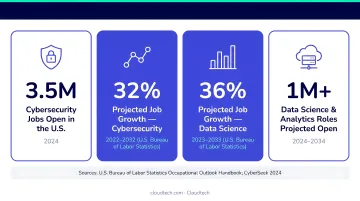
Full-time hiring for these roles is slow, expensive, and often unsuccessful for businesses that can't match enterprise compensation. Staff augmentation lets you access this expertise in weeks rather than months, scoped to exactly what you need.
Cost Efficiency Without Sacrificing Capability
The real cost of a full-time technical hire goes well beyond base salary:
| Cost Component | Description |
|---|---|
| Base salary | The visible number |
| Benefits burden | ~43% of wages (paid leave, insurance, retirement) |
| Recruitment fees | ~$4,700 average cost per hire |
| Onboarding & training | Weeks before full productivity |
| Long-term commitment | Cost persists regardless of workload |
With staff augmentation, you pay a scoped contract rate. No benefits overhead, no recruitment cost, no obligation beyond the engagement.
Scalability Aligned to Project Demand
IT projects are cyclical by nature. A cloud migration has a start and an end. A compliance audit runs for a defined period. Staff augmentation lets you:
- Scale up quickly during high-demand phases
- Scale back when the initiative concludes
- Avoid the HR complexity of layoffs or restructuring
That flexibility matters more than ever: 83% of organizations rank addressing skill gaps as a high priority, per CompTIA's 2026 Workforce and Learning Trends report. Flexible staffing has become the practical answer for teams that can't hire their way out of every demand spike.
Faster Time-to-Value
Augmented professionals arrive pre-vetted and experienced. Unlike a full-time hire, there's no months-long ramp-up period. For time-sensitive work — infrastructure modernization, security remediation, a product launch — that speed directly affects project outcomes and delivery timelines.
Retained Control and Institutional Knowledge
Your managers direct the work. Your team retains institutional knowledge. Your IP stays in-house. Unlike managed outsourcing, you keep full ownership — staff augmentation adds capacity without transferring control.
IT Staff Augmentation vs. Outsourcing vs. Managed Services
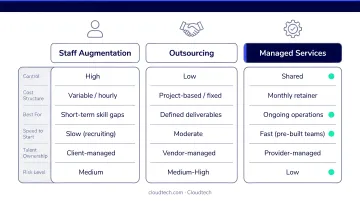
These three models are often used interchangeably, but they work very differently.
| Model | Who Controls Delivery | What You're Buying | Best For |
|---|---|---|---|
| Staff Augmentation | Client | A person's time and skills | Filling a specific skill gap while keeping direction in-house |
| Outsourcing | Vendor | A completed function or deliverable | Full delegation of an entire function |
| Managed Services | MSP | Ongoing operational support against agreed SLAs | Long-term, outcome-accountable operational management |
When Each Model Makes Sense
- Staff augmentation fits when you need a cloud security engineer for a 3-month compliance project — your team directs the work; they supply the expertise.
- Outsourcing fits when you want a third party to own your entire customer support operation end-to-end.
- Managed services fits when you need 24/7 infrastructure monitoring and incident response with defined response times.
Staff Augmentation vs. Professional Services
Professional services engagements are advisory or outcome-based — a consulting firm delivers a defined result or recommendation. Staff augmentation provides individual professionals who integrate into your team, execute work under your direction, and are billed on a time-and-materials basis. The deliverable is their time and expertise, not a packaged outcome.
Cloudtech operates as a professional services partner: fixed-price packages and custom implementations with defined deliverables, not headcount placed on your payroll.
When Should Your Business Use IT Staff Augmentation?
Four scenarios consistently signal that staff augmentation is the right move:
- Launching a new product or cloud migration that requires skills your in-house team doesn't have — and building those skills internally would take longer than the project timeline allows
- Facing a tight deadline where traditional recruiting would cause a meaningful delay — 41–49 days to fill a role is simply too long for most project schedules
- Budget constraints that make a full-time senior hire impractical, but the work genuinely demands senior-level capability
- Seasonal or cyclical workload spikes where permanently expanding headcount would create overhead once demand normalizes
Those four scenarios cover most cases where augmentation delivers clear ROI. There's one situation where it doesn't.
One Honest Caution
Staff augmentation is less effective for highly complex, long-tenured programs where deep institutional context takes months to build. If the ramp-up period would consume a significant portion of the contract's value, evaluate whether a longer-term engagement structure (or a different model entirely) makes more sense.
The one-question decision test: Do I need a specific skill integrated into my team for a defined period, while keeping management in-house? If the answer is yes, staff augmentation is the right model.
How to Choose the Right IT Staff Augmentation Partner
Evaluate the Technical Vetting Process
Ask whether the provider screens for real-world technical depth, not just credentials. Can they demonstrate past work in your specific domain — cloud infrastructure, security architecture, data engineering? A provider whose team includes former practitioners from leading tech environments offers a meaningful quality signal. Cloudtech's team, for example, includes former AWS employees and professionals who have advised organizations including Capital One and Cisco.
Verify Certifications and Partnership Credentials
For cloud-focused augmentation, confirm the provider holds:
- Relevant AWS certifications (Solutions Architect, DevOps, Security specializations)
- Recognized AWS Partner tier — not just self-reported capability
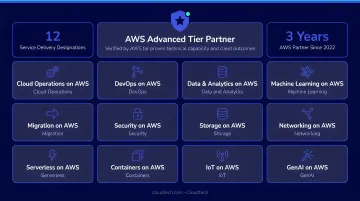
Cloudtech holds AWS Advanced Tier Partner status and 12 AWS Service Delivery Designations — each requiring a technical validation by AWS Partner Solutions Architects, not just an application. These span data warehousing (Redshift), ETL (Glue), real-time streaming (Kinesis), database migration, serverless computing, and more.
Assess Cultural and Operational Fit
The best augmentation partners operate as a genuine extension of your team. Look for providers who:
- Communicate transparently and proactively
- Align to your business goals, not just a job description
- Hold themselves accountable to measurable outcomes
- Build your team's capability rather than creating dependency
Cloudtech's engagement with Klamath Health Partnership illustrates this in practice. The project included continuous knowledge transfer and hands-on training throughout — so when deployment wrapped, Klamath's internal team could run the solution independently. They also eliminated their managed services provider entirely and cut infrastructure costs by 77% year-over-year.
For SMBs pursuing cloud modernization without enterprise-level budgets or permanent headcount, an AWS Advanced Tier Partner with former AWS professionals on staff and a model built around client empowerment rather than dependency is the right call.
Frequently Asked Questions
What are staff augmentation services?
Staff augmentation services allow companies to bring in external IT professionals — developers, cloud architects, DevOps engineers, and others — on a temporary or project basis to fill specific skill gaps. The client retains full management control over the work, direction, and outcomes.
Is staff augmentation cost-effective?
Yes. Businesses pay only for the skills and time they need, avoiding the full-time employment costs of benefits, long-term salaries, recruitment fees, and training. The employer burden on a full-time hire adds roughly 43% on top of base wages — costs that don't apply to augmented staff.
What is the difference between staff augmentation and professional services?
Professional services are typically outcome-based — a firm delivers a defined result or advisory recommendation. Staff augmentation provides individual professionals who integrate into your team, work under your direction, and are billed on a time-and-materials basis.
When should a business consider IT staff augmentation?
The clearest triggers: a skills gap on a time-sensitive project, a product launch requiring niche expertise not available in-house, or budget constraints that make a full-time senior hire impractical.
What IT roles are most commonly filled through staff augmentation?
Software engineers, cloud architects, DevOps engineers, data engineers, cybersecurity specialists, and QA testers — typically roles where demand is project-driven or the skill set is too specialized for a permanent hire.
How long does an IT staff augmentation engagement typically last?
Engagements range from a few weeks for a targeted sprint to several months for a larger transformation program. Most providers offer flexible extensions if timelines shift.