Introduction
AI chatbots have crossed a threshold. What started as basic FAQ widgets now handles millions of conversations — qualifying leads, triaging patients, and processing loan inquiries without a single human agent involved.
The market reflects this shift. According to Grand View Research, the global chatbot market reached $9.6 billion in 2025, is projected to hit $11.8 billion in 2026, and is expected to grow to $41.2 billion by 2033 at a 19.6% CAGR.
Most businesses haven't caught up. Growing customer demands, thinly staffed support teams, and rising operational costs create real pressure — and traditional scaling through headcount or additional software licenses isn't sustainable.
This guide breaks down the measurable benefits of AI chatbots in 2026, which use cases are generating the strongest ROI, the leading tools on the market, and a practical framework for SMBs evaluating an AWS-native deployment.
Key Takeaways
- AI chatbots deliver 24/7 availability, faster resolution times, and meaningful cost reduction across customer-facing and internal workflows
- High-impact use cases span customer service, sales, HR, healthcare, and financial services
- Top 2026 platforms include ChatGPT, Claude, Zendesk AI, IBM Watsonx, and AWS-native tools like Lex, Bedrock, and Amazon Q
- Match your chatbot to your industry, compliance needs, and existing tech stack — not the other way around
- AWS-native deployments offer SMBs a cost-effective path to enterprise-grade conversational AI
What Are AI Chatbots for Business?
AI chatbots are software programs that use natural language processing (NLP) and large language models (LLMs) to simulate human conversation — answering questions, executing tasks, and automating interactions across channels.
Two distinct types exist, and knowing which fits your situation matters:
| Type | How It Works | Best For |
|---|---|---|
| Rule-based chatbots | Follow scripted decision trees | Predictable FAQs, simple workflows |
| AI-powered chatbots | Use NLP/ML to understand context, learn over time | Open-ended queries, dynamic conversations |
Rule-based bots work well for narrow, stable use cases such as order status lookups, store hours, and basic account queries. AI-powered bots handle everything else.
What's Different in 2026
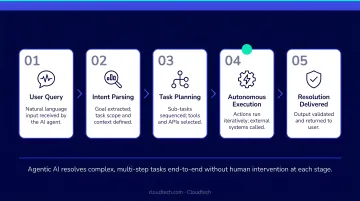
The 2026 generation of chatbots has moved well beyond conversation. Earlier systems automated single-turn interactions — one question, one answer, done.
Today's agentic AI systems complete multi-step tasks autonomously: pulling data from CRMs, updating records in ERPs, routing tickets in help desk platforms, and escalating to human agents with full context already attached.
Gartner predicts that by 2029, agentic AI will autonomously resolve 80% of common customer service issues without human intervention — a benchmark that's already within reach for well-configured deployments today.
Key Benefits of AI Chatbots for Business in 2026
24/7 Availability and Faster Response Times
Customers don't wait. A chatbot that responds in seconds at 2 a.m. beats a human agent who responds in hours the next morning, and the impact shows up directly in satisfaction scores.
Zendesk's 2026 case studies show concrete results:
- Dunlop Sports achieved an 89% reduction in answer time and a 95.3% CSAT score
- Liberty London reduced first reply time by 73% and increased CSAT by 9%
These aren't outliers. They reflect what happens when chatbots eliminate queue-based delays entirely.
Significant Cost Reduction
Chatbots don't replace headcount linearly; they change the equation. A team of five agents handling 200 tickets per day doesn't need to become a team of 50 when volume hits 2,000. The chatbot absorbs the volume.
Gartner's 2025 forecast projects this shift will produce a 30% reduction in operational costs as agentic AI handles the majority of routine issues autonomously. For SMBs operating with tight margins, this is a structural advantage, not just an efficiency gain.
Scalability Without Added Overhead
Peak demand (a product launch, a seasonal rush, a viral moment) can overwhelm a fixed support team in hours. Chatbots handle thousands of simultaneous conversations without degrading quality or response speed.
For SMBs, this is the single most compelling operational argument. You can't hire and train staff in time for a traffic spike. A properly configured chatbot absorbs it automatically.
Lead Generation and Sales Enablement
Sales-focused chatbots don't just answer questions; they qualify visitors, collect intent signals, and route high-value prospects to sales reps before they bounce. Intercom documented a B2B case where Livestorm increased monthly inbound demos by 233% after deploying a chatbot for website visitor conversion. That's a meaningful pipeline multiplier, driven by capturing intent at the moment it exists.
Personalization and Continuous Improvement
When chatbots connect to CRM data, responses stop being generic. A returning customer gets order history, product recommendations based on past behavior, and personalized follow-up rather than a scripted FAQ.
The self-learning loop amplifies this over time. Every interaction trains the model on what resonates, where drop-offs occur, and what drives conversions. Over months, the chatbot improves continuously, without manual reconfiguration each time customer behavior shifts.
Top AI Chatbot Use Cases by Business Function
Customer Service and Support
Chatbots handle tier-1 tickets — FAQs, order status, returns, account queries — and triage complex cases to the right human agent with full context attached. The resolution rates across Zendesk's 2026 customer examples range from 30–80% automation, depending on channel and configuration:
- Vimeo: 30–40% automation, 20% increase in self-service score
- Best Egg: 80% automation on messaging
- Lush: 60% first-contact resolution, 93% CSAT, 5 minutes saved per ticket
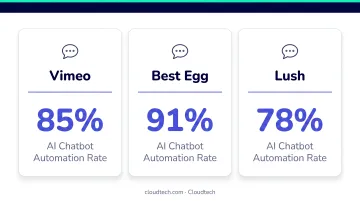
The range matters. A 30% resolution rate in a complex B2B environment still deflects thousands of tickets annually. An 80% rate in high-volume retail fundamentally changes staffing economics.
Sales and Marketing
Beyond lead qualification, chatbots enable conversational commerce across both B2C and B2B channels:
- Guide e-commerce shoppers through product selection and complete transactions without human involvement
- Recover abandoned carts through proactive, personalized messaging
- Schedule demos and nurture B2B prospects through the funnel
- Hand off warm leads to sales reps with behavioral context already documented
HR and Internal IT Support
Customer-facing use cases get most of the attention, but internal support is where chatbots often deliver the fastest ROI. Employees generate a steady stream of predictable, repetitive queries — PTO balances, benefits enrollment deadlines, password resets, onboarding checklists — that don't require a human to answer. They require an accurate, instant response available at any hour.
ServiceNow reports that AI can reduce employee support ticket volume by 60% and cut IT help desk response times from an industry standard of 7 hours to near-instant resolution. SHRM data shows HR bots are already included in 39% of employee automations, a figure that's grown rapidly.
Healthcare and Life Sciences
Healthcare providers use conversational AI for appointment scheduling, patient triage, symptom assessment, medication reminders, and insurance queries. The operational impact is measurable: AI-assisted outpatient workflows have reduced median patient wait times from 1.97 hours to 0.38 hours in peer-reviewed research.
Cloudtech's HealCall product, built specifically for healthcare providers on AWS, has managed 2,500–5,000 monthly patient calls autonomously, with warm transfer to human agents completing in under 2 seconds. HIPAA compliance is a baseline requirement in these deployments — not an afterthought.
Financial Services
The compliance demands of financial services make chatbot architecture decisions consequential — but the operational upside is equally significant. Klarna's OpenAI-powered assistant is the clearest recent proof point. In its first month, the assistant handled 2.3 million conversations — two-thirds of all customer service chats — reduced average resolution time from 11 minutes to 2 minutes, cut repeat inquiries by 25%, and was projected to improve profit by $40 million in 2024.
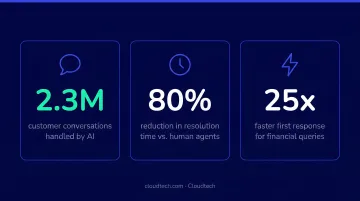
For regulated financial institutions, the chatbot architecture must support compliance logging, data privacy controls, and audit trails. FINRA has documented securities firms using AI-based chatbots for both customer interaction and compliance workflows — meaning the regulatory framework exists; the remaining question is implementation quality.
Leading AI Chatbot Tools to Know in 2026
ChatGPT (OpenAI) — With over 5 million business users on its enterprise platform, ChatGPT is the dominant generative AI option for customer support, content generation, and sales engagement via API integration. It's highly flexible but requires thoughtful implementation to manage accuracy in regulated contexts.
Claude (Anthropic) — Built with a safety-first design philosophy, Claude is positioned for risk-sensitive industries. Anthropic launched Claude for Financial Services in 2025, specifically targeting financial analysis, underwriting, risk, and compliance workflows where hallucination rates and auditability matter most.
Microsoft Copilot / Power Virtual Agents — The natural choice for organizations standardized on Microsoft 365. No-code bot building with deep integration into Teams, Power Automate, and Dynamics makes it especially effective for internal HR and IT automation.
Zendesk AI and Intercom — Purpose-built customer service platforms with AI layered in. Both offer ticketing, routing, CSAT tracking, and omnichannel coverage without requiring custom builds. Intercom leads in B2B SaaS engagement; Zendesk dominates enterprise support ticketing.
IBM Watsonx — Built for large organizations in regulated industries — banking, government, insurance — where explainability, data governance, and bias monitoring are mandatory. SMBs in heavily regulated sectors may encounter it through enterprise partnerships, but it's generally overkill for most small and mid-sized deployments.
AWS-Native Stack (Amazon Lex, Bedrock, Amazon Q for Business) — The three components cover distinct needs:
- Amazon Lex — builds voice and text conversational interfaces
- Bedrock — provides managed access to foundation models for building AI agents
- Amazon Q for Business — functions as an enterprise AI assistant for workplace knowledge and task automation
The ecosystem's advantage is integration depth: security, scalability, and native connectivity with existing cloud workloads on pay-as-you-go pricing. For SMBs already on AWS, this stack eliminates vendor sprawl — a single implementation covers chat, voice, and internal knowledge retrieval. Cloudtech builds and deploys AWS-native conversational AI for small and mid-sized businesses, typically delivering production-ready solutions in two to four weeks.
Here's a quick comparison to help narrow your options:
| Tool | Best For | Deployment Model | SMB Fit |
|---|---|---|---|
| ChatGPT (OpenAI) | Support, content, sales | API / Enterprise plan | High |
| Claude (Anthropic) | Regulated industries | API / Financial Services tier | Moderate |
| Microsoft Copilot | Microsoft 365 shops | No-code, Teams-native | High |
| Zendesk AI / Intercom | Customer service | SaaS platform | High |
| IBM Watsonx | Large regulated orgs | Enterprise deployment | Low |
| AWS Stack (Lex/Bedrock/Q) | Custom voice + chat + knowledge | Cloud-native build | High |
The right tool depends less on features and more on where your data lives, what your team can manage, and how quickly you need to go live — factors the next section on implementation will walk through directly.
How SMBs Can Deploy AI Chatbots on AWS
Why AWS Makes Sense for SMBs
AWS eliminates the most common objection to enterprise AI: upfront cost and engineering overhead. The key advantages for smaller organizations:
- Pay-as-you-go pricing — costs scale with usage, not with infrastructure commitments
- Managed services — Lex, Bedrock, and Amazon Q handle the underlying infrastructure, reducing the engineering burden on lean teams
- Native integrations — connect to databases, CRM systems, and Lambda functions without building custom middleware
- Security by default — AWS security controls, encryption, and compliance tooling (CloudTrail, KMS, Config) are baked into the stack
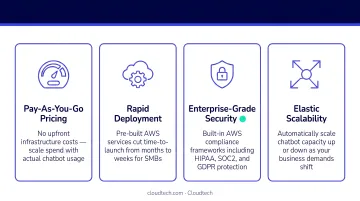
A standard AWS chatbot deployment for an SMB typically combines Lex for the conversational interface, Bedrock or Amazon Q for Business for the AI layer, and Amazon Connect for voice channel support.
The Pitfalls of Going It Alone
SMBs that attempt chatbot implementation without expert guidance consistently hit the same walls:
- Poor data integration — the chatbot can't access the CRM, help desk, or ERP data it needs to answer accurately
- Inadequate training data — the model doesn't understand industry-specific terminology or customer intent patterns
- Misaligned conversation design — flows that make sense to the developer frustrate the end user
The result is low resolution rates and customer complaints — which is what the chatbot was built to avoid. Getting the implementation right from day one matters.
Cloudtech, an AWS Advanced Tier Partner with AWS-certified architects, helps SMBs across healthcare, financial services, manufacturing, and retail configure, integrate, and optimize chatbot deployments on AWS — without the trial-and-error. The firm's HealCall product is a concrete example: HIPAA-compliant, EHR-integrated, and handling thousands of patient calls monthly with near-instant escalation capability.
AWS Partner Funding can reduce or eliminate out-of-pocket costs for eligible businesses, making this a more accessible path than most SMBs assume.
Frequently Asked Questions
What are the typical benefits of chatbots for a business?
The core benefits are 24/7 availability, reduced support costs, faster response times, scalable lead generation, and continuous self-improvement through each interaction. AI-powered chatbots compound these advantages over time as they learn from real conversations, unlike rule-based systems that require manual updates to improve.
What is the trend in chatbots in 2026?
The dominant shift is toward agentic AI — chatbots that complete multi-step tasks autonomously rather than just answering questions. Deeper LLM integration, rising adoption in regulated industries like finance and healthcare, and the growth of cloud-native platforms (particularly AWS-native stacks) define the 2026 landscape.
What is the difference between rule-based and AI chatbots?
Rule-based chatbots follow scripted decision trees and work well for predictable, narrow FAQ scenarios. AI chatbots use NLP and machine learning to understand context, handle open-ended queries, and improve over time — making them far better suited for complex customer interactions and complex workflows.
How much does it cost to deploy an AI chatbot for a business?
Costs range from $0–$500/month for out-of-the-box SaaS platforms to $75,000+ for fully custom AI builds. AWS-native deployments reduce upfront infrastructure costs, and eligible businesses working with an AWS Advanced Tier Partner may qualify for AWS Partner Funding that offsets costs further.
Which industries benefit most from AI chatbots?
Retail, financial services, healthcare, technology/SaaS, and manufacturing see the strongest ROI, though results vary by query complexity and integration depth. Healthcare and financial services in particular show the sharpest operational gains when compliance and EHR/core banking integrations are properly configured.
How do I choose the right AI chatbot for my business?
Evaluate based on primary use case (customer service vs. internal automation), existing tech stack, compliance requirements, and budget. Start with your highest-volume, lowest-complexity workflows, where chatbots deliver the fastest payback, then expand once the foundation is working.