Introduction
Travel and hospitality businesses face a customer service problem that keeps getting harder to solve with headcount alone. 65% of surveyed hotels reported staffing shortages at year-end 2024, and the demand side isn't getting any easier — travelers expect instant responses to booking changes, flight disruptions, cancellation requests, and personalized recommendations, around the clock.
AI chatbots have moved well past scripted FAQ responses. The best platforms in 2026 handle multi-step bookings, proactively alert guests to disruptions, switch languages mid-conversation, and escalate to human agents with full context preserved. Accor Plus, for example, achieved a 220% improvement in resolution time and a 20% increase in digital sales revenue after deploying Zendesk's AI-powered CX platform.
This guide covers the top AI chatbots purpose-built for travel and hospitality in 2026: what sets each platform apart, which types of operators they serve best, and what to evaluate before committing.
Key Takeaways
- AI chatbots now handle bookings, cancellations, real-time disruption alerts, and multilingual guest support — far beyond basic FAQs.
- The strongest platforms pair generative AI with deep integrations across reservation, distribution, and property management systems.
- Match your platform to business scale: enterprise tools like Cognigy.AI suit airlines and large chains; Botsonic and Engati fit SMBs and boutique properties.
- Multilingual support, omnichannel deployment, and peak-season scalability are non-negotiable selection criteria.
- Successful deployment depends on well-architected cloud infrastructure as much as the chatbot platform you choose.
AI Chatbots in Travel & Hospitality: What's Changed
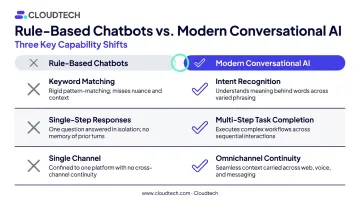
Rule-based chatbots dominated hospitality tech stacks for years — the kind that follow fixed decision trees and break the moment a traveler asks something unexpected. Modern conversational AI agents are a different category. They use natural language processing and generative AI to understand intent, handle open-ended queries across voice and text, and complete multi-step tasks like itinerary changes without human intervention.
What separates the two generations comes down to three shifts:
- Intent recognition over keyword matching — queries no longer need to be phrased a specific way
- Multi-step task completion — booking changes, refunds, and itinerary updates handled end-to-end
- Omnichannel continuity — conversations that carry context across voice, chat, and messaging apps
That capability shift is showing up in production numbers. Lufthansa's Cognigy deployment handles over 16 million AI conversations annually across 16+ customer-facing agents, answering more than 10,000 customers per day in real time. That's not a pilot program — it's operational infrastructure running at airline scale.
For travel businesses now moving from evaluation to deployment, the harder question isn't whether to adopt AI. It's which platform fits the operational reality of your business.
Best AI Chatbots for Travel & Hospitality in 2026
The five platforms below were evaluated on natural language capabilities, travel-specific integrations, multilingual support, scalability during peak demand, and overall value for travel and hospitality businesses. Each profile covers key features, pricing, and the business types each tool fits best.
Zendesk AI
Zendesk AI is a customer service platform pre-trained on billions of real-world CX interactions. Its AI agents deploy across travel websites, apps, and messaging channels with no coding required — making it one of the fastest paths from purchase to production for mid-size and large travel businesses.
What makes it work for travel is the balance between automation and escalation. It handles high-volume, repetitive queries — booking changes, refund requests, flight status checks — while routing complex cases to human agents seamlessly. Accor Plus used Zendesk to achieve a 220% improvement in resolution time, 352% improvement in response time, and a 20% increase in CSAT alongside a 20% lift in digital sales revenue.
| Category | Details |
|---|---|
| Key Features | AI agents, omnichannel routing, live chat, knowledge base, prebuilt analytics dashboards, automations |
| Pricing | Support Team from $19/agent/month; Suite Team from $55/agent/month; Suite Enterprise (contact sales) |
| Best For | Mid-to-large travel businesses and hotel chains needing omnichannel CX with fast time-to-value |
Cognigy.AI
Cognigy.AI is the platform of choice for enterprise-scale travel and airline deployments. Lufthansa Group's 16M+ annual AI conversations — across languages, channels, and post-pandemic surge periods — were handled by Cognigy's infrastructure. Few platforms can show verified performance at that conversation volume.
The platform's differentiators for travel are specific and practical:
- Supports 100+ NLU languages with intent recognition and slot extraction built into the language engine
- Connects across 30+ channels — web chat, phone, WhatsApp, and major messaging platforms
- Handles end-to-end task completion across multi-step service processes through agentic AI
- Passes full conversation context to human agents at escalation, so nothing restarts from scratch
| Category | Details |
|---|---|
| Key Features | Agentic AI, Knowledge AI, voice and chat agents, 30+ channel integrations, multilingual NLU, agent copilot |
| Pricing | Contact Cognigy for enterprise pricing |
| Best For | Airlines, large travel management companies, and global hospitality groups handling massive conversation volumes |
Yellow.ai
Yellow.ai serves a broad middle market — mid-size hotel groups, travel agencies, and OTAs that need multilingual, omnichannel support without the complexity of an enterprise platform implementation.
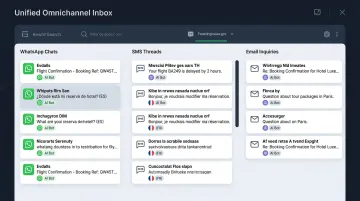
Its generative AI-powered inbox unifies conversations from booking inquiries to loyalty program questions across channels including WhatsApp, SMS, Facebook Messenger, and email. The InteleTravel deployment illustrates real-world scale: Yellow.ai supports 140,000+ independent travel advisors 24/7 at a 92% resolution rate, without requiring additional headcount.
Key details to note: the platform offers 100+ pre-built bot templates (not 150+ — that figure refers to integrations) and 35+ channels (channel count, not language count).
| Category | Details |
|---|---|
| Key Features | Generative AI inbox, 100+ pre-built templates, voice bots, automated workflows, 35+ channel support |
| Pricing | Free tier (1 AI agent, 500 sessions/month); Enterprise pricing on request |
| Best For | Mid-size hotel groups, travel agencies, and OTAs needing multilingual, omnichannel support with quick deployment |
Botsonic (by Writesonic)
Travel businesses with no developer resources can train Botsonic on their own data — booking policies, destination guides, FAQs — through a no-code interface and deploy in hours, not weeks.
Its appeal for smaller operators is straightforward: affordable entry pricing, visual customization to match brand identity, and an embeddable widget that works on any website or messaging platform. It supports GPT-4 and newer GPT-4o-family models through a model-agnostic router, which keeps response quality high across query types.
One practical note: current pricing tiers are Professional ($40.83/month billed annually) and Advanced ($249/month), not the "Starter" and "Business" labels sometimes referenced in older reviews.
| Category | Details |
|---|---|
| Key Features | GPT-4 support, no-code builder, embeddable widget, chatbot customization, knowledge base training |
| Pricing | Free (1 seat); Professional from $40.83/month; Advanced from $249/month; Enterprise from $800/month |
| Best For | Small travel agencies, boutique hotels, and travel startups looking for an affordable, no-code AI chatbot |
Engati
Engati positions itself at the intersection of accessibility and multilingual reach. Its travel chatbot supports 54 languages, covers booking confirmation workflows from inquiry through confirmation, and offers a visual flow designer for building and adjusting bot logic without engineering support.
The TBO Holidays deployment gives a concrete sense of what it delivers at scale: Engati's bot reportedly handled 1.5x as many users as a human agent and resolved 90.4% of questions — covering booking, cancellation, and travel-plan queries. A shared WhatsApp team inbox keeps conversations across channels visible to support staff.
| Category | Details |
|---|---|
| Key Features | Multilingual bots (54 languages), visual flow builder, live chat, shared WhatsApp inbox, booking automation |
| Pricing | Starts under $1/day; 7-day free trial available; Enterprise via contact |
| Best For | Tour operators, travel startups, and regional hospitality brands serving international travelers |
How to Choose the Right Platform
The platforms above cover a wide range of business sizes and use cases, but the selection process matters. A common mistake is choosing a general-purpose chatbot without verifying whether it can connect to your actual tech stack.
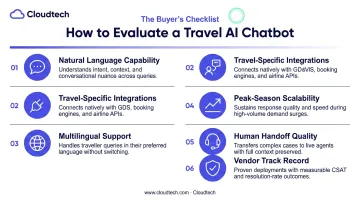
Key evaluation criteria:
- Natural language capability — Can it handle open-ended travel queries, not just scripted prompts?
- Travel-specific integrations — Does it connect with your GDS, OTA platform, PMS, or CRM out of the box?
- Multilingual support — What languages, and does it auto-detect the traveler's language?
- Peak-season scalability — Can it handle 5x normal volume during holidays without degrading?
- Human handoff quality — Does the agent receive full conversation context, or does the traveler start over?
- Vendor track record — Has the platform been deployed in production travel environments at scale?
One factor that rarely appears on evaluation checklists: the underlying cloud infrastructure. Integrating an AI chatbot with booking systems, CRMs, and payment gateways requires a well-architected environment where APIs, data flows, and security controls are properly configured from the start.
Fragmented legacy hotel tech stacks and data silos are among the most cited constraints on AI deployment in hospitality, according to PhocusWire's 2026 analysis of hotel AI adoption at Choice, Minor Hotels, and Ascott.
For travel businesses building on AWS, working with an AWS-certified partner to handle the integration layer can cut implementation time considerably. Cloudtech's engagement with Monster Reservations Group illustrates what that looks like in practice: by architecting the AWS infrastructure layer using Amazon Bedrock and Amazon Connect, the project achieved 500ms response latency and a projected 67% reduction in cost-per-call — outcomes driven by the integration architecture, not just the AI model on top of it.
Conclusion
Choosing the right AI chatbot for your travel or hospitality business comes down to fit — fit with your guest journey, your existing tech stack, and your team's capacity to manage and iterate after launch.
Before finalizing a platform, pressure-test three things:
- Scalability — Can it handle peak season surges without service degradation?
- Integration depth — Does it connect natively with your booking engine, PMS, or loyalty system?
- Multilingual reach — Does it serve your actual traveler base, not just English-speaking guests?
Once you've identified the right platform, the underlying cloud infrastructure determines how well it actually performs at scale. If your travel or hospitality business needs help building the AWS foundation — data pipelines, cloud architecture, or system integrations — that your chosen chatbot runs on, Cloudtech's AWS-certified team can get you there. Reach out at connect@cloudtech.com to talk through your infrastructure requirements.
Frequently Asked Questions
What is the best AI chatbot for hospitality?
There's no single answer — it depends on your scale and use case. Enterprise platforms like Cognigy.AI and Zendesk AI suit large hotel chains and airlines, while Botsonic and Engati are better matched to boutique properties, smaller operators, and travel startups with tighter budgets.
How is AI used in hospitality and tourism?
AI automates guest inquiries, handles booking and cancellation requests, delivers real-time travel updates, provides personalized recommendations, and manages post-trip feedback collection. Most platforms also support multiple languages, enabling consistent service across international traveler segments without additional staffing.
What is the difference between a rule-based chatbot and a conversational AI agent?
Rule-based bots follow fixed decision trees and fail when users stray from predefined prompts. Conversational AI agents use NLP and generative AI to understand intent and handle open-ended queries — making them far better suited to the unpredictability of real travel interactions.
Can AI chatbots handle multilingual support for international travelers?
Yes. Platforms like Cognigy.AI support 100+ NLU languages, Zendesk handles 80 languages at native fluency, and Engati covers 54 languages with automatic detection. Most modern platforms can identify a traveler's language and respond accordingly without manual configuration.
How do I integrate an AI chatbot with my booking or property management system?
Most enterprise platforms offer APIs and pre-built connectors for common travel systems. Integration complexity depends on your existing stack — businesses running legacy infrastructure often need additional support to ensure secure, reliable data flow between systems.
How much does an AI chatbot cost for a travel business?
Costs range widely — from free tiers on Botsonic and Yellow.ai for small operators, to enterprise contracts with Zendesk or Cognigy.AI for large-scale deployments. Total cost of ownership also includes integration, customization, and ongoing tuning, which can add substantially to the platform licensing cost.