Modern conversational AI — not the rigid chatbots of a decade ago — offers a practical resolution. This guide covers what conversational AI actually does in a credit union context, where it delivers measurable results, how to implement it, and what NCUA compliance looks like in practice.
One data point sets the stage: according to Filene Research Institute's 2024 report, 66% of credit unions plan to leverage AI for credit decisioning. The shift is already underway.
Key Takeaways
- Conversational AI handles routine member inquiries 24/7, reducing contact center volume and after-hours overflow
- Real credit unions have seen results: 60% call containment, 54% fewer abandoned calls, and automated loan decisions growing from 43% to 63%
- Modern platforms understand intent, retain context, and connect directly with core banking systems — capabilities basic chatbots lack
- NCUA supports responsible AI adoption under existing technology-neutral regulations
- Amazon Lex, Amazon Connect, and Amazon Bedrock provide a proven, scalable foundation built for credit union deployments
What Is Conversational AI in a Credit Union Context?
Beyond the Old Chatbot Experience
Many credit unions tried early chatbots and walked away disappointed. Those tools followed rigid decision trees — press 1 for balance, press 2 for loans — and fell apart the moment a member asked anything outside the script. That experience doesn't reflect what modern platforms can do.
As AWS explains, conversational AI uses natural language processing (NLP), machine learning, and natural language understanding (NLU) to interpret member intent and context — not just keywords. The system understands that "I need to move money to cover my car payment" means the same thing as "can I do a transfer between accounts?" and responds accordingly.
What "Conversational" Actually Means for Members
In practice, a credit union conversational AI platform:
- Interprets member intent, not just surface-level keywords
- Retains context throughout the conversation so members never have to repeat themselves
- Integrates with core systems like Symitar or a loan origination platform to pull real-time account data
- Routes to a human agent with the full conversation thread attached, eliminating cold handoffs
That last point is often what separates genuinely useful implementations from frustrating ones. Smart escalation is a deliberate design choice, not an afterthought.
Where It Operates
Conversational AI meets members across channels:
- Website chat and mobile app messaging
- Voice/IVR, replacing hold-music menus with natural dialogue
- SMS for proactive notifications and two-way conversations
The goal is consistency: a member who starts a loan inquiry on web chat shouldn't have to re-explain their situation when they call in.
Key Use Cases: Where Conversational AI Delivers Results
24/7 Member Self-Service
The most common member complaints at credit unions center on after-hours limitations. When branches close and call queues run long, members with simple questions — balance checks, transaction history, card status — have nowhere to turn.
Conversational AI handles these high-volume, low-complexity requests without human involvement:
- Account balance and transaction inquiries
- Internal transfers between accounts
- Card freeze requests and dispute initiation
- Password resets and account unlocks
- Loan status checks
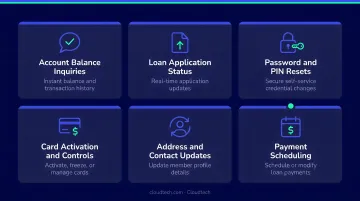
Interra Credit Union's AI deployment produced a 20% decrease in after-hours overflow, demonstrating that this is one of the clearest early wins available.
Loan Application Assistance
Loan inquiries generate significant contact center volume — members want to know if they qualify, what documents they need, and where their application stands. Conversational AI can guide members through each of these steps without requiring a loan officer's time.
FORUM Credit Union in Indiana provides a useful benchmark. According to America's Credit Unions, AI automation enabled FORUM to process up to 70% more loans compared to traditional manual underwriting — a direct result of reducing the friction in the application and review process.
Fraud Alerts and Member Response
When suspicious activity is flagged, response time matters. Conversational AI can:
- Proactively notify the member via their preferred channel
- Walk them through a structured response flow (confirm/deny the transaction)
- Execute card freezes or dispute initiation immediately
- Escalate to a specialist if the situation requires it
Members resolve most fraud situations in minutes — no branch visit, no hold time.
New Member Onboarding and Internal Staff Support
Two often-overlooked use cases:
The first 90 days determine long-term member value. AI-guided onboarding — covering mobile app setup, direct deposit enrollment, and product education — reduces early attrition and increases product adoption without adding to staff workload.
Conversational AI also supports employees, not just members. CreditUnions.com reports that 125 of 325 full-time employees at Interra Credit Union use an internal AI assistant daily for HR queries, policy lookups, and compliance questions — freeing staff from chasing answers through internal systems.
The Business Case: Benefits and ROI
Contact Center Cost Reduction
A substantial share of contact center volume is repetitive: balance inquiries, status checks, password resets. These interactions require human time but not human judgment.
Interra Credit Union's results show what AI automation achieves at scale:
| Metric | Result |
|---|---|
| Call containment rate | 60% |
| Decrease in call abandonment | 54% |
| Reduction in after-hours overflow | 20% |
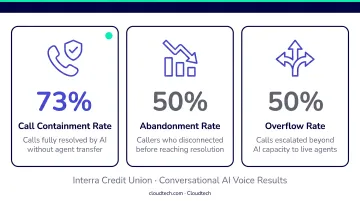
Those numbers translate directly to staffing costs, overtime, and vendor overflow expenses. Accenture's research on intelligent service centers suggests automated service interactions can save up to 86% of the cost per interaction compared to live agent handling.
Scalability Without Adding Headcount
Volume spikes — whether during rate changes, community events, or broader economic disruptions — overwhelm contact centers quickly. Hiring and training staff to cover peaks is expensive and slow.
Conversational AI scales instantly. One virtual agent can handle thousands of simultaneous conversations. That capacity doesn't require new hires, benefits, or training time. For credit unions operating lean, that's a meaningful structural advantage.
Improved Lending Outcomes
Centris Federal Credit Union provides one of the clearest lending-specific examples in the industry. According to CUInsight, AI technology grew automated loan decisions from 43% to 63% — while also identifying loan candidates with thin credit files who wouldn't have qualified under traditional scoring methods.
Expanding credit access to underserved members — while maintaining sound lending practices — is exactly what distinguishes credit unions from commercial banks. When AI improves both throughput and inclusion simultaneously, it directly advances that mission rather than just cutting costs.
Staff Productivity and Member Satisfaction
The goal is not replacing staff — it's changing what they spend their time on. When AI handles routine inquiries, human agents concentrate on complex situations that actually require judgment and empathy.
Interra's leadership put it directly: AI is "about enhancing service, not replacing employees." Agents working alongside AI tools spend more time on high-value interactions, which improves both job satisfaction and member outcomes.
J.D. Power's 2025 U.S. Credit Union Satisfaction Study confirms credit unions already lead retail banks by 74 points in overall member satisfaction — but digital channels are lagging:
- Overall satisfaction score: 729
- Digital channel satisfaction score: 715
That 14-point gap is where faster, more accurate AI-assisted responses make a direct difference.
How to Implement Conversational AI at Your Credit Union
Assess Before You Build
Before selecting a platform, audit your member journey from the outside in. The most common implementation mistake is skipping this step and building features members don't need.
Specifically:
- Identify your top 10 inquiry types from call center logs and chat transcripts
- Flag after-hours pain points — where are members hitting dead ends?
- Rank use cases by member impact and feasibility, starting with high-volume, low-complexity requests
- Loop in frontline staff early — agents know what members ask repeatedly
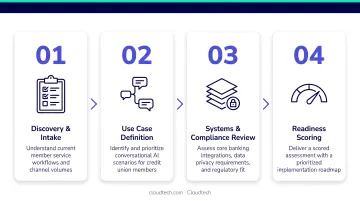
This assessment prevents over-engineering and ensures ROI is visible quickly. A well-scoped Phase 1 beats an ambitious one that runs over budget — and gives you real results to build on before expanding scope.
Choose the Right Cloud Infrastructure
Platform choice affects scalability, security, compliance posture, and total cost of ownership. Getting this decision right before you build saves costly rework later.
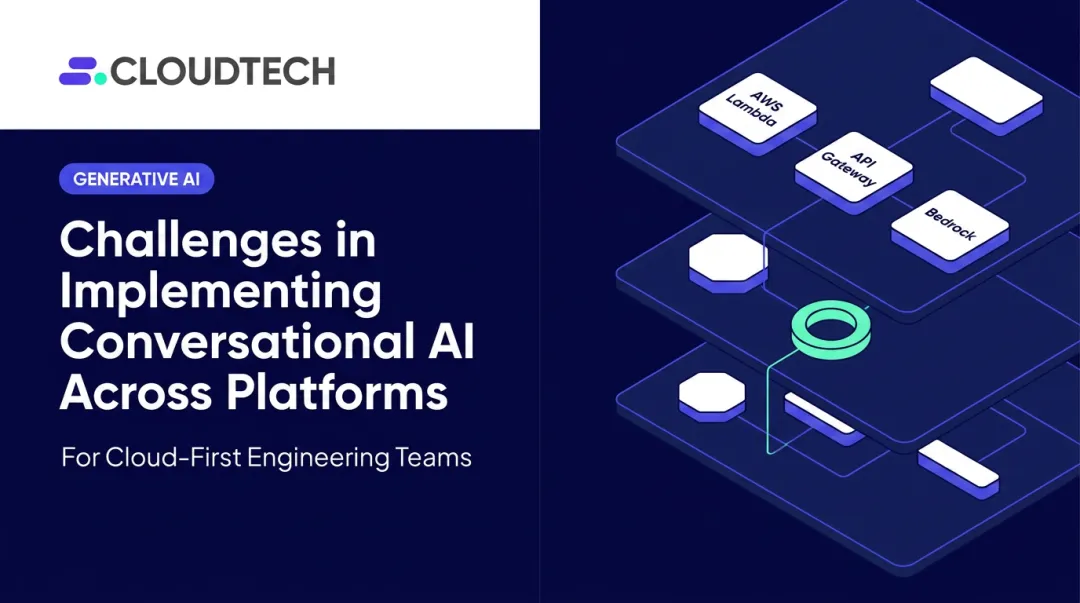
AWS offers a suite of purpose-built services that work well together for credit union deployments:
- Amazon Lex: natural language understanding for building conversational interfaces
- Amazon Connect: AI-powered cloud contact center that replaces legacy IVR infrastructure
- Amazon Bedrock: generative AI foundation models for more complex, open-ended interactions
These services combine into a secure, scalable solution without building from scratch. Working with an AWS Advanced Tier Partner like Cloudtech means the architecture comes pre-designed around financial services security controls and compliance requirements. AWS Partner Funding programs are also available and can significantly reduce upfront costs for qualifying credit unions.
Integrate with Core Systems
The AI's value depends entirely on what data it can access. A conversational AI that can't pull a member's actual balance or loan status delivers generic responses — which frustrates members and undermines trust.
Key integration considerations:
- Inventory your current systems early: core banking platform, loan origination system, card processor
- Involve IT during vendor evaluation, not after contract signing
- Plan for real-time data access, not batch updates — members expect current account information
- Document API availability for each system the AI needs to query
Train, Monitor, and Improve Continuously
Conversational AI is not a deploy-and-forget system. The model needs to learn your credit union's products, terminology, and member behavior patterns.
Establish a monitoring cadence that tracks:
- Intent accuracy rates: is the AI understanding what members actually mean?
- Escalation rates: how often are members being handed off, and why?
- Member satisfaction scores for AI-handled interactions
- Containment rates by inquiry type
Set a review cycle of at least monthly, and build a clear process for updating the model when products, rates, or policies change. Credit unions that plan for this upfront — with assigned ownership and a feedback loop from frontline staff — consistently outperform those that treat launch day as the finish line.
Navigating NCUA Compliance and AI Governance
The regulatory picture for credit union AI is straightforward. The NCUA's AI resource page confirms that existing regulations are technology-neutral — they apply equally to AI-powered processes. No AI-specific rules have been issued. If your existing technology governance practices are sound, they extend to AI deployments.
The NCUA has established an AI Compliance Plan and appointed a Chief Artificial Intelligence Officer, signaling that the agency views AI as a legitimate tool — not a compliance risk to be avoided.
What the NCUA Expects
Credit unions deploying AI should be prepared to demonstrate:
- Identify what specific risks the AI system introduces
- Monitor those risks continuously over time
- Implement controls that prevent errors, bias, or unauthorized access
- Conduct due diligence on any vendor-provided AI — understanding how it works, what data it uses, and what protections are in place
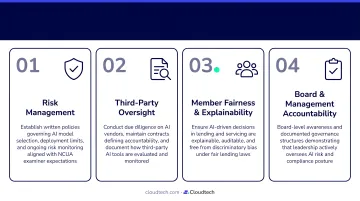
The NCUA points specifically to Letter 07-CU-13 on evaluating third-party relationships as the applicable guidance for vendor AI tools.
Transparency with Members
While no NCUA rule currently requires disclosure that a member is interacting with AI, transparency aligns with the trust-based culture credit unions have built. Clearly identifying AI interactions — and communicating data privacy practices — is both good governance and good member relations.
Fair lending obligations extend to AI as well. ECOA and Regulation B apply directly to AI-driven credit decisions, and credit unions must provide clear adverse action notices whenever AI contributes to a denial or unfavorable outcome.
Frequently Asked Questions
How can conversational AI help credit unions?
Conversational AI lets credit unions deliver 24/7 member service across chat, voice, and SMS — automating balance inquiries, loan status checks, fraud response, and new member onboarding. It reduces contact center costs and improves response times while preserving the personal, relationship-driven experience members expect through seamless escalation to human agents.
How much does a conversational AI consultant for credit unions cost?
Scoped pilot engagements typically start in the low five figures, with full-scale deployments ranging higher depending on integration complexity and the number of member journeys involved. AWS Partner Funding programs — available through partners like Cloudtech — can offset upfront costs significantly. Starting with two or three targeted use cases keeps initial investment manageable while delivering visible ROI before scaling.
What is the difference between a chatbot and conversational AI for credit unions?
Legacy chatbots follow rigid scripts and fail when members ask anything unexpected. Modern conversational AI understands intent, retains context across the conversation, integrates with core banking systems for real-time data, and escalates to human agents with the full conversation history intact — so members never have to repeat themselves.
How long does it take to implement conversational AI at a credit union?
Targeted use cases built on pre-configured cloud services like Amazon Connect and Amazon Lex can go live in weeks. Full-scale deployments with deep core system integration typically take 2-4 months, depending on the number of integrations, the complexity of the member journeys involved, and the readiness of existing systems.
Is conversational AI compliant with NCUA regulations?
Under current NCUA guidance, existing technology-neutral regulations apply to AI tools — no AI-specific rules have been issued to date. Credit unions should follow standard vendor due diligence practices, implement monitoring and risk controls, and ensure fair lending compliance for any AI-assisted credit decisions. Verify the latest guidance directly with NCUA before deployment.
What AWS services power conversational AI for credit unions?
The core stack includes Amazon Lex for natural language understanding, Amazon Connect for cloud contact center capabilities, and Amazon Bedrock for generative AI foundation models. These services integrate with each other and with core banking systems to create a secure, scalable solution tailored to credit union member journeys.